ICD-10 Code Y76.0: Diagnostic obstetric and gynecological devices
ICD-10 Code Y76.0: Definition and billable status ICD-10 Code Y76.0 is a valid, ...

Last Updated: Oct 23, 2026
Billable Code Specific Code
O89.8 is the billable ICD-10-CM code for other complications of anesthesia during the puerperium. It covers an anesthetic complication documented after delivery, up to about six weeks postpartum, that no named O89 subcode describes.
The code sits in category O89, Complications of anesthesia during the puerperium, and is active in the FY2027 ICD-10-CM release, effective October 1, 2026. Assignment turns on timing: a complication during labor or delivery codes to O74 instead.
Let Pabau's smart automation suggest the right codes, reduce claim denials, and keep your practice compliant—effortlessly.
Automate repetitive tasks and focus on what matters most—your patients.
Reduce coding errors and ensure compliance with the latest regulations.
Clean claims, fewer denials, and faster reimbursements.
Powerful insights and reporting to help your practice thrive.
HIPAA compliant SOC 2 certified GDPR-compliant Trusted by 4,000+ clinics worldwide

ICD-10 Code O89.8 is the billable ‘other specified’ code in category O89, and it is active in the FY2027 ICD-10-CM release.
O89.8 applies only to the puerperium, up to about six weeks postpartum. Complications during labor or delivery code to O74, and antepartum ones to O29.
Rule out every named O89 subcode first: a spinal or epidural headache is O89.4, and other spinal or epidural complications are O89.5.
Documentation must come from the anesthesiologist’s record and link the complication explicitly to the anesthetic event during the puerperium.
Pabau’s claims management software helps obstetric practices submit and track O89.8 claims with supporting documentation attached.
ICD-10 Code O89.8 captures anesthetic complications that occur during the puerperium, meaning any time from immediately after delivery through approximately six weeks postpartum. The code sits within the O89 parent category, “Complications of anesthesia during the puerperium.” It is the catch-all for complications that no more specific O89 subcode captures.
The code applies to complications of epidural, spinal, or general anesthesia given around delivery, where the complication surfaces or is documented postpartum. Postdural puncture headache (PDPH) is the classic case to rule out first, because it has its own code, O89.4.
O89.8 does not cover anesthetic complications that occur intrapartum, during active labor or delivery. Those belong to category O74. The clinical picture may look identical, so the deciding factor is timing and where the complication sits in the maternal record.
Here is where each type of anesthesia tends to land in the puerperium:
Yes, ICD-10 Code O89.8 is a billable, valid code in the current ICD-10-CM classification. It is active in the fiscal year 2027 release (effective October 1, 2026), needs no 7th character, and goes directly on a claim. Confirm its status against the official CDC/NCHS ICD-10-CM web tool each October when the annual update goes live.
Billable status matters because a non-billable parent code, such as O89 itself, cannot appear on a submitted claim. Only a fully specified child code like O89.8 can. Our guide to medical billing fundamentals explains how a code travels from the record to the claim.
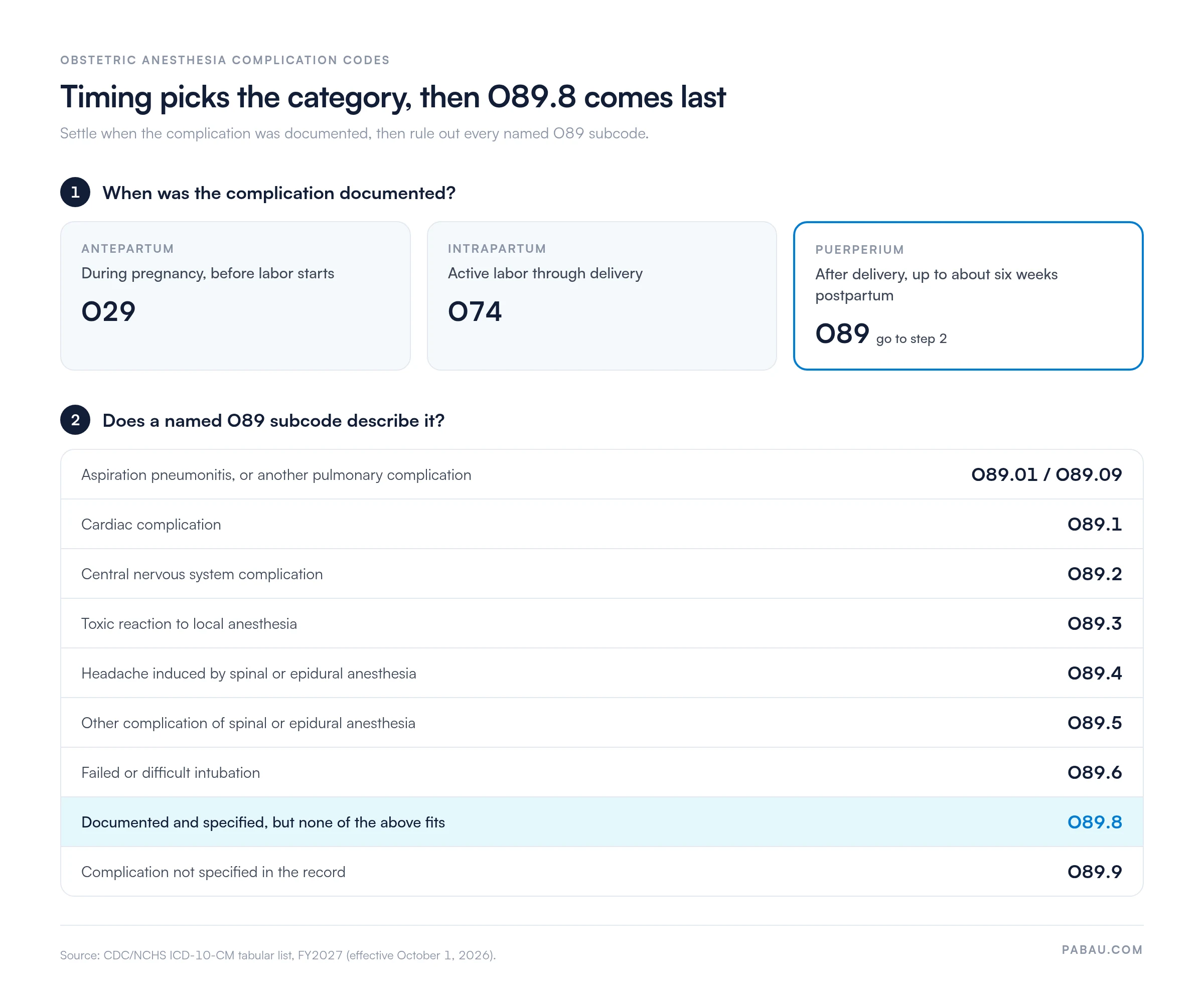
The O89 category covers the full range of anesthetic complications specific to the puerperium. O89.8 is the “other specified” code. It applies when the complication type is documented but matches none of the named subcodes below. Coders should always check whether a more specific O89 subcode applies before defaulting to O89.8.
The AAPC ICD-10-CM code lookup allows searching by both code number and clinical description to verify specificity.
In practice, a postdural puncture headache after an epidural in the puerperium maps to O89.4, not O89.8. Confirm the complication type against the named subcodes before landing on O89.8.
Before assigning O89.8, audit the full O89 sibling list. If the complication is a headache, use O89.4. If it is a broader spinal or epidural complication, check O89.5 first. O89.8 is the residual code. It applies only when the documented complication does not match any named sibling.
The O29, O74, and O89 categories form a timeline tied to the obstetric encounter. Telling them apart comes down to when the complication was identified and documented. Timing, rather than the anesthetic type, decides the category.
The most common mismatch is assigning O89.8 when O74 is correct. If the anesthesiologist’s note places the complication during labor or at delivery, O74 governs. O89.8 applies only when the complication is documented in the puerperium record, whenever the anesthesia was given.
The CMS ICD-10 coding resources provide the official tabular definitions for all three categories.
The diagram below runs both checks in the order a coder should: timing first, then the O89 subcode list.
The O89 category carries Excludes2 notes rather than the more restrictive Excludes1. An Excludes2 note means the excluded condition is not part of this code but may be coded together when both conditions are present and documented. Review the official tabular list through the CDC/NCHS ICD-10-CM tool for the current exclusion notes, as these can change with annual updates.
Two coding guideline rules apply directly to O89.8:
Always verify sequencing instructions in the current year’s ICD-10-CM Official Guidelines for Coding and Reporting, published annually by CMS and NCHS.
O89.8 applies to any documented anesthetic complication of the puerperium that does not map to a named O89 subcode. OB coding teams meet these scenarios often in postpartum documentation reviews.
The critical rule for all of these: the anesthesiologist’s note must explicitly connect the complication to the anesthetic event and place it within the puerperium. Without that linkage in the record, a coder cannot assign O89.8 based on clinical inference alone.
Documentation is the part of an O89.8 claim your team controls most directly. Our guide to medical billing compliance covers how to audit records like these before they reach a payer.
Five elements must be present in the maternal record to support the code. Practices focused on submitting a clean claim on the first pass verify each one before submission:
Payer expectations for O89.8 vary, but three requirements surface consistently across Medicare, Medicaid, and most commercial plans:
Practices billing obstetric complication codes should verify patient eligibility and confirm coverage for postpartum encounters before claim submission. Obstetric claims management tools take most of the manual work out of that check.
Pabau, the practice management platform we build, connects to the Claim.MD clearinghouse for that step. O89.8 claims run through the same submission and eligibility workflow as other maternal diagnosis codes. Claim.MD’s real-time eligibility checks cover over 400 payers, and Pabau’s integration reaches thousands of US payers for claims.
O89.8 claims are prone to denial because the timing distinction and documentation requirements are easy to miss under production coding pressure. Structured denial management workflows route obstetric anesthesia denials to a dedicated work queue. That lets teams spot patterns before they spread.
Reviewing denied O89.8 claims against medical billing denial codes by CARC reason shows coding teams which of these six root causes creates the most rework. Start with the most frequent one for your obstetric accounts.
Build a pre-submission checklist for O89.8 claims with five gates. Confirm the complication is puerperal, not intrapartum, and rule out every more specific O89 subcode. Include the anesthesia CPT, check the provider note for an explicit causal link, and sequence O89.8 as secondary. Run every claim through all five before submission to cut first-pass denial rates.
In many OB practices, the O89.8 checks happen by hand. A coder reads the anesthesia note, confirms the postpartum timing, and chases a missing CPT code over email.
Pabau’s claims management software attaches the supporting documentation directly to the claim. Each O89.8 submission is tracked by status from submission through remittance, so nobody has to ask the clearinghouse where a claim stands.
Denials are routed to the right work queue automatically, with the payer’s reason attached. Your team can see a run of timing or sequencing errors early and correct the coding step behind them.

Pabau keeps the anesthesia note, the codes, and the claim status on one record. Obstetric anesthesia claims go out complete, and denials are faster to resolve.

O89.8 is a residual code, and it should behave like one on your claims. If coders reach for it often, look upstream at the anesthesia notes. They are likely skipping the postpartum timing or never naming the complication.
Fix the note template before you fix the claims. A prompt for the postpartum day and the causal link settles the coding question at the source, which costs far less than reworking denials later.
Book a demo to see how Pabau ties obstetric anesthesia notes to claims you can track to payment.

Want to reduce claim rejections before they reach the payer? Understanding electronic remittance advice covers how ERA files surface denial reasons and help coding teams resolve O89-related issues faster.
Managing obstetric billing across multiple providers? How superbills support accurate claim submission walks through the role of the superbill in capturing all diagnosis and procedure codes for a maternal encounter.
Coding the anesthesia service for a cesarean? CPT code 01961 for cesarean delivery anesthesia covers the procedure code that pairs with obstetric anesthesia complication codes.
Was the complication documented during labor instead? ICD-10 Code O74.8 explains the intrapartum counterpart to O89.8.
ICD-10 Code O89.8 is the billable “other specified” diagnosis code within category O89, covering complications of anesthesia that arise during the puerperium. It applies when a documented complication matches no more specific subcode. Two to rule out first are O89.4 (postdural puncture headache) and O89.5 (other spinal and epidural complications). It is active in the FY2027 release and needs no 7th character.
Yes, O89.8 is billable and valid for submission on a claim. It is an active code in the FY2027 ICD-10-CM release, effective October 1, 2026. The parent code O89 is not billable, so only a child code such as O89.8 can appear on a submitted claim.
The difference is timing. O29 covers anesthetic complications during pregnancy (antepartum). O74 covers complications during active labor and delivery (intrapartum). O89.8 covers complications identified during the puerperium, the period from immediately after delivery through approximately six weeks postpartum. The anesthetic type does not determine the category; the timing of the documented complication does.
Yes, O89.8 is designed for postpartum anesthesia complications. The complication must be documented in the puerperium record and must not match a more specific subcode. If the complication is a postdural puncture headache, use O89.4 instead. If it involves broader spinal or epidural complications, check O89.5 before defaulting to O89.8.
O89.8 is a complication code used when anesthesia was administered correctly but a complication arose. Adverse effect codes (T-range) apply when the substance was given incorrectly or in error. The two code types are mutually exclusive for the same clinical event and carry different sequencing instructions under ICD-10-CM Official Guidelines Section I.C.19. Using both for the same episode will trigger a denial.
There are six common reasons. The complication was intrapartum rather than puerperal, or a more specific O89 subcode applies. The claim lacks an anesthesia CPT code, or the provider note has no explicit causal link. An adverse effect T-code was submitted for the same event, or O89.8 was sequenced as the principal diagnosis.