



HCPCS code E0198: Water pressure pad billing guide
HCPCS code E0198 is a water pad for a standard mattress HCPCS code E0198 is the ...

Last Updated: Oct 13, 2026

CPT code 11308 describes shaving of a single epidermal or dermal lesion on the scalp, neck, hands, feet, or genitalia when the lesion diameter exceeds 2.0 cm.
Shaving is defined by the AMA as sharp removal via transverse incision or horizontal slicing without full-thickness dermal excision, distinguishing it from excision codes (11400 series).
CPT 11300-11313 are all standalone, per-lesion codes chosen by anatomic site and diameter — none of them are add-on codes, including 11300-11303.
Medicare coverage requires documented medical necessity per LCD A57113; benign cosmetic lesion removal is typically non-covered without supporting clinical indication.
Practice management software like Pabau helps dermatology and primary care practices track lesion size and site documentation, apply correct modifiers, and reduce CPT 11308 claim denials.
CPT code 11308 is a billing code for shaving a single epidermal or dermal lesion on the scalp, neck, hands, feet, or genitalia when the lesion measures more than 2.0 cm in diameter. It sits at the top of the scalp/neck/hands/feet/genitalia shaving series.
In practice, missing lesion size, the wrong anatomic site, and a shave procedure coded as an excision account for most denied claims in this code family.
The American Medical Association (AMA) defines shaving as the sharp removal of an epidermal or dermal lesion by transverse incision or horizontal slicing, without full-thickness dermal excision.
That distinction matters for coding: if the procedure penetrates into the deep dermis and requires closure, it is an excision (11400 series), not a shave. CPT code 11308 specifically applies when a single lesion on the scalp, neck, hands, feet, or genitalia measures more than 2.0 cm in greatest diameter.
Dermatology and primary care billers working on dermatology EMR workflows encounter this code for seborrheic keratoses, acrochordons, and other benign neoplasms that meet the size threshold on these specific body sites. Understanding the code’s scope, its family context, and its documentation requirements is the foundation for clean claims.
CPT code 11308 does not exist in isolation. It’s the highest-diameter code in the scalp/neck/hands/feet/genitalia shaving group, one of three anatomic-site groups that make up the full shave-removal family.
Selecting the wrong code in this family, most often mixing up the site group rather than misjudging the diameter band, is the most common source of coding errors for these procedures.
The shaving family splits by anatomic site first, then by lesion diameter. Codes 11300-11303 cover the trunk, arms, or legs. Next, 11305-11308 cover the scalp, neck, hands, feet, or genitalia, while 11310-11313 cover the face, ears, eyelids, nose, lips, or mucous membrane.
All three groups use the exact same four diameter bands: 0.5 cm or less, 0.6-1.0 cm, 1.1-2.0 cm, and over 2.0 cm. There is no 4.0 cm breakpoint anywhere in this code family. The table below shows the full series:
Importantly, none of the codes in this family are add-on codes, including 11300-11303. Instead, each one is a standalone, per-lesion code: you choose it by matching the lesion’s anatomic site to the correct group, then matching its measured diameter to the correct band.
When a patient has multiple lesions removed in the same session, report the appropriate standalone code for each lesion, appending modifier -59 as needed to show they are separate, distinct procedures — you do not stack 11300-11303 underneath 11308 or any other code as an add-on.
Practices managing skin clinic billing workflows should ensure their charge entry systems capture site and diameter for every lesion so each one is coded independently.
Reimbursement for CPT code 11308 varies by place of service. The CMS Physician Fee Schedule Look-Up Tool publishes the current Medicare national average reimbursement. Non-facility rates (office-based shave procedures) are higher than facility rates because practice expense RVUs are factored into the non-facility payment.
Always verify current rates directly via the CMS tool before publishing any fee schedule in your billing system. Medicare reimbursement varies by geographic locality using the Geographic Practice Cost Index (GPCI), so a practice in San Francisco receives a different rate than one in rural Mississippi.
The figures below represent approximate national averages calculated from published RVU components and the current Medicare Conversion Factor; rates change with the annual CMS fee schedule update.
Private payer rates, however, vary widely and are not tied to the Medicare fee schedule. Instead, negotiate rates separately with each commercial payer and load the contracted amounts into your fee schedule management system. Practices using claims management software can configure payer-specific fee schedules so expected reimbursement displays at the time of charge entry.
RVUs determine the Medicare payment formula. The three RVU components for CPT code 11308 are work (wRVU), practice expense (PE RVU), and malpractice (MP RVU). Multiply the sum of locality-adjusted RVUs by the current Medicare Conversion Factor (CF) to calculate the allowed amount. Use FastRVU’s RVU lookup for precise values with GPCI adjustments by zip code.
Verify all CPT 11308 RVU values using the CMS Physician Fee Schedule Look-Up Tool or FastRVU before building your fee schedule. RVU values update annually, and using prior-year figures in your billing system can lead to systematic under- or over-billing across thousands of claims.
Modifier errors are the second most common denial driver for CPT code 11308 claims. In addition, the National Correct Coding Initiative (NCCI) governs bundling rules and modifier requirements when billing 11308 alongside other services. Consult the NCCI Procedure-to-Procedure (PTP) edit tables to confirm current edit status before finalizing your modifier strategy.
Billing CPT code 11308 with a same-day E&M service requires careful documentation. The E&M must reflect a separate, medically necessary evaluation unrelated to the decision to perform the shave, or document additional conditions addressed beyond the lesion removal. Append modifier -25 to the E&M code, not to 11308.
Practices using digital medical forms can build templated procedure notes that prompt providers to document medical decision-making separately from the procedural note, supporting clean -25 application.
Skin and reconstructive procedures generate detailed claims, so comparing the best plastic surgery software is worth the time.
Every claim for CPT code 11308 requires a paired ICD-10-CM diagnosis code that supports medical necessity.
Because 11308 is a site-specific code (scalp, neck, hands, feet, or genitalia), the diagnosis code should reflect that same site whenever a site-specific option exists, must match the documented clinical finding, meet the specificity requirements of the controlling HIPAA-mandated code set standards, and align with the payer’s Local Coverage Determination (LCD).
The codes below are the most commonly used with CPT 11308; always select the most specific code available and verify your payer’s LCD requirements.
CMS Local Coverage Determination A57113 (Billing and Coding: Removal of Benign Skin Lesions) governs Medicare coverage for CPT 11308. In short, knowing when a claim is covered before submission prevents the most costly category of denials: medical necessity rejections that require appeal, rebilling, and sometimes a write-off. Accounts receivable aging surfaces which codes are slow to pay well before anyone flags a denial pattern.
Medicare generally considers benign skin lesion removal a non-covered cosmetic service unless the documentation shows one or more of the following clinical indications:
Purely cosmetic removal without any of the above criteria is non-covered by Medicare. Bill the patient with an Advance Beneficiary Notice (ABN) and use the appropriate GA, GY, or GZ modifier if filing a claim for denial tracking purposes. Practices should review the full LCD A57113 text in the AAPC Codify reference database for complete coverage criteria.
Teams building HIPAA-compliant billing workflows should document the clinical indication in the procedure note rather than relying on the diagnosis code alone to convey medical necessity.

Practice management software like Pabau helps dermatology and skin clinic teams track lesion site and size documentation, configure payer-specific fee schedules, and catch modifier errors before claims are submitted. See how it works for your practice.

The operative note for a CPT code 11308 claim needs to document enough detail to confirm the code is correct and the procedure was medically necessary. Specifically, auditors reviewing dermatology claims look for exact data points, not general procedure descriptions.
A complete CPT 11308 procedure note should include all of the following:
Practices using digital clinical forms can create structured procedure note templates that include all six required fields as mandatory fields, so the documentation errors that trigger denials show up before the claim goes out. This is especially useful for high-volume dermatology practices managing dozens of shave procedures weekly.
Claims for CPT code 11308 fail for predictable reasons. Knowing the most frequent audit triggers lets billers build pre-submission checks that catch errors before they generate denials or Recovery Audit Contractor (RAC) flags.
Practices processing large dermatology claim volumes can reduce these errors through automated claim scrubbing. Pabau’s claims management software flags common CPT 11308 modifier issues and site-code mismatches before submission, reducing the manual review burden on billing staff.
Build a pre-submission checklist for every CPT 11308 claim: (1) Is lesion diameter greater than 2.0 cm and documented in the note? (2) Is the anatomic site scalp, neck, hand, foot, or genitalia, and does the ICD-10 code match that site? (3) Is an E&M being billed on the same day, and does it have modifier -25? Running this check before submission catches the three most common 11308 denial causes.
Connecting CPT 11308 billing to practice management workflows fixes exactly this kind of disconnect. Here is how that works in a dermatology or primary care practice managing shave procedures at volume.
The billing error patterns documented above share a root cause: documentation created in one system and billing executed in another, with no automated handoff to catch mismatches.
When a provider documents a 2.3 cm lesion on a patient’s hand in a paper procedure note but the biller enters 11307 from memory, no system catches it. When the E&M note lacks a separate medical decision-making section but modifier -25 gets appended anyway, no system flags the risk.
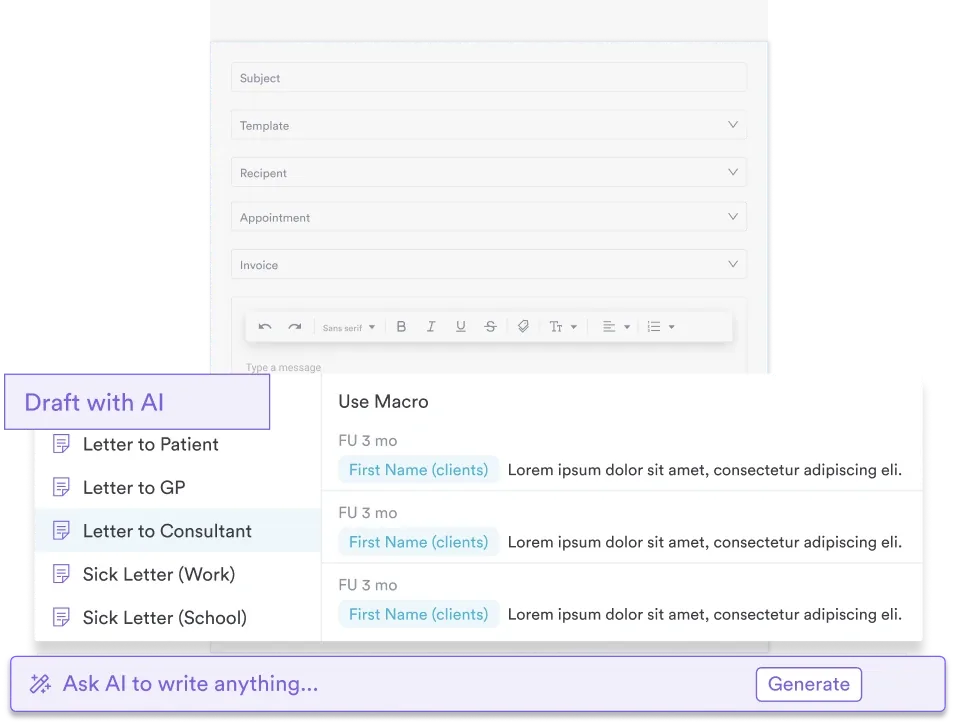
Pabau’s AI-powered clinical documentation tools and structured procedure note templates connect that documentation directly to billing. Providers document lesion size, site, and technique in a structured format that feeds directly into the billing workflow.
As a result, coders see the documented data alongside the suggested code, which reduces the chance of code selection based on memory rather than the actual procedure note.
For practices running a dermatology EMR alongside a separate billing platform, the disconnect is where CPT 11308 errors originate. By contrast, an integrated approach connects the clinical note to the claim, so the biller has the documented diameter, site, and technique on screen when selecting and submitting the code. That operational connection between documentation and billing is what reduces the denial rate at scale.
Overall, CPT code 11308 denials concentrate around three documentation failures: no measured lesion diameter, wrong anatomic-site group, and incomplete separation of the E&M from the procedure note. Ultimately, getting those three right for every claim covers the majority of preventable rejections.
Pabau’s structured procedure documentation and claims management software gives dermatology and skin clinic teams the workflow infrastructure to catch these errors before claims are submitted, not after denials arrive. To see how it works for your practice, book a demo with the Pabau team.

Coding a related skin procedure? CPT 11000 covers debridement of eczematous or infected skin, a different procedure family from lesion shaving.
Need the modifier rules for a related skin code? CPT 11006 breaks down debridement modifiers and the current fee schedule.
Billing a related lesion biopsy? CPT 19083 covers ultrasound-guided breast biopsy billing.
Pairing a connective-tissue diagnosis? ICD-10 code M35.4 covers diffuse eosinophilic fasciitis.
CPT code 11308 is a billing code that describes the shaving of a single epidermal or dermal lesion located on the scalp, neck, hands, feet, or genitalia when the lesion diameter exceeds 2.0 cm. Shaving is defined by the AMA as sharp removal via transverse incision or horizontal slicing without full-thickness dermal excision, distinguishing it from excision codes in the 11400 series.
CPT code 11307 covers shaving of a single epidermal or dermal lesion on the scalp, neck, hands, feet, or genitalia with a diameter of 1.1 to 2.0 cm. CPT code 11308 applies when the same lesion type and anatomic site has a diameter greater than 2.0 cm. A lesion measuring exactly 2.0 cm codes to 11307, not 11308. Billing 11308 for a 2.0 cm lesion is a common upcoding error.
No. Every code in the CPT 11300-11313 shave-removal family, including 11300-11303, is a standalone, per-lesion code — none of them are add-on codes. If a patient has multiple lesions removed at the same session, report the correct standalone code for each lesion based on that lesion’s own site and diameter, using modifier -59 to indicate the procedures are distinct. Do not bill 11300-11303 as an add-on underneath 11308 or any other code in the family.
The most commonly applied modifiers with CPT code 11308 are: modifier -25 (significant, separately identifiable E&M on same day), modifier -59 (distinct procedural service, used to bypass NCCI bundling edits or to separate multiple standalone lesion codes billed at the same session), modifier -51 (multiple procedures, though Medicare typically applies its own multiple procedure rules), and anatomic modifiers -RT/-LT for paired sites like the hand or foot when payer LCDs require it. CPT 11308 carries a 0-day global period, so -76/-77 applies only to a same-day repeat procedure, not an extended global window. Always verify current NCCI PTP edit status before applying modifier -59.
The most commonly paired ICD-10-CM codes with CPT code 11308 include D23.4 (benign neoplasm of skin of scalp and neck), D23.61/D23.62 (benign neoplasm of skin of the right/left upper limb, which includes the hand), D23.71/D23.72 (benign neoplasm of skin of the right/left lower limb, which includes the foot), D23.9 (benign neoplasm of skin, unspecified, commonly used for genital-skin lesions since ICD-10-CM has no dedicated genital subsite under D23), and L82.0 (inflamed seborrheic keratosis). Always select the most specific site-appropriate code available and confirm that your payer’s LCD A57113 criteria are met by the documented diagnosis.



