ICD-10 Code S42.444P: Medial epicondyle fracture, right humerus
ICD-10 Code S42.444P: full descriptor and code validity ICD-10 Code S42.444P car...

Last Updated: Oct 13, 2026
Billable Code Specific Code
S31.147D is the billable ICD-10-CM code for puncture wound of abdominal wall with foreign body, left flank without penetration into peritoneal cavity, subsequent encounter.
It applies at follow-up visits after active treatment, such as a wound check, suture removal, or aftercare after foreign body removal. The 6th character 7 means the left flank, not the left lower quadrant (4). The 7th character D marks a follow-up, while A marks the initial encounter.
Let Pabau's smart automation suggest the right codes, reduce claim denials, and keep your practice compliant—effortlessly.
Automate repetitive tasks and focus on what matters most—your patients.
Reduce coding errors and ensure compliance with the latest regulations.
Clean claims, fewer denials, and faster reimbursements.
Powerful insights and reporting to help your practice thrive.
HIPAA compliant SOC 2 certified GDPR-compliant Trusted by 4,000+ clinics worldwide

S31.147D covers follow-up care for a left flank puncture wound with a foreign body. Use S31.147A for the first active-treatment encounter.
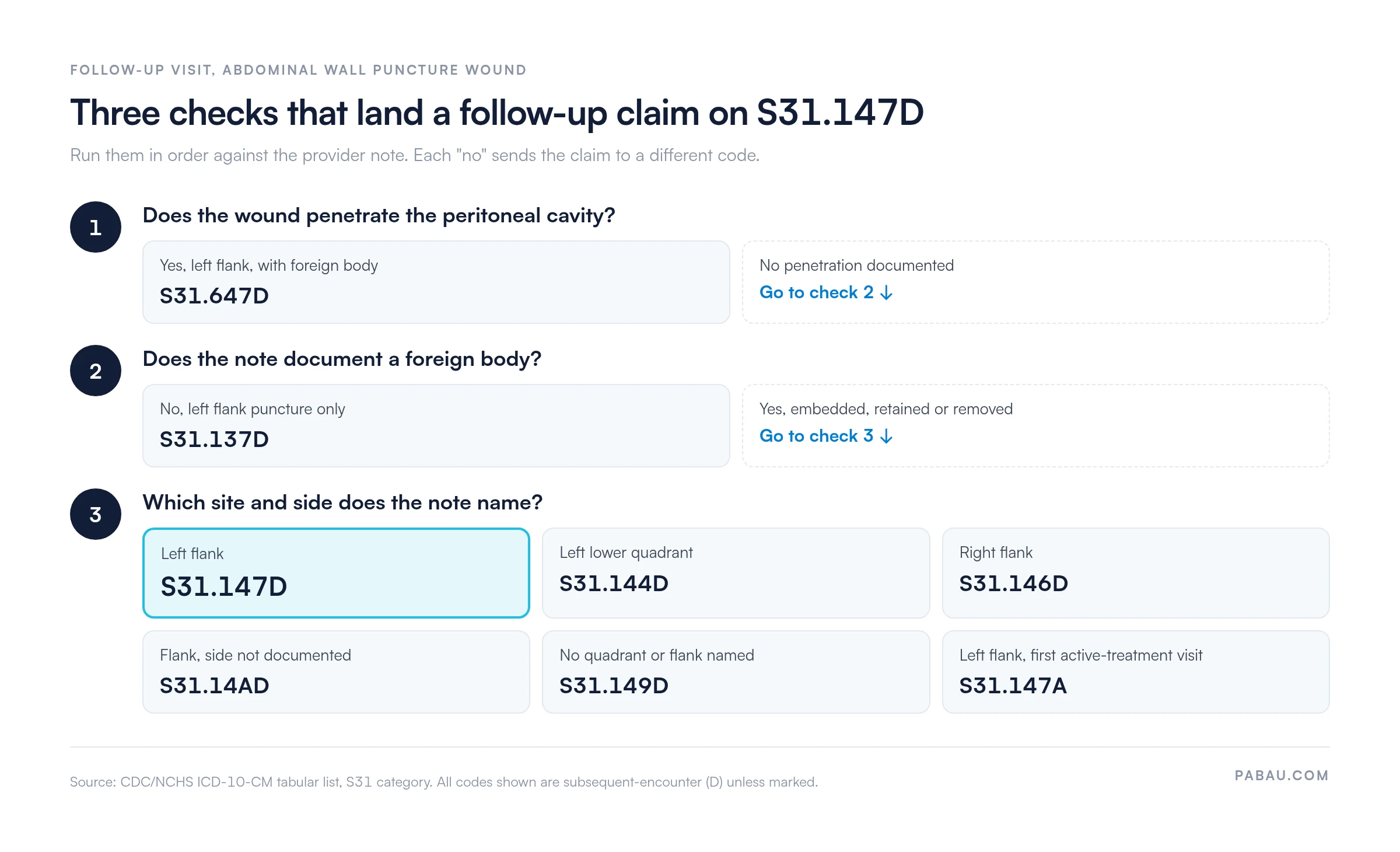
The 5th character 4 confirms a foreign body. With no documented foreign body, use S31.137D instead.
The 6th character 7 means the left flank, not the left lower quadrant. A left lower quadrant wound takes S31.144D.
If the note gives no quadrant or flank, the fallback is S31.149D. A flank with no side documented takes S31.14AD.
Pabau’s claims management software pairs S31.147D with matching CPT codes and flags missing documentation before submission.
ICD-10 Code S31.147D is a valid, billable ICD-10-CM code for follow-up care of a left flank puncture wound with a foreign body. Its full official descriptor is: Puncture wound of abdominal wall with foreign body, left flank without penetration into peritoneal cavity, subsequent encounter.
The code sits in Chapter 19 of the CDC/NCHS ICD-10-CM tabular list (Injury, Poisoning and Certain Other Consequences of External Causes, S00-T88). Its category is S31, which covers open wounds of the abdomen, lower back, pelvis, and external genitals.
The 7th character “D” designates a subsequent encounter. Per the ICD-10-CM Official Guidelines for Coding and Reporting, that means the visit takes place after active treatment for the injury is complete.
Three 7th character options govern injury codes in this category:
The most common coding error is applying “A” to every visit in the treatment timeline. Once active treatment is complete, coders switch to “D” for routine follow-up encounters, even if the patient is still symptomatic. Using “A” on a return wound-check visit is a coding inaccuracy that can draw payer audit attention.
S31.147D applies when a patient returns for follow-up care after active treatment for a puncture wound with a foreign body in the left flank. The flank is the side of the trunk between the lower ribs and the hip.
Three worked scenarios illustrate appropriate use:
The S31 category and the S31.1 subcategory carry scope notes in the CDC tabular list. Check them before assigning S31.147D.
Six codes are routinely confused with S31.147D. The table below shows where each one differs.
The most frequent site mix-up is S31.147D vs S31.144D. Both describe a left-sided puncture wound with a foreign body, but 7 is the left flank and 4 is the left lower quadrant. The flank sits on the side of the trunk, while the lower quadrant sits on the front of the abdomen.
The most frequent detail mix-up is S31.147D vs S31.137D. The 5th character decides it: 4 means a foreign body is documented, and 3 means there is none. Coders cannot infer a foreign body from the wound description alone, so the provider note must state it.
The decision path below runs the three checks in the order a coder should make them.
Using S31.147D without adequate supporting documentation is a common payer denial trigger. The clinical note should support every element of the code before the claim goes out.
The provider note must confirm all five of the following:
If the wound type itself is not documented, the code moves out of the puncture subcategory altogether. An unspecified open wound of the left flank is S31.107D, and one with no site at all is S31.109D.
Run a pre-bill documentation audit on every S31.147D claim. Confirm the note names the wound type, states the foreign body status, specifies the left flank, and uses follow-up language. Claims missing any one of these elements are predictably denied and need rework before an appeal can succeed.
Subsequent encounter codes like S31.147D generally do not need prior authorization for routine wound care. Payers still apply several claims-processing checks that decide whether the claim pays on first submission. Good medical billing fundamentals account for these before the claim goes out.
For practices with a high volume of wound care claims, claims management software that validates CPT-ICD linkage before transmission cuts first-pass denials. Pabau, the practice management platform we build, submits claims electronically through Claim.MD and runs those checks before the claim leaves the practice.
The procedure billed alongside S31.147D must match what was documented and performed at the subsequent encounter. The table below shows the most frequently paired CPT codes by service type.
CPT selection depends on what the provider documented and performed, not on the ICD-10 diagnosis alone. A fragment lodged in muscle is billed with 20520 rather than 10120. Debridement at the follow-up visit is billed with 97597, plus 97598 for each additional 20 sq cm.
Use the AAPC ICD-10-CM lookup for crosswalk checks, and confirm each pairing against National Correct Coding Initiative (NCCI) edits.
S31.147D denials follow predictable patterns. Knowing them before submission reduces rework and protects reimbursement timelines.
A structured denial management workflow that logs these five denial types speeds up appeals. It also shows whether the cause is documentation, coding, or CPT selection. Knowing the denial codes in medical billing behind each rejection tells you which fix applies before you appeal.
Track your S31.14xD denial rate separately from other wound codes. If denials keep citing missing information (CARC 16), fix it at the point of care, not at the billing desk. Add foreign body status and wound site prompts to your wound care encounter template so the provider records both before closing the note.
Wound care follow-ups generate many ICD-10 selections where one wrong character becomes a denied claim. A flank coded as a quadrant, a missing foreign body note, or the wrong encounter letter is enough. Pabau’s claims management tools connect clinical documentation to billing so coders can check both before submission.
Through Pabau’s integration with the Claim.MD clearinghouse, practices get real-time eligibility checks, built-in CPT and ICD-10 catalogs, electronic 837P claim transmission, and ERA/835 remittance processing. For high-volume wound care practices, S31.147D claims go out with the supporting CPT already validated, without adding manual review steps.

Pabau pairs ICD-10 codes with the right CPT codes, runs real-time eligibility checks, and submits claims through Claim.MD. Your S31.147D follow-up claims go out clean.

S31.147D rewards precise notes and punishes assumptions. The 6th character 7 means the left flank, so a wound on the front of the lower abdomen belongs to S31.144D instead. Build the site, the foreign body status, and the follow-up wording into your wound care templates, and the code assigns itself correctly.
Pabau’s claims management and Claim.MD integration give wound care billing teams a pre-submission check that catches CPT/ICD mismatches before the payer does. To see how it works in practice, book a demo with the Pabau team.

Need to understand how clearinghouse submissions work? Medical claims clearinghouse guide explains how electronic claim routing and ERA processing reduce denial rates.
Want to understand the full revenue cycle behind these claims? What is revenue cycle management covers how coding accuracy connects to cash flow for clinical practices.
Looking for a structured wound care superbill reference? Superbill guide walks through how to build a compliant superbill that supports ICD-10 code specificity requirements.
ICD-10 Code S31.147D is the billable code for follow-up care of a left flank puncture wound with a foreign body. The wound does not penetrate the peritoneal cavity. It is used for wound checks, suture removal, and aftercare once active treatment is complete.
The 7th character “A” (initial encounter) applies while the patient is receiving active treatment for the injury. The 7th character “D” (subsequent encounter) applies to routine follow-up visits once active treatment is complete. The switch depends on the phase of care, not the number of visits.
The provider note must state five facts. It must name a puncture wound and a foreign body that is present or was removed. It must place the wound in the flank and state that the side is left. It must also describe a follow-up visit, such as a wound check or suture removal.
No. The 6th character 7 in S31.147D means the left flank. A puncture wound with a foreign body in the left lower quadrant is S31.144D at a follow-up visit.
Yes. If the emergency department completed active treatment, S31.147D is correct for the first return visit. That covers a wound check, suture removal, or other aftercare. The code is not limited to second or third visits.
Common pairings include 10120 or 10121 for subcutaneous foreign body removal and 20520 for removal from muscle. Wound check visits use 99212-99215, and debridement uses 97597-97598. The correct CPT depends on what the provider performed and documented at the encounter.
Common reasons include no initial encounter (S31.147A) on file, or a note that never documents the foreign body. Others are a site recorded as the left lower quadrant or left unspecified, or a CPT that does not match the service. A sequela character on routine aftercare also triggers denials.