ICD-10 Code Y66: Nonapplication of measure
ICD-10 code Y66 is the billable ICD-10-CM external cause code for nonadministrat...

Last Updated: Nov 2, 2026
Billable Code Specific Code
S31.30XD is the billable ICD-10-CM code for unspecified open wound of scrotum and testes, subsequent encounter. It applies to a follow-up visit when the note doesn't state the wound type.
Use D once active treatment has ended, because A applies only to active treatment (ICD-10-CM Guidelines I.C.19.a). Routine healing care, such as a wound check or suture removal, takes D.
Let Pabau's smart automation suggest the right codes, reduce claim denials, and keep your practice compliant—effortlessly.
Automate repetitive tasks and focus on what matters most—your patients.
Reduce coding errors and ensure compliance with the latest regulations.
Clean claims, fewer denials, and faster reimbursements.
Powerful insights and reporting to help your practice thrive.
HIPAA compliant SOC 2 certified GDPR-compliant Trusted by 4,000+ clinics worldwide

S31.30XD reports a follow-up visit for an open wound of the scrotum or testes when the note doesn’t name the wound type.
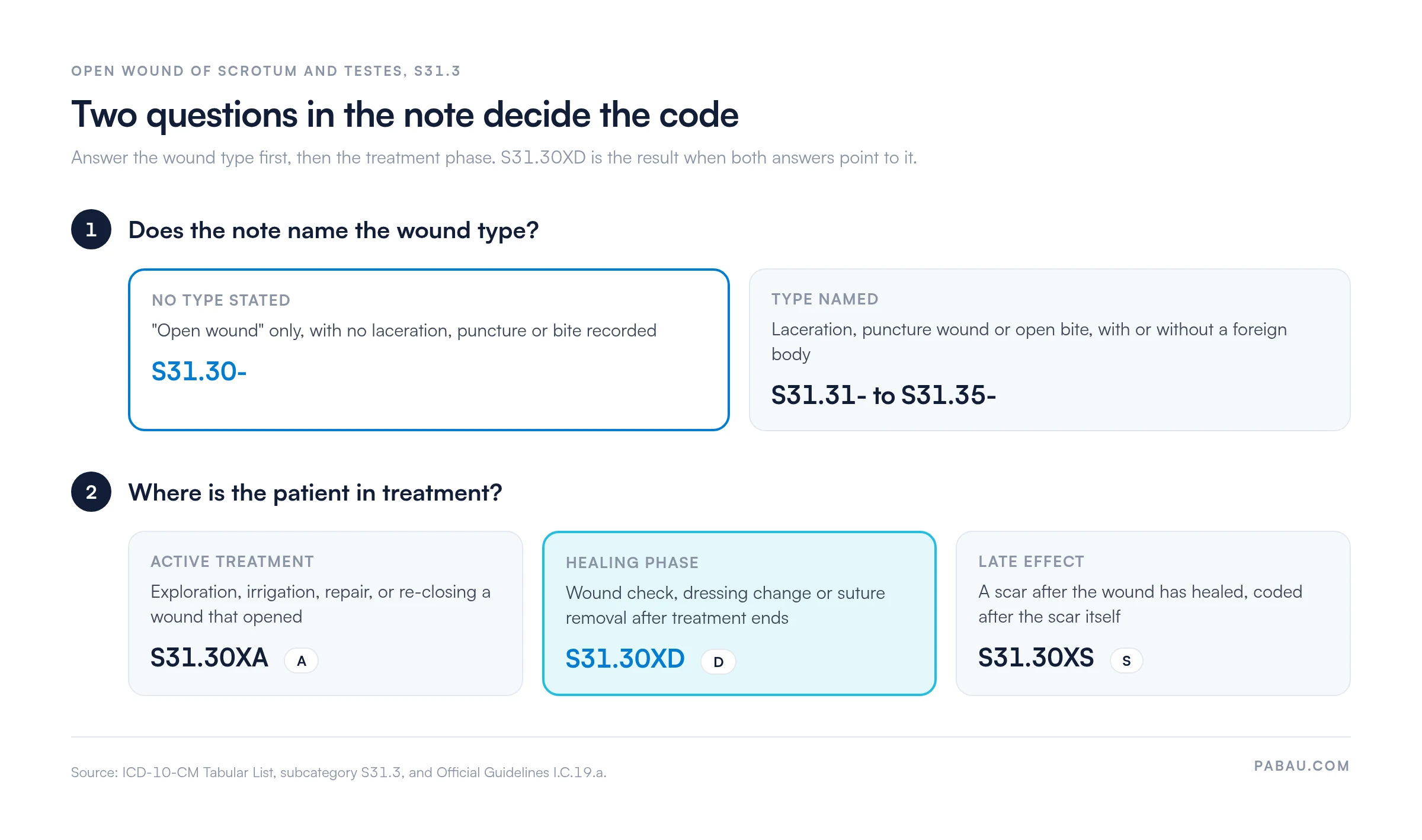
Once the note says laceration, puncture or bite, the S31.31 to S31.35 codes replace S31.30, with or without a foreign body.
The 7th character D applies once active treatment has ended, so routine healing care uses D, never an aftercare Z code.
External cause codes are optional nationally, but if you report one, its 7th character matches the injury code’s D.
Pabau, the practice management platform we build, checks eligibility and sends CMS-1500 claims through Claim.MD, with remittances posted back to the invoice.
ICD-10 code S31.30XD is the billable ICD-10-CM code for an unspecified open wound of the scrotum and testes at a subsequent encounter. You assign it when the patient comes back after active treatment, and the note doesn’t say what kind of wound it was.
Typical visits are a wound check, a dressing change or suture removal after an emergency repair. The code reads in five parts:
S31.30XD is billable and specific in the CMS ICD-10-CM code files. Codes update every October 1, so check the version in force on the date of service.
Unspecified codes are a fallback. If the ED record or your own note describes the wound, a more specific S31.3 code applies. An unspecified code with the detail sitting in the chart invites a query.
Here is how the subsequent-encounter codes in the subcategory split:
A few neighboring codes catch wounds that don’t belong here at all:
D means active treatment is over and the patient is in the healing or recovery phase. ICD-10-CM Guidelines I.C.19.a define it that way, and the definition matters more than the calendar.
Here’s a quick example. A patient has a scrotal laceration repaired in the ED, then sees your provider five days later to have the wound checked. That second visit takes D, even though it’s the first time your practice has seen him.
Flip it around. If the wound has opened and your provider re-explores and re-closes it, that visit is active treatment again, so A applies. Changing providers doesn’t reset the character, and a second visit doesn’t force D.
The instructional notes sit at category level, so they apply to S31.30XD. They read the same on the AAPC code record and in the official tabular list.
One guideline adds a further limit. Under I.C.19.b, you don’t code a superficial injury, such as a contusion, at the same site as the open wound.
There’s no national requirement to report external cause codes, per guideline I.C.20. Many payers and state reporting programs still ask for them, so check yours.
If you add one, guideline I.C.20.a.2 says its 7th character matches the injury code for that encounter. So a dog bite follow-up reads S31.35XD with W54.0XXD.
Place of occurrence (Y92), activity (Y93) and external cause status (Y99) work differently. They’re generally reported once, at the initial encounter, so they usually stay off the D claim.
The note carries the code, so read it before you open the billing screen. Two of its answers settle which code you report:
A clean note for S31.30XD covers five points:
Does the follow-up note say only “wound cleaned and redressed”? Then ask the provider what type of wound it was, and whether active treatment has ended. One answer moves you off S31.30, and the other confirms the D.
The coding is one step in a longer chain. Here is the route a typical S31.30XD claim takes in a US practice:
Watch the global period on step three. If the repair carried a global surgical period, routine follow-up by the same provider is usually included in the repair fee. That leaves the visit with nothing separate to bill.
A short check here saves a resubmission later. Tick each line before the claim leaves the practice:
Most rejections on this code come from a handful of habits. Each one is quick to fix once you know to look for it.
Is A carried over from the ED? Copying the ED’s S31.30XA onto your wound-check claim is the classic one. The injury is the same, but the encounter isn’t.
Did the chart name the wound? S31.30XD on a claim whose note says laceration invites a query. Code the laceration, S31.31XD or S31.32XD.
Did a Z code slip in? Z48.0- aftercare codes look right for a dressing change, but injury aftercare uses the D code instead.
Is the service the repair again? Billing the original repair at a suture-removal visit draws a mismatch. Bill the service your provider performed today.
Read the CARC codes on each ERA against these four, and work the fixes into your denial management routine.
In many practices, the follow-up visit is booked in one system and billed in another. Then someone re-keys the codes and chases the payer by phone.
With Pabau, eligibility is checked from the patient’s record through our integration with the Claim.MD clearinghouse, which reaches thousands of US payers. After the visit, the invoice becomes a superbill or an electronic CMS-1500 claim, sent as an 837P.
Claim statuses update from the payer, and ERA (835) remittances post back against the claims they settle. Your team can see which follow-up claims are paid, pending or denied in Pabau’s claims management software, without logging into a portal.
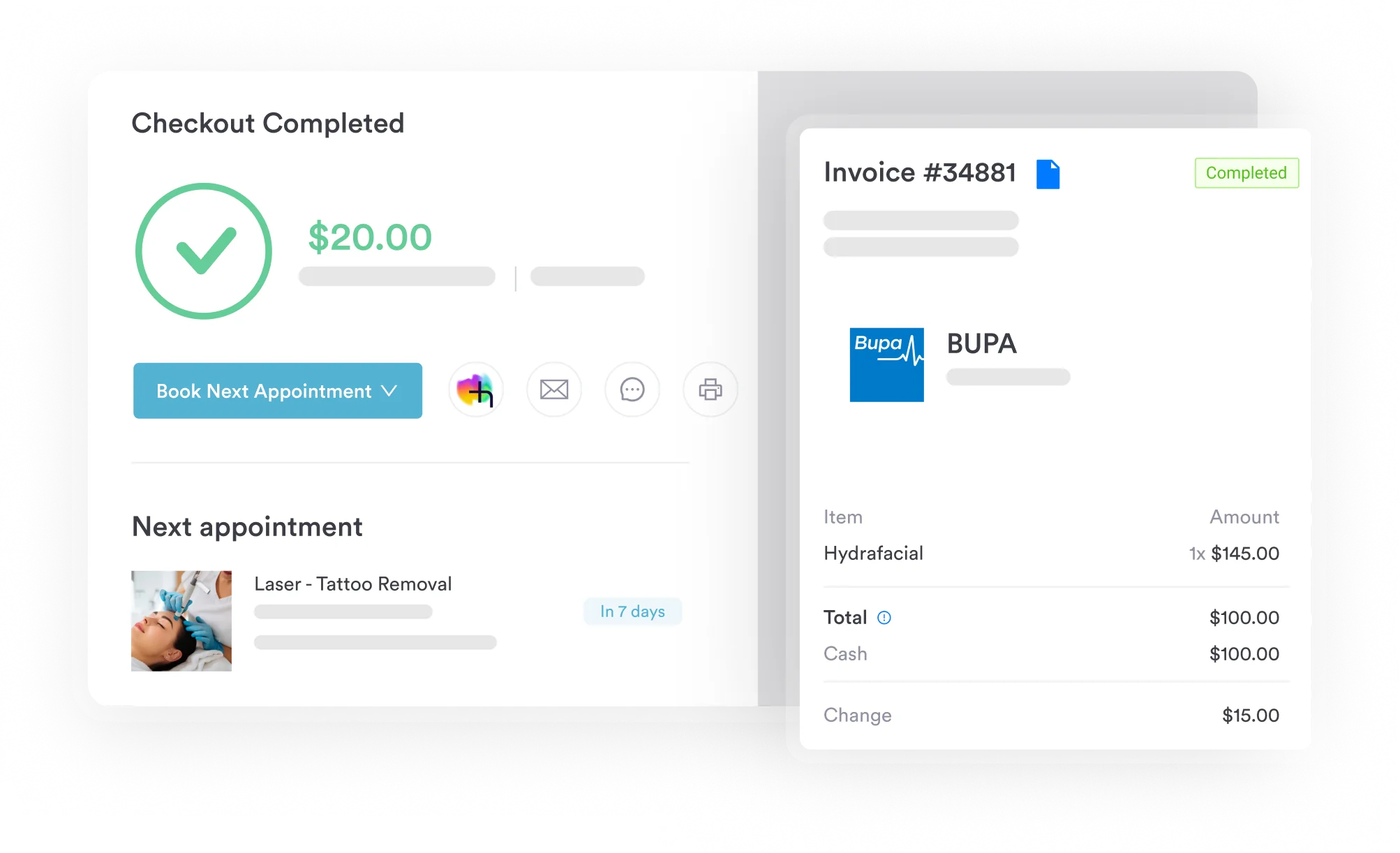

Pabau checks eligibility, turns the invoice into an electronic CMS-1500 claim through Claim.MD, and posts the ERA back when the payer settles. Your team sees every follow-up claim from booking to payment.

S31.30XD looks simple, and the anatomy is the easy part. The judgment sits in two places: whether the note lacks a wound type, and whether active treatment has ended.
Get both right, and the claim mostly takes care of itself. Read the follow-up note for those two answers before anyone opens the coding screen. When either is missing, query the provider.
Book a demo to see how Pabau takes a wound care follow-up from eligibility check to posted remittance in one system.

Want to see how a follow-up claim reaches the payer? Claim.MD clearinghouse overview walks through clearinghouse routing, edits and rejections.
Working a denial on an injury code? Denial codes in medical billing maps CARC and RARC codes to the fix for each one.
Building a cleaner superbill for wound follow-ups? Superbill documentation guide shows which fields keep the diagnosis and the service in step.
No. Aftercare Z codes aren’t used for injury aftercare, per guideline I.C.21.c.7. Report the injury code with the 7th character D instead, such as S31.30XD, or S31.31XD once the laceration is documented. Z48.02 fits suture removal after a planned surgery.
No. S31 covers traumatic wounds. A surgical incision that breaks open is coded to T81.31-, disruption of an external surgical wound. An infected incision goes to the T81.4- infection codes, with the 7th character still showing the encounter type.
No. The scrotum and testes form one coded site in S31.3, so there’s no laterality digit. The code still needs the placeholder X in the 6th position so the 7th character D can follow.
Use it for as long as the patient gets routine healing care, such as dressing changes and wound checks. Once the wound has healed and a scar becomes the reason for the visit, code the scar first. Then add S31.30XS to show its cause.