ICD-10 code S32.436K: Anterior column nonunion, unspecified side
ICD-10 code S32.436K reports a nonunion with no side on record ICD-10 code S32.4...

Last Updated: Nov 2, 2026
Billable Code Specific Code
S31.125S is the billable ICD-10-CM code for laceration of abdominal wall with foreign body, periumbilic region without penetration into peritoneal cavity, sequela.
It applies once the wound around the navel has healed. The patient is now treated for a condition the injury left behind, such as a scar or chronic pain. Code that late effect first, for example L90.5 for a scar, then add S31.125S to name the injury that caused it.
Let Pabau's smart automation suggest the right codes, reduce claim denials, and keep your practice compliant—effortlessly.
Automate repetitive tasks and focus on what matters most—your patients.
Reduce coding errors and ensure compliance with the latest regulations.
Clean claims, fewer denials, and faster reimbursements.
Powerful insights and reporting to help your practice thrive.
HIPAA compliant SOC 2 certified GDPR-compliant Trusted by 4,000+ clinics worldwide

ICD-10 code S31.125S is billable, and it applies only after a periumbilic abdominal wall laceration with a foreign body has healed.
Use 7th character A during active treatment, D for routine follow-up while the wound heals, and S for a late effect such as a scar.
Sequence the late effect first, such as L90.5 for a scar or G89.21 for chronic pain due to trauma, then S31.125S.
The sequela note needs foreign body evidence from the original record, a stated causal link, and the late effect named as a diagnosis.
Pabau, our practice management and billing platform, submits and tracks claims electronically, so a rejected S31.125S claim is visible quickly.
ICD-10 code S31.125S is the billable code for a sequela of a periumbilic abdominal wall laceration with a foreign body. The original wound did not penetrate the peritoneal cavity. You use it once the wound has healed and the visit treats a late effect of that injury. The late effect gets its own code, and it goes on the claim first.
The code sits at the bottom of a six-level path in the CMS ICD-10-CM code set. Each level narrows the injury until the region, the foreign body and the encounter type are all fixed:
The periumbilic region is the part coders most often get wrong. A laceration elsewhere on the abdominal wall takes a different fifth character, before the 7th character is even added. Check the descriptor against an ICD-10-CM code lookup if the region in the note is vague.
The 7th character S marks a sequela encounter. The patient is being treated for a condition caused by the original laceration, not for the laceration itself. Section I.C.19.a of the ICD-10-CM Official Guidelines for Coding and Reporting sets this rule, and it also decides the order of codes on the claim.
The S31.125 base code takes three 7th characters, and each one matches a different point in the patient’s recovery:
One point trips up new coders. “Initial encounter” does not mean the patient’s first visit to your practice. It means the visit is for active treatment, so several providers can all report A. Sequela applies only once the wound has fully healed.
S31.125S describes late effects of a cut around the navel that had a foreign body in it. The injury itself was coded S31.125A or S31.125D during active care, and it has now resolved. The late effect may be scar contracture, chronic pain at the site, abdominal wall weakness, or nerve injury causing numbness or hypersensitivity.
The treating provider has to link the current complaint to that original laceration. “Foreign body” means any outside material in the wound, such as glass, metal, wood splinters or gravel. Its presence should be on record from the original encounter, through imaging, an operative report or direct visualization.
The S31 category and the S31.1 subcategory carry instructional notes that apply to S31.125S. Read them before you finalize the claim, because each one changes what else you can report.
Excludes1 (never coded together):
Excludes2 (may be coded together when both conditions are present):
Code also: Add a code for any associated spinal cord injury (S24.0, S24.1-, S34.0, S34.1-) and for any wound infection.
The sequela itself needs a second code, and guideline I.C.19.a fixes the order. The specific late effect is sequenced first, followed by S31.125S. L90.5 covers scar conditions and fibrosis of skin, and G89.21 covers chronic pain due to trauma.
Document the sequela condition as a distinct active diagnosis in your note. Write ‘Scar contracture of the anterior abdominal wall, sequela of prior laceration with foreign body’, not just ‘wound scar’. The late-effect code must match a clearly named condition in the record, not a vague complaint.
The S31.1 family has several codes that differ by a single character. Each one turns on a fact you can check in the original record:
The pair to watch is S31.115S and S31.125S. If the coder reads only the follow-up note, the foreign body is easy to miss. The ICD List lookup tool shows the S31.12 family side by side for a quick comparison.
The S31.12 group covers lacerations with foreign body of the abdominal wall without peritoneal penetration. S31.125 is the periumbilic member, and each region has its own sequela code:
Take the region from the note that describes the original injury, not from the follow-up visit. The CDC/NCHS ICD-10-CM browser gives the authoritative descriptor for each code.
An S31.125S claim stands on three pieces of documentation. If any one is missing, the claim is open to denial or recoupment on audit.
A prompt in your follow-up visit template that asks for all three keeps this at the point of care. Building medical billing compliance into the note costs far less time than reworking a denied claim.
Here is how one patient moves through all three 7th characters. A patient cuts the skin beside the navel on a broken glass panel, and the wound does not enter the abdominal cavity.
The third claim is where the order flips. During active care the injury code leads, while at the sequela visit the late effect leads and the injury code explains it:
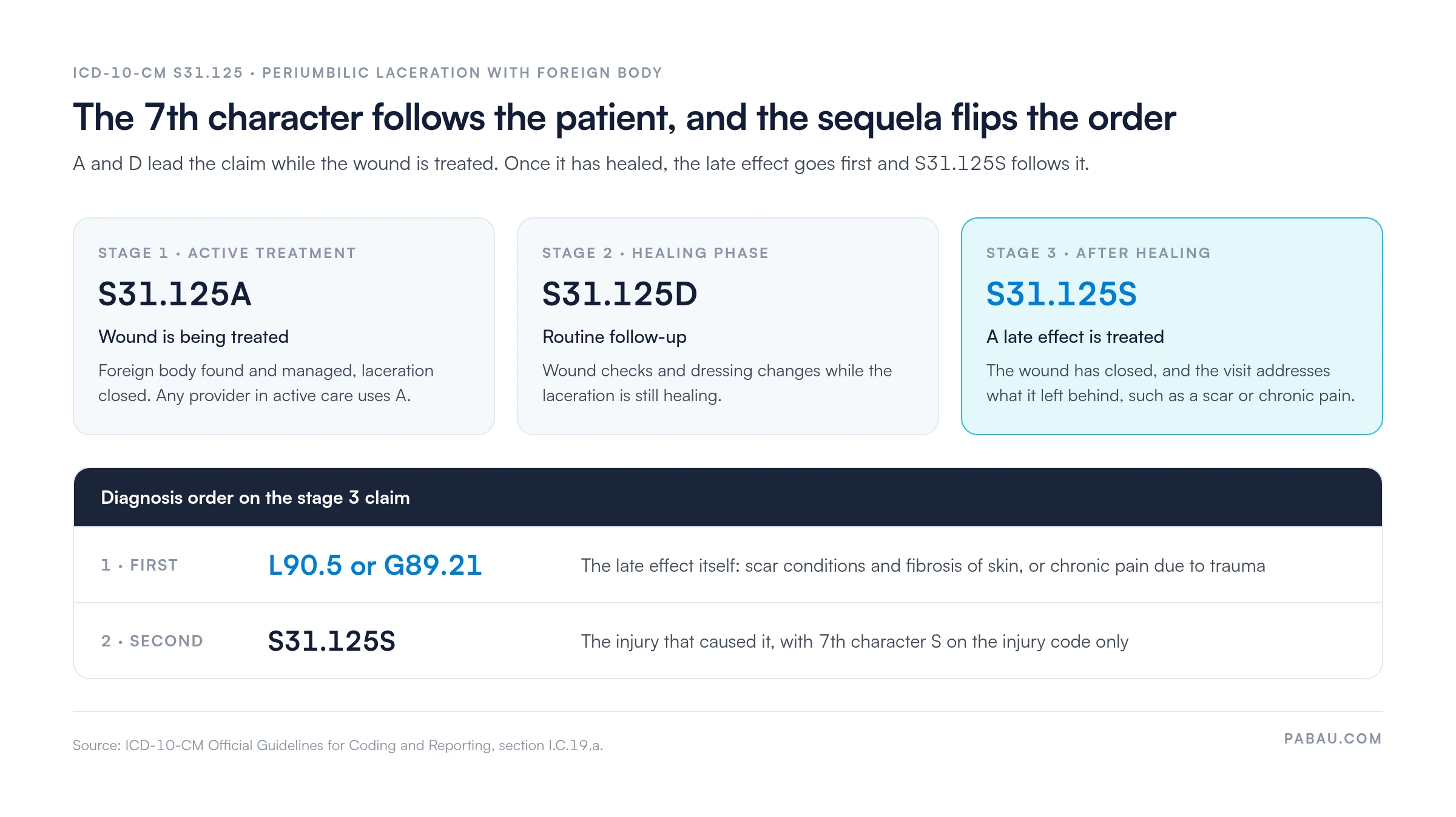
If the surgeon revises the scar at visit 3, the procedure code changes, but the diagnosis order does not. A revision billed as a complex repair of the trunk, such as 13100, still carries L90.5 first and S31.125S second.
S31.125S is accepted by Medicare, Medicaid and commercial payers. Coverage turns on the pairing of procedure and diagnosis, not on the diagnosis alone. Check the local coverage determination (LCD) for the CPT code you bill with it, through your Medicare Administrative Contractor.
The CPT code depends on what the visit does. An assessment of the late effect is an evaluation and management code (99202-99215). A scar revision is usually coded as a complex repair of the trunk (13100-13102) or an adjacent tissue transfer of the trunk (14000-14001).
Once the claim is built, it goes through a clearinghouse such as Claim.MD before it reaches the payer. The Claim.MD clearinghouse runs its own edits on format and code validity, and rejects what fails. That turns some denials into same-day fixes instead of weeks of waiting.
The diagnosis order is where most sequela claims go wrong. Put the late-effect code, such as L90.5 or G89.21, in the first diagnosis position and S31.125S after it. Then point the CPT line to both, so the payer sees what was treated and why. That order is part of submitting a clean claim.
Each of these patterns has a simple fix at the coding desk:
Sorting denial management by root cause shows which of these keeps recurring. Matching each one to its denial codes in billing speeds up both the appeal and the fix upstream.
Run through this list on every sequela claim before it leaves the practice. It takes a minute and covers each failure above.
For a broader view of where coding sits in the claim cycle, see this guide to what medical billing involves.
In many practices, the coder rekeys diagnosis codes from the note into a separate billing system. Then someone checks the payer portal days later to learn whether the claim went through. A reversed code order on a sequela claim can sit unnoticed for weeks.
Pabau, the practice management platform we build, keeps the visit record and the claim in one place. The claim form is pre-filled from the record, and ICD-10-CM codes are searchable from a built-in library. The software also checks that required claim fields are complete before you can send it.
In the US, claims go out through the Claim.MD clearinghouse, which applies its edits before the payer sees them. Claim status and remittance post back to Pabau, so a rejected S31.125S claim shows up quickly. That is the job our claims management tools do: submit, track and reconcile claims electronically.

Pabau submits claims electronically, tracks their status and posts remittance back to the patient record. Rejected claims surface quickly, so your team can correct and resend them.

S31.125S is a narrow code, and that works in your favor. If the wound has healed and the foreign body is on record, the only judgment left is the order of codes. Put the late effect first and S31.125S second, every time.
The bigger win sits upstream. A follow-up template that asks for the causal link and names the late effect saves more time than any appeal. Fix the note, and the claim mostly takes care of itself.
If your team still chases sequela claims through payer portals, book a demo to see how Pabau tracks each claim from submission to payment.

Want to see how clearinghouse edits catch claim errors? How Claim.MD clearinghouse works explains how claims are checked before they reach the payer.
Billing a scar revision on the trunk? CPT code 14000 covers adjacent tissue transfer for defects of 10 sq cm or less.
Seeing repeated denials on wound claims? What is revenue cycle management covers the full claim lifecycle and where coding errors enter it.
Need to trace why a sequela claim was rejected? Electronic remittance advice (ERA) explains how to read the denial reason codes on an 835 remittance.
Yes. S31.125S is a billable, fully specified ICD-10-CM code. It is reported second, after the code for the late effect being treated.
L90.5 covers scar conditions and fibrosis of skin. When the scar follows a periumbilic laceration with foreign body, code L90.5 first and S31.125S second.
No. The ICD-10-CM guidelines set no time limit on sequela codes. A late effect may appear soon after the injury or months to years later.
There is no national requirement to report external cause codes, though some payers and states ask for them. If you report one, give it 7th character S as well.
G89.21 covers chronic pain due to trauma. Sequence it first and S31.125S second. G89.28 is a different code, for other chronic postprocedural pain.