ICD-10 Code S52.541M: Smith’s fracture of right radius with nonunion (open type I or II)
ICD-10 Code S52.541M: Definition and billable status ICD-10 Code S52.541M is the...

Last Updated: Oct 15, 2026
Billable Code Specific Code
S25.122D is the billable ICD-10-CM code for major laceration of left innominate or subclavian artery, subsequent encounter. It applies to follow-up visits after active treatment of a complete transection or traumatic rupture of the left-sided vessel has ended.
The code sits in the S25.12 major laceration subcategory. Its sixth character sets the side: 1 for right, 2 for left and 9 for unspecified. Because the innominate artery is normally right-sided, a left-sided injury coded here usually involves the left subclavian artery.
Let Pabau's smart automation suggest the right codes, reduce claim denials, and keep your practice compliant—effortlessly.
Automate repetitive tasks and focus on what matters most—your patients.
Reduce coding errors and ensure compliance with the latest regulations.
Clean claims, fewer denials, and faster reimbursements.
Powerful insights and reporting to help your practice thrive.
HIPAA compliant SOC 2 certified GDPR-compliant Trusted by 4,000+ clinics worldwide

S25.122D is the billable ICD-10-CM code for a major laceration of the left innominate or subclavian artery at a subsequent encounter.
The seventh character D covers routine care while the injury heals after active treatment ends. The active treatment episode itself is coded S25.122A.
The sixth character 2 means left. A right-sided injury is S25.121D, and an injury with no side documented is S25.129D.
A laceration documented without a severity qualifier codes to minor laceration (S25.11-), so the record must state major laceration, complete transection or traumatic rupture.
Pabau, the practice software we build, pre-fills claims from the patient record and submits them through Claim.MD.
ICD-10 code S25.122D is the billable ICD-10-CM code for “Major laceration of left innominate or subclavian artery, subsequent encounter.” You use it once the emergency repair is done and the patient comes back for routine care while the vessel heals.
The seventh character carries the most weight. A follow-up billed with A tells the payer that active treatment is still underway, while the visit note says it has ended. That mismatch is one of the fastest routes to a denial.
The code has been valid since October 1, 2015, and it stays valid in the current release. Below, you’ll see how each character is chosen, what the record must show and how a clean follow-up claim moves.
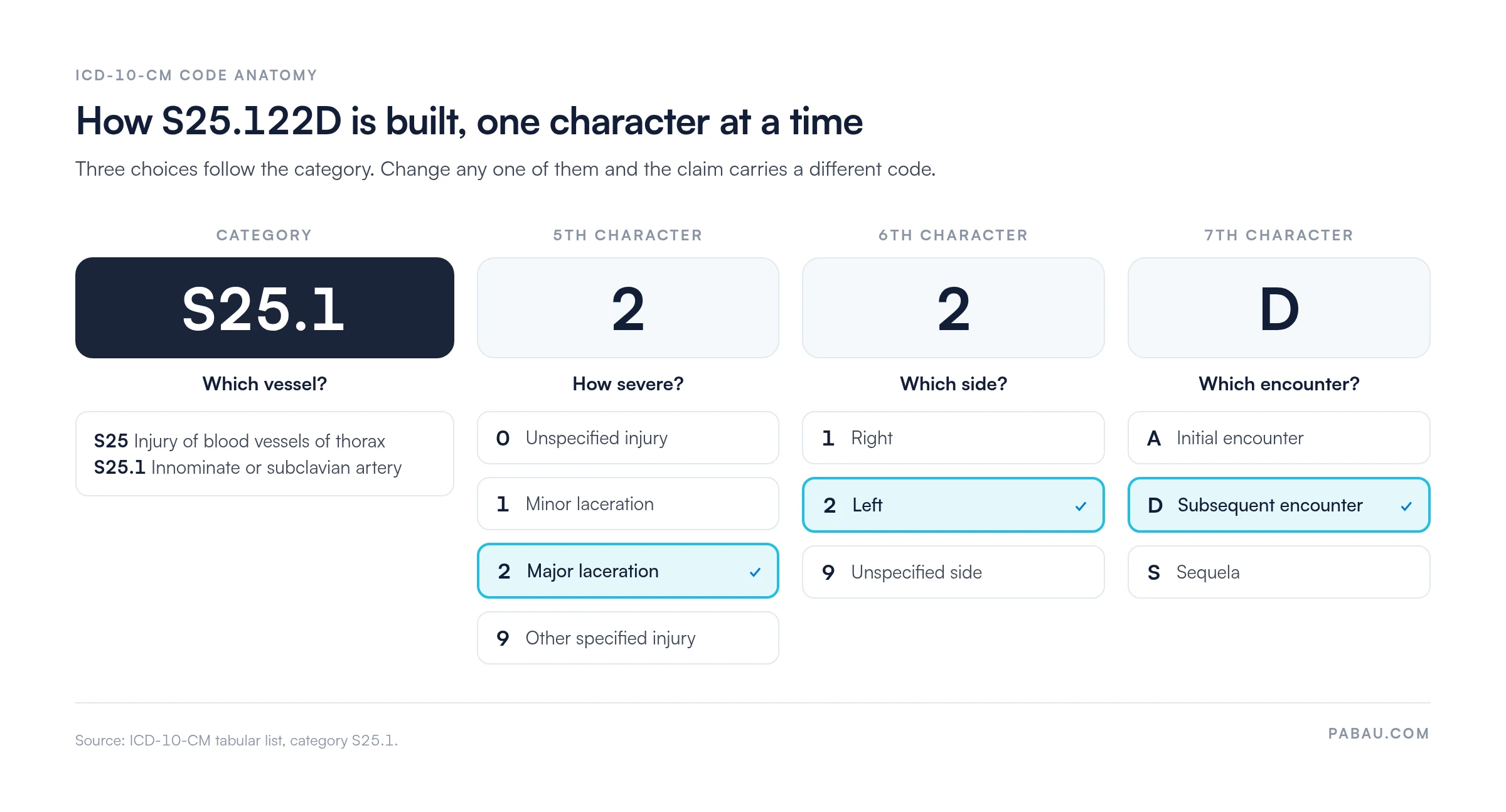
Each character after the category does one job. The fifth character 2 marks a major laceration, and the sixth character 2 marks the left side. The seventh character D marks a subsequent encounter, and the diagram below shows the options at each position.
In typical anatomy, the innominate artery, also called the brachiocephalic artery, is a right-sided vessel. It rises from the aortic arch and divides into the right common carotid and right subclavian arteries. On the left, there is usually no innominate artery, because the left subclavian artery branches directly off the aortic arch.
That means S25.122D almost always describes an injury to the left subclavian artery. A left innominate artery only appears in rare arch variants, such as a right-sided aortic arch with mirror-image branching. Either way, the operative report or attending note must name the vessel and state that it is on the left.
The seventh character D means the patient is receiving routine care while the injury heals, after active treatment is complete. Under the ICD-10-CM Official Guidelines (Section I.C.19.a), “subsequent” does not mean the second visit. It means the patient has moved past the active treatment phase.
Vascular repairs have no healing marker as clear as a fracture line on an X-ray. The visit note should therefore state that active repair is complete and the patient is in the healing or monitoring phase. That statement is what supports the D character if the claim is reviewed.
So what counts as major? S25.122D covers a complete transection or traumatic rupture of the left innominate or subclavian artery, coded at a subsequent encounter. Those are the two inclusion terms the tabular list gives for the S25.12 major laceration subcategory.
Severity, side and encounter type decide the code in this family. Get any one of them wrong and the claim carries a different code, as the table below shows.
The minor-laceration trap works the same way on the right side, where an unqualified laceration codes to S25.111D. Before you swap in any neighbor, read its full descriptor in the tabular list or our diagnostic code library.
The medical record must support every element of the code. Good medical billing documentation starts with the operative or emergency report and carries through each follow-up note.
Flag any operative report that names the innominate or subclavian artery without stating right or left. Query the surgeon before the claim goes out, because querying after a denial is slower and can run into timely filing limits.
S25.122D is valid on HIPAA-standard electronic claims, but the seventh character must match what the visit note describes. Submitting a clean claim for this code means the vessel, side, severity, encounter type and service code all agree.
Some payers require prior authorization for imaging after a major vascular repair. Check the payer’s policy before scheduling post-operative angiography and billing it alongside S25.122D.
Here’s a typical path. A patient’s left subclavian artery transection was repaired in the hospital. Six weeks later, they see the vascular surgeon for a duplex ultrasound check.
That last step is where the money shows up. The payer’s electronic remittance advice explains each payment or adjustment. Posting it promptly keeps revenue cycle management accurate across a long recovery.
Two codes signal a coding problem when a claim comes back. Claim adjustment reason code 11, usually returned with group code CO, means the payer found the diagnosis inconsistent with the procedure billed. Remark code MA130 means the claim was unprocessable because information was missing or invalid.
An MA130 claim carries no appeal rights, so the fix is a corrected, resubmitted claim. A structured denial management workflow sorts returned claims by these codes, so each one goes straight to the right fix.
Many practices still look up injury codes in one tool and type them into a claim in another. Each retyped character is a chance to swap a 2 for a 1 or a D for an A.
Pabau’s claims management tools pull patient, treatment and insurer details from the patient record into a pre-filled claim. Pabau runs validation checks and keeps Send disabled until required details are filled in.
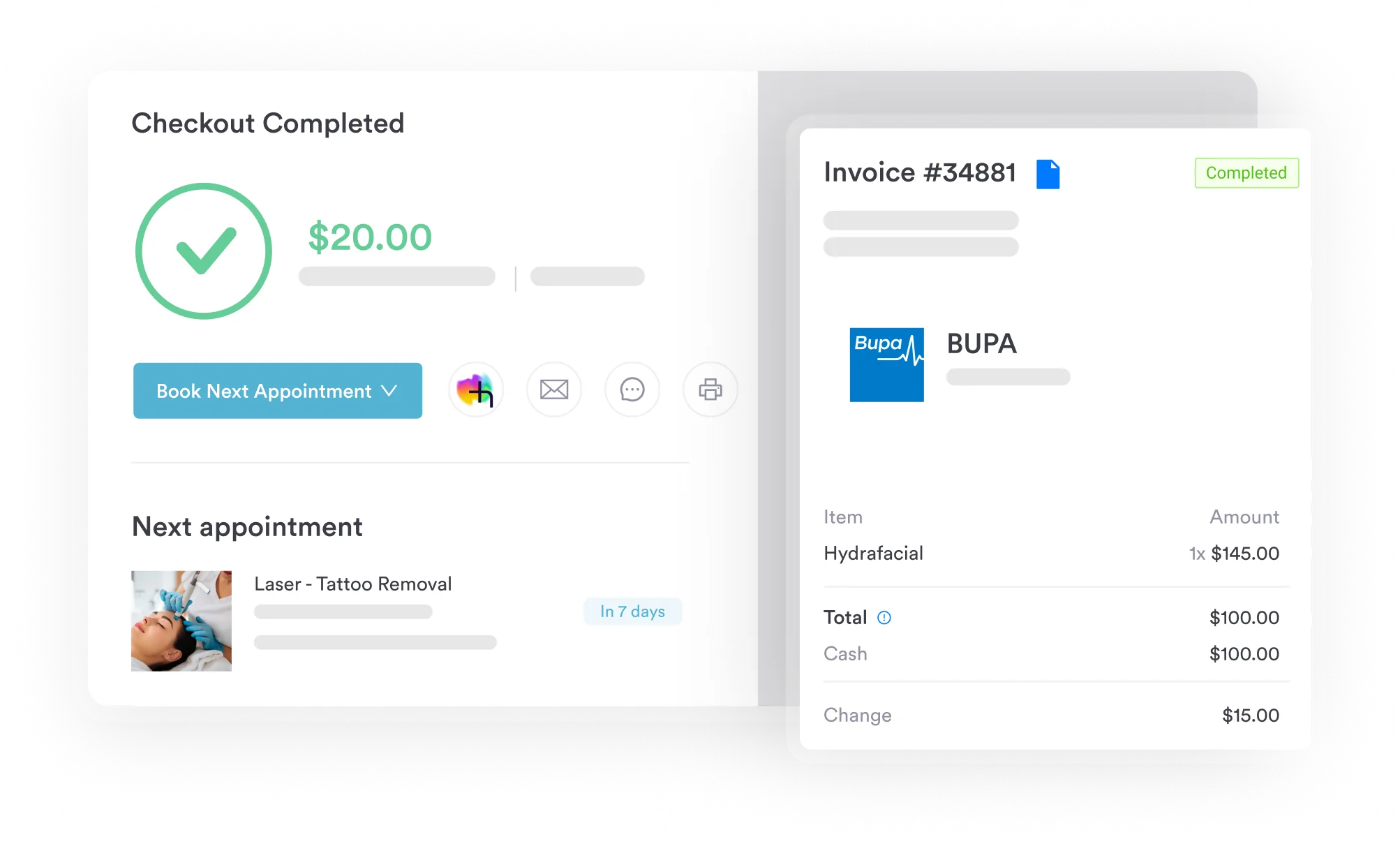
Claims then go out through Pabau’s Claim.MD integration, and each claim’s status stays visible in the same platform. Across a long vascular recovery, every follow-up claim stays linked to one patient record.

Pabau lets your team pre-fill claims from the patient record, validate them before sending and submit them through Claim.MD. See how it fits your practice.

S25.122D is narrow, and that is where claims go wrong. The side, the severity and the encounter type each change the code, and a left subclavian injury is easy to file under its right-sided neighbor.
Make the operative report name the left vessel and the severity, and make every follow-up note confirm that active treatment has ended. With those two habits in place, the code on the claim matches the record. Watch the global period too, because a surgeon’s routine follow-up inside it is already paid through the surgical fee.
Book a demo to see how Pabau keeps claim pre-fill, validation and Claim.MD submission together for your practice.

Need to understand clearinghouse submissions for ICD-10 claims? Medical claims clearinghouse guide explains how electronic claim routing and payer edits work for diagnosis-coded submissions.
Want to build a cleaner billing workflow around injury codes? Superbill documentation guide covers how to structure encounter documentation so ICD-10 codes are supported at the point of service.
Looking for guidance on ICD-10 billing compliance? Medical billing compliance overview outlines documentation and coding standards that apply to complex diagnosis codes like S25.122D.
It means “Major laceration of left innominate or subclavian artery, subsequent encounter.” Coders use it at follow-up visits after active treatment of the injury has ended.
No. The ICD-10-CM guidelines say aftercare Z codes aren’t used for injuries that have a seventh character for subsequent care. You assign the injury code with D instead, which is S25.122D here.
External cause codes can be reported at every encounter for the injury, using the same seventh character as the injury code. Place, activity and status codes are reported only at the initial encounter. No national rule makes them mandatory, but some states and payers require them.
There is no set time limit. S25.122D applies as long as the patient receives routine care during healing or recovery. Once a late effect, such as stenosis at the repair site, becomes the focus of care, code that condition and add S25.122S.
Not inside the global period of the repair. Routine postoperative visits by the operating surgeon are part of the surgical package and are reported with CPT 99024. Visits by other providers, or after the global period ends, are billed normally.