ICD-10 code S31.30XD: Unspecified open wound of scrotum and testes, subsequent encounter
ICD-10 code S31.30XD covers a scrotal or testicular wound at follow-up ICD-10 co...

Last Updated: Nov 2, 2026
Billable Code Specific Code
S25.119D is the billable ICD-10-CM code for minor laceration of unspecified innominate or subclavian artery, subsequent encounter.
It applies when a minor laceration of the innominate (brachiocephalic) or subclavian artery has already been treated and the visit covers healing-phase care. Use it only when the record does not name the side. A documented right or left side moves the claim to S25.111D or S25.112D.
Let Pabau's smart automation suggest the right codes, reduce claim denials, and keep your practice compliant—effortlessly.
Automate repetitive tasks and focus on what matters most—your patients.
Reduce coding errors and ensure compliance with the latest regulations.
Clean claims, fewer denials, and faster reimbursements.
Powerful insights and reporting to help your practice thrive.
HIPAA compliant SOC 2 certified GDPR-compliant Trusted by 4,000+ clinics worldwide

S25.119D reports a minor laceration of the innominate or subclavian artery at a healing-phase visit when the record does not name the side.
A minor laceration means an incomplete transection or a superficial tear. A complete transection or traumatic rupture is a major laceration, coded in S25.12-.
Only the right side has an innominate artery, so a left-sided injury in this subcategory is a left subclavian injury, coded S25.112D.
The 7th character D reflects the phase of care, not the visit count. Use it for routine follow-up once active treatment has ended.
Intercostal vessel injuries sit in a different subcategory, S25.5-, and never belong on an S25.119D claim.
ICD-10 code S25.119D reports a minor laceration of the innominate or subclavian artery at a subsequent encounter, when the record doesn’t name the side. Its official descriptor reads Minor laceration of unspecified innominate or subclavian artery, subsequent encounter.
It’s a billable, specific code in Chapter 19, filed under block S20-S29 (Injuries to the thorax) and category S25 (Injury of blood vessels of thorax).
The CDC/NCHS ICD-10-CM web tool carries the official annual release, including validity dates and the full tabular list for S25.119D. Check the active fiscal year there before you submit, because descriptors and code status can change every October 1.
To compare neighboring injuries, our index of ICD-10-CM codes lists the other diagnosis code guides in one place.
The 7th character D means the patient is receiving care during the healing or recovery phase of the injury. It does not mean this is literally their second visit, and that misreading drives denials across Chapter 19 injury codes.
Official Guidelines Section I.C.19.a defines the three 7th character options for S25.119 like this.
A patient can be seen several times during active treatment, and each of those encounters carries A as its 7th character. The switch to D happens when active treatment ends and the visit becomes routine follow-up care. Switching to D on the second visit, regardless of clinical status, produces claims that payers reject or audit.
For the source text, the CMS ICD-10 codes page links to the Official Guidelines PDF, the authoritative reference for 7th character use.
S25.119D covers the innominate artery, also called the brachiocephalic trunk, and the subclavian arteries. The innominate artery is the first branch of the aortic arch. Behind the right sternoclavicular joint, it divides into the right subclavian and right common carotid arteries.
The left subclavian artery has no innominate artery above it, because it arises directly from the aortic arch. Each subclavian artery becomes the axillary artery at the outer border of the first rib. Past that point, the injury moves to a different code family.
Anatomy can settle a vague note. Only the right side has an innominate artery, so a note naming the innominate or brachiocephalic artery points to a right-sided injury. Confirm the side with the provider and code S25.111D rather than leaving the side unspecified.
The S25.1 subcategory splits innominate and subclavian artery injuries by vessel, injury type, side and encounter. Picking from the wrong branch is a common source of rejected claims, so it pays to work through the four questions below in order.
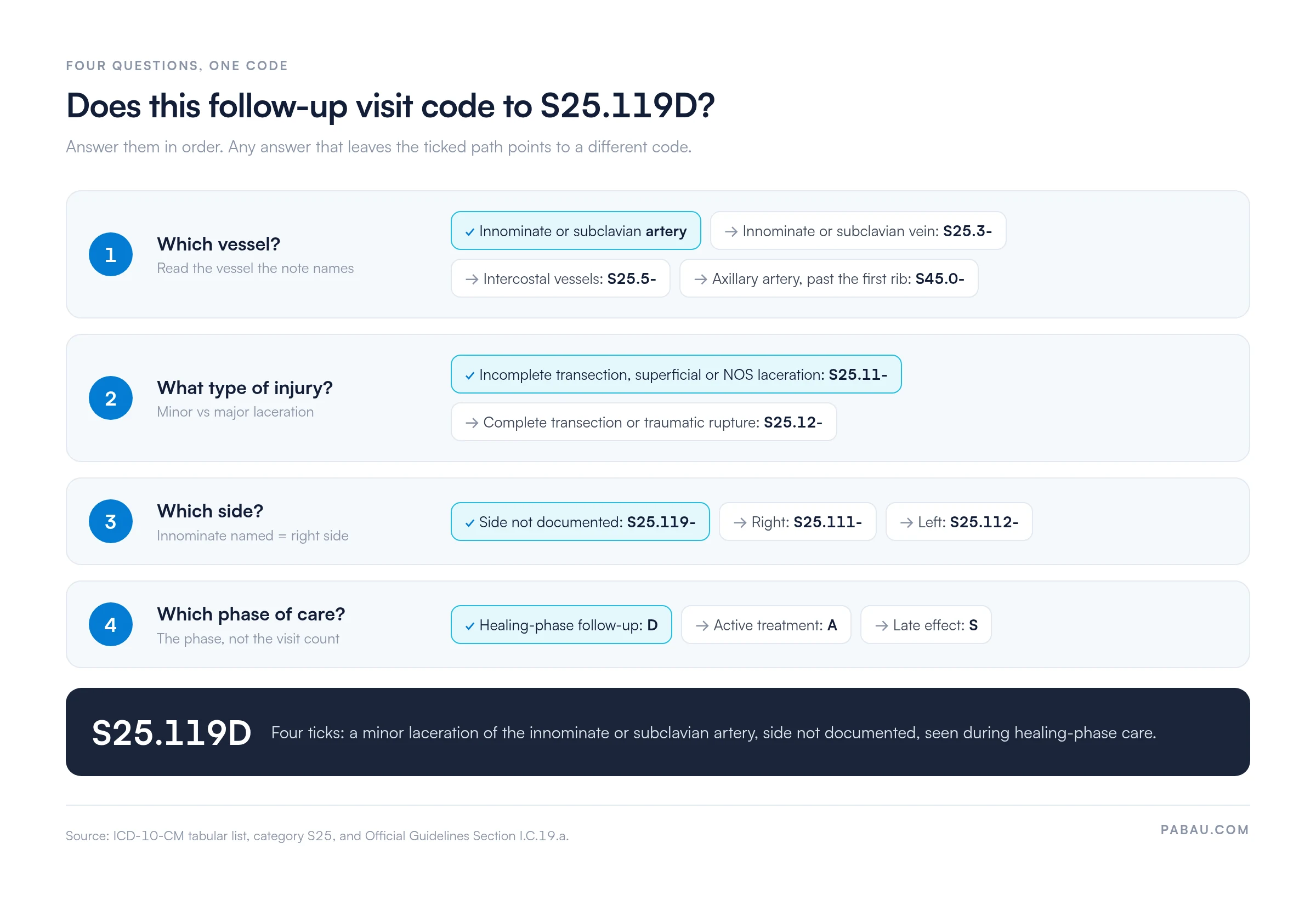
Once you know which detail is missing or different, the table shows the codes coders most often weigh against S25.119D.
The AAPC Codify ICD-10-CM lookup lets coders view the full S25 family side by side. That helps confirm the subcode before submission when the provider note is ambiguous.
The tabular notes that apply to S25.119D sit at the block, category and subcategory levels. Read all three before assigning the code.
An Excludes2 note means the condition is not part of S25.119D, but both codes can be reported when both are present. A clavicle fracture and a subclavian artery laceration can therefore share a claim.
Not this code: These neighboring injuries have their own codes and never belong under S25.119D.
When a traumatic hemothorax is still being followed, report S27.1XXD as an additional code. Sequence by the reason for the encounter, per Official Guidelines Section II (inpatient) or Section IV (outpatient).
The note must support five elements before S25.119D can be assigned. Missing any one of them leaves the claim open to a records request or an audit finding.
A structured superbill documentation workflow helps practices capture these elements at the point of care, instead of chasing addenda later. Official Guidelines Section I.C.19 and Section IV then govern how the diagnosis is sequenced on professional claims.
For electronic claims, a clean claim submission process that checks the 7th character against the documented encounter type catches the most avoidable error before transmission.
Here’s how one follow-up claim moves from the note to the remittance. Picture a patient seen six weeks after repair of a minor subclavian artery laceration from a knife assault. The surgical global period has ended, and the visit is a routine recovery check.
Most of the work happens in the first two steps. Once the note and the codes agree, the rest of the claim tends to move without friction.
The follow-up visit itself rarely needs prior authorization, but the procedure billed with S25.119D may. Follow-up CT angiography and other advanced imaging often carry payer authorization rules that apply independently of the diagnosis code.
Medicare and commercial payers accept S25.119D as a principal or additional diagnosis when the documentation supports it. Complication or comorbidity (CC/MCC) status can change with each fiscal year’s MS-DRG definitions. Check the CMS MS-DRG Definitions Manual for the discharge year before quoting any DRG impact.
Coverage problems are cheaper to catch before the visit than at adjudication. A real-time eligibility check confirms the plan is active on the date of service, which removes one avoidable reason for a denied follow-up claim.
NCCI (National Correct Coding Initiative) edits apply to procedure code pairs, not to diagnosis codes. Any bundling conflict on an S25.119D claim comes from the CPT codes billed alongside it. Solid medical billing compliance means checking the current NCCI tables for every CPT pair during pre-submission scrubbing.
A 7th character that doesn’t match the phase of care is a frequent error on injury codes like S25.119D. The other triggers are just as predictable, and each one has a pre-submission check.
A structured denial management workflow tracks CARC reason codes by ICD-10 code. It shows whether S25.119D denials cluster around the 7th character, the side, or the vessel, so staff training can target the right error.
Check the vessel and the side before you check the 7th character. A note naming the brachiocephalic artery points to the right side, and a note naming the axillary artery moves the claim out of S25 altogether. Catching both at code assignment stops the most avoidable S25.119D rejections.
Chapter 20 external cause codes (V00-Y99) describe how the injury happened. Official Guidelines Section I.C.20 sets no national requirement to report them. Report them when a state mandate or the payer requires it, and many practices report them anyway.
The external cause code takes the same 7th character as the injury code, so D on a subsequent encounter. Common mechanisms for this injury include transport accidents (V00-V99), falls (W00-W19), and assault by a sharp object (X99).
Place of occurrence (Y92), activity (Y93) and external cause status (Y99) codes are reported only once, at the initial encounter. Leave them off an S25.119D claim. If your team is newer to injury claims, our overview of medical billing basics shows how diagnosis and service codes work together.
S25.119D is a diagnosis code, so every claim also needs a CPT code for the service performed. At a subsequent encounter, those services are usually follow-up visits and imaging of the repaired or healing artery.
The CPT code always follows the documented service, and each one needs its own supporting documentation. None of these pairings is automatic.
Practices billing thoracic trauma across several payers benefit from claims management software that keeps codes, claims and remittances in one place. Reviewing electronic remittance advice (ERA) data by CPT and ICD-10 pair shows which combinations generate denials.
Every row in the denial table above maps to a check you can run before the claim leaves the practice. Work down this list in order.
S25.119D errors usually start at the point of coding, with the wrong side, vessel or encounter phase. When staff retype the diagnosis from the note into a separate billing tool, those slips travel straight to the payer.
Pabau, the practice management platform we build, pre-fills the CMS-1500 from the patient record. Coders search the full ICD-10-CM library inside the claim, so S25.111D, S25.112D and S25.119D sit side by side before one is chosen.
Required claim fields are checked before the claim can be sent. For US practices, the Claim.MD integration adds real-time eligibility checks, claim status tracking and ERA posting, so a rejected follow-up claim surfaces quickly.
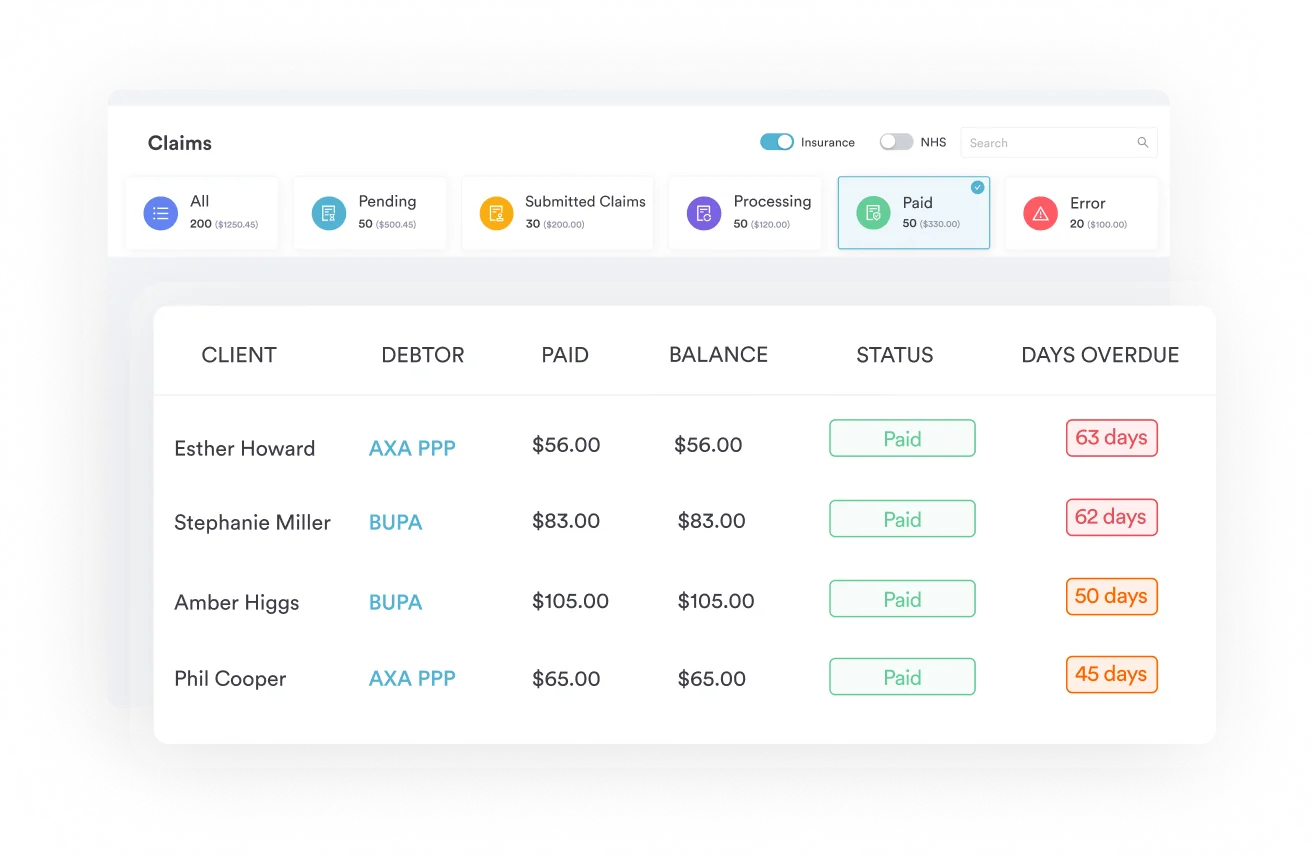

Pabau pre-fills claims from the patient record and sends them through Claim.MD with eligibility checks and ERA posting, so follow-up injury claims go out complete.

S25.119D is a narrow code, and that narrowness is useful. It fits only when four facts line up. The laceration is minor, the vessel is the innominate or subclavian artery, the visit is healing-phase care, and the note names no side.
Of those four facts, the side is the one worth chasing. A quick laterality query before submission turns many of these claims into S25.111D or S25.112D, and payers have one less reason to request records. Keep S25.119D for the visits where nobody can confirm the side.
If your practice bills follow-up care for thoracic trauma, book a demo to see how Pabau keeps injury claims complete from record to remittance.

Need to understand denial reason codes on rejected claims? Denial codes in medical billing explains CARC and RARC codes and how to action each denial type.
Want to verify eligibility before the encounter? Insurance eligibility verification covers how to confirm patient coverage before a subsequent-encounter visit.
Looking for an overview of the clearinghouse submission process? Medical claims clearinghouse guide explains how 837P files move from practice to payer and where errors get caught.
Filling in claims by hand? CMS-1500 form template gives you the professional claim form that carries S25.119D in item 21.
Need a claim form patients can complete? Medical insurance claim form template is a downloadable form for collecting claim details.
It’s the billable code for a minor laceration of the innominate or subclavian artery, with no side documented, at a subsequent encounter. Use it once active treatment has ended.
Yes, when the record doesn’t support a side. The Official Guidelines allow unspecified codes when that detail isn’t available at the encounter. Payers may still request records, so query the provider first.
No. The phase of care sets the 7th character, not the provider. A physical therapist or primary care physician seeing the patient during recovery also reports D.
No fixed limit exists. D applies for as long as the patient receives routine healing-phase care. Once care targets a lasting complication, switch to S25.119S plus a code for that residual condition.
Yes. The diagnosis code doesn’t change with the visit format. Telehealth details go on the service line instead, such as place of service 02 or 10 and any modifier the payer requires.
Major lacerations sit in subcategory S25.12-. At a subsequent encounter with no side documented, that’s S25.129D. A complete transection or traumatic rupture always belongs there.