ICD-10 Code Z86.73: Personal history of TIA
ICD-10 Code Z86.73: Definition, descriptor, and code hierarchy ICD-10 Code Z86.7...

Last Updated: Nov 20, 2026
Billable Code Specific Code
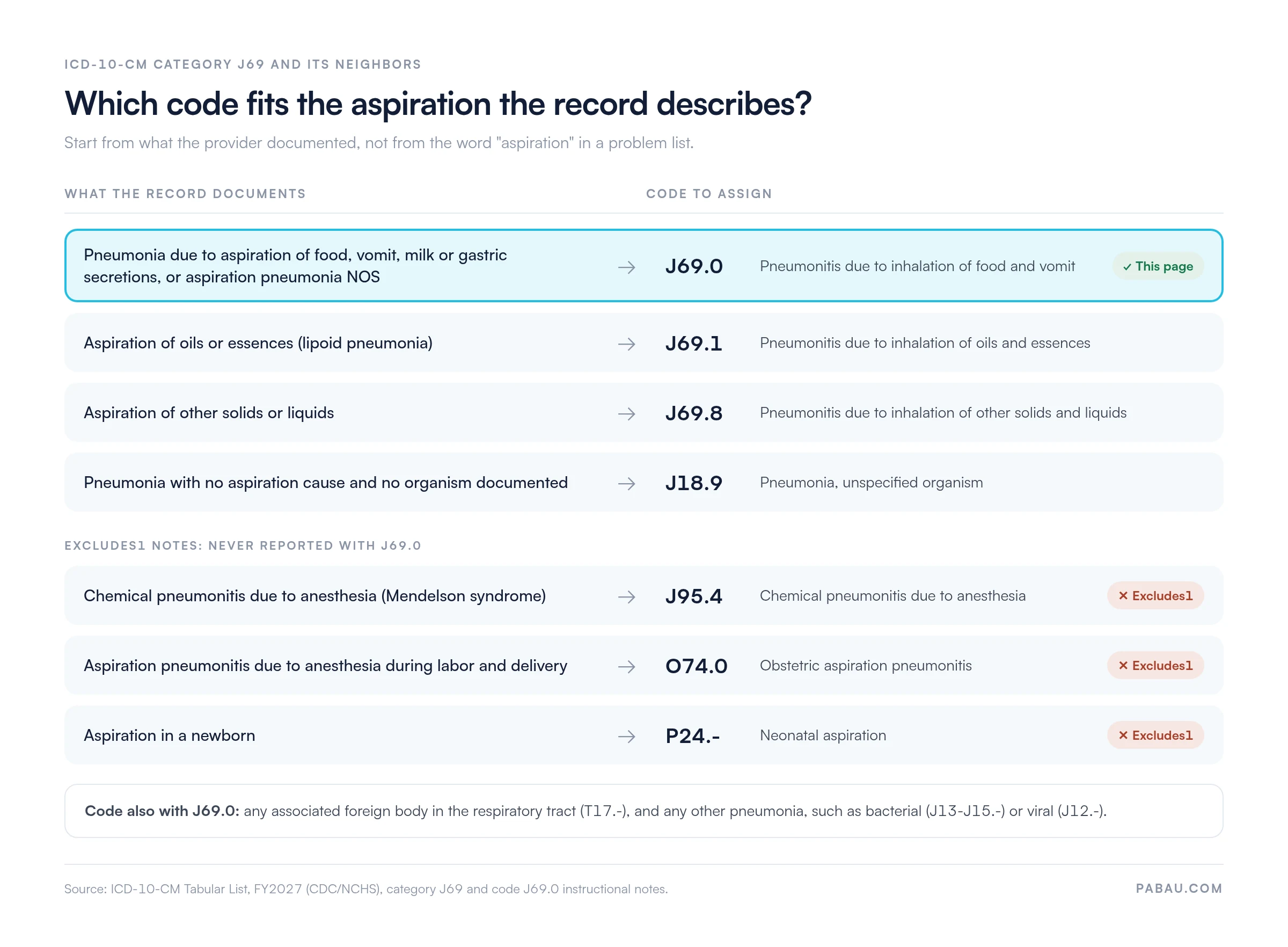
J69.0 is the billable ICD-10-CM code for pneumonitis due to inhalation of food and vomit. It covers aspiration pneumonia NOS and pneumonia from aspirated food, vomit, milk or gastric secretions.
J69.0 sits in category J69 (Pneumonitis due to solids and liquids), within the J60-J70 block for lung diseases due to external agents. Claims are denied when documentation does not link the pneumonia to aspiration. Don't confuse it with J95.4 (Mendelson syndrome), an Excludes1 code, or with J18.9 (unspecified pneumonia).
Let Pabau's smart automation suggest the right codes, reduce claim denials, and keep your practice compliant—effortlessly.
Automate repetitive tasks and focus on what matters most—your patients.
Reduce coding errors and ensure compliance with the latest regulations.
Clean claims, fewer denials, and faster reimbursements.
Powerful insights and reporting to help your practice thrive.
HIPAA compliant SOC 2 certified GDPR-compliant Trusted by 4,000+ clinics worldwide

ICD-10 code J69.0 covers pneumonia from aspirated food, vomit, milk or gastric secretions, and aspiration pneumonia NOS.
Chemical pneumonitis due to anesthesia is J95.4, an Excludes1 code, so it never goes on the same claim as J69.0.
The provider must link the pneumonia to aspiration, and coders can query for that link but can’t infer it from imaging.
As the principal inpatient diagnosis, J69.0 groups to MS-DRG 177, 178 or 179, depending on the secondary CCs and MCCs coded.
Pabau’s claims management submits claims through Claim.MD, with eligibility checks and ERA remittance matching.
ICD-10 code J69.0 is the billable ICD-10-CM code for pneumonitis due to inhalation of food and vomit. Coders reach for it when a provider documents aspiration pneumonia.
The code sits in category J69 of the CDC’s FY2027 ICD-10-CM browser, inside the J60-J70 block for lung diseases due to external agents. It has been valid for HIPAA-covered transactions since ICD-10-CM took effect on October 1, 2015.
The code turns on one question. Did the provider tie the pneumonia to aspirated food, vomit, milk or gastric secretions? If yes, J69.0 fits. If the record only says pneumonia, it doesn’t.
The tabular list names what belongs under J69.0. Each item below is an inclusion term, so documentation naming any of them supports the code.
Aspiration pneumonia NOS also lands here, so a note that says “aspiration pneumonia” with no substance still codes to J69.0. Other aspirated solids and liquids go to J69.8, and oils and essences go to J69.1. If an object was inhaled, J69.0 carries a “code also” note for the foreign body in the respiratory tract (T17.-).
An Excludes1 note is a hard stop: the two codes can’t be reported together. J69.0 picks up Excludes1 notes at two levels, and each one points to a different setting.
J18 pneumonia codes aren’t on that list. J18 is “Pneumonia, unspecified organism”, and it’s a separate choice rather than an excluded one.
Gastric contents can reach the lungs in a stroke unit or on an operating table. The tabular sends the first to J69.0 and the second to J95.4. Don’t confuse either with J68.0, which covers bronchitis and pneumonitis from inhaled chemicals, gases, fumes and vapors.
Most confusion sits between J69.0 and the J18 codes. The deciding fact is whether the provider documented aspiration as the cause. When the note says pneumonia with no cause and no organism, the code is J18.9, and a query can settle the doubt.
Put the setting and the substance side by side and the choice gets quicker, as the decision table below shows.
A J69.0 claim stands or falls on the provider’s words. “Aspiration risk” is a risk, not a diagnosis, and it never supports the code on its own. Check the record against the current fiscal year’s ICD-10-CM Official Guidelines and these four elements.
Uncertain wording works differently by setting. On an inpatient claim, “probable” or “suspected” aspiration pneumonia at discharge is coded as if confirmed.
Outpatient and emergency claims can’t code an uncertain diagnosis, so they report the symptoms instead. Coders may query to clarify, but they can’t infer aspiration from a chest X-ray.
Query the provider when the note mentions aspiration around an anesthetic, a delivery or an oily substance. The answer decides between J69.0, J95.4, O74.0 and J69.1, and two of those can’t share a claim with J69.0.
J69.0 can be the principal diagnosis when aspiration pneumonia is the condition chiefly responsible for the admission, per the UHDDS definition. J69.0 carries no “code first” note, so standard principal diagnosis rules apply.
Three scenarios come up most:
Code the neurological driver too, such as G20 for Parkinson’s disease or an F03 code for dementia. The CMS ICD-10 code files list every valid code for the current year, so check new or revised codes there.
On a hospital inpatient claim, J69.0 as principal diagnosis groups to the Respiratory infections and inflammations family. That holds under the current CMS MS-DRG version (FY2027, v44). The secondary diagnoses decide the tier.
DRG 177 carries a higher relative weight than DRG 179, so an uncoded MCC costs the hospital money. Check each secondary diagnosis against the current CMS CC and MCC lists, and confirm weights in the FY2027 tables.
Respiratory failure is a frequent secondary diagnosis to check after aspiration. Documented without an acuity or type, it takes respiratory failure code J96.90, so query for more detail first.
Physician practices see a different claim. A pulmonologist or hospitalist reports J69.0 on a professional claim to support the visit codes, and no DRG applies there.
No national or single LCD applies to J69.0, and payer policies and MAC guidance vary. Inpatient aspiration pneumonia is paid by DRG, so medical necessity reviews focus on the admission itself. Build those checks into your medical billing compliance routine rather than chasing them after an audit letter.
Reviewers of an inpatient stay usually look for the same evidence:
Every J69.0 claim passes through the same five hands, and each one can stall it. Seeing the whole path helps your team spot where a medical billing problem starts.
A clean claim on the first pass beats any appeal. Run these checks before the claim leaves your system:
J69.0 claims fail for predictable reasons. The remittance names each one with a reason code, which our guide to medical billing denial codes decodes.
Track which of these hits you most often. A steady denial management process turns that pattern into a fix upstream, usually at the documentation step.
Code references explain what J69.0 means. The work that follows happens in your billing system, where claims are built, sent and reconciled.
Pabau, the practice management platform we build, includes claims management software for US practices. Claims go out through Claim.MD to thousands of US payers, with eligibility checks before the visit. ERA remittance matching then puts each payment or denial reason beside the claim it belongs to.
The result is a shorter loop between a denial and its fix. If you’re weighing clearinghouse options, our guide to the Claim.MD clearinghouse explains how the connection works.

Pabau submits claims through Claim.MD, checks eligibility before the visit and matches ERA remittances to each claim. Book a demo to see the workflow for your practice.

J69.0 rewards one habit: read the setting before you read the diagnosis. Aspiration in a stroke unit, an operating room and a delivery room lands on three different codes.
Fix the note first, and the claim usually fixes itself. A provider who names aspiration as the cause saves you the query, the denial and the appeal.
Book a demo to see how Pabau sends your claims through Claim.MD and brings every remittance back to the right claim.

Need to understand how clearinghouses process respiratory claims? Medical claims clearinghouse guide explains how claim scrubbing and payer routing work before a claim reaches adjudication.
Want to reduce upstream denials with better eligibility checks? Insurance eligibility verification covers how real-time payer checks prevent avoidable claim failures.
Looking for the revenue cycle context behind aspiration pneumonia billing? Revenue cycle management overview maps the full claim lifecycle from encounter to payment posting.
Coding COPD alongside aspiration pneumonia? ICD-10 code J44.9 covers COPD when no infection or exacerbation is documented.
Comparing billing platforms for a US practice? Best medical billing software in the US weighs the options for claims, eligibility and remittances.
J69.0 is on the CMS MCC list. Reported as a secondary diagnosis, it can move a case into a with-MCC MS-DRG, unless a CC exclusion applies to the principal diagnosis.
It was 507.0, pneumonitis due to inhalation of food or vomitus. J69.0 replaced it when ICD-10-CM took effect on October 1, 2015.
It can add one. The J69 code also note tells you to report another pneumonia the provider documents, such as bacterial (J13-J15) or viral (J12). J69.0 stays on the claim.
No. Both go to J69.0 when food, vomit, milk or gastric secretions caused them. Pneumonitis from anesthesia is the exception, coded J95.4, or O74.0 during labor and delivery.
Yes, on inpatient claims. Report Y if the aspiration pneumonia was present when the admission order was written, or N if it developed during the stay.
Yes, once the provider confirms aspiration pneumonia. Outpatient and ED coders can’t code possible aspiration, though, so they report the symptoms until the diagnosis is confirmed.