ICD-10 code I21.4: Non-ST elevation myocardial infarction
ICD-10 code I21.4: Official descriptor and code details ICD-10 code I21.4 is a v...

Last Updated: Nov 10, 2026
Billable Code Specific Code
J18.9 is the billable ICD-10-CM code for pneumonia, unspecified organism. Coders assign it when a provider documents pneumonia but the record names no pathogen and no more specific type, such as lobar pneumonia.
The code sits in the J09–J18 Influenza and pneumonia block of Chapter 10, Diseases of the respiratory system. A named organism, confirmed COVID-19 or ventilator-associated pneumonia moves the claim to a different code.
Let Pabau's smart automation suggest the right codes, reduce claim denials, and keep your practice compliant—effortlessly.
Automate repetitive tasks and focus on what matters most—your patients.
Reduce coding errors and ensure compliance with the latest regulations.
Clean claims, fewer denials, and faster reimbursements.
Powerful insights and reporting to help your practice thrive.
HIPAA compliant SOC 2 certified GDPR-compliant Trusted by 4,000+ clinics worldwide

J18.9 applies only when no causative organism is identified or documented. A known pathogen requires a more specific code.
Aspiration pneumonia (J69.-) is an Excludes2 at J18, so it may be coded alongside J18.9.
Influenza goes first under the J18 “Code first” note, ahead of the pneumonia code.
In inpatient settings, probable pneumonia at discharge may be coded J18.9. Outpatient settings require a confirmed diagnosis or symptom codes instead.
Pabau, our practice management and billing platform, sends ICD-10-CM coded claims to payers through its Claim.MD clearinghouse integration.
ICD-10 Code J18.9 is the billable ICD-10-CM code for pneumonia when the provider names no causative organism and no more specific type.
It needs no further subdivision and is valid this fiscal year in the code set from CMS and NCHS. The table below gathers the reference data coders check before submitting a claim.
J18.9 applies when the physician documents pneumonia but no causative organism appears in the record. This covers two clinical scenarios: pneumonia NOS (not otherwise specified), and pneumonia where culture results are pending or were never obtained. Bronchopneumonia NOS is not one of them, because it has its own code, J18.0.
The code is appropriate when no additional workup identified the pathogen before the claim was submitted.
Community-acquired pneumonia (CAP) is where coders meet J18.9 most often. Patients typically present with fever, cough, dyspnea, and chest imaging consistent with pneumonia.
Sputum cultures, though, either return negative, are never ordered, or come back after the visit. J18.9 is the correct code in all these situations, as long as no Excludes1 condition is documented and no more specific pneumonia code applies.
The Excludes1 and Excludes2 notes for J18.9 sit at category J18 in the ICD-10-CM tabular list, and they apply to every code under it.
An Excludes1 note marks a condition that is never coded alongside J18.9. An Excludes2 note marks a condition that is not part of J18, but that may be coded together with J18.9 when the patient has both.
Two instructional notes at J18 matter just as much. “Code first, if applicable” covers associated influenza (J09.X1, J10.0-, J11.0-), so the influenza code goes ahead of the pneumonia code. “Code also, if applicable” covers any associated condition such as aspiration pneumonia (J69.-), so both codes can appear on the claim.
COVID-19 pneumonia and ventilator-associated pneumonia are not in these notes, but the Official Guidelines still keep J18.9 off the claim. Confirmed COVID-19 pneumonia is coded U07.1 first, then J12.82 for pneumonia due to coronavirus disease 2019. Ventilator-associated pneumonia takes J95.851, and guideline I.C.10.d.1 says not to add a code from J12-J18 for it.
The most frequent pneumonia coding error is using J18.9 when organism-specific documentation exists in the record. A sputum culture that grows Streptococcus pneumoniae, for example, moves the claim to J13. The table below maps the most commonly confused codes to the documentation that calls for each one.
The ICD-10-CM Official Guidelines require coding at the highest level of specificity supported by documentation. J18.9 is appropriate only when you work through the following decision logic and no more specific code applies. Run through the steps in order. The chart after them puts the whole path on one screen.
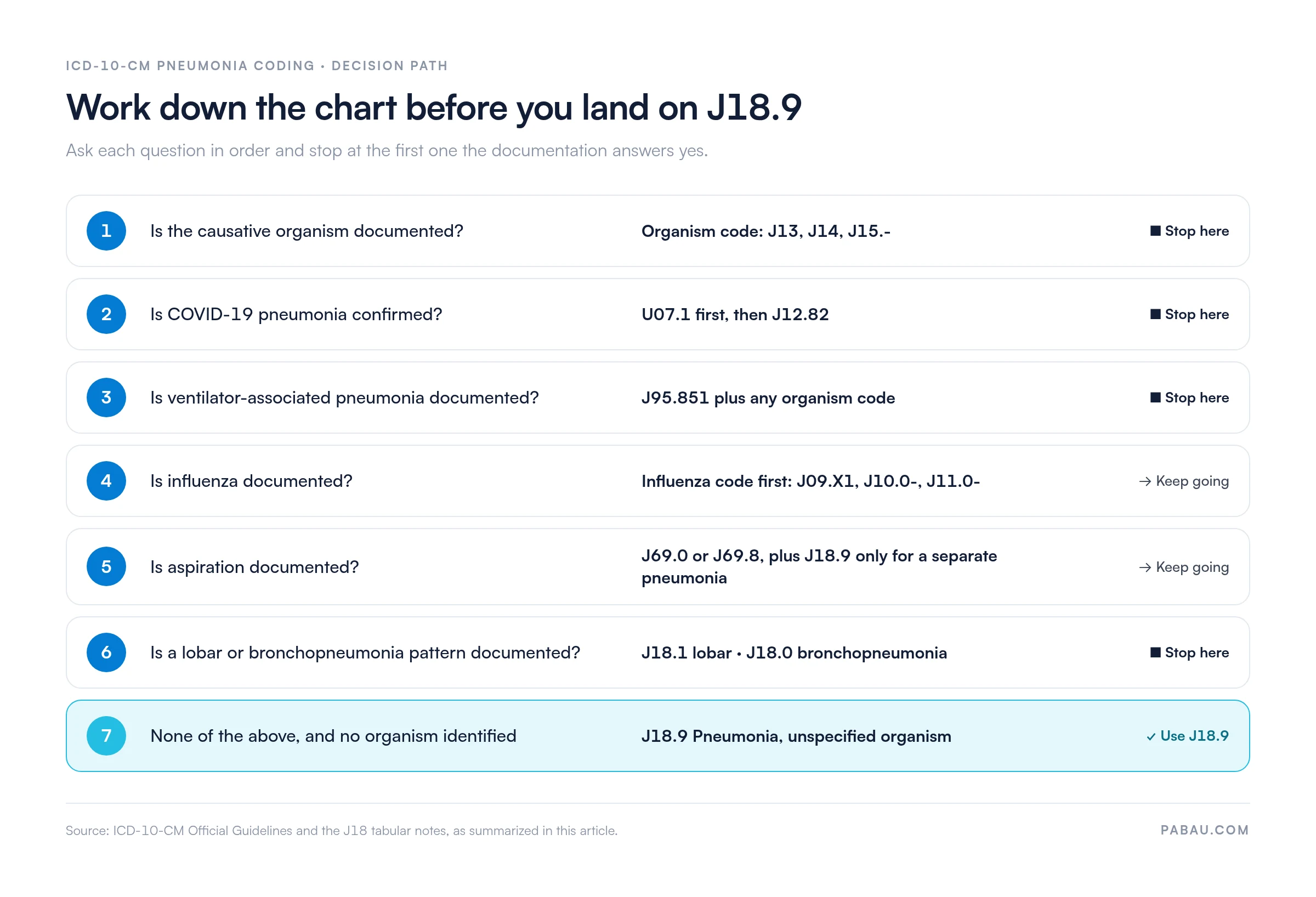
Before defaulting to J18.9, clinical documentation improvement (CDI) teams should consider querying the physician. If culture results are pending at discharge in an inpatient setting, the query may allow documentation of a probable organism, enabling a more specific code. Per guidance from the AAPC’s ICD-10-CM code reference, the highest specificity supported by documentation is always required.
Run a CDI query before closing an inpatient chart coded J18.9 if a sputum or blood culture is still pending. If the culture comes back positive after discharge, a late query or amended documentation can allow recoding to a more specific pathogen code. That may change the DRG tier and improve reimbursement.
ICD-10 Code J18.9 is not automatically valid because a physician writes “pneumonia” in a note. The physician record must contain specific clinical elements that substantiate the diagnosis. When one of these elements is missing from the chart, payers often query or deny the claim. The risk is highest for Medicare Part A inpatient admissions, where medical billing compliance audits are most rigorous.
Per the ICD-10-CM Official Guidelines for Coding and Reporting, inpatient coders may code conditions documented as “probable,” “suspected,” or “likely” at discharge. This exception does not extend to outpatient settings. See the outpatient vs. inpatient section below for the full distinction.
When J18.9 is the principal diagnosis on an inpatient claim, it maps to the MS-DRG 193/194/195 family. The tier depends on whether secondary codes capture a complication and comorbidity (CC) or a major complication and comorbidity (MCC). The DRG tier directly affects Medicare inpatient reimbursement.
CDI specialists should review secondary diagnosis documentation carefully. Acute respiratory failure (J96.0-) and sepsis qualify as MCCs when properly documented and sequenced. Chronic respiratory failure (J96.1-) is a CC, and hypoxia (R09.02) is neither a CC nor an MCC.
Capturing one additional MCC secondary code can shift a claim from DRG 195 to DRG 193, a significant reimbursement difference in acute care. Verify DRG relative weights against the current fiscal year IPPS Final Rule in the Federal Register, because national payment weights update annually.
J18.9 follows different uncertain-diagnosis rules in inpatient and outpatient settings. The rule comes from the ICD-10-CM Official Guidelines for Coding and Reporting, Sections II, III and IV. It draws a hard line between the two settings.
This distinction matters most when ED notes contain language like “rule out pneumonia” or “consistent with pneumonia.” Neither phrase confirms the diagnosis, so the outpatient coder reports the presenting symptoms. A confirmed diagnosis does not need a positive culture. “Probable pneumonia,” though, supports J18.9 only in an inpatient discharge summary.
J18.9 itself does not trigger a prior authorization requirement. The authorization requirement in pneumonia cases attaches to the inpatient admission, not to the specific diagnosis code. That distinction matters for how practices approach revenue cycle management for respiratory admissions.
Submitting J18.9 without adequate medical necessity documentation is a denial risk across all payer types. For clean claim submission, check the physician note against the documentation requirements above before releasing the claim.
J18.9 is the principal diagnosis in most pneumonia admissions. Secondary codes still matter, because they capture the full clinical picture and keep the DRG tier accurate. Sequencing rules govern which code is the principal diagnosis versus which is secondary, and the distinction affects DRG assignment significantly. Thorough secondary-code capture supports accurate medical billing workflows from the outset of the encounter.
Sometimes pneumonia is a complication of another condition rather than the reason for admission. Then it moves to a secondary position, and the other condition becomes the principal diagnosis. This reverses the DRG grouping entirely. CDI teams should identify the reason for admission to establish correct sequencing before the chart is closed.
J18.9 claims are denied for a predictable set of reasons. Most denials trace back to one of two errors. Either a more specific code was available, or the note lacks the evidence the payer needs.
The table below maps the most frequent denial patterns to their root causes and denial management strategies. For a full list of standardized CARC denial codes applied by payers, see the reference on medical billing denial codes.
Before releasing any pneumonia inpatient claim coded J18.9, check the lab section for culture results returned after admission but before discharge. A positive blood culture naming the organism may have come back during the stay without the coder being alerted. Recoding at that point, before submission, avoids a denial and potential audit flag for specificity failure.
Accurate ICD-10-CM coding is only part of the revenue cycle picture. The claim must also be formatted, validated and submitted correctly to reach the payer.
A clean J18.9 claim puts the principal diagnosis code in the correct claim field and sequences every secondary diagnosis code appropriately. The place of service code must match the setting (inpatient vs. outpatient).
Medical necessity documentation goes in supporting attachments when the payer requires it. For a step-by-step overview of clean claim submission requirements across payer types, see the linked reference.
J18.9 denials usually start before the claim leaves the practice. A culture result lands after coding, an influenza code ends up second, or “rule out pneumonia” in an ED note gets coded as a diagnosis. Catching those by hand means re-reading every pneumonia chart before release.
Pabau’s claims management software keeps the diagnosis codes, the clinical note and the claim in one patient record. Your coder checks the labs, the setting and the sequencing against the note in one place, so a specificity error gets fixed before submission.
Claims then go to payers as CMS-1500 or 837P claims through Pabau’s Claim.MD clearinghouse integration, with an eligibility check before submission. Electronic remittance advice (ERA) comes back into Pabau, so a denied pneumonia claim shows up against the visit it belongs to.

Pabau integrates with the Claim.MD clearinghouse to validate and submit ICD-10-CM coded claims electronically. See how accurate claim routing reduces denials for respiratory admissions.

J18.9 holds up at audit when it is the last code left standing. Reach for it only after the chart rules out an organism, a pattern, COVID-19 and ventilator-associated pneumonia, with any influenza code sequenced first.
The trade-off is time. A physician query on a pending culture can hold a chart open for a day or two. That delay is often cheaper than a specificity denial, or an inpatient claim grouped to DRG 195 when the record supported DRG 193.
Run that check before release, while fixing a code costs a query instead of an appeal. Book a demo to see how Pabau keeps pneumonia coding, documentation and claim submission in one workflow.

Coding a suspected pneumonia in the ED? ICD-10 code J22 covers acute lower respiratory infection when pneumonia is not confirmed.
Getting repeat denials on inpatient respiratory claims? Denial management in healthcare outlines the workflow steps that reduce CARC-coded denials across payer types.
Want to understand the full claim lifecycle for a J18.9 encounter? Medical billing workflows covers the end-to-end process from encounter to payment posting.
Culture came back positive for pneumococcus? ICD-10 code J13 covers pneumonia due to Streptococcus pneumoniae, the organism-specific code that replaces J18.9.
Ready to release the claim? Clean claim submission walks through the fields and checks payers expect before they accept a claim.
ICD-10 Code J18.9 is the billable ICD-10-CM diagnosis code for pneumonia, unspecified organism. It is used when the physician documents pneumonia but no causative pathogen has been identified or confirmed in the medical record. It sits in the J09-J18 Influenza and pneumonia block of Chapter 10 and covers pneumonia NOS. Bronchopneumonia NOS has its own code, J18.0.
J18.9 fits only when pneumonia is documented with no identified organism, no documented pattern (lobar or bronchopneumonia) and no more specific cause. A named organism points to J13-J16, confirmed COVID-19 pneumonia to U07.1 + J12.82, and ventilator-associated pneumonia to J95.851. Influenza and aspiration work differently. The J18 “Code first” note puts the influenza code ahead of the pneumonia code. Aspiration pneumonia (J69.-) is an Excludes2, so it may be coded alongside J18.9.
Most J18.9 denials come from a short list of errors. An organism named in the chart was coded as J18.9, or influenza was left off or sequenced after the pneumonia code. Confirmed COVID-19 pneumonia was reported without U07.1 and J12.82. Aspiration pneumonia was coded as J18.9 alone, in place of J69.0 or J69.8. J18.9 was added to a ventilator-associated pneumonia (VAP) claim alongside J95.851. Or the physician note lacked the imaging and clinical indicators that support medical necessity.
J18.9 as the principal inpatient diagnosis maps to MS-DRG 193 (simple pneumonia with MCC), DRG 194 (with CC), or DRG 195 (without CC/MCC). Secondary codes that qualify as CCs or MCCs set the tier. Acute respiratory failure (J96.0-) supports DRG 193, and pleural effusion (J90) supports DRG 194. Verify exact DRG relative weights against the current IPPS Final Rule.
Yes, J18.9 is valid for both outpatient and Medicare billing when a confirmed pneumonia diagnosis is documented. In outpatient settings (including the ED), only confirmed diagnoses may be coded as J18.9; “probable” or “suspected” pneumonia requires symptom codes instead. For Medicare Part B outpatient encounters, documentation should support medical necessity for the visit billed, for example clinical indicators and imaging where performed.
J18.9 (Pneumonia, unspecified organism) is used when neither the causative organism nor the pneumonia distribution pattern is specified. J18.1 (Lobar pneumonia, unspecified organism) is used when the physician documents a lobar pattern without naming the pathogen. J18.1 carries greater specificity, so if the physician documents lobar pneumonia, J18.1 is the more accurate choice over J18.9.
The Excludes1 notes at category J18 cover congenital pneumonia (P23.0), drug-induced interstitial lung disorders (J70.2-J70.4) and interstitial pneumonia NOS (J84.9). They also cover neonatal aspiration pneumonia (P24.-), pneumonitis due to fumes and vapors (J68.0) and usual interstitial pneumonia (J84.178). None of these is ever coded with J18.9. Aspiration pneumonia (J69.-), lipid pneumonia (J69.1) and lung abscess with pneumonia (J85.1) are Excludes2. They may be coded alongside J18.9 when both are documented.