ICD-10 Code Z86.73: Personal history of TIA
ICD-10 Code Z86.73: Definition, descriptor, and code hierarchy ICD-10 Code Z86.7...

Last Updated: Nov 20, 2026
Billable Code Specific Code
J96.90 is the billable ICD-10-CM code for respiratory failure, unspecified, unspecified whether with hypoxia or hypercapnia. Use it when the provider documents respiratory failure but names neither the acuity (acute, chronic, or acute and chronic) nor the type (hypoxic or hypercapnic).
If the note states either detail, a more specific J96 code applies. Hypoxic respiratory failure with no stated acuity, for example, is J96.91. As a principal diagnosis on an inpatient claim, J96.90 groups to MS-DRG 189, Pulmonary edema and respiratory failure.
Let Pabau's smart automation suggest the right codes, reduce claim denials, and keep your practice compliant—effortlessly.
Automate repetitive tasks and focus on what matters most—your patients.
Reduce coding errors and ensure compliance with the latest regulations.
Clean claims, fewer denials, and faster reimbursements.
Powerful insights and reporting to help your practice thrive.
HIPAA compliant SOC 2 certified GDPR-compliant Trusted by 4,000+ clinics worldwide

J96.90 is for respiratory failure documented with no acuity and no type, the last J96 code left when the note states neither.
A low SpO2 or an abnormal ABG never supports J96.90 on its own, because a provider has to document respiratory failure.
Hypoxic or hypercapnic respiratory failure with no stated acuity codes to J96.91 or J96.92, not J96.90.
As a principal diagnosis, J96.90 and J96.01 both group to MS-DRG 189, a single DRG with no MCC or CC split.
When pneumonia or a COPD exacerbation arrives with respiratory failure, either may be principal, while sepsis and COVID-19 follow mandatory sequencing rules.
ICD-10 code J96.90 is the billable code for respiratory failure, unspecified, unspecified whether with hypoxia or hypercapnia. CDC’s FY2027 ICD-10-CM Tabular List places it under J96.9, alongside J96.91 and J96.92. You assign it when the provider writes “respiratory failure” and stops there.
Two details are missing in that case. The note doesn’t say whether the failure is acute, chronic, or acute and chronic. It also doesn’t say whether it’s hypoxic or hypercapnic. Once either detail appears, a more specific code takes over.
Category J96 holds 12 billable codes across four subcategories. Each code is the meeting point of an acuity and a type, so the whole family fits on one grid. J96.90 is the corner where both are unstated.
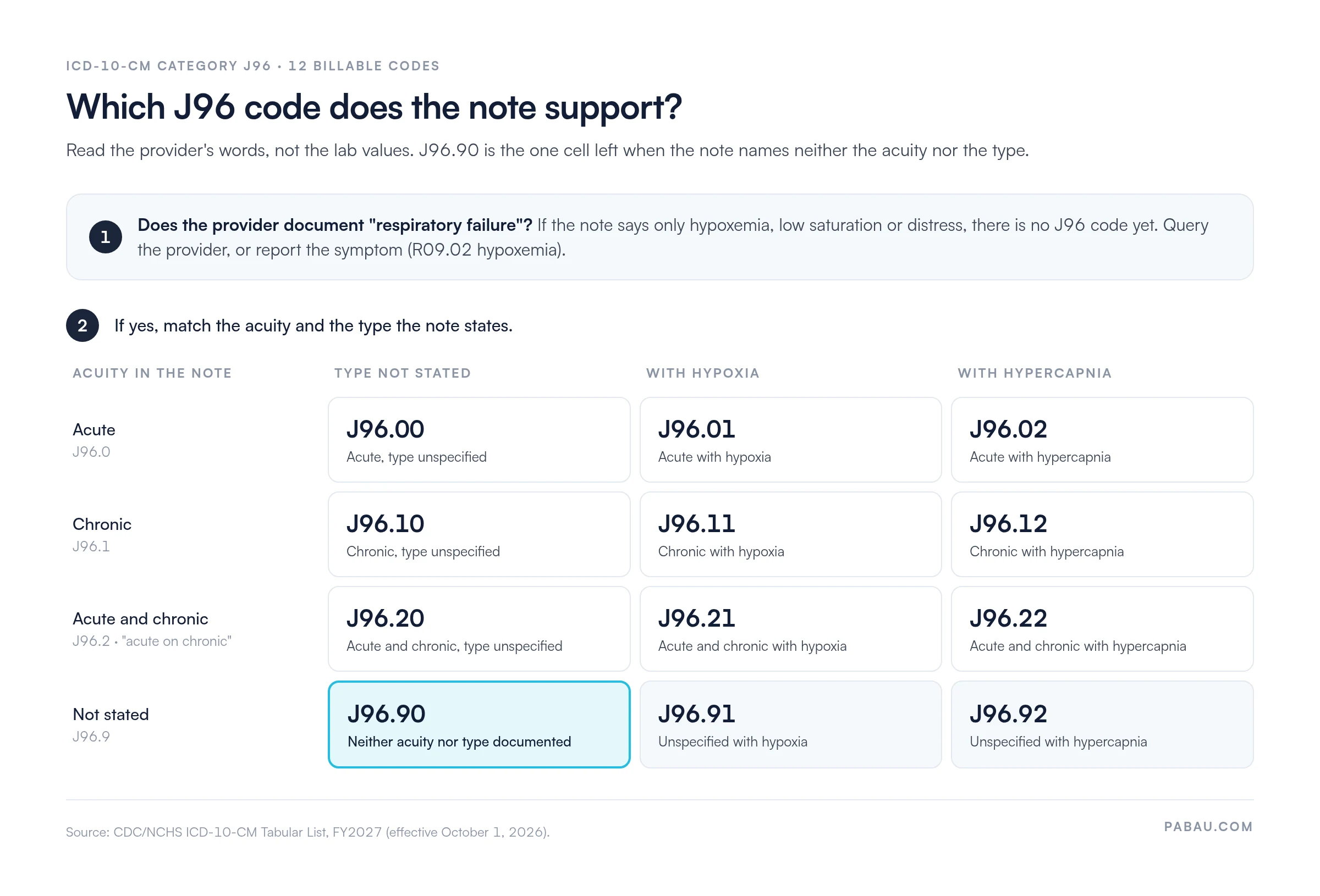
Read the grid from the note outward. Start with the acuity row the provider’s words support, then move across to the type. J96.91 and J96.92 sit right next to J96.90, and they’re the codes a query most often lands on. Neither one needs the provider to name acute or chronic.
These two get swapped more than any other pair in the family. J96.00 needs the word “acute” in the provider’s documentation. J96.90 makes no claim about acuity at all. If the chart reads like an acute episode but the note never says so, query rather than infer. Where the provider confirms acute hypoxic failure, J96.01 is the code.
R09.02 is hypoxemia, a symptom code. When the provider has documented respiratory failure, hypoxemia is part of that diagnosis and isn’t coded separately.
The reverse mistake turns up just as often. A coder sees a saturation of 86% and assigns J96.90 with no provider diagnosis behind it. That claim won’t survive an audit. R09.02 is not a substitute for a physician-documented diagnosis, and neither is J96.90 a substitute for one.
Search the whole record for the phrase ‘respiratory failure’ before you assign J96.90: the H&P, progress notes, consult notes and the discharge summary. If you only find ‘hypoxemia’, ‘low O2 sat’ or ‘increased oxygen requirement’, send a query first. A query takes minutes, and an appeal takes weeks.
Category J96 carries one Excludes1 note, and it covers every J96 code, J96.90 included. An Excludes1 condition is never coded alongside J96.90. If the provider documents one of these, that code is reported in place of the J96 code.
J96 has no “use additional code” note. Good practice still applies, though. Code the condition that caused the failure, such as pneumonia, COPD or heart failure, as its own diagnosis. Chronic pulmonary edema without heart failure, for example, is reported as ICD-10-CM code J81.1.
Here’s the order an experienced inpatient coder works through a record that mentions respiratory failure. It keeps the query decision early, before the claim is built around a vague code.
A record that clears all five steps also meets most clean claim requirements for the diagnosis line. One more point is worth checking against your own rules. Some payers and facility policies want an attending to confirm a resident’s diagnosis. Medicare’s coding rules don’t require it, since any provider caring for the patient can document a codable diagnosis.
This example is illustrative. A patient with COPD on home oxygen is admitted short of breath. The H&P says “respiratory failure, start BiPAP”. The ABG shows acidosis with a raised PaCO2, and the progress notes mention a COPD flare.
As written, the note only supports J96.90. The coder queries, and the provider documents “acute on chronic hypercapnic respiratory failure”. The claim now carries J96.22 with the COPD exacerbation, J44.1, and Z99.81 for the home oxygen. Which of the first two is principal depends on why the patient was admitted, which is the next question.
The principal diagnosis is the condition established after study to be chiefly responsible for the admission. The FY2027 official coding guidelines apply that rule to acute respiratory failure in Chapter 10, section I.C.10.b. J96.90 follows the same general rule from Section II.
Yes, when respiratory failure is the condition chiefly responsible for the admission and the Alphabetic Index and Tabular List support it. In practice, a record built around respiratory failure usually holds clues about its acuity. Query before you finalize a principal J96.90.
Then either one may be principal. The guidelines say the principal diagnosis won’t be the same in every case where respiratory failure arrives with another acute condition. It depends on the circumstances of admission and the focus of treatment.
If both equally caused the admission, the rule for two equally qualifying diagnoses applies. If the record is unclear, query the provider.
As a principal diagnosis, any J96 code groups to MS-DRG 189, Pulmonary edema and respiratory failure. DRG 189 is a single DRG with no MCC or CC tiers, so a more specific code doesn’t change the payment. DRGs 190 to 192 belong to COPD, not respiratory failure.
Check current relative weights in the CMS ICD-10 code files for the fiscal year you’re billing.
So why query at all? The specific code makes the record accurate and supports risk adjustment through HCCs. It also matters when respiratory failure is a secondary diagnosis.
There, the acute codes (J96.0x) and the acute and chronic codes (J96.2x) count as MCCs. Confirming acuity can then change the DRG of the principal condition.
When the patient is ventilated, the inpatient claim needs an ICD-10-PCS code from section 5A as well as the diagnosis. The code depends on how long ventilation lasted, so the times in the record matter as much as the diagnosis.
A missing start or stop time is the usual reason a ventilation claim lands in the wrong DRG. Ask respiratory therapy to chart both times every time, not just the start.
Payers look harder at unspecified codes, and J96.90 is the least specific code in its family. These are the patterns that send claims back, with the fix for each.
When a claim still comes back, the remark codes tell you which of these failed. Our guide to common denial codes explains the CARC and RARC pairs payers use. A structured denial management workflow then tracks each appeal until it’s resolved.
Hospital coders own the inpatient DRG. The pulmonologist or intensivist bills their own professional services with the same diagnosis. Those CMS-1500 claims carry J96.90 or a more specific code, and payers deny them for the same reasons.
Pabau, the practice management and billing platform we build, sends those claims to US payers through Claim.MD. Its claims software for practices runs eligibility checks and submits 837P claims electronically. ERA remittances come back into Pabau, so your team sees how each payer answered.
Claim.MD and each payer still run their own edits, so coding decisions stay with your coders. What changes is the follow-up. A denied respiratory failure claim is easy to find, correct and resubmit, without a separate spreadsheet of open claims.

Pabau checks eligibility, sends claims through Claim.MD and brings ERA remittances back. Your billing team sees which J96 claims need a corrected code or an appeal.

Treat every J96.90 as a question for the provider, not a final answer. Does the chart show a sudden onset, home oxygen or a raised PaCO2? Then a short query usually turns it into a code the record can defend.
The trade-off is a few minutes before billing against weeks of rework after a denial. On a principal diagnosis the DRG won’t move, but the record, the risk score and any appeal file all get stronger.
Book a demo to see how Pabau tracks your practice’s respiratory failure claims from submission to remittance.

Coding the pneumonia behind the failure? ICD-10 code J18.9 covers pneumonia with no organism documented and when to query for one.
Working a newborn record instead? ICD-10 code P28.5 is the respiratory failure code that J96 excludes for newborns.
Checking what the payer paid on a J96 claim? Electronic remittance advice explains how to read the ERA that comes back.
Need to understand how claims flow from diagnosis to payment? Medical billing fundamentals explains the full cycle from code assignment to remittance posting.
Looking at the bigger revenue picture? Revenue cycle management shows where coding accuracy fits between scheduling and collections.
J96.90 means respiratory failure, unspecified, unspecified whether with hypoxia or hypercapnia. The provider documented respiratory failure but not its acuity or its type, so it’s the least specific code in category J96.
Yes. J96.90 is a billable code in the FY2027 ICD-10-CM code set, effective October 1, 2026. Check each new release, which takes effect every October 1.
For acute respiratory failure due to COVID-19, the FY2027 guidelines assign U07.1 with a code from J96.0-. U07.1 goes first when COVID-19 meets the definition of principal diagnosis.
Use the J96.1 code that matches the documented type, such as J96.11 for chronic hypoxic respiratory failure. Add Z99.81, dependence on supplemental oxygen, to show the long-term oxygen use.
The FY2027 guidelines direct a code from subcategory J96.1, chronic respiratory failure, followed by Z99.11, dependence on respirator status. Match the J96.1 code to the type the provider documents.