ICD-10 code E55.9: Vitamin D deficiency, unspecified
ICD-10 code E55.9: Definition and official descriptor ICD-10 code E55.9 is the I...

Last Updated: Nov 10, 2026
Billable Code Specific Code
J44.9 is the billable ICD-10-CM code for chronic obstructive pulmonary disease, unspecified. It covers confirmed COPD when the provider documents no acute lower respiratory infection, no acute exacerbation and no other specified form of the disease.
It is valid in inpatient and outpatient settings. Stable COPD and routine follow-up visits are its typical use, while J44.0, J44.1, J44.81 and J44.89 cover the specific cases.
Let Pabau's smart automation suggest the right codes, reduce claim denials, and keep your practice compliant—effortlessly.
Automate repetitive tasks and focus on what matters most—your patients.
Reduce coding errors and ensure compliance with the latest regulations.
Clean claims, fewer denials, and faster reimbursements.
Powerful insights and reporting to help your practice thrive.
HIPAA compliant SOC 2 certified GDPR-compliant Trusted by 4,000+ clinics worldwide

J44.9 is a billable ICD-10-CM code for confirmed COPD when the note documents no infection, exacerbation or other specified form.
The J44 category holds five billable codes: J44.0, J44.1, J44.81, J44.89 and J44.9.
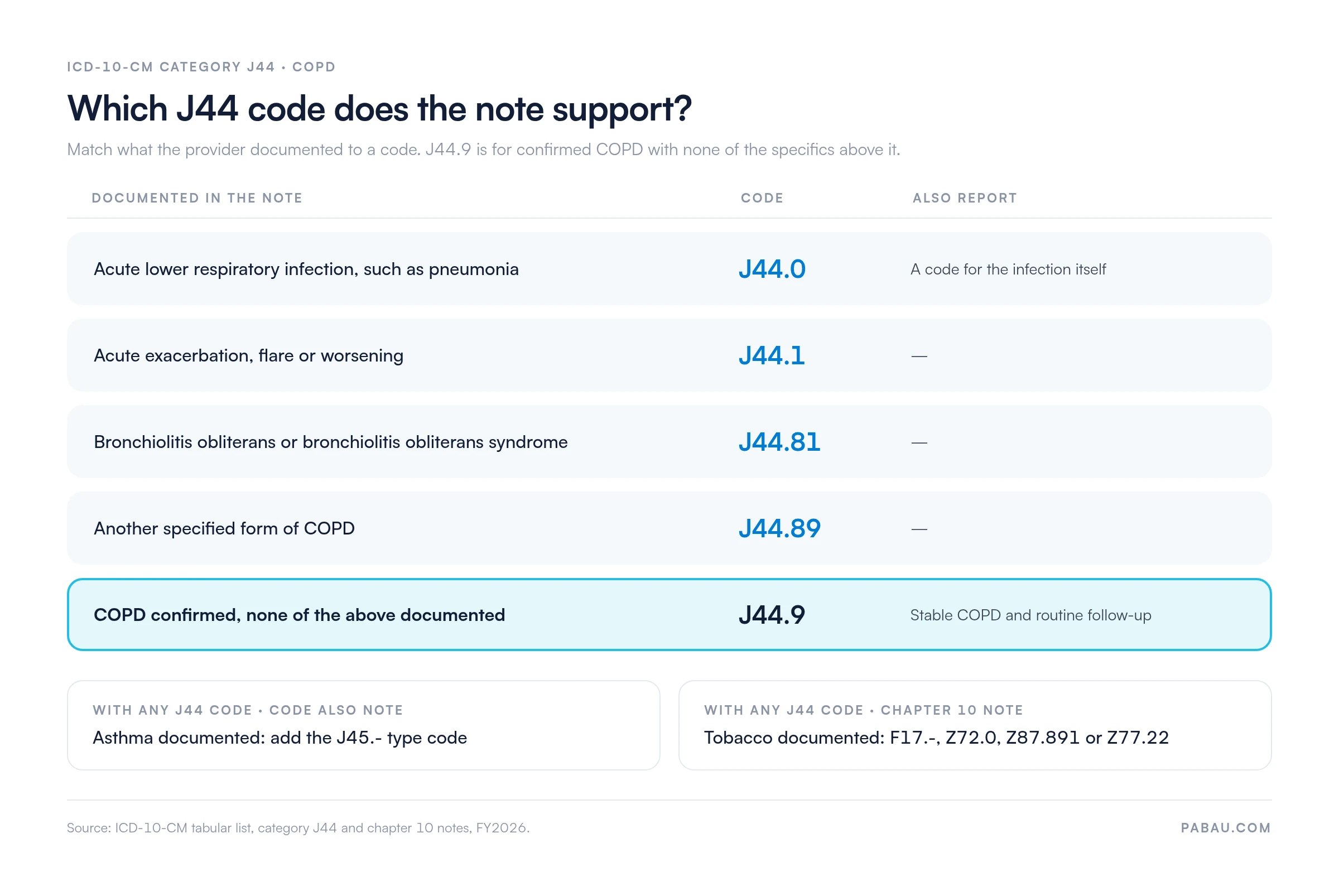
Asthma documented with COPD takes a J44 code plus the J45.- code for the asthma type, per the J44 Code also note.
Report tobacco use, dependence, history or exposure with F17.-, Z72.0, Z87.891 or Z77.22 when the provider documents it.
Pabau, the practice software we build, keeps the COPD visit note and the insurance claim in one patient record, so coders check one place.
ICD-10 code J44.9 is the billable ICD-10-CM code for chronic obstructive pulmonary disease, unspecified. Coders assign it when the provider confirms COPD but documents no acute lower respiratory infection, no acute exacerbation and no other specified form.
The CDC/NCHS ICD-10-CM tabular list places it in Chapter 10, Diseases of the respiratory system (J00-J99), under category J44, Other chronic obstructive pulmonary disease. It has no further subdivision, so it is billable as written. Each of the other four J44 codes needs something more specific in the note.
J44.9 covers confirmed chronic obstructive pulmonary disease where the clinical presentation does not meet the threshold for a more specific J44 subcode. The diagnosis requires spirometric confirmation per GOLD guidelines: A post-bronchodilator FEV1/FVC ratio below 0.70 is the established diagnostic threshold. When the practice runs that test before and after a bronchodilator, it bills CPT 94060.
Clinical presentations appropriately captured by J44.9 include:
J44.9 is not appropriate when documentation supports a more specific subcode. If the encounter involves an acute exacerbation, J44.1 applies. If an acute lower respiratory infection such as pneumonia is present alongside COPD, J44.0 is correct and the infection is coded additionally. Bronchiolitis obliterans takes J44.81, and another specified form of COPD takes J44.89.
The ICD-10-CM tabular list attaches several notes to category J44, and one more applies from the chapter level. Together they decide what J44 absorbs, what can be coded beside it, and which extra codes to add.
The J44 category contains five billable codes: J44.0, J44.1, J44.81, J44.89 and J44.9. Picking the wrong one invites a specificity denial, most often when J44.9 goes out on a note that supports J44.1. The chart matches each documentation pattern to its code, plus the extra codes that can sit beside it.
Before assigning J44.9, audit the note for the words “exacerbation,” “flare,” “worsening,” or “acute.” Any of these in the provider’s assessment strongly suggests J44.1 is the correct code. Query the provider rather than defaulting to unspecified.
Several neighboring codes get assigned in error when J44.9 is correct. The reverse happens too, with J44.9 used where the note supports one of these codes.
A stable patient with COPD and unspecified, uncomplicated asthma, for example, is reported with J44.9 and J45.909. Neither code replaces the other.
Payers reviewing J44.9 claims look for a specific documentation package, and a missing element raises the denial risk. Under the CMS ICD-10-CM coding guidelines, coders assign only what the provider documents. An “unspecified” code still needs the COPD diagnosis stated in the note.
Required documentation elements for J44.9 include:
GOLD grades I through IV are based on FEV1 percentage predicted after bronchodilator administration. Grade I indicates mild obstruction (FEV1 at or above 80% predicted); Grade IV indicates very severe obstruction (FEV1 below 30% predicted). ICD-10-CM does not have separate subcodes for each GOLD grade within the J44 family. All four severity levels map to J44.0, J44.1, J44.81, J44.89 or J44.9. The choice depends on what the note documents, not on the severity grade.
Some Medicare Administrative Contractors and commercial payers still require GOLD staging documentation. They use it to support medical necessity for pulmonary rehabilitation (CPT 94625-94626), home oxygen (Z99.81) or long-term inhaled therapy. Including GOLD grade in the encounter note is a good documentation practice even when it does not change the ICD-10-CM code assigned. Understanding these medical billing fundamentals helps practices build documentation habits that hold up under payer audit.
Medicare is the dominant payer for COPD given the condition’s prevalence in patients aged 65 and older. Medicare Administrative Contractors (MACs) publish Local Coverage Determinations governing pulmonary services billed alongside J44.9. Before submitting a claim, verify that the CPT codes being billed are supported by the contractor’s current LCD for the jurisdiction.
Common CPT codes billed alongside J44.9:
Broader billing compliance requirements for respiratory diagnoses apply on top of the LCD. Meeting them limits audit exposure under Medicare and commercial contracts.
J44.9 claims run into trouble when the code is less specific than the note, or when the record lacks the evidence a payer expects. Each pattern below maps to a corrective action and a claim adjustment reason code (CARC). The full list of medical billing denial codes explains each CARC in more detail.
Practices managing chronic condition panels can also use structured denial management workflows to track J44.9 denials by payer.
Run a quarterly audit of J44.9 claims and compare the smoking status in each note with the codes on the claim. Where the note records tobacco use but the claim carries no tobacco code, fix the visit template before retraining coders. A required smoking-status field puts the answer in every COPD note.
The J44 category gained two codes effective October 1, 2023, the start of FY2024. J44.81 covers bronchiolitis obliterans and bronchiolitis obliterans syndrome, and J44.89 covers other specified COPD. Before then, the category held only J44.0, J44.1 and J44.9. J44.9 itself did not change.
The NCHS updates the ICD-10-CM tabular list effective October 1 each year, with limited updates sometimes issued mid-year. Coders should check any J44 guidance changes against the CMS annual release files at the start of each fiscal year. The AAPC ICD-10-CM code lookup reflects the current year’s tabular structure.
In many practices the COPD note lives in one system and the claim gets built in another. Smoking status, spirometry dates and exacerbation language are copied across by hand. That copy step is where a J44.9 claim drifts away from the note behind it.
Pabau keeps the visit note, intake forms and insurance claim in one patient record. Practices can add a smoking-status question to intake, so the answer is on file before the visit. Its claims management software sends US claims through Claim.MD, with eligibility checked before the encounter.
Remittances post back to the same record, so your team sees which payer denied a J44.9 claim and why. That helps practices track every claim and catch missing documentation before the next submission.
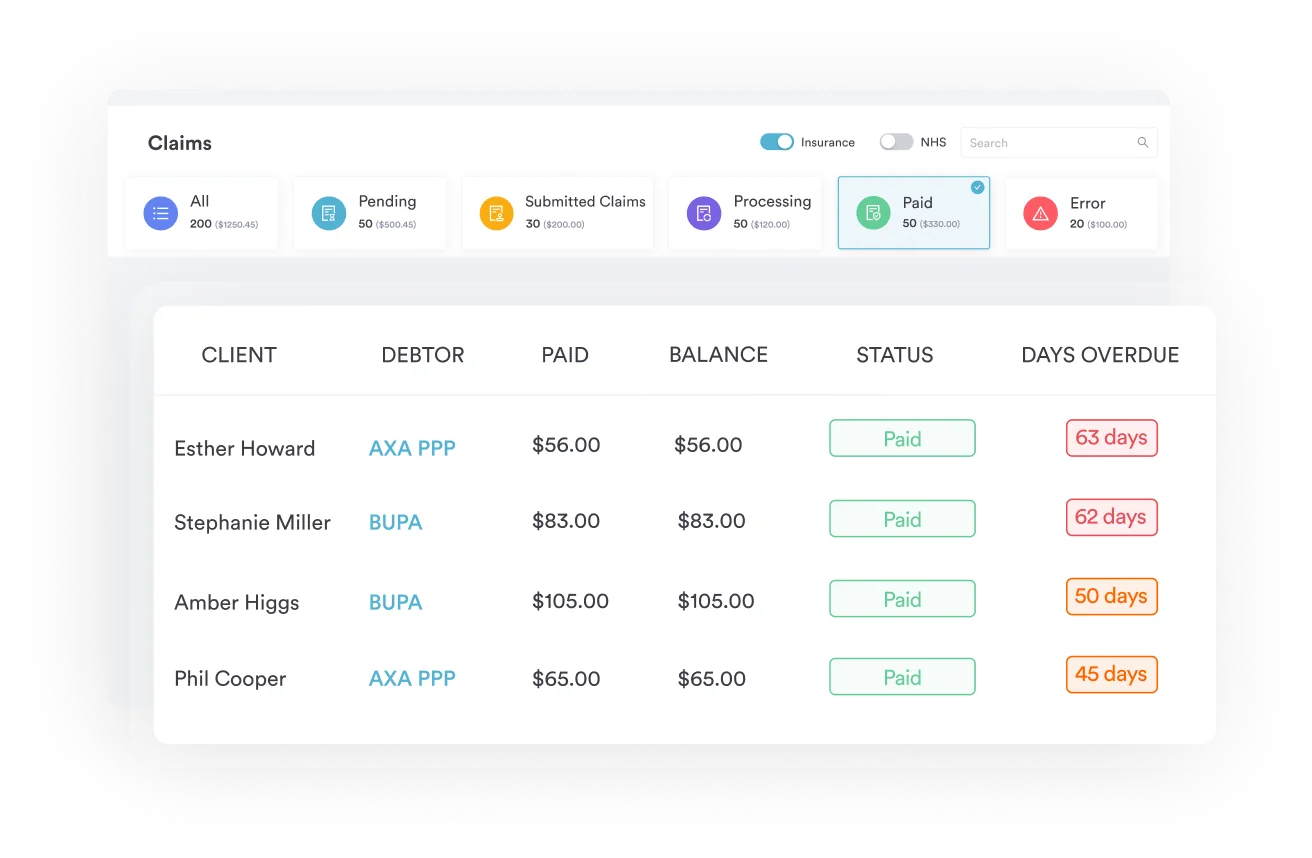

Pabau holds the COPD visit note, intake answers and insurance claim in one patient record. US claims go out through Claim.MD with eligibility checked first, and remittances post back to the same record.

J44.9 is the right code more often than its “unspecified” label suggests, provided the note confirms COPD and names nothing more specific. The checks worth building in are the ones that change the claim. Look for exacerbation or infection language, a documented asthma type and a recorded smoking status.
Those checks belong in the visit template rather than at the billing desk. A note that answers them up front produces a J44.9 claim nobody has to rewrite later.
Book a demo to see how Pabau keeps COPD documentation and insurance claims in one patient record.

Need a foundation in claim lifecycle management? Revenue cycle management explained covers the end-to-end process from encounter to payment posting.
Want to reduce denial rates across your respiratory panel? Clean claim submission guide details the payer edits and documentation checks that keep claims out of the denial queue.
Looking for clearinghouse integration options? Medical claims clearinghouse overview explains how clearinghouses validate claims and route them to payers.
ICD-10 code J44.9 is the billable ICD-10-CM code for chronic obstructive pulmonary disease, unspecified. It applies when the provider confirms COPD and documents nothing more specific. An acute lower respiratory infection points to J44.0, an acute exacerbation to J44.1, and bronchiolitis obliterans to J44.81. It is valid in both inpatient and outpatient settings.
Yes, J44.9 is a billable ICD-10-CM leaf code. It requires no further subdivision and is accepted by Medicare and commercial payers. The code is confirmed valid for FY2025 and FY2026.
J44.0 applies when COPD coexists with an acute lower respiratory infection (such as pneumonia); code the infection separately. J44.1 applies when the provider documents an acute exacerbation of COPD without a separate identified infection. J44.9 applies when COPD is confirmed but neither an exacerbation nor an acute infection is documented.
Use J44.9 only when the encounter note contains no language indicating exacerbation, flare, worsening, or acute lower respiratory infection. If any of those terms appear in the provider’s assessment, query the provider or assign J44.1 or J44.0 as appropriate. J44.9 is a valid specificity level, not a documentation shortcut.
The most common pairings include 99213-99215 for office E&M visits, 94010 for spirometry, 94640 for nebulizer treatments, and 94625-94626 for outpatient pulmonary rehabilitation. Each CPT must be supported by an applicable LCD when billed to Medicare. Verify MAC coverage before submitting to avoid CO-11 mismatches.
Yes. When a patient has both a chronic bronchitis and an emphysema component under a COPD diagnosis, the applicable J44 code captures both. Per the J44 Includes note, “chronic bronchitis with emphysema” maps to J44.x. Do not separately assign J42 (chronic bronchitis) or J43.x (emphysema) when COPD is the documented diagnosis.