

ICD-10 Code R63.4: Abnormal weight loss
ICD-10 Code R63.4: Definition, billability, and code structure ICD-10 code R63.4...

Last Updated: Nov 13, 2026
Billable Code Specific Code
I48.91 is the billable ICD-10-CM code for unspecified atrial fibrillation. It applies when testing confirms AF but the record doesn't say whether it's paroxysmal, persistent or permanent.
Denials tied to I48.91 usually start when it's used while the chart supports a more specific I48 code. Missing ECG documentation of the rhythm is the other common cause.
Let Pabau's smart automation suggest the right codes, reduce claim denials, and keep your practice compliant—effortlessly.
Automate repetitive tasks and focus on what matters most—your patients.
Reduce coding errors and ensure compliance with the latest regulations.
Clean claims, fewer denials, and faster reimbursements.
Powerful insights and reporting to help your practice thrive.
HIPAA compliant SOC 2 certified GDPR-compliant Trusted by 4,000+ clinics worldwide

ICD-10 Code I48.91 is the billable code for unspecified atrial fibrillation, valid since FY2016 and still valid in FY2027.
Use I48.91 only when AF is confirmed but the type (paroxysmal, persistent or permanent) isn’t documented.
Defaulting to I48.91 when the chart supports a specific sub-code is a coding error that can trigger audits.
Pabau’s claims management sends US claims through Claim.MD, with eligibility checks and remittances that show each denial reason.
ICD-10 Code I48.91 is a billable ICD-10-CM diagnosis code with the official descriptor “Unspecified atrial fibrillation.”
CMS’s FY2027 ICD-10-CM code files list it under that title for encounters from October 1, 2026, to September 30, 2027. It sits in Chapter 9 (Diseases of the Circulatory System), under the I48 category for atrial fibrillation and flutter.
In I48.91, “unspecified” describes the AF type. The rhythm is confirmed as atrial fibrillation, but the record doesn’t say whether the episode is paroxysmal, persistent, long-standing persistent or permanent. Once the provider documents the type, ICD-10-CM coding guidelines require the matching I48 sub-code.
The I48 block was expanded in FY2020. Before that update, the AF codes were I48.0 (paroxysmal), I48.1 (persistent), I48.2 (chronic) and I48.91 (unspecified). FY2020 replaced I48.1 and I48.2 with four codes: I48.11, I48.19, I48.20 and I48.21. That split made specificity the central coding question in every AF encounter.
I48.91 is the code of last resort within this block. Use it only when the chart supports none of the sub-codes above. Per CMS ICD-10-CM coding guidelines, coders must assign the highest level of specificity supported by the documentation.
I48.91 applies in a narrow set of clinical situations. In each one, testing confirms AF, but the information needed to classify the type isn’t in the record.
I48.91 doesn’t cover any encounter where the physician has documented the type of AF. If the note says “paroxysmal atrial fibrillation,” I48.0 applies. If it says “permanent atrial fibrillation,” I48.21 applies. The documented type controls the code selection, regardless of which code the coder finds more familiar or convenient.
A frequent coding error across the I48 block is using I48.91 when a more specific code is supported. This comparison covers the usual points of confusion.
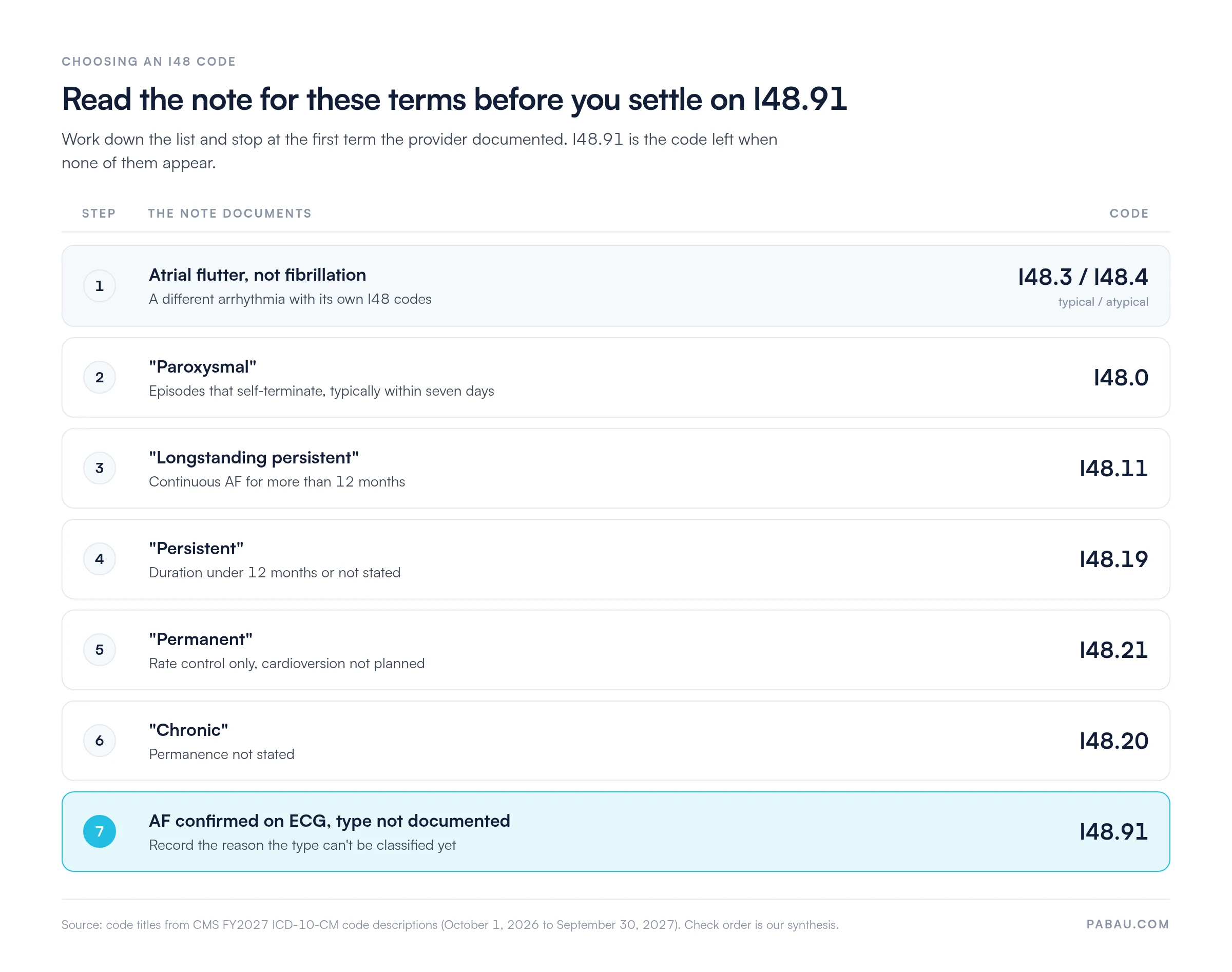
In each row, the chart holds a word or treatment decision that maps to a specific code, and the coder bypasses it for I48.91. Under AHIMA and CMS guidelines, that is a specificity failure. Query the provider before defaulting to I48.91, and check the note for these terms in the order below.
Rapid ventricular response (RVR) is a clinical modifier describing the ventricular rate during an AF episode, not a separate ICD-10-CM code. This distinction trips up many coders who search for an “AF with RVR” code and cannot find one.
Assign the I48 sub-code the documentation supports, which is I48.91 only when the type is undocumented. Then add a code for any condition driving or resulting from the rapid rate. For example, AF with RVR and heart failure takes a heart failure code (I50.-) as an additional diagnosis, per sequencing instructions. ICD-10-CM has no separate RVR code.
Before coding I48.91 for an AF with RVR encounter, read the full note for any documented AF type. ‘Rapid ventricular response’ describes rate, not rhythm type. If a cardiologist classified the AF at an earlier visit, query the provider so the current note documents that type.
Three documentation elements should be in the record for I48.91 to pass payer review. Missing any one of them is a direct route to a denial.
Cardiology practices using structured clinical notes can build these elements into the encounter template so they appear by default. Without that template, a missing reason often surfaces only after a denial. A documentation check before the claim leaves the practice is the more reliable fix.
I48.91 appears as the primary or secondary diagnosis on a wide range of cardiac procedure and E/M claims. The table below covers the codes most often billed with it.
Warfarin INR management is billed with 93793, which covers reviewing a new INR result, giving patient instructions and adjusting the dose. CPT instructs coders not to report it on the same day as an E/M service, because the E/M already covers that work. Document the INR value, the dose decision and the instructions given on every 93793 claim.
Medicare and commercial payer requirements for I48.91 diverge at the procedure level. The diagnosis itself does not trigger prior authorization, but several procedures commonly billed alongside it do.
Per the CDC/NCHS ICD-10-CM tool, confirm code validity for each fiscal year against that year’s official tabular list. I48.91 has been valid since FY2016 and remains valid in FY2027, with no revision or deletion. Payer LCD policies can still change independently of code validity.
I48.91 denials cluster around four patterns. Knowing which one drives rejections in your practice tells you which fix to make.
A specificity downgrade can be fixed inside the practice, with no payer involved. Run a 90-day audit of every I48.91 claim against its note, and search each note for paroxysmal, persistent, chronic or permanent. Where one appears and I48.91 was used, that encounter is a correctable coding error.
Denial management workflows track these patterns over time. That way, the coding habit behind a denial gets fixed along with the claim itself.
The medical billing denial codes on I48.91 remittances show what the payer is citing. That may be a diagnosis and procedure mismatch (CO-11), missing documentation (CO-16) or a bundling edit (CO-97). Each reason code points to a different fix. Review electronic remittance advice files on a set schedule to catch I48.91 patterns before they compound.
AF rarely presents in isolation. These secondary diagnoses appear frequently alongside I48.91 and each has specific coding sequence implications.
The AAPC ICD-10-CM lookup gives index entries and tabular notes for each of these secondary codes. That includes sequencing instructions and the Excludes notes that affect how they interact with I48.91.
Yes. ICD-10 Code I48.91 is valid for FY2026 and for FY2027, which took effect on October 1, 2026, with no revision or deletion. It has been part of ICD-10-CM since the original code set in FY2016, and the FY2027 addenda leave the I48 block unchanged.
CMS publishes updated ICD-10-CM files each October for the new fiscal year. Changes to the I48 block appear in the annual update files, available through the ICD List reference tool and the official CMS ICD-10 codes page. Practices that bill high volumes of AF encounters should review each October update before a denied claim flags the change.
Each of the four denial patterns above needs a workflow fix as well as coder training. Without one, a specificity problem often surfaces only when the remittance comes back.
Pabau, the practice management platform we build, handles US insurance billing through its claims management software. Claims go out as CMS-1500/837P files through Claim.MD, our US clearinghouse partner, with eligibility checks built in. Remittances come back into Pabau, so coders can work I48.91 denials from the same system.

Prior authorization is tracked on the patient’s case, with the auth code, dates and sessions, and Pabau warns when one is missing. That helps on cardioversion and ablation claims, where commercial payers often require authorization alongside an I48 code.

Pabau sends US claims through Claim.MD with eligibility checks and remittance tracking, so I48.91 denials are easier to spot and fix. Prior authorizations for procedures like cardioversion are tracked on the patient’s case.

ICD-10 Code I48.91 is the right code for a narrow set of encounters: AF confirmed on testing, with the type still unknown. Misuse usually comes from habit, with coders reaching for “unspecified” when the chart names the type. Catch that at the coding stage, and the appeal never has to happen.
Start with the 90-day audit, then build the AF type and the reason it’s missing into your encounter template. Book a demo to see how Pabau’s claims, eligibility checks and remittance tracking support AF billing from encounter note to payment.

Need a broader medical billing foundation? What is revenue cycle management explains the end-to-end claims workflow from encounter to payment posting.
Want to understand clearinghouse submission formats? 837 file submission guide covers how ICD-10 diagnosis codes like I48.91 travel to payers in electronic claims.
Tightening your documentation standards? Medical billing compliance outlines the documentation standards that prevent I48.91 specificity denials.
Coding heart failure alongside AF? ICD-10 code I50.30 covers unspecified diastolic heart failure and the documentation it needs.
Billing a cardioversion for AF? CPT code 92960 walks through cardioversion billing and coding.
ICD-10 code I48.91 is the billable ICD-10-CM diagnosis code for unspecified atrial fibrillation. It’s used when testing confirms AF but the record doesn’t document the type (paroxysmal, persistent or permanent). It has been valid since FY2016 and remains valid in FY2027.
I48.0 is the code for paroxysmal atrial fibrillation, used when the physician documents that AF episodes self-terminate, typically within seven days. I48.91 is used only when no AF type is documented at all. If the chart says “paroxysmal atrial fibrillation,” I48.0 is required, and using I48.91 there is a specificity coding error.
Use I48.11 when the physician documents longstanding persistent AF, continuous for more than 12 months. Use I48.19 for other persistent AF the provider documents. Reserve I48.91 for encounters where the record has no AF duration or type. When in doubt, query the treating provider rather than defaulting to I48.91.
Four patterns cause most I48.91 denials. The documentation supported a more specific I48 sub-code, or no ECG or rhythm strip confirmed the AF. The note may lack a CHA2DS2-VASc score supporting anticoagulation, or 93793 was billed on the same day as an E/M visit.
For a patient on warfarin, CPT 93793 covers anticoagulant management, including review of a new INR result and dose adjustment. I48.91 can support it as the diagnosis. Don’t report 93793 on the same day as an E/M visit, because the E/M already covers that work.
ICD-10-CM guidelines require the highest level of specificity the documentation supports. I48.91 needs no upgrade if the record lacks AF type documentation. When the chart contains “paroxysmal,” “persistent,” “chronic” or “permanent,” the matching I48 sub-code is required instead of I48.91.



