

ICD-10 Code R63.4: Abnormal weight loss
ICD-10 code R63.4: Definition, billability and code structure ICD-10 code R63.4 ...

Last Updated: Nov 13, 2026
Billable Code Specific Code
I50.30 is the billable ICD-10-CM code for unspecified diastolic (congestive) heart failure. Coders use it when the physician documents diastolic heart failure or HFpEF but does not state whether it is acute, chronic, or acute on chronic.
Acuity is the central documentation question for this code. When the record supports acute, chronic, or acute on chronic heart failure, I50.31, I50.32 or I50.33 replaces I50.30.
Let Pabau's smart automation suggest the right codes, reduce claim denials, and keep your practice compliant—effortlessly.
Automate repetitive tasks and focus on what matters most—your patients.
Reduce coding errors and ensure compliance with the latest regulations.
Clean claims, fewer denials, and faster reimbursements.
Powerful insights and reporting to help your practice thrive.
HIPAA compliant SOC 2 certified GDPR-compliant Trusted by 4,000+ clinics worldwide

ICD-10 Code I50.30 is billable for FY 2027, which runs from October 1, 2026 to September 30, 2027. Its parent code I50.3 is not billable and triggers a denial.
Use I50.30 only when physician documentation confirms diastolic heart failure but does not specify acuity (acute, chronic, or acute on chronic).
HFpEF (heart failure with preserved ejection fraction) codes to the I50.3x series, and I50.30 applies when acuity is undocumented.
Under CMS-HCC V28, I50.30 maps to HCC 226, while acute and acute on chronic diastolic heart failure map to HCCs of their own.
Pabau submits US claims through the Claim.MD clearinghouse and returns ERA denial codes, so billers can fix the cause of a rejection.
ICD-10 Code I50.30 is the billable ICD-10-CM code for unspecified diastolic (congestive) heart failure, used when the physician documents diastolic heart failure without its acuity.
The code is valid for FY 2027, which covers discharges and encounters from October 1, 2026 through September 30, 2027. The CDC/NCHS ICD-10-CM web tool confirms its current billable status and official descriptor.
Diastolic heart failure is a condition in which the left ventricle cannot relax and fill normally, even though the ejection fraction is preserved. On echocardiogram, that usually means an EF of 50% or above.
Clinically, it is the same condition as HFpEF (heart failure with preserved ejection fraction), which codes to the I50.3x series under CMS ICD-10-CM guidance.
The distinction from systolic heart failure decides the series. Systolic heart failure, with a reduced EF that is typically below 40%, maps to I50.2x, while diastolic maps to I50.3x.
Submitting I50.20 when the physician documented diastolic heart failure is a common error. It draws a medical necessity denial, because the record and the code describe different conditions.
I50.3 is the header category for all diastolic (congestive) heart failure codes. It is not billable. Only the four subcodes carry a valid claim submission designation, and each maps to a specific acuity scenario.
“Unspecified” in I50.30 refers to acuity, not to the type of heart failure. The physician has documented diastolic heart failure, so the type is settled.
The notes leave out whether the episode is acute, chronic, or acute on chronic. The ICD-10-CM Official Guidelines allow an unspecified code only when the documentation supports nothing more specific.
That makes I50.30 the last-resort code in the I50.3x series. When a coder sees “diastolic heart failure” in the notes with no acuity detail, the query workflow runs in four steps.
AHA Coding Clinic guidance supports this order. When clinical indicators in the record point to a more specific code, the coder asks the physician before assigning an unspecified one.
The I50.3x category carries coding instructions that limit what can be submitted alongside I50.30. Ignoring them is a leading cause of Excludes1 edit denials.
The table lists the comorbid conditions most often reported with I50.30. Inpatient sequencing follows the standard ICD-10-CM principal diagnosis conventions. In outpatient settings, the condition chiefly responsible for the visit leads.
Documentation failures cause more I50.30 denials than wrong code selection does. Coders who work in clinical documentation improvement (CDI) see the same omissions from one chart to the next.
Run a pre-submission eligibility and diagnosis check on every heart failure claim. Payer edits for I50.30 vary. Some flag the code when no echo result supports it. Others flag it when a prior claim for the same patient used I50.32 or I50.33, which suggests acuity was already established.
Five documentation elements clear most I50.30 claims without a query.
The most common I50.30 denials, and the fix for each, are below.
When the same denial keeps returning, the fix belongs upstream. Our guide to denial management in healthcare covers that side, from ERA review to appeal.
Under CMS-HCC V28, the risk adjustment model fully in effect for payment year 2026, I50.30 maps to HCC 226 (Heart Failure, Except End-Stage and Acute). V28 splits heart failure into separate HCCs by severity and acuity. End-stage heart failure sits in HCC 222, acute on chronic in HCC 224, and acute in HCC 225.
Acuity documentation therefore moves Medicare Advantage risk scores as well as claim accuracy. Check the CMS mapping file for your payment year before relying on any crosswalk.
Before a heart failure encounter, insurance eligibility verification confirms whether the patient has traditional Medicare or Medicare Advantage. That tells the practice whether HCC risk adjustment applies. When a claim comes back, the denial codes on the ERA identify which payer edit rejected it.
Each code in the I50.3x series matches what the physician documents about acuity at the encounter. The chart below runs the decision in the order a coder meets it, with the type of heart failure first and acuity second.
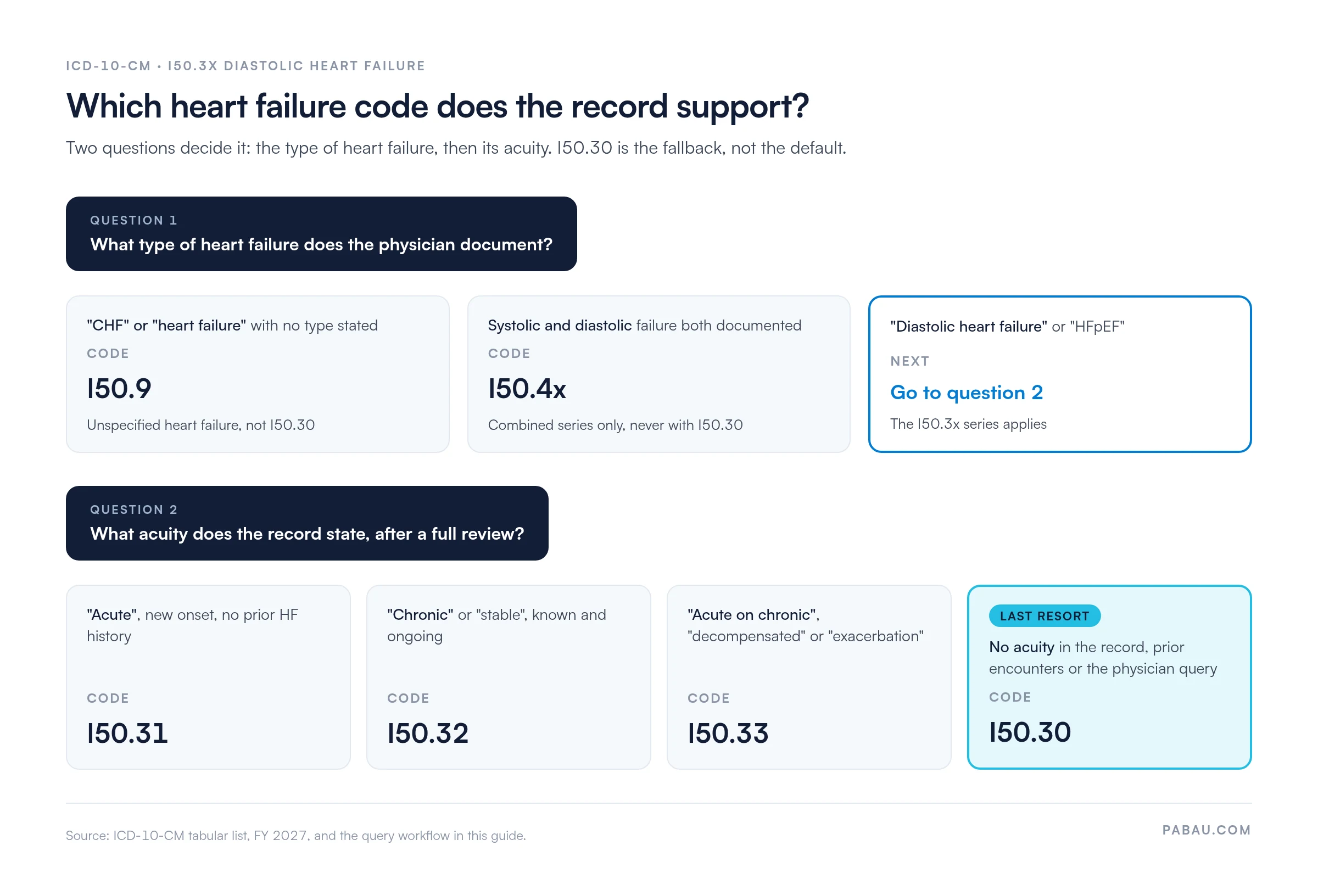
The table adds the trigger phrases for each code and the mistake that most often sends a claim to the wrong one.
The AAPC ICD-10-CM lookup shows every Excludes note and code-also instruction for the I50.3x series in one view. For risk adjustment, the HCC ICD-10 Crosswalk maps I50.30 to its current-year HCC for Medicare Advantage encounters.
A clean claim for a diastolic HF encounter depends on getting the I50.3x selection right before the claim leaves the practice.
Build a diastolic HF query template for your CDI team with three questions. Is this presentation acute, chronic, or acute on chronic? Has an echocardiogram confirmed preserved ejection fraction? Is hypertension the underlying cause? One structured query settles acuity and sequencing in a single physician touchpoint.
Much of the rework on heart failure claims starts after submission. A claim goes out with the unspecified code, the payer rejects it, and someone rebuilds the encounter from the chart weeks later.
Pabau, the practice management platform we build, keeps the encounter note and the claim in the same patient record. Its claims management software submits claims through the Claim.MD clearinghouse and checks eligibility before the visit. ERA remittances come back with their denial reason codes attached.
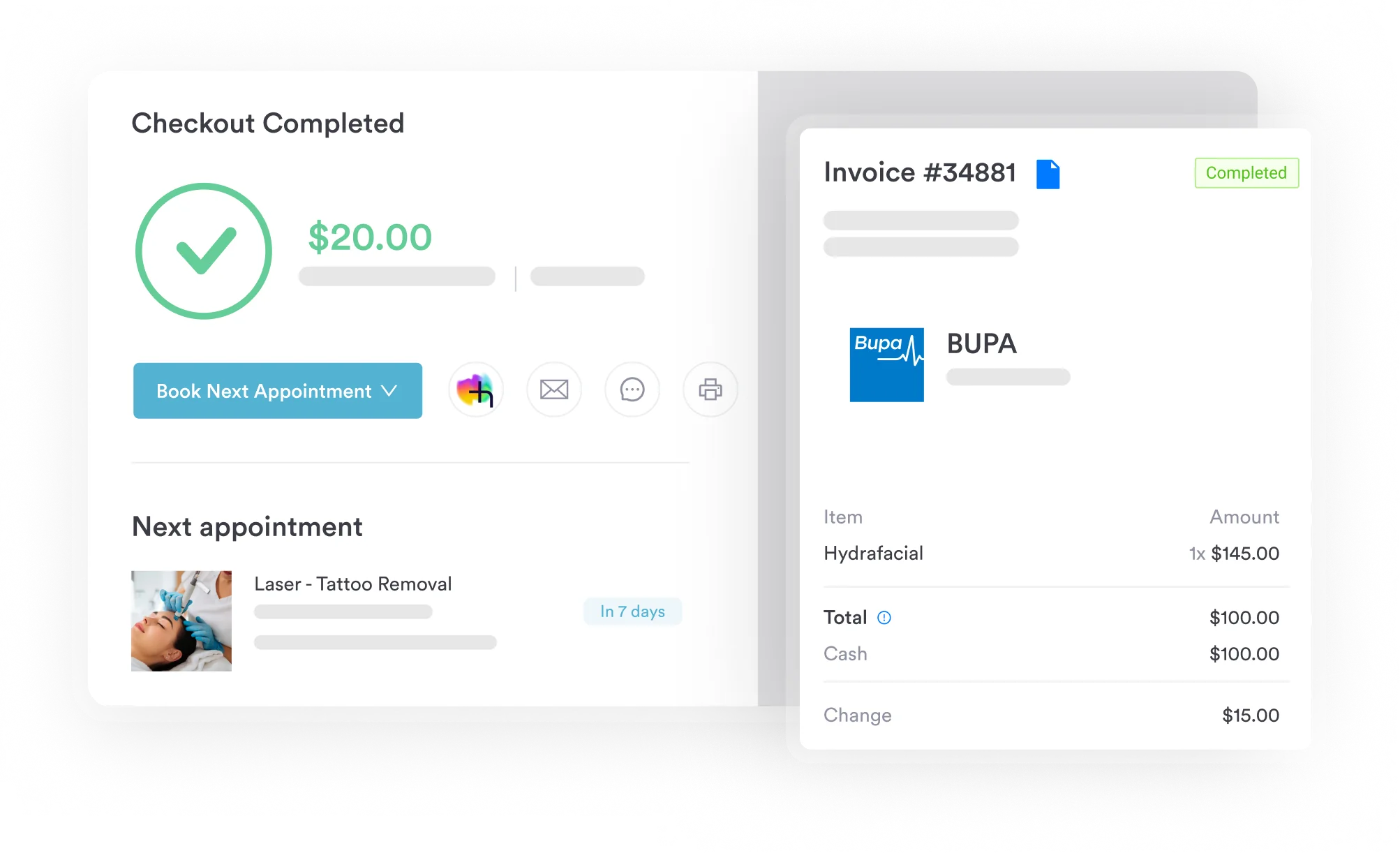
When an I50.30 claim is denied, the biller sees the reason code next to the note that produced it. The fix becomes a physician query or a corrected code, made once, so the same claim never goes out twice unchanged.

Pabau submits claims through Claim.MD, checks patient eligibility, and brings ERA denial codes back to the patient record. Catch I50.30 acuity, Excludes1 and sequencing problems before they turn into rework.

I50.30 is a valid code, but it should be the rarest one in your diastolic heart failure claims. When it shows up often, the cause sits upstream in the note, where acuity goes unstated. Fix that documentation habit and the code mix corrects itself.
Under V28, acuity also decides the HCC. Acute and acute on chronic episodes land in categories of their own, so an unspecified code can misstate a Medicare Advantage patient’s risk.
Build the acuity question into your CDI queries and your revenue cycle management checks, so it is answered before the claim leaves the practice. Book a demo to see how Pabau links the encounter note, the claim and the remittance for heart failure billing.

Billing heart failure care to traditional Medicare? Medicare billing sets out how Medicare claims are built, submitted and paid.
Reading the remittance on a denied I50.30 claim? Electronic remittance advice explains what each part of an ERA tells your billing team.
ICD-10 Code I50.30 is the billable ICD-10-CM diagnosis code for unspecified diastolic (congestive) heart failure. It is used when a physician documents diastolic heart failure but not whether it is acute, chronic, or acute on chronic. It sits under parent category I50.3, a non-billable header code.
Yes. I50.30 is a valid, billable ICD-10-CM code for FY 2027, which runs from October 1, 2026 to September 30, 2027. Its parent code I50.3 is not billable and triggers an automatic denial if submitted.
I50.30 applies when acuity is not documented; I50.32 applies when the physician explicitly documents chronic diastolic heart failure. If the encounter note or problem list includes “chronic” or “stable” language and diastolic HF is confirmed, I50.32 is the correct code, not I50.30.
Use I50.33 when a patient has known chronic diastolic heart failure and presents with an acute exacerbation or decompensation. Use I50.30 only when the clinical record genuinely provides no acuity information and a physician query has not resolved it. Prior encounter history showing I50.33 supports returning to I50.33 on a subsequent acute visit.
Yes, Medicare accepts I50.30 as a principal or primary diagnosis when documentation supports it. For Medicare Advantage risk adjustment, I50.30 maps to HCC 226 under the CMS-HCC V28 model for payment year 2026. Check the current CMS mapping file each year, because HCC structure can change.
The physician must document the diagnosis of diastolic heart failure (or HFpEF) explicitly in the encounter record. Echocardiographic evidence of preserved ejection fraction strengthens the medical necessity case. The record must not contain acuity language (acute, chronic, decompensated) that would support a more specific sibling code.



