

ICD-10 Code R63.4: Abnormal weight loss
ICD-10 code R63.4: Definition, billability, and code structure ICD-10 code R63.4...

Last Updated: Nov 13, 2026
Billable Code Specific Code
I50.20 is the billable ICD-10-CM code for unspecified systolic (congestive) heart failure. It applies when the provider documents systolic heart failure or HFrEF but doesn't say whether it's acute, chronic, or acute on chronic.
It sits in subcategory I50.2 with three acuity-specific siblings: I50.21, I50.22 and I50.23. When no heart failure type is documented at all, I50.9 fits instead.
Let Pabau's smart automation suggest the right codes, reduce claim denials, and keep your practice compliant—effortlessly.
Automate repetitive tasks and focus on what matters most—your patients.
Reduce coding errors and ensure compliance with the latest regulations.
Clean claims, fewer denials, and faster reimbursements.
Powerful insights and reporting to help your practice thrive.
HIPAA compliant SOC 2 certified GDPR-compliant Trusted by 4,000+ clinics worldwide

I50.20 applies when the provider documents systolic heart failure or HFrEF but not its acuity (acute, chronic, or acute on chronic).
HFrEF, heart failure with reduced ejection fraction (typically LVEF 40% or below), is listed under I50.2 in the tabular, so it codes the same way.
If the record states acuity anywhere, I50.21, I50.22 or I50.23 replaces I50.20. If it states no type at all, use I50.9.
Systolic and diastolic heart failure documented together go to a combined I50.4- code, never I50.2- plus I50.3-.
Most I50.20 denials trace back to the chart, so a short pre-submission check catches them before the claim leaves.
ICD-10 code I50.20 is the billable ICD-10-CM code for unspecified systolic (congestive) heart failure. It’s listed under subcategory I50.2 in CMS’s FY2027 ICD-10-CM files, beside three siblings that each name an acuity. You assign it when the provider has written “systolic heart failure” or “HFrEF” and nothing about acute or chronic.
It’s valid as a principal or secondary diagnosis and has been in the code set since ICD-10-CM took effect in October 2015.
You can also look the code up in the CDC/NCHS ICD-10-CM web tool. The tabular list changes every October 1, so check you’re coding from the current fiscal year.
Systolic heart failure is the clinical picture of heart failure with reduced ejection fraction (HFrEF). The left ventricle contracts weakly and can’t pump enough blood forward. The 2022 ACC/AHA/HFSA heart failure guideline defines HFrEF by a left ventricular ejection fraction (LVEF) of 40% or below. When the physician also documents cardiomyopathy without naming its type, I42.9 can be reported alongside I50.20.
The “(congestive)” in the descriptor doesn’t mean the patient must show fluid overload. The index routes “congestive heart failure, systolic” to I50.2-, so either phrasing lands in the same subcategory.
The provider has settled the type. What’s missing is the time course: a new acute episode, a stable chronic condition, or an acute flare on a chronic baseline. Three situations come up again and again:
Subcategory I50.2 holds four codes, and they differ only in the acuity the provider documents.
The costliest mistake in this block is coding I50.20 on an inpatient stay for decompensated heart failure when the chart supports I50.23. Payers, Medicare included, can recoup inpatient payments where an unspecified code was billed despite documentation that supported a specific one.
One more boundary sits at I50.2 itself. Its Excludes1 note sends combined systolic and diastolic heart failure to I50.4-, so the two types are never coded side by side.
I50.9 and I50.20 are the two “unspecified” endpoints in category I50, and they sit at different levels of detail. I50.9 means heart failure with no type stated. I50.20 means the type is systolic and only the acuity is missing.
Coding I50.9 when the provider wrote “systolic heart failure” undercodes the record. The guidelines ask for the most specific code the documentation supports, so I50.20 wins whenever the type is on file. Diastolic documentation moves the other way, into I50.3-, starting with I50.30 when acuity is missing there too.
Put together, the whole choice comes down to two questions about the provider’s own words, as the flow below shows.
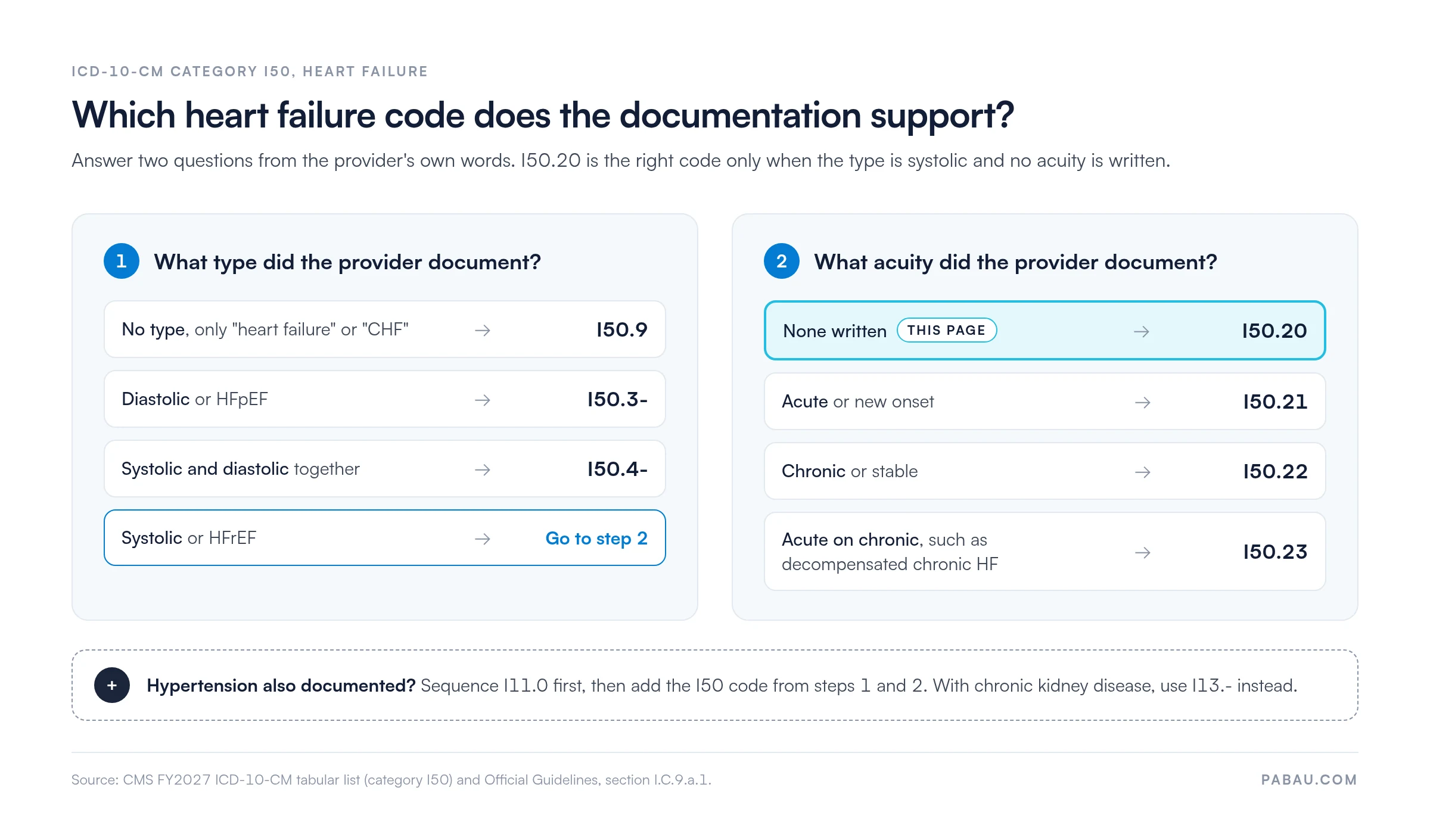
Query the provider before settling on I50.20 for an inpatient stay. Elevated BNP, a reduced LVEF on echo and a decompensated presentation may support I50.23 with one line from the attending. Keep the query and the answer in the chart.
Each of these elements gives an auditor or a payer’s additional documentation request (ADR) something to check against:
The ICD-10-CM Official Guidelines for Chapter 9, together with AHA Coding Clinic, govern heart failure coding across category I50.
The hypertension rule sits in section I.C.9.a.1 of the FY2027 ICD-10-CM Official Guidelines. Because I11.0 already carries the hypertension, you don’t add I10 on the same claim.
Symptoms that come with heart failure aren’t coded separately either. Once the provider documents heart failure, shortness of breath (R06.02) is integral to it and stays off the claim. The same goes for a note that says only dyspnea, which would otherwise code to R06.00.
I50.2 has no Excludes2 note of its own. The one that applies sits at the I50 category level and names cardiac arrest (I46.-) and neonatal cardiac failure (P29.0). Either condition is outside I50.20 but may be reported alongside it when present. The CMS ICD-10 codes page publishes the updated tabular files each October.
Most I50.20 problems start long before the payer sees the claim. Here’s the route a typical claim takes:
Payers, including Medicare Administrative Contractors (MACs), flag unspecified codes when the submitted record supports a more specific one. These are the I50.20 denials coders see most:
When a claim does come back, the reason code on the remittance tells you which row above you’re dealing with. Our guide to medical billing denial codes explains what each one means and how to respond.
Running through this list takes a minute, and it covers the field-level checks in our clean claim requirements guide as well.
Medicare and most commercial payers accept I50.20 as a valid diagnosis, but acceptance doesn’t remove audit risk. CMS and MACs apply MS-DRG validation, medical necessity and clinical validation reviews to inpatient HF admissions.
Heart failure rarely travels alone. These codes often share a claim with I50.20 or get mixed up with it.
Coronary disease and diabetes are the pairings you’ll code most often. Our reference pages for I25.10 and E11.65 cover their own documentation rules.
For a practice billing heart failure visits, the chart is only half the job. Someone still checks coverage, chases authorizations and follows each claim until it’s paid.
Pabau, the practice management platform we build, keeps that work next to the patient record. Pabau’s Claim.MD integration supports eligibility checks and 837P claim submission, with ERA remittances coming back to the practice. Prior authorization codes, dates and sessions are tracked on the patient’s case, with a warning when one is missing.
That means fewer surprises at the payer stage, and a clear trail when an ADR arrives. Our claims software for practices shows how secondary claims and remittances fit the same workflow.

Pabau runs eligibility checks, tracks prior authorizations and submits 837P claims through Claim.MD, with ERA remittances coming back to your practice.

I50.20 is a holding code. It’s correct when the provider has named the type and stopped there, and wrong the moment an acuity word shows up.
If you code a lot of heart failure, the best investment is upstream. Teach providers to write the acuity, and query when they don’t. Each I50.20 that becomes an I50.21, I50.22 or I50.23 is a claim with less audit exposure.
Book a demo to see how Pabau tracks eligibility, authorizations and claims for your heart failure patients in one place.

Coding the diastolic side? ICD-10 code I50.30 covers unspecified diastolic heart failure and its acuity siblings.
Reading a heart failure denial? Denial codes in medical billing explains the reason codes payers send back and how to respond.
Need a full denial prevention workflow? Denial management in healthcare covers how to build denial tracking and appeals for ICD-10-coded claims.
Submitting claims electronically for the first time? Clean claim requirements explains the data elements every 837P must carry to avoid edits on first submission.
Connecting coding to cash flow? Revenue cycle management shows how coding accuracy feeds reimbursement.
Systolic heart failure (I50.2-) involves reduced ejection fraction, where the ventricle contracts weakly. Diastolic heart failure (I50.3-) involves preserved ejection fraction, where a stiff ventricle fills poorly. When both types are documented, assign a combined systolic and diastolic code from I50.4- instead of reporting I50.2- and I50.3- separately.
It was 428.20, “systolic heart failure, unspecified.” The general equivalence mappings carry it forward to I50.20, which helps when you’re reviewing older records.
Yes, it adds a code. I50.2 carries a “code also” note for end-stage heart failure, I50.84. Report it alongside the systolic code when the provider documents end-stage disease.
No. The outpatient guidelines don’t allow coding a diagnosis documented as probable, suspected or rule out. Code the documented signs or symptoms instead, such as shortness of breath or edema.
No. I50.20 is already a complete, billable code. Adding a character makes it invalid, and the claim will reject at the edit stage.



