



CCSD code G5100: Bypass of duodenum billing guide
CCSD code G5100 bills a bypass that leaves the duodenum in place CCSD code G5100...

Last Updated: Oct 16, 2026

CPT Code 92960 describes elective, external (transthoracic) electrical cardioversion of a cardiac arrhythmia.
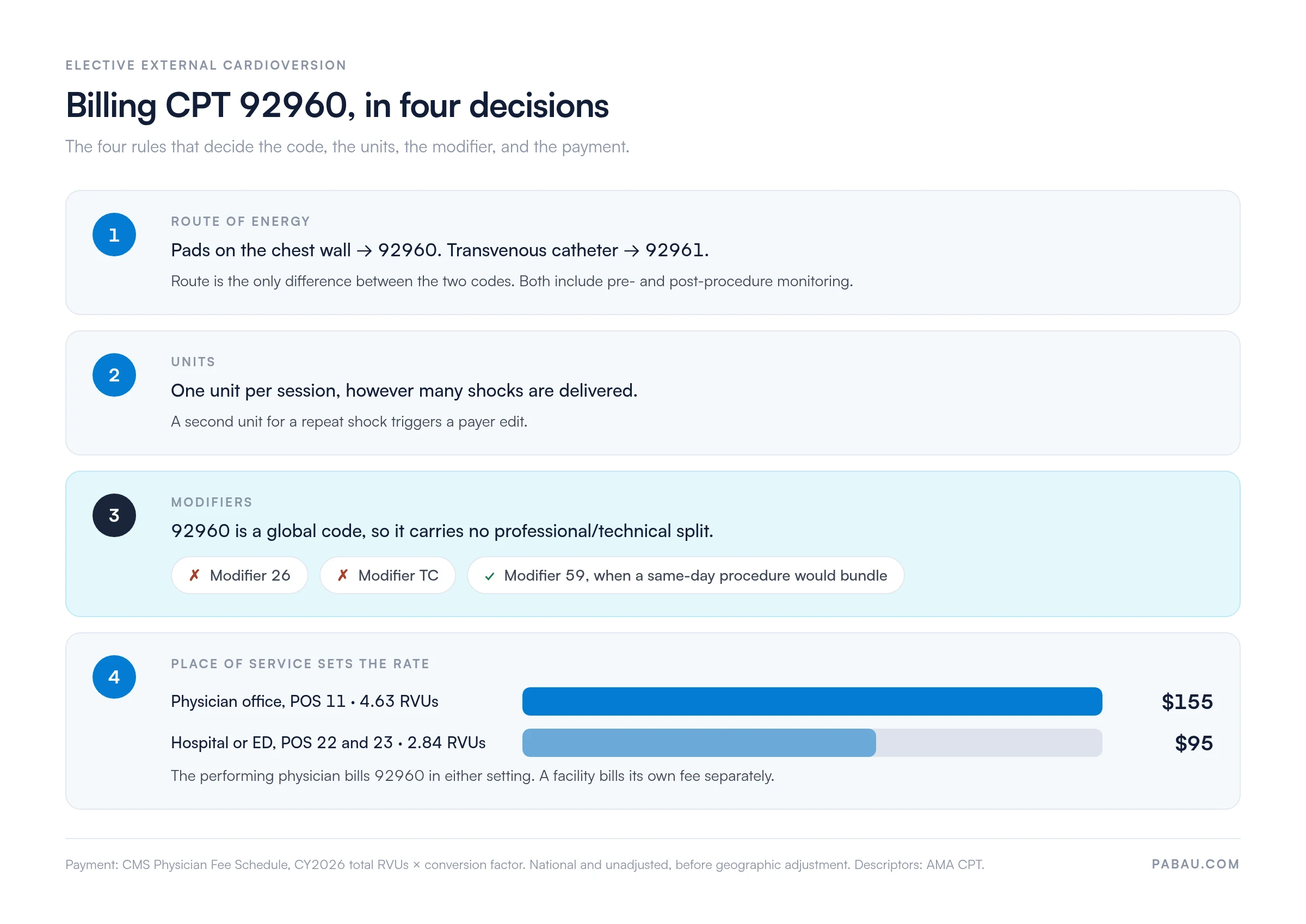
Report 92960 once per session, however many shocks the patient receives.
92960 is a global code, so modifiers 26 and TC never apply to it in any setting.
Medicare pays roughly $155 in a physician office and $95 in a facility, before geographic adjustment.
Practice management software like Pabau submits 92960 claims, tracks their status, and posts the remittance automatically.
CPT Code 92960 is the billing code for elective external electrical cardioversion, the planned shock that returns an arrhythmia to sinus rhythm. It covers one full session: preparation, energy delivery, and the monitoring on either side of it.
This guide covers the official descriptor, the 92960 versus 92961 split, ICD-10 pairings, 2026 Medicare rates, modifier rules, and documentation. It also covers the denials that follow when one of those rules is missed.
CPT Code 92960 is the AMA CPT code set descriptor for: Cardioversion, elective, electrical conversion of arrhythmia; external. The code applies when a physician or qualified clinician performs transthoracic electrical cardioversion to restore normal sinus rhythm. It covers the full session, from pre-procedure preparation through energy delivery to post-procedure monitoring.
Three clinical facts determine whether 92960 is the correct code:
Report CPT Code 92960 once per cardioversion session. Pre- and post-procedure monitoring are included in the code and cannot be billed separately. ACEP reimbursement guidance and AMA CPT guidelines both confirm this.
The 92960 versus 92961 distinction is straightforward but frequently confused. Route of energy delivery is the sole differentiator.
CPT 92961 is used when electrodes are placed internally, typically through a transvenous catheter. It is less common in outpatient cardiology. Both codes are reported once per session, and both include pre- and post-procedure monitoring. Billing both codes for the same session is not permitted.
Correct ICD-10 pairing is what establishes medical necessity. Payers match the diagnosis code against LCD policies to determine coverage. Using an unspecified code when a more specific one is available is a common reason for downcoding or denial.
Code to the highest level of specificity the documentation supports. Pair CPT Code 92960 with the ICD-10 code that reflects the arrhythmia type documented in the procedure note. Avoid I48.91 when the record clearly identifies the AFib subtype.
Reimbursement for CPT Code 92960 varies by place of service. Non-facility rates carry practice expense RVUs for the equipment and supplies a physician office buys itself. In a hospital those costs sit with the facility, so the physician’s rate falls. Check the current figure for your locality in the CMS Physician Fee Schedule lookup, since geographic adjustment applies to every rate below.
Both figures are national and unadjusted. They come from the CY2026 total RVUs above multiplied by the Medicare conversion factor, which runs between $33.40 and $33.57 depending on qualifying participation. Geographic practice cost indices then move the amount by locality, so run your own ZIP code before quoting a number to a patient.
The office rate is higher because the practice absorbs the supply and equipment cost. In hospital outpatient and emergency department settings, the hospital bills its own facility fee on a separate claim for the room, staff, and equipment.
Run an insurance eligibility check before every elective cardioversion session. Confirming active coverage and any cardioversion-specific limits ahead of time removes a large share of post-service denials. It matters most for patients who changed plans mid-year.
92960 is billed globally by the physician who performs the cardioversion, in every setting. The code carries a PC/TC indicator of 0, which means it has no professional or technical component to split. Coders and payers reject 26 and TC on it, so modifier 59 is the only one in routine use.
A hospital or emergency department recovers its equipment and staffing cost through its own facility claim. That is not modifier TC, and appending TC to 92960 will not produce it. Where modifier 59 does apply, document the clinical rationale for the distinct service in the note itself.
Taken together, the route, the unit count, the modifier, and the place of service decide what a 92960 claim looks like.
Incomplete documentation is the main reason payers downcode or deny CPT Code 92960 on post-payment audit. A strong procedure note protects the claim and satisfies both Medicare and commercial payer requirements. Build the note around these elements.
Note: CPT Code 92960 is reported once per session regardless of how many shocks were delivered. Billing it multiple times for a multi-shock session triggers payer edits and potential compliance review.
Most cardioversion claim denials are preventable, and they cluster around a short list of causes. Running insurance eligibility verification before an elective session clears the coverage-related ones in advance.
Practices that route claims through a clearinghouse with built-in edit checks catch formatting and eligibility problems before submission. Reading the denial codes on your remittance tells you which of the causes above triggered a rejection. From there you can trace the pattern back to the note or the claim line.
Coding 92960 correctly is one job. Getting the claim out, tracking it, and posting the payment is another, and that second half runs on your software rather than on the coder.
Practice management software like Pabau handles that half through its claims management software. Claims go to the payer electronically through the Claim.MD clearinghouse, and eligibility can be checked in real time before the session is booked. Each submitted claim then carries a status you can see, so nobody has to call a payer to ask where it went.
Required fields are validated before a claim leaves the queue, including membership numbers and authorization codes. Code selection itself stays where it belongs, with the coder and the procedure note. What comes off your team’s desk is the administrative half: rekeying claim data, chasing status by phone, and posting remittance by hand.
Electronic remittance advice posts back against the original claim, so a $95 facility payment reconciles against the visit that produced it. When a cardioversion claim is short-paid, the reason code sits next to the charge instead of in a separate statement.

Pabau submits your claims electronically, checks patient eligibility in real time, and posts remittance back against the visit. Your billers stop rekeying claim data and calling payers for a status update.

92960 is an easy code to get slightly wrong. The once-per-session rule, the external versus internal split, and the absence of any professional or technical component account for most of the rejections it collects.
All three are settled in the procedure note, before anyone opens a claim form. Get the note right and the claim becomes an administrative task rather than an appeal.
Book a demo to see how Pabau submits cardiology claims, checks eligibility, and posts remittance for multi-specialty practices.

Need to understand how clearinghouse validation works end to end? Medical claims clearinghouse guide explains how claims flow from practice to payer and where errors are caught.
Looking for a full breakdown of revenue cycle fundamentals? What is revenue cycle management covers the complete billing lifecycle from scheduling through remittance.
Want to reduce denials across your CPT code portfolio? Getting credentialed with insurance companies walks through the payer enrollment steps that affect claim acceptance rates.
CPT Code 92960 is the billing code for elective, external (transthoracic) electrical cardioversion of cardiac arrhythmia. It covers the full procedure session including pre-procedure preparation, energy delivery, and post-procedure monitoring. Billing it multiple times for a single session is not permitted regardless of how many shocks were administered.
Modifier 59 is the one in routine use, when cardioversion is performed on the same day as a procedure it would otherwise bundle with. Modifiers 26 and TC do not apply. CPT 92960 is a global code with a PC/TC indicator of 0. The performing physician bills it whole in every setting, and the facility bills its own fee separately.
Yes. CPT Code 92960 may be billed in a physician office (POS 11), outpatient hospital (POS 22), or emergency department (POS 23). The office setting uses the non-facility rate, which is higher because the practice absorbs equipment and supply costs rather than a separate facility.
The frequent causes are insufficient medical necessity documentation and billing the code more than once per session. Others are incorrect modifier application, missing pre-authorization where the payer requires it, and a place of service code that does not match the setting. A pre-submission clearinghouse check catches most of these before the claim reaches the payer.



