Medication tracker template: Free PDF for clinicians and caregivers
A medication tracker is a form that records each medication a patient takes, whe...

2
Last Updated: Oct 12, 2026
EMT practice scenarios are structured training exercises that simulate a 911 call. They let emergency medical technicians rehearse patient assessment before a live patient or the NREMT psychomotor exam. Each scenario walks you through dispatch, scene size-up, the primary and secondary surveys, vital signs, history-taking, interventions, and the transport decision.
This template gives you one medical and one trauma scenario with answer keys, plus the scope notes an EMT-B candidate needs. Use it as a student working toward certification, a provider keeping skills current, or an instructor planning a lab session.
A medical and a trauma patient assessment scenario, each with dispatch details, findings, and a structured answer key. It also covers EMT-B scope of practice and how each stage maps to the NREMT skill sheets.
Download template
EMT practice scenarios rehearse the timed medical and trauma patient assessment stations of the NREMT psychomotor exam.
Every scenario follows the same order: Dispatch, scene size-up, primary survey, secondary survey, SAMPLE and OPQRST history, reassessment, and transport decision.
Medical scenarios turn on the chief complaint and history, while trauma scenarios turn on mechanism of injury and a fast transport decision.
EMT-level medications such as oxygen, oral glucose, aspirin, and epinephrine auto-injectors are within scope, subject to local protocol.
Running scenarios in a group with an observer and a debrief mirrors how the assessment stations are graded.
An EMT practice scenario is a structured simulation of a 911 call, from dispatch through patient handoff at the hospital. Unlike a multiple-choice question, it makes you perform the full assessment in order. You size up the scene, run both surveys, take vitals and a history, then decide on treatment and transport. You do all of it under time pressure, with incomplete information.
Scenarios build clinical decision-making by forcing you to prioritize. A patient with chest pain, a history of diabetes, and signs of respiratory distress makes you choose which finding comes first. You also decide which questions to ask first and what your scope allows. Multiple-choice tests don’t teach this kind of triage thinking.
The NREMT practical exam includes scenario-based patient assessment stations. You pass or fail them on how well you run the standard assessment sequence while an examiner watches. Practicing in the same format, with feedback after each run, is why instructors build their labs around scenarios.
Standardized EMT scenarios share the same anatomy, aligned with the NREMT skill sheets. Learn the structure once and you can apply it to any scenario type. The sequence below is the one the scenarios in the download follow.
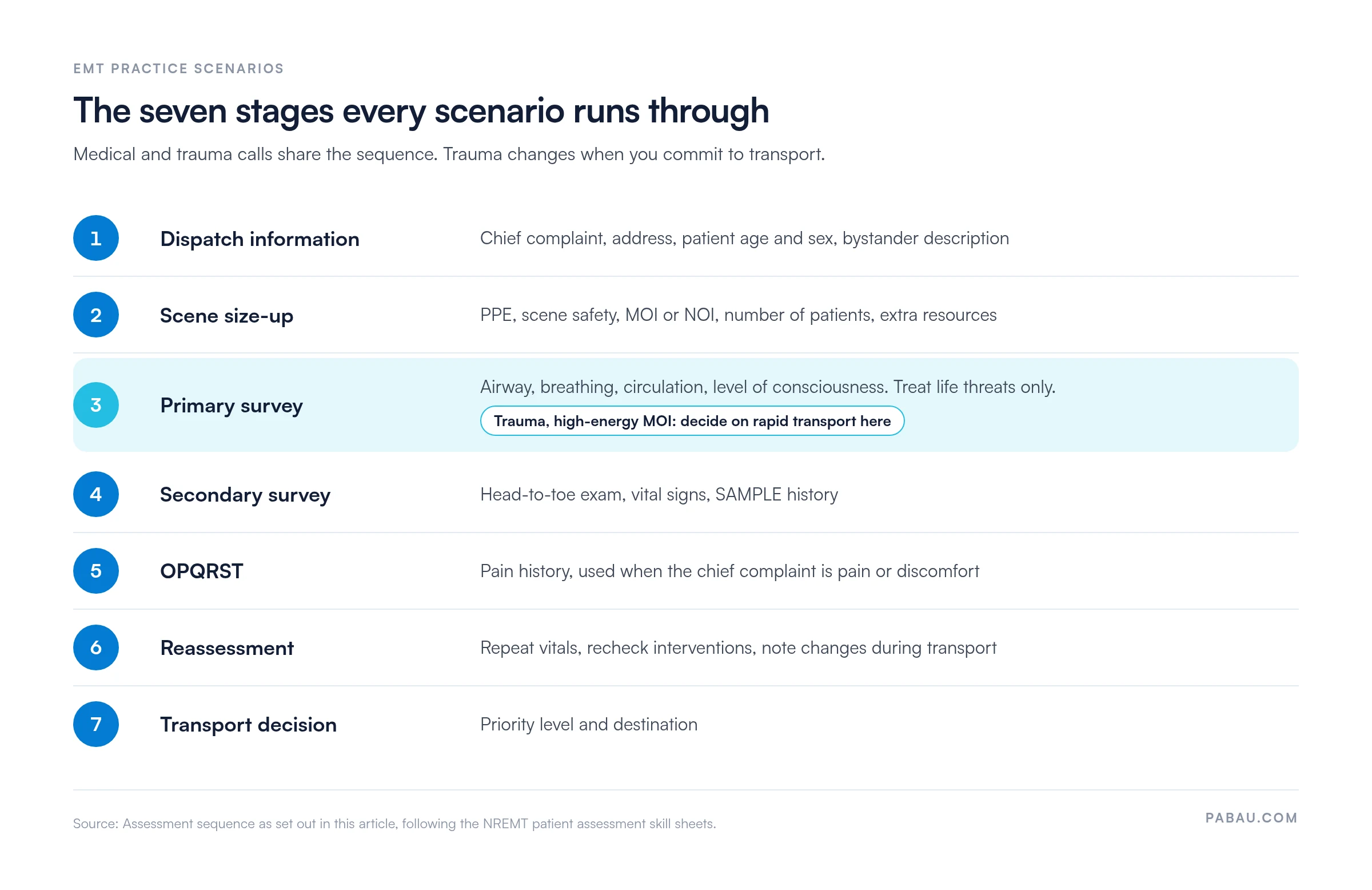
Instructors grade how you execute this sequence, so drill the order until it no longer needs thought. To practice the same steps on a fillable form, use the EMT patient assessment template. A vital signs record keeps each repeat set of readings timestamped during reassessment.
Medical scenarios present patients with non-traumatic chief complaints. Typical examples are chest pain, difficulty breathing, altered mental status, a diabetic emergency, or a severe allergic reaction. Your job is to identify the problem, rule out immediate life threats, take a focused history, and decide on transport.
Here is how a typical medical scenario runs:
Other common medical scenarios include stroke (FAST positive), respiratory distress from asthma or anaphylaxis, and altered mental status from hypoglycemia, overdose, or head injury. Severe GI bleeding and sepsis presentations also come up.
Trauma scenarios emphasize rapid assessment and an early transport decision, and the mechanism of injury is your main clue. High-energy mechanisms call for rapid transport whatever the injuries look like. Examples include a fall from higher than 10 feet, ejection from a vehicle, or penetrating trauma to the trunk. You treat based on the mechanism, not on appearance alone.
Here is an example trauma scenario:
Trauma scenarios test whether you can tell when speed of transport outweighs a complete assessment. “Load and go” is your decision point.
Every scenario uses the same acronyms. Knowing them cold frees up your attention for the patient during testing.
Scenarios work best with a partner or group and an instructor to debrief. Solo study helps you learn the structure, but the skill comes from feedback and role-play.
Close each run with a verbal handoff to whoever plays the receiving nurse. The SBAR handoff format keeps it to the situation, background, assessment, and recommendation.
Groups using patient intake software can have students write their findings into a structured digital form during the debrief. That one exercise reinforces both assessment and documentation.
EMT-Basic certification has defined scope limits, and NREMT scenarios are calibrated to them. You will not be tested on advanced airways, IV access, or ALS-only drugs. EMT-level medications such as oxygen, oral glucose, aspirin, and epinephrine auto-injectors are within scope, subject to local protocol.
In scenarios, these EMT-level interventions are usually enough:
When a scenario calls for an intervention beyond EMT scope, such as IV fluids or an advanced airway, request ALS backup and keep transport moving.
The NREMT psychomotor exam includes timed medical and trauma patient assessment stations of up to 10 minutes each, alongside other skill stations. An examiner observes you and scores your performance against a skill sheet. Critical criteria listed on the skill sheet mean an automatic fail of the station. Examples include failing to take PPE precautions or to determine scene safety.
The skill sheets on the official NREMT site also cover airway and breathing management. They score rapid transport decisions in trauma and history-taking in medical scenarios. Practice to those sheets, not to instinct.
Written multiple-choice questions test memory. Scenarios test decisions made under time pressure with incomplete information, which is what the job demands. Scenario practice mirrors how the assessment stations are graded, which is why instructors favor it.
Scenarios also show what a written test can hide. You might score 90% on a written exam and still stall when a patient presents slightly atypically. Repeated scenario runs prepare you for that variability.
Start with one medical and one trauma scenario, and run each twice. On the first attempt, focus on speed and order. On the second, focus on thoroughness and communication. After each run, check the answer key and note what you skipped.
If you’re studying alone, say your findings aloud as you go and record yourself. Speaking each step builds the rhythm of an assessment and sharpens the report you give hospital staff.
As your confidence grows, mix scenarios randomly so you can’t predict the patient type. Real calls don’t announce themselves, and practicing surprises is how you learn to spot patterns and adjust quickly.
After a scenario run, the assessment usually lives on a paper skill sheet or a clipboard. Once the debrief ends, those notes rarely get filed anywhere useful.
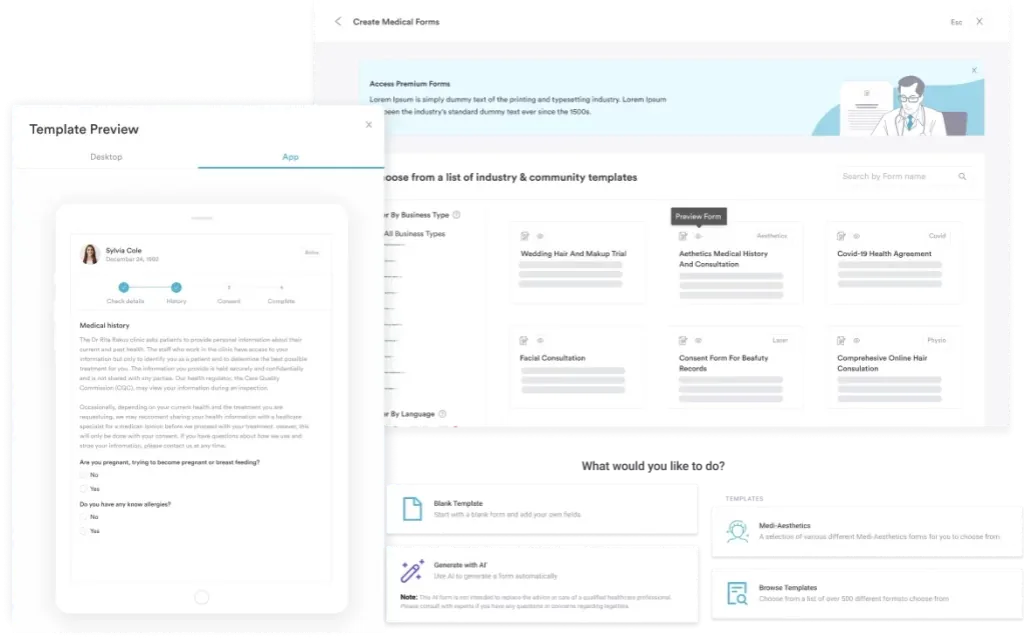
Pabau, the practice management platform we build for private practices, does the same job with digital forms. You can build a form with SAMPLE, OPQRST, and vital-sign fields once, complete it on a tablet, and save it to the patient record.
If your career moves into a private practice after EMT training, the habit carries over. You follow the same assessment order, and every record ends up signed, dated, and searchable.

Pabau brings patient records, digital forms, and scheduling together for private practices. Build your assessment structure into a form once, and every record follows it.

Scenario practice is the part of EMT prep you can’t cram. The assessment sequence only becomes automatic through repetition, with someone watching and a debrief afterward. Start with the two scenarios in the download, and score each run against the skill sheet rather than your own impression.
The trade-off is time, since group sessions take more planning than flashcards. In return, they show you where you hesitate before an exam station does.
Book a demo to see how Pabau’s digital forms turn a structured assessment into a searchable patient record for private practices.

Want the assessment as a fillable form? EMT patient assessment template walks through each step from scene size-up to transport.
Logging repeat vitals during reassessment? Vital signs record keeps each set of readings timestamped in one place.
Curious how the ED picks up after handoff? Emergency nursing assessment shows how the receiving nurse continues the assessment.
Running a respiratory distress scenario? Respiratory assessment breaks down the breathing findings worth documenting.
Want to track assessment competencies over time? Digital patient records keep every completed assessment on file for review.
Medical scenarios present non-traumatic chief complaints, such as chest pain, difficulty breathing, or altered mental status. They test your ability to take a focused history and identify the underlying condition. Trauma scenarios emphasize mechanism of injury and rapid assessment, and transport decisions rest on the MOI, not on appearance.
A full scenario, from scene size-up to transport decision, takes 8 to 15 minutes depending on complexity. NREMT patient assessment stations allow a maximum of 10 minutes.
Solo study helps you learn the scenario structure and answer keys. Group practice with feedback does more for confidence and exam readiness. If you’re studying alone, record yourself running the scenario and listen back for missed steps.
The NREMT official website publishes the skill sheets and exam blueprint. Most EMT textbooks (for example Emergency Care and Transportation of the Sick and Injured, AAOS) include practice scenarios aligned to NREMT standards.