Physician credentialing checklist
A physician credentialing checklist lists every license, certificate, verificati...

Last Updated: Oct 23, 2026
The DuPont shift work schedule is a 12-hour, four-crew rotation that repeats every 28 days and keeps an operation staffed 24/7. Each crew works 14 shifts per cycle and averages 42 hours a week. The fact to plan around is how unevenly those hours fall: a 72-hour peak week, then seven straight days off.
E. I. du Pont de Nemours and Company (DuPont), the chemical company, is credited with developing this pattern for plants that never stop. Healthcare teams now adapt it for round-the-clock patient care. There, a misjudged peak week shows up as overtime bills and empty appointment slots. So learn the cycle, its costs, and the rollout before you commit.

The DuPont shift work schedule uses four crews on 12-hour shifts across a 28-day rotating cycle to deliver 24/7 coverage.
Each crew averages 42 hours per week, but Week 2 reaches 72 hours, and three of the four weeks pass the 40-hour overtime line.
Every crew gets a full seven-day rest block every four weeks, which helps work-life balance but concentrates fatigue in the 72-hour peak week.
Common modifications include 8/12-hour hybrids and fixed day and night crews for settings where full rotation is hard to run.
Pabau, the practice management platform we build, has scheduling and timesheet tools that help you manage staff rotas and availability.
The DuPont shift work schedule is a rotating 12-hour pattern that uses four crews to cover every hour of every day. It repeats on a 28-day cycle. Day shifts typically run from 7 am to 7 pm, and night shifts from 7 pm to 7 am.
The four-crew structure is what makes round-the-clock coverage work. On any given day, one crew works days, one works nights, and two are off. For practice managers, that means a predictable 28-day template that repeats unchanged.
The core structural facts of the standard pattern:
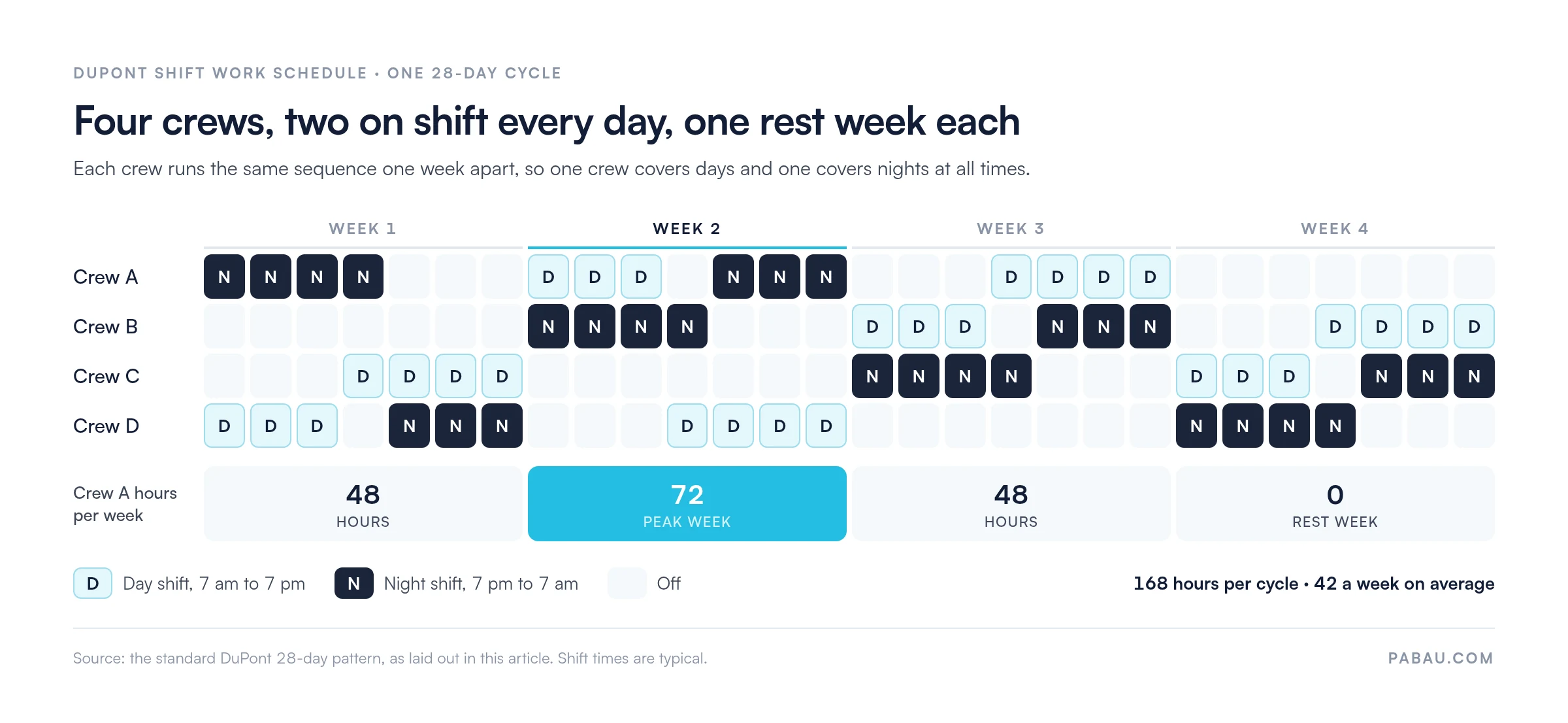
The 28-day cycle runs each crew through blocks of nights, days, and rest. Every crew follows the same sequence, offset by one week. The table below shows Crew A’s pattern across the full cycle.
Week 2 is the pattern’s hardest stretch. Crew A works three day shifts, takes one day off, then works three night shifts. That is six 12-hour shifts and 72 hours in seven days, plus a switch from days to nights with a single rest day between them.
Week 2 is also where overtime exposure peaks for employers of non-exempt staff. The seven-day rest block in Week 4 is the design’s counterbalance, giving workers a full week to recover before the cycle restarts.
Each of the four crews follows this same sequence, staggered by one week. While Crew A rests in Week 4, Crews B, C, and D are in Weeks 3, 2, and 1. The grid below shows how that stagger keeps one crew on days and one on nights, every day of the cycle.
Prefer a ready-made layout? Our rotating 12-hour shift schedule template sets out the same day, night, and rest blocks for each crew.
Across the full 28-day cycle, each crew works 14 shifts of 12 hours, totaling 168 hours. Divided by four weeks, that averages 42 hours per week. On paper, that looks manageable. The catch is how the hours are distributed.
Under the Fair Labor Standards Act (FLSA), overtime is calculated week by week, not as a cycle average. Three of the four weeks cross the 40-hour line. Weeks 1 and 3 each create 8 overtime hours, and the 72-hour Week 2 creates 32. That adds up to 48 overtime hours per cycle for every non-exempt employee on the rota.
Here is one cycle’s pay for a non-exempt employee on a $20 hourly base rate, with overtime at 1.5x, or $30 an hour:
The overtime premium, the extra half-time on top of straight pay, is $10 for each overtime hour. Week 2 alone carries 32 × $10, or $320, above straight-time pay. Across a full cycle the premium is $480. Over 13 cycles a year, that reaches 624 overtime hours and $6,240 in premium per non-exempt employee.
That is a meaningful budget line for any practice running the pattern on clinical or support staff. Run it past your HR team and employment counsel first. California adds another layer. Employers there must follow the state’s alternative workweek election rules, or 12-hour shifts trigger daily overtime under the California Labor Code.
The DuPont shift work schedule has a mixed record across the industries that use it. Here is how it looks from each side of the rota.
Employer advantages
Employee advantages
Disadvantages to weigh
It can be, because it carries the health risks of any rotating night work. Those include circadian disruption, poorer sleep, and higher cardiovascular and metabolic risk over time. Its own pressure points are the four-night run in Week 1 and the quick switch from days to nights in Week 2.
The direction of the evidence is clear. NIOSH training on shift work and long hours links night and rotating schedules with sleep disorders, cardiovascular disease, metabolic problems, and gastrointestinal complaints.
Those associations come from long-term exposure. A worker doing one DuPont rotation is not in the same risk category as someone who has worked nights for fifteen years.
The pattern’s nights come in short blocks. The longest run is four nights, in Week 1, and Week 2 adds three more. Workers stay on one circadian phase for a few nights at a time rather than flipping every other day. Three rest days follow each night block.
The harder part is the Week 2 turnaround. Moving from three day shifts to three night shifts with one rest day between them gives the body little time to adjust. The seven-day rest block then offers more recovery time than most rotating schedules. That does not remove the risk, but it puts it in context.
Practical ways to soften the risk for night-shift staff:
A modified DuPont schedule adjusts the standard pattern to ease the 72-hour peak week or to suit settings where 12-hour blocks are impractical. Some versions also answer local labor rules.
Two common modifications are compared below.
The fixed-nights variant is worth a look in a practice setting. Some research suggests staff who choose permanent nights tolerate them better, though evidence on absence is mixed. If some of your practitioners prefer overnight or late-hour work, a permanent night crew may suit them better than forcing rotation across all four.
The DuPont shift work schedule suits any operation that cannot stop, where an uncovered shift costs more than the overtime premium of running four crews. Demand for that kind of coverage is broad.
According to Bureau of Labor Statistics data from 2017–18, 16% of US wage and salary workers usually worked something other than a regular daytime schedule. The DuPont pattern turns up most often in these sectors:
Healthcare use of the DuPont shift work schedule reaches beyond hospitals. Urgent care centers, residential care facilities, and multi-practitioner practices with extended hours also evaluate it as patient demand moves toward evenings and weekends.
If the operation runs fewer than 18 hours a day, four crews and 12-hour blocks may not justify the overhead.
The DuPont pattern is one of several 12-hour four-crew systems. Choosing between them means trading off rest-block length, peak weekly hours, and cycle complexity.
The 2-2-3 rotation goes by both the Pitman and Panama names, and it alternates 36-hour and 48-hour weeks. That keeps its peak week 24 hours lighter than DuPont’s, but its rest blocks top out at three days. DuPont’s distinguishing feature is the seven-day rest block, a full week off in every cycle.
If the full rest week matters most as a retention and recovery tool, DuPont is the pattern that delivers it. If lowering peak weekly hours matters more, especially for fatigue-sensitive clinical roles, 2-2-3 is the better choice. Our Panama shift schedule template lays out that pattern if you want to compare the two.
Running the DuPont shift work schedule in a practice is harder than in a factory, because patient bookings have to follow the staff rotation. A practitioner off for a full week is easy to handle if her appointments are covered. It becomes a problem when her calendar sits empty and patients are turned away.
Take Crew A’s Week 2, starting on a Monday. Monday to Wednesday are day shifts, each opening at 7 am with a handover from Crew B, who are on nights that week. Thursday is the single rest day. Friday evening starts a three-night block that runs through Sunday.
From Friday on, Crew A can’t take daytime appointments, so the front desk needs to see that change in the booking calendar. Trouble starts when the rota lives in a spreadsheet and the appointment book lives somewhere else. Bookings land with practitioners who are asleep after a night shift.
Work through these six checks before the first cycle starts. Each one is cheaper to fix on paper than mid-rotation.
These are the slip-ups that tend to undo a DuPont rollout in its first few months.
Many practices plan a rotating rota in a spreadsheet and keep the appointment book in a separate system. When the two drift apart, patients get booked with practitioners who are on a rest week, and the front desk has to rebook them.
In Pabau, the practice management software we build, staff rotas and availability sit in the same system as your appointment calendar and patient records. Timesheets record the hours each team member works, so weekly totals are on hand when you review overtime.
Your front desk books patients with the practitioners on shift that day. Managers can see each crew’s week in one place.

Pabau’s scheduling and timesheet tools help you manage staff rotas and availability in the same platform you use for appointments and patient records.

The DuPont schedule earns its place when you need 24/7 coverage and can field four full crews. Staff value the rest week, and it helps with both recruiting and recovery. You pay for it with a 72-hour peak week and 48 overtime hours per cycle for every non-exempt employee.
So settle two numbers first: crew headcount and the overtime budget. If both hold up, the pattern pays back with a rota you build once and reuse all year. If either looks shaky, a 2-2-3 rotation or a fixed day and night split is the safer choice.
Book a demo to see how Pabau keeps your DuPont rota and your appointment book in step.

Need a ready-made layout for a 12-hour crew rota? Rotating 12-hour shift schedule is a free template for planning day, night, and rest blocks across your crews.
Working out how many staff each crew needs? Healthcare workforce planning shows how to forecast the headcount a four-crew rota depends on.
Checking weekly hours against the 40-hour line? Free timesheet template gives you a weekly log for recording the hours each team member works.
Want to reduce no-shows across rotating shift coverage? How to improve patient no-show rate covers the automated reminder and confirmation workflows that keep attendance high when practitioner availability changes weekly.
Managing staff across more than one practice location? Multi-location scheduling software explains how to synchronize rotas and room availability across locations without duplicating administrative effort.
You need at least four people for every post you want covered around the clock, one in each crew. Most employers add some slack on top. Without it, every sick day or vacation pulls someone from an off crew into overtime.
About 2,184 hours, from 168 hours per 28-day cycle across 13 cycles. A standard 40-hour week over 52 weeks comes to 2,080 hours. So DuPont staff work roughly 104 more hours a year.
Yes, with four shifts of leave. Book the four day shifts that close Week 3 as vacation. They sit between three rest days and the seven-day rest block, which gives 14 days off in a row.
Cover usually comes from one of the two crews that are off that day, which means overtime. Avoid pulling anyone out of their seven-day rest block where you can. Track who covers, so the extra shifts don’t keep landing on the same people.
No. Both use four crews on 12-hour shifts and average 42 hours a week. The Pitman, or 2-2-3, pattern never goes above 48 hours in a week, but it never gives more than three days off in a row. DuPont peaks at 72 hours and adds a full rest week.