Physician credentialing checklist
A physician credentialing checklist lists every license, certificate, verificati...

Last Updated: Oct 23, 2026
A work life balance worksheet is a fill-in form that shows how your working week compares with the time you keep for yourself. This free PDF for healthcare professionals asks you to log your weekly schedule, work responsibilities and personal commitments.
You then rate the time and energy you give work and personal life on two 1 to 10 scales. It closes with a satisfaction question and three reflection questions about how balanced you feel.
Most clinicians sense their balance is off long before they can say why. Writing the week down, day by day, turns that feeling into something you can see and change. The sections below walk through each part of the PDF, then show how to read your answers and pick one change.
A printable fill-in worksheet with fields for your details, a Monday-to-Sunday work schedule, your work responsibilities and your personal commitments. It also includes two 1 to 10 time and energy scales, a satisfaction question and three reflection questions.
Download template
A work life balance worksheet records your weekly schedule, work responsibilities and personal commitments in one place.
Two 1 to 10 scales let you rate the time and energy you give work and personal life.
Three reflection questions help you spot what drains you and what makes it hard to switch off.
Comparing your two ratings with your weekly schedule shows which days and tasks to change first.
Practice software such as Pabau can take booking and reminder admin off your evenings, which protects your personal hours.
A work life balance worksheet is a self-assessment that compares the time and energy you give work with what you keep for personal life. It pairs a written record of your week with two simple ratings. Read together, they show where the imbalance sits and what is causing it.
The worksheet is most useful at three moments: When you start a new role, after a busy season, and once a quarter. It works as a conversation starter too. A practice manager can complete it with a team member during a one-on-one, using the same questions to compare notes.
Clinical roles carry long hours, emotional load and shifting schedules, which makes balance harder to protect than in many other jobs. The pressure lands differently depending on your role:
Poor balance is linked with burnout, and burnout affects both clinician well-being and the quality of patient care. The World Health Organization classifies burnout as an occupational phenomenon, not a medical condition, which makes early self-assessment a practical first step.
The PDF is short enough to complete in one sitting. It has seven parts, and each one builds on what you wrote in the part before it. The diagram below groups them into three stages, plus the step you plan yourself.
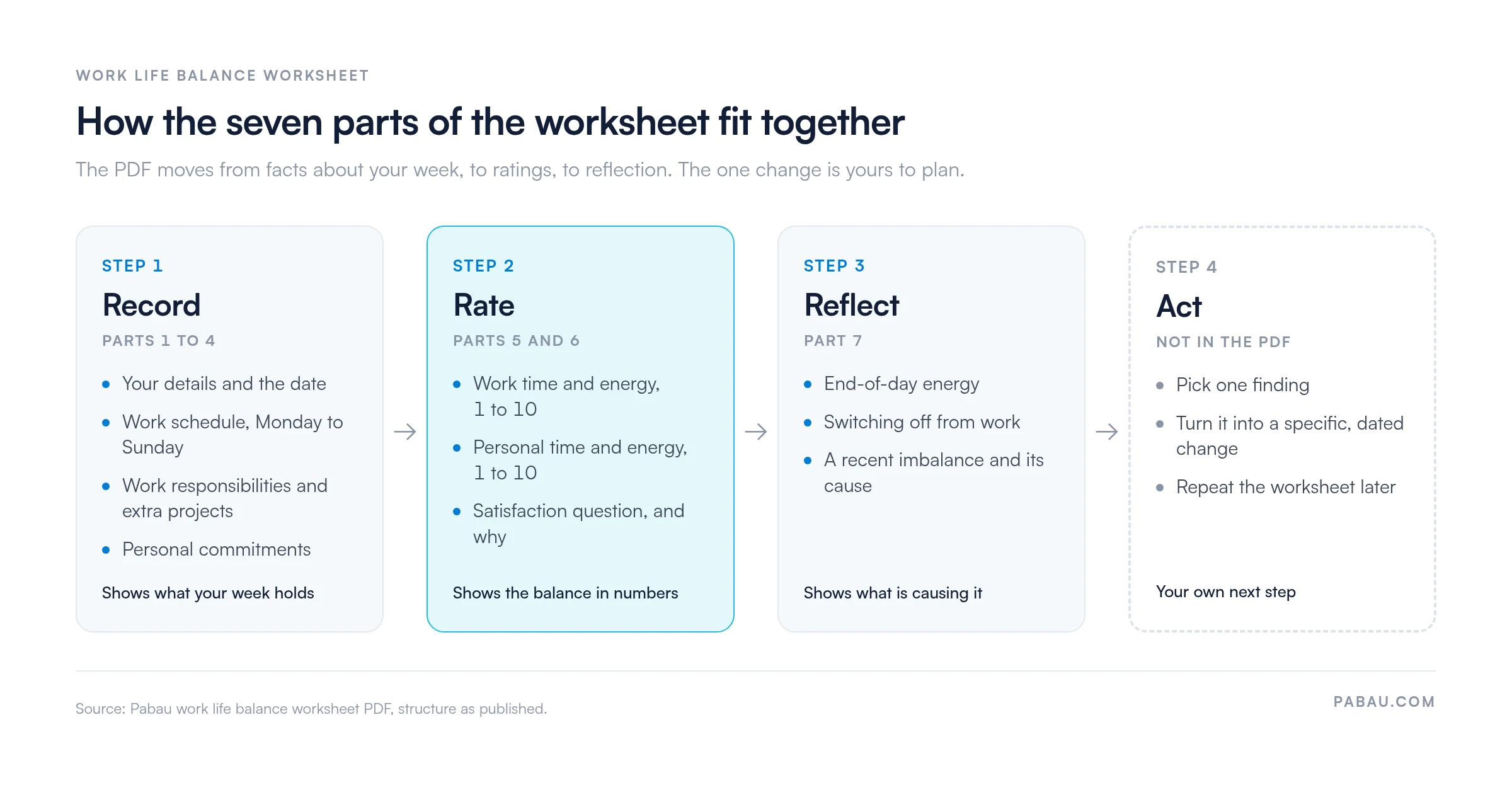
The worksheet opens with a block the PDF labels “Client information.” It has four short fields: Name, date, gender and position or role. The date matters most, because it lets you compare this result with your next one. Your role adds context, since a practice owner and a part-time nurse face very different pressures.
The instructions ask you to fill in each field with accurate details about your schedule, responsibilities and personal commitments. They also ask you to answer the satisfaction question honestly. The aim is to find where small adjustments could give you a healthier balance.
This part builds a factual picture of your week before you rate anything. It has three fill-in areas:
Be specific here. “Patient notes on Thursday evenings” tells you far more than “admin”, and the later sections depend on that detail.
The time allocation section asks how much time and energy you currently give to two areas. You rate work on one scale and personal life on the other, each from 1 (very little) to 10 (a lot).
A satisfaction question follows: Are you satisfied with the balance between your work and personal life, and why or why not? Answer it in full sentences. The reason you give often tells you more than the yes or no.
The worksheet does not score your answers for you, so reading them is up to you. Start by comparing the two ratings. Work at 9 and personal life at 3 suggests work is taking time your personal commitments need. Then look back at your schedule, since the overloaded days usually explain the low personal rating.
The worksheet ends with three reflection questions. They move you from what your week looks like to how it feels.
These answers point to causes. Feeling drained most evenings, with unfinished notes as the barrier, is a specific problem with a specific fix.
If exhaustion or detachment persists, talk with a colleague, supervisor or your own clinician. A validated tool such as the Copenhagen Burnout Inventory or the Oldenburg Burnout Inventory measures burnout directly. The worksheet supports self-reflection and does not replace professional support.
The worksheet has no goals section, so the next step is yours to plan. Pick one finding from your answers and turn it into a specific, time-bound change. Vague intentions rarely survive a busy week.
If your answers point to blurred boundaries, a few general habits can help:
Work life balance looks different in each clinical setting. These examples show how answers from the worksheet can translate into changes at the practice level.
Set aside around 30 minutes and find a quiet space. Steps 2 to 6 follow the order of the PDF.
Repeat the worksheet every quarter and compare your two ratings with last time. If your personal rating has climbed closer to your work rating, the change is working. A shift of one or two points still counts as progress.
Many of the admin tasks that erode balance are repetitive. At a typical practice, someone phones patients to confirm bookings, types reminder texts and sends aftercare instructions by hand, often after the last appointment.
Pabau takes that work off your team. Online booking lets patients book and reschedule themselves, and automated reminders go out without anyone picking up the phone. Therapists and counselors can see how this fits their week in Pabau’s therapy practice management software.
When your worksheet shows admin eating into personal time, automated workflows can take over reminders and follow-ups. Practice leads can then compare the time saved with their next set of worksheet ratings, so they know whether the change helped.
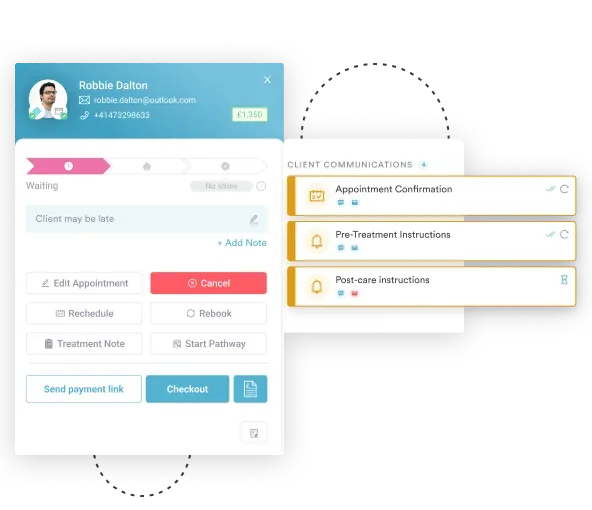

If the worksheet points to admin as the biggest drain on your week, see how Pabau handles online booking, reminders and workflows in one place.

The worksheet is only useful if your answers change what goes on your calendar. Start with the day your schedule shows running longest, then choose one task to delegate, decline or automate this month.
Balance rarely improves through willpower alone. If the schedule you wrote down has no slack, the fix lies in how your practice runs. Repeat the worksheet in 90 days to see whether the change held.
Where admin is the drain, Pabau can take reminders, online booking and follow-ups off your team’s plate. Book a demo to see how many evenings your practice could win back.

Want to measure burnout, not just balance? Copenhagen Burnout Inventory scores personal, work-related and client-related burnout with a validated questionnaire.
Need a burnout tool that separates exhaustion from disengagement? Oldenburg Burnout Inventory template and scoring guide measures both dimensions and explains how to score each item.
Want to rate more life areas than work and home? Wheel of life assessment scores 10 life domains on one wheel, so you can see where the imbalance sits.
Looking for ways to recover between shifts? Self-care wheel breaks self-care into eight sections so you can plan recovery across each one.
Wondering how well you bounce back from pressure? Resilience test helps you gauge how you cope with stress and setbacks at work.
A work life balance worksheet is a fill-in self-assessment that records your weekly schedule and commitments. It then rates the time and energy you give work and personal life.
Quarterly works well for most clinicians, with an extra pass after a particularly busy season or a change of role.
The worksheet helps you spot early warning signs through self-reflection, but it is not a clinical intervention. Speak with a qualified professional if burnout symptoms persist.
The PDF covers your role, a day-by-day work schedule, your main work responsibilities and your personal commitments. It then asks you to rate the time and energy you give work and personal life on a 1 to 10 scale. It closes with a satisfaction question and three reflection questions.
No. The worksheet is a reflection tool that shows how you split time and energy between work and personal life. Validated questionnaires such as the Copenhagen Burnout Inventory or the Oldenburg Burnout Inventory measure burnout symptoms directly.
Yes. Ask each team member to complete it before a one-on-one, then use the schedule and ratings to guide the conversation. Keep completion voluntary, and treat the answers as private unless the team member chooses to share them.
Go back to the work responsibilities you listed and mark the tasks someone else could own or software could automate. Pick one change for the next month, then complete the worksheet again to see whether your ratings moved.