Medication tracker template: Free PDF for clinicians and caregivers
A medication tracker is a form that records each medication a patient takes, whe...

3
Last Updated: Oct 12, 2026
A rotating 12-hour shift schedule is a staffing pattern in which employees work consecutive 12-hour shifts, then take blocks of consecutive days off. Crews alternate between day and night coverage instead of holding one fixed slot. Three or four crews running the same sequence keep a practice staffed around the clock with fewer people than an 8-hour model needs.
This guide covers the four patterns most teams use: DuPont, Panama (2-2-3), Pitman, and 4-on 4-off. DuPont buys the longest unbroken break, seven days in every 28. 4-on 4-off is the simplest to administer, because the whole cycle repeats every eight days. Below you can download a free weekly schedule sheet to publish once you have picked one.
A printable one-week grid with morning, midday, afternoon, evening, and night rows for all seven days. It also carries fields for the employee, job title, department, week beginning, and preparer, plus space to log any changes.
Download template
A rotating 12-hour shift schedule moves crews between day and night blocks, so three or four teams can hold 24-hour coverage.
DuPont, Panama (2-2-3), Pitman, and 4-on 4-off are the four common patterns, and they differ mainly in how the rest days are grouped.
All four work roughly half the days in a cycle, which averages about 42 hours a week and crosses the FLSA overtime threshold.
Healthcare employers can elect the 8/80 rule, paying overtime past 8 hours in a day or 80 hours in a 14-day period.
Pabau’s team management and scheduling features hold each crew’s working hours, so booking availability follows whoever is actually on shift.
A rotating 12-hour shift schedule splits coverage into day shifts, say 7am to 7pm, and night shifts from 7pm to 7am. Each crew moves between the two rather than holding one fixed slot. Compared with 8-hour shifts spread over five or six days, the 12-hour version packs the same hours into fewer working days.
The rotation itself means every crew runs the same sequence, offset from the others. One crew works days, another works nights, and the rest are off. Over a cycle of 8 to 28 days, each crew takes an equal share of the night shifts nobody volunteers for.
Practices, hospitals, and nursing homes need round-the-clock cover but cannot carry the headcount that 8-hour shifts across seven days would demand. A 12-hour rotation needs only three to four crews for full coverage. The catch is that shift cover has to line up with patient scheduling, or clinicians end up on site with an empty diary.
Four patterns dominate 24/7 staffing. They run on different cycle lengths and group the rest days differently, and that grouping is the part staff actually feel. The map below lays out one full cycle for each rhythm, day by day.
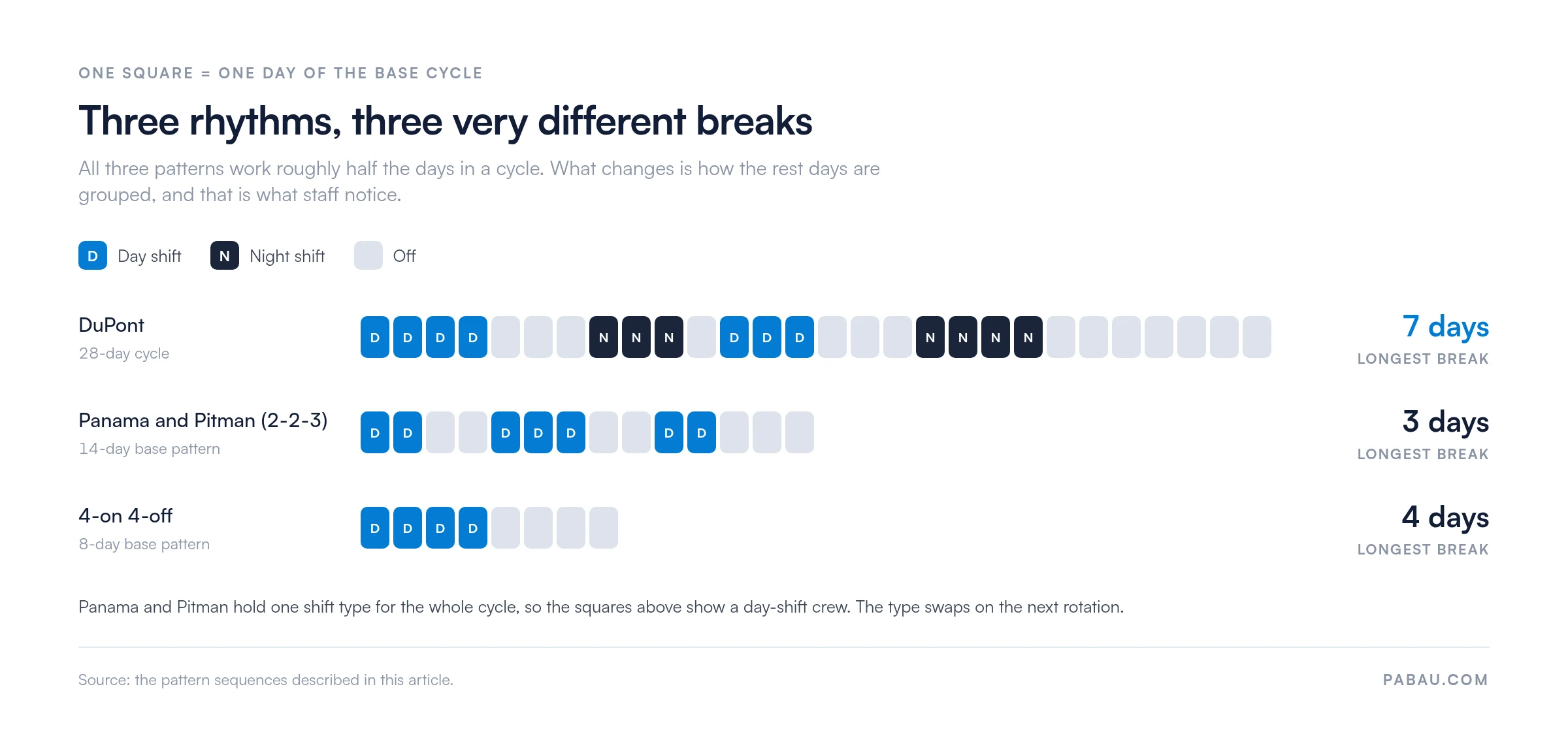
The DuPont schedule runs a 28-day cycle across four crews. Each crew works four 12-hour day shifts, takes three days off, works three night shifts, then takes a single day off. It then works three more day shifts, takes three days off, works four night shifts, and closes with seven consecutive days off. That seven-day block is the longest unbroken break in common rotating shift work, which is why the pattern keeps its following.
Employees work two 12-hour shifts, take two days off, work three shifts, take two days off, work two shifts, then take three days off. That 14-day pattern then repeats. The crew holds the same shift type for the whole cycle, either all days or all nights, and the type only swaps every four weeks. Staff get frequent short breaks and a pattern they can recite from memory, but never more than three days off in a row.
Pitman runs the same 2-2-3 rhythm as Panama, anchored so that every other weekend falls inside an off block. Staff with school-age children, or a partner on weekday hours, often rate that above a longer break. The trade-off matches Panama’s: no rest block runs longer than three days.
Four days on, four days off, repeating every eight days. That base cycle is the shortest of the four, which makes the pattern the easiest to publish and the easiest for staff to plan around. It still averages about 42 hours a week, and the four-day break is long enough for genuine recovery.
Healthcare runs 24/7, and staffing is the largest line on most budgets. A 12-hour rotation cuts the number of clinicians, nurses, and support staff needed to hold continuous cover. It also hands people longer stretches away from work, which matters most in emergency medicine, ICU nursing, and aesthetic centers where fatigue drives turnover.
Healthcare worker burnout is driven partly by unpredictable schedules and too little recovery time. A fixed rotation answers both. Staff can see their shifts months ahead, and the off-blocks are long enough to be worth planning around.
Three factors decide it: crew size, your regulatory position, and what staff actually want.
Once you have picked a pattern, five steps turn it into a published schedule.
A practice management app that already holds staff working hours saves you rekeying the cycle into a second system. For groups running several sites, multi-location scheduling software keeps one master schedule instead of a spreadsheet per location.
Most practices design the rotation in a spreadsheet, then rebuild it by hand inside whatever runs the appointment book. The two drift apart within weeks. A clinician shows as bookable on a night they are off, or a day shift goes out with nobody assigned to reception.
Practice management software like Pabau holds each staff member’s working hours against the calendar, location by location. Once a crew’s shift pattern is entered, the online booking portal only offers slots when that clinician is on shift. Reception sees the same picture, and so does anyone covering a second site that week.
The template above is where the rotation gets designed. Entering those hours in Pabau is what stops the schedule and the appointment book from disagreeing a month later.

Pabau holds each clinician’s working hours against the calendar, so online booking only offers slots when someone is on shift. Multi-location practices run every site from one master schedule.

Pick the pattern by the break your staff want, not by the cycle length. DuPont pays seven consecutive days off, but it needs four crews and puts people through more shift-type changes. 4-on 4-off is easier to run and easier to remember, and its four-day break suits most people.
Whichever you choose, the cost lands at roughly 42 hours a week per person. Settle the 8/80 election with your labor counsel before the first cycle goes out. Then download the template, assign your crews, and publish at least eight weeks ahead.
Book a demo to see how Pabau keeps staff working hours and patient bookings on the same schedule.

Need a simpler weekly rota to start from? Practice schedule template gives you a plain weekly grid before you commit to a 12-hour rotation.
Assigning care staff day by day? CNA daily assignment sheets break a shift down to who is responsible for which patients.
Worried about the overtime bill? Best healthcare payroll software compares the tools that calculate shift differentials and overtime for you.
Ready to move off spreadsheets? Medical practice scheduling software explains what changes when the rota and the appointment book share one system.
A rotating 12-hour shift schedule is a staffing pattern where employees work consecutive 12-hour shifts, alternating between day and night. Crews then take blocks of consecutive days off, and three or four of them run the same sequence offset from each other. That holds 24-hour coverage while giving everyone predictable time away from work.
Days off depend on the pattern. DuPont gives seven consecutive days off every 28 days. Panama (2-2-3) provides two to three days off between each block of shifts, and Pitman anchors those off-days so every other weekend is free. 4-on 4-off gives four consecutive days off every eight days. All four run roughly half the days on and half off, which works out at about 170 to 185 days off a year.
These patterns average about 42 hours a week, which is above the 40-hour FLSA threshold. Healthcare employers can elect the 8/80 rule under FLSA Section 7(j). It pays overtime past 8 hours in a day, or past 80 hours in a 14-day period. Other industries either pay the overtime or reshape the pattern to stay under 40 hours. Check your position with DOL guidance and a labor attorney in your state.
Night shifts disrupt circadian rhythms and raise fatigue, particularly in the last hours of a long shift. Countermeasures include capping consecutive night shifts at three or four and keeping sleep times consistent. Recovery days built into the switch from nights back to days help as well. NIOSH recommends fatigue-risk management programs for any operation running rotating shifts.
Print the PDF, or fill it in with a PDF editor that supports form fields. Complete the employee, job title, department, and week-beginning fields, then write each day’s shift into the matching time row. Adjust the time bands if your shifts do not run 7am to 7pm and 7pm to 7am. Print one sheet per person for each week of the cycle.