How to retain employees in healthcare: Proven strategies
Learning how to retain employees in healthcare starts with fixing the four reaso...

Last Updated: Oct 6, 2026
The Panama shift schedule is a 2-2-3 rotation that keeps a practice staffed around the clock with four teams working 12-hour shifts. Over a 14-day block, each team works 2 days, has 2 off, works 3, has 2 off, works 2, then has 3 off.
Two teams cover days and two cover nights, and the pairs usually swap after 14 days, so the full cycle runs 28 days. Each employee averages 42 hours a week and gets every other weekend off as a three-day weekend.
The pattern only holds up when leave, pay weeks, and handovers are planned around it. Below you’ll find the full 28-day grid, a free weekly template, and the points where the rota usually comes under strain.
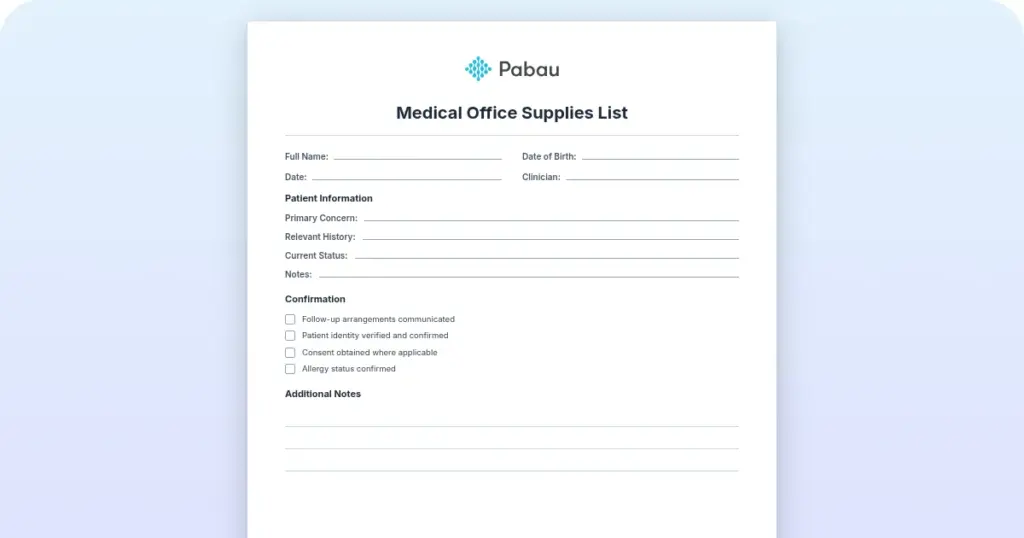
A one-week schedule sheet with morning, midday, afternoon, evening, and night slots for each day, plus employee, department, and week-beginning fields. It also has rows for each activity, its time, the person responsible, and notes, and a box to record that week’s changes and why.
Download template
The Panama shift schedule runs four teams on 12-hour shifts in a 2-2-3 on/off pattern that repeats every 14 days.
Two teams cover days and two cover nights, and the pairs swap every 14 days, so the full cycle lasts 28 days.
Each employee works seven shifts per 14 days, an average of 42 hours a week, with every other weekend off.
Pitman uses the same 14-day on/off sequence, while DuPont runs a 28-day cycle that ends with seven days off.
Pabau’s team management software repeats shift patterns, approves time off, and feeds clock-ins into timesheets, so the rota and payroll stay in step.
The Panama shift schedule is a four-team rotation of 12-hour shifts that covers every hour of every day. At any moment one team is on duty, while the other three are off or resting between shifts.
The “2-2-3” label comes from the runs of working days. Each team works 2 shifts, has 2 days off, works 3 shifts, has 2 off, works 2, then has 3 off. That sequence takes 14 days, and the four teams are staggered so their working days interlock.
Shifts usually run 7:00 AM to 7:00 PM and 7:00 PM to 7:00 AM. With only two handovers a day, there are fewer points where patient information can get lost between staff.
The table below shows the first 14 days for four teams. Teams A and B share the day shifts, and Teams C and D share the nights.
On day 15 the pairs swap: Teams A and B move to nights, and Teams C and D move to days. The grid below shows the full 28-day cycle, including where each team’s three-day weekend falls.
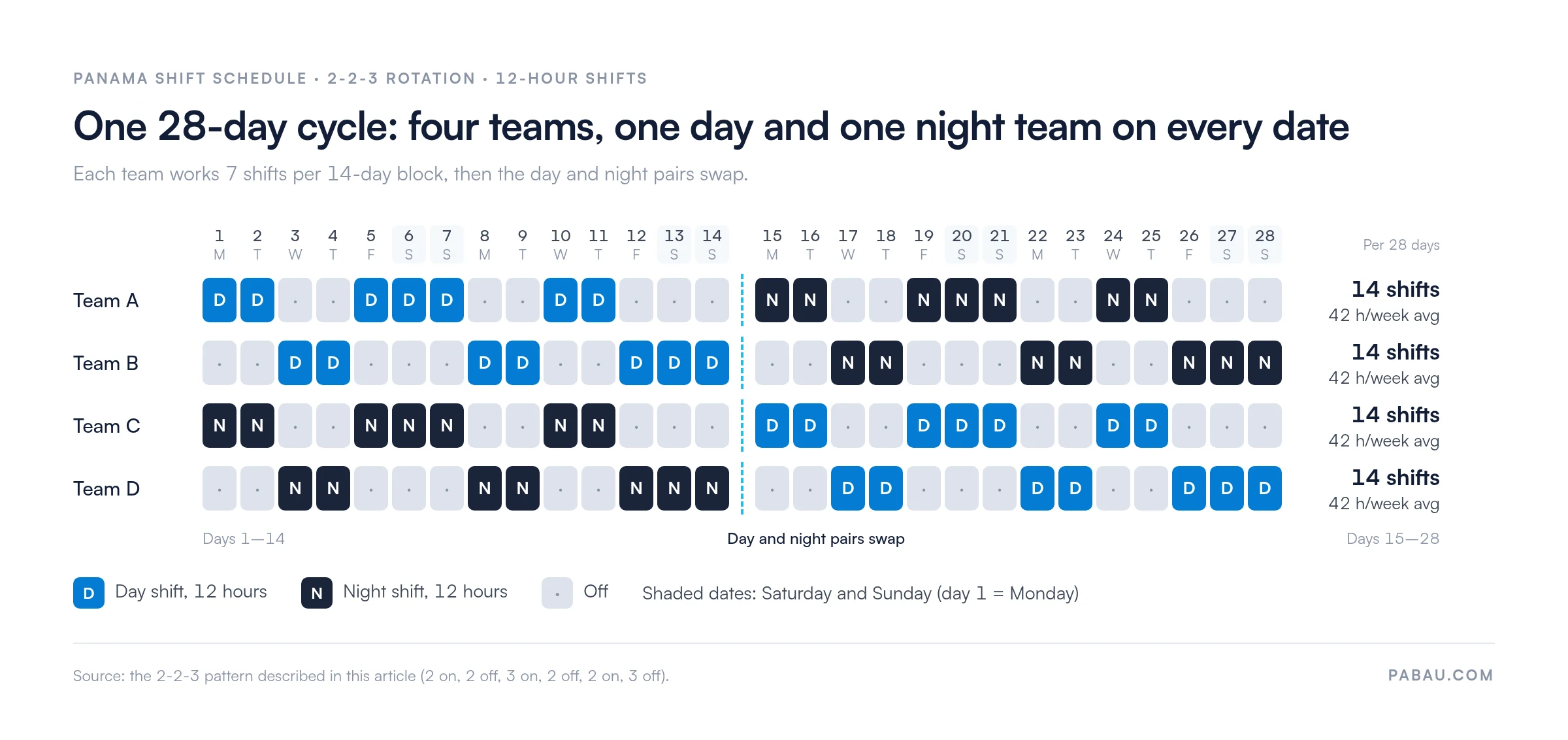
Because every team spends half the cycle on nights, no one is stuck on permanent overnight work. Some operations skip the swap and keep fixed day and night teams, which turns the pattern into a 14-day Pitman rotation.
The downloadable template is a one-week sheet, so you fill in one copy per employee or team for each week of the rotation. Here’s how to complete it.
For shift-level tasks, our daily assignment sheets pair well with this schedule. Practices that book patients around the rota often move it into medical scheduling software, so the calendar shows which team is on duty.
The pattern suits any operation that can’t close overnight. Healthcare adopts it widely because patient care can’t pause.
Outpatient practices that close in the evening rarely need it. A fixed roster or a two-shift day covers their opening hours with less strain on staff.
The pattern trades long shifts for more days off. The table sets out where it helps a team and where it strains one.
Occupational health research from NIOSH shows that shift work and long hours raise health and safety risks. Twelve-hour shifts cut the number of shift changes in a week compared with 8-hour rotations, but each shift runs longer.
Individual experience varies. Some staff thrive on longer runs of days off, while others find 12-hour shifts taxing regardless of rotation. Our guide to burnout in healthcare covers the warning signs to watch for.
Three 12-hour rotating patterns dominate 24/7 operations. Each has its own cycle length and trade-offs.
Pitman runs the same on/off sequence as Panama, usually with teams kept on fixed day or night shifts. Panama adds the day/night swap, which stretches its full cycle to 28 days.
DuPont also repeats every 28 days, but it packs work into longer blocks and ends with seven straight days off. Choose Panama if your staff prefer short, frequent breaks and you have a stable four-team structure.
Choose DuPont if they would rather work harder stretches in exchange for one long break each month. Neither pattern suits every team, so ask staff before you commit.
Rolling out the pattern takes planning beyond the template. Work through these steps before the first cycle starts.
On paper, a Panama rota lives in a spreadsheet that someone rebuilds every month. Leave requests arrive by message, and hours get keyed into payroll by hand.
Pabau, the time-saving practice management app we build, holds the rota in the same calendar as your patient bookings. You build the 2-2-3 shifts once, repeat the pattern, and approve time off, so the calendar always shows who’s available.
Staff on scheduled shifts can be clocked in and out automatically, and those hours flow straight into timesheets and wages. The 36-hour and 48-hour weeks get paid correctly without anyone checking the grid by hand.

Pabau’s team management tools repeat your shift pattern, approve time off, and feed clock-ins into timesheets, so every team is covered and paid correctly.

The Panama shift schedule earns its place when you need round-the-clock cover and have four stable teams to run it. If you can’t field four teams, a lighter pattern will be easier to sustain.
Run the template for one full cycle, track fatigue and leave closely, and ask staff for feedback at three months. The trade-off to remember is more days off, paid for with long shifts.
Want the rota, leave approvals, and timesheets in one place? Book a demo to see how Pabau schedules four-team rotations for your practice.

Need a blank weekly roster? Practice schedule template gives you a printable layout for planning the whole team’s week.
Paying staff on alternating 36- and 48-hour weeks? Best healthcare payroll software compares tools that handle variable hours.
Booking patients around your rota? Patient scheduling and appointment management shows how to keep bookings matched to staff availability.
You work an average of 42 hours a week across the cycle. Pay weeks alternate between three 12-hour shifts (36 hours) and four (48 hours), which balances out to 42.
Hospitals, emergency departments, residential care, emergency medical services, fire departments, police and security teams, and manufacturing plants use it most. Any operation that needs 24/7 cover with a stable four-team workforce is a candidate.
Yes, for most staff, compared with fixed night roles. It gives every other weekend off and keeps no team on permanent nights. The 12-hour shifts are still demanding, and fatigue on consecutive nights is common.
You need four teams of equal size, each able to cover a full 12-hour shift alone. If you need 10 staff per shift, you need 40 people in total. The pattern doesn’t work with three or five teams.
Both use the same 14-day sequence: 2 on, 2 off, 3 on, 2 off, 2 on, 3 off. The Panama version usually swaps day and night teams after each block, so its full cycle runs 28 days. Pitman teams often stay on fixed shifts.
Download our free template above and fill in one weekly sheet per employee or team. Mark the shifts from the 28-day grid, list fixed duties with who is responsible, and log any changes with the reason.