Free patient financial agreement template for practices
A financial agreement is the form a patient signs before treatment to confirm wh...

Last Updated: Oct 23, 2026
A sleep schedule for night shift workers is a fixed timetable that lines up your sleep and wake times with your shift pattern. For a 7pm-7am shift, that usually means sleeping from about 8:30am to 4:30pm on every work day. Over your days off, you ease back to nighttime sleep.
Most night shift workers struggle because their body clock expects sleep while they work and alertness while they try to rest. This template gives you sample sleep windows for fixed night shifts and 12-hour rotations, plus pre-shift routines, light and melatonin timing, and napping rules.
A printable plan with fixed and rotating night shift sleep windows, pre-shift and post-shift routines, and light timing for each day of the rotation. Fill in your own shift times and keep it by the bed.
Download template
A consistent sleep schedule for night shift workers anchors your circadian rhythm by setting fixed sleep and wake times, even on days off.
Night shift sleep disruption stems from circadian misalignment: Your body’s internal clock expects wakefulness at night, so every daytime sleep works against your biology.
The three pillars of a night shift sleep schedule are a fixed sleep window, a 30-minute wind-down routine, and deliberate light timing.
After a run of nights, move your sleep window back to nighttime in steps across your days off rather than flipping it overnight.
Pabau’s staff scheduling software helps practices build predictable night blocks, so staff can protect a sleep window instead of rebuilding it every week.
Your circadian rhythm is a 24-hour biological cycle that regulates sleep, hormone release, body temperature, and alertness. Night shift work puts your internal clock and your schedule in direct conflict. While you are meant to be sleeping, your body is primed for activity, and the consequences are measurable.
A 2016 CDC NIOSH study of 6,338 US adults found insomnia in 18.5% of night shift workers, compared with 8.4% of day workers. That is roughly 2.2 times the rate. Chronic sleep loss follows, and some night shift workers become fatigued enough to have accident and error rates comparable to drunk drivers.
Over months and years, circadian misalignment also increases the risk of cardiovascular disease, metabolic syndrome, and mood disorders.
The biological mechanism is simple: Light exposure, meal timing, and activity cues anchor your circadian clock to a particular schedule. When you work nights and sleep days, each of those signals tells your body the opposite of what you want it to do.
A deliberate sleep schedule counters this. It locks in consistent sleep and wake times, uses light strategically, and times naps and supplements to move your body clock during rotations.
A working sleep schedule for night shift workers rests on three non-negotiable elements: A fixed sleep window, a wind-down routine, and deliberate light timing. These five steps turn them into a plan for your shift pattern.
This timetable applies to practitioners and nurses working a consistent 12-hour night shift, 7pm to 7am.
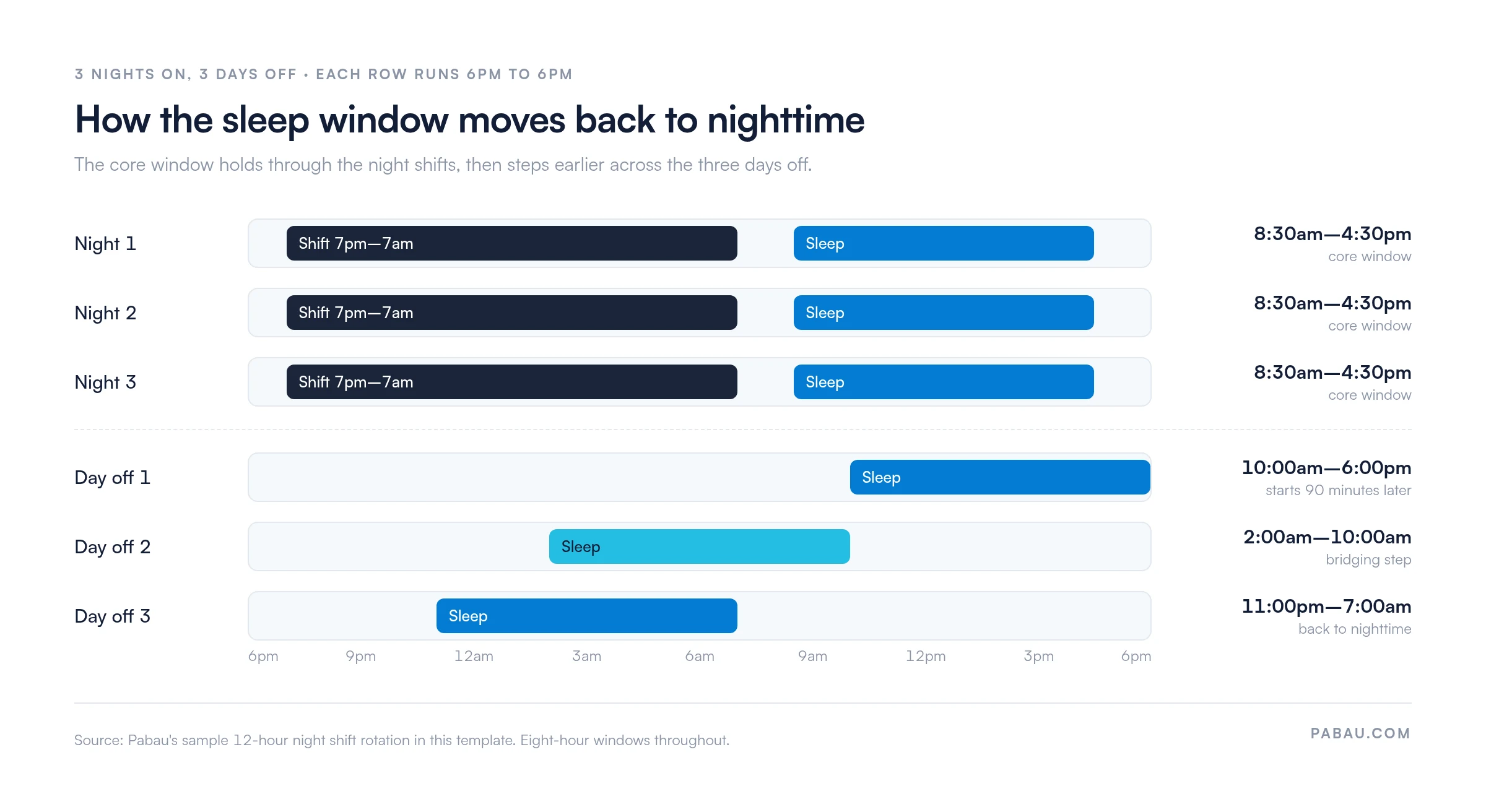
Many healthcare facilities use a rotating 12-hour pattern, such as three nights on and three days off, or two on and two off. This timetable holds a core sleep window through the nights, then moves it back to nighttime in steps across the days off.
Laid out on a single clock, the days off show two moderate steps instead of one overnight flip from daytime to nighttime sleep.
Nurses face specific sleep challenges: Back-to-back night shifts, frequent rotations (sometimes night to day within 48 hours), on-call interruptions, and compassion fatigue. Each one can disrupt sleep quality, even on rest days. A night shift nurse sleep schedule must account for all of them.
A rotating shift sleep schedule faces a fundamental challenge: Your circadian rhythm cannot adapt fast enough to a rotation that changes every 2-3 days. Deliberate light exposure and melatonin timing help speed the adjustment up.
On the day you move from day shifts to night shifts, get bright light in the first 4 hours of your night shift. Use darkness (blackout curtains, amber glasses) for the rest of it. This signals your circadian clock to shift wakefulness later.
On the final night before returning to day shifts, avoid bright light during your shift and get bright daylight as soon as you finish. This pulls the clock back toward days. The American Academy of Sleep Medicine gives melatonin a conditional recommendation based on very low certainty evidence, without setting a specific dose.
Commonly studied doses of roughly 0.5-3 mg, taken 30-60 minutes before your target sleep time, may further speed adaptation.
A practical rotating shift protocol: On your first night of a new shift pattern, prioritize 30 minutes of your scheduled wind-down. Even partial adherence helps, such as dimming lights and avoiding screens. By night 2-3, your body begins to adapt. By night 4, many practitioners report deeper sleep despite the late schedule.
If your rotation changes faster than every 3 days, full adaptation is unrealistic. Focus instead on consistency, keeping the same sleep and wake times whatever hours you work. Protect a core sleep window, even if it is shorter.
The room you sleep in and the habits you carry matter as much as your timetable. These sleep hygiene essentials make your sleep schedule for night shift work harder.
A personal sleep schedule only holds if the staff schedule behind it is stable. Last-minute swaps, irregular rotations, and short breaks between night blocks undo a sleep window faster than any noise or light problem. That makes team scheduling software part of how a practice protects staff health.
In Pabau, the platform for healthcare practices we build, managers create shifts, repeat the patterns that don’t change, and approve time off in one calendar. That makes predictable night blocks easy to keep, ideally 3-4 nights in a row followed by 2-3 days off.
Staff who know their pattern weeks ahead can set their core sleep window before the block starts. Clock-ins and hours worked flow into timesheets too, so managers can see who has stacked back-to-back nights.
Stable schedules mean less fatigue on shift, fewer errors, and lower turnover among nurses and practitioners. If burnout in healthcare is already costing your practice staff, the schedule is the first lever you control.

Pabau’s team management tools let you build recurring shifts and approve time off in one calendar. Staff see their night blocks well ahead, so they can plan sleep around them.

Night shift sleep works when the window stays fixed, light is timed on purpose, and the return to days happens in steps. Start with the sample timetable closest to your pattern and change one variable at a time.
Keep a sleep journal for two weeks. It will show whether noise, light, meal timing, or the schedule itself is costing you the most sleep.
The trade-off to remember is that no personal routine survives an unpredictable staff schedule. If you manage a team, a stable night block protects their sleep and your patients’ safety. Book a demo to see how Pabau helps your practice build night shift schedules that staff can sleep around.

Worried about your team running on empty? Healthcare worker burnout solutions covers practical fixes a practice can put in place without an HR department.
Planning the whole week, not just the nights? The practice schedule template gives you a ready-made layout for mapping appointments and staff cover.
Handing out tasks at the start of a shift? The CNA daily assignment sheets template keeps patient assignments and duties clear for every shift.
Need an accurate record of hours worked? Staff time tracking software shows how clock-ins and breaks flow straight into timesheets.
Most night shift workers need 7-9 hours of sleep per 24 hours, the same as day workers. The timing and quality of sleep matter as much as the total. Six hours of consolidated daytime sleep on a fixed schedule often feels more restorative than 8 fragmented hours scattered across different times.
Sleep after your shift, when sleep pressure is highest. Sleeping before a night shift often backfires: You wake groggy, your body clock misaligns further, and you may not sleep long enough to recover. The exception is a short pre-shift nap (20-30 minutes) before a 16+ hour stretch.
Yes, it can help some people. Commonly studied doses are roughly 0.5-3 mg, taken 30-60 minutes before your target sleep time. That may help you fall asleep and shift your circadian rhythm during rotation weeks. Melatonin works alongside light timing, consistent schedules, and sleep hygiene rather than replacing them. Check with a physician first, as it interacts with some medications.
Transition gradually. On your first day off after nights, stay in dimmed light and sleep your full 8 hours. On day 2, get bright morning light and dim the lights after sunset. By day 3, your circadian clock typically re-anchors to a day schedule. Avoid staying up past your planned bedtime on those first days off, as it prolongs the adjustment.
Anchor a core sleep window (e.g. 9am-1pm) that overlaps on all shift types, and extend it on days off. Use bright light and darkness strategically to speed up circadian adjustment during rotation weeks. Ask for predictable schedules that repeat week to week, so your body can anticipate changes. Build recovery time between night blocks: A minimum of 2 consecutive days off after 3-4 nights lets your circadian rhythm partially reset.