HIPAA compliant texting: What you can send patients & how to communicate securely
HIPAA compliant texting is possible when a text holds no protected health inform...

Last Updated: Oct 16, 2026

A DHA license comes in two forms, and a practice owner usually needs both a professional license and a facility license.
Every application runs through Sheryan, DHA’s online licensing portal, because paper and emailed submissions are not accepted.
The professional route takes roughly three to six months, and DataFlow verification plus the Prometric exam account for most of it.
Fees change and vary by profession, grade, and facility category, so confirm the current figure in Sheryan before you budget.
A facility license only activates after a DHA inspection that asks for proof of tested NABIDH connectivity.
A DHA license is the Dubai Health Authority’s permission to work in healthcare in Dubai, and it comes in two forms. A professional license covers one clinician. A facility license covers one site, and the business that operates it.
Both run through Sheryan, DHA’s online licensing portal. There is no paper form and no email route, so the sequence below is the whole process for either license.
This guide is written for the person opening or running the practice rather than the clinician relocating for a job. That means both routes, what each one costs, and the step that decides your opening date.
That last step is a software one. Pabau is practice management software with a native NABIDH integration. It sends patient and clinical data to DHA in the format the exchange expects.
The DHA license requirements split by applicant. A clinician is measured against DHA’s Professional Qualification Requirements, which set the qualification, experience, and licensing history needed per profession and grade. A facility is measured against its premises, its people, and its records system.
For a clinician, the checklist is short and the verification is slow:
For a facility, the requirements are about the site and how it will run:
Notice which items you cannot buy in a hurry. Verification depends on other institutions replying, and the layout depends on a consultant DHA already recognizes.
If you are opening a practice, you need both. The facility license lets the business treat patients, and each clinician working there holds their own professional license, registered to that facility. A site in Ajman or Ras Al Khaimah needs the same pair, issued by the Ministry of Health and Prevention as a MOHAP license.
The two routes also run on different clocks, and sequencing them is what a launch date depends on. The diagram below sets them side by side.
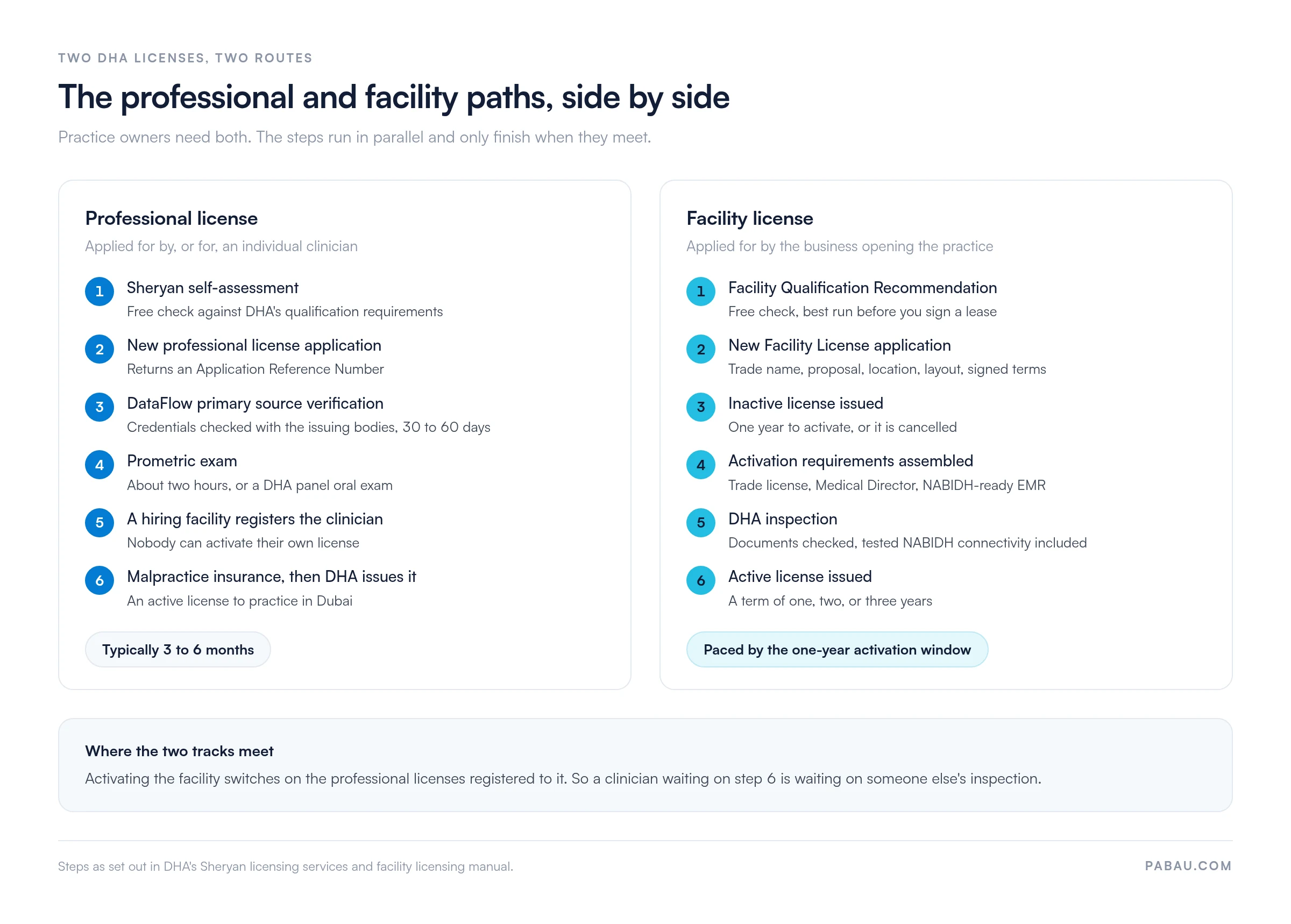
The dependency runs one way. A clinician cannot switch on their own license, and your facility cannot pass its inspection without enough licensed staff for the services you applied for. Start the hiring paperwork before the fit-out is finished.
The professional route runs in six steps, and the order is fixed:
Two details matter more than they look. Verification and an exam pass are not a license to practice, since a facility still has to register you. And the pass gives you about a year to find that facility.
For an owner recruiting a launch team, that year is a scheduling tool. A candidate who passed nine months ago is on a shorter clock than their resume suggests. Their license is also only as fast as your activation date. A hire from Abu Dhabi still applies to DHA, since a DOH Abu Dhabi license covers that emirate only.
Licensing a facility takes two separate Sheryan services rather than one. New Facility License issues a license that is inactive, and Activate Facility License turns it into one you can treat patients under.
The inactive stage is where launch plans slip. The license lasts one year in that state, and the practice can neither treat patients nor advertise. Miss the year and it is canceled, so you apply again from the start.
Unsubmitted drafts expire faster. An application left untouched for 90 days cancels itself. So a half-finished form is not a safe place to park a project while you wait on a landlord.
The Medical Director appointment deserves attention early. The post cannot sit vacant for more than two weeks, and one director can cover several facilities inside the same group. Plan cover when you hire a medical director, not just a name.
For the portal mechanics behind these steps, including account setup, the facility service catalog, and what each application status means, read the Sheryan portal guide.
A professional DHA license usually costs somewhere between AED 2,400 and AED 12,000 in total, spread across four payments. The spread is that wide because issuance scales with grade, and a consultant pays far more than a nurse.
Treat every figure above as indicative. DHA revises fees, and the amount you owe depends on your profession, your grade, and your facility category. Sheryan shows the current figure when you apply, and that is the number to budget from.
One of those stages moves the total far more than the other three. The bars below put all four payments on the same scale.
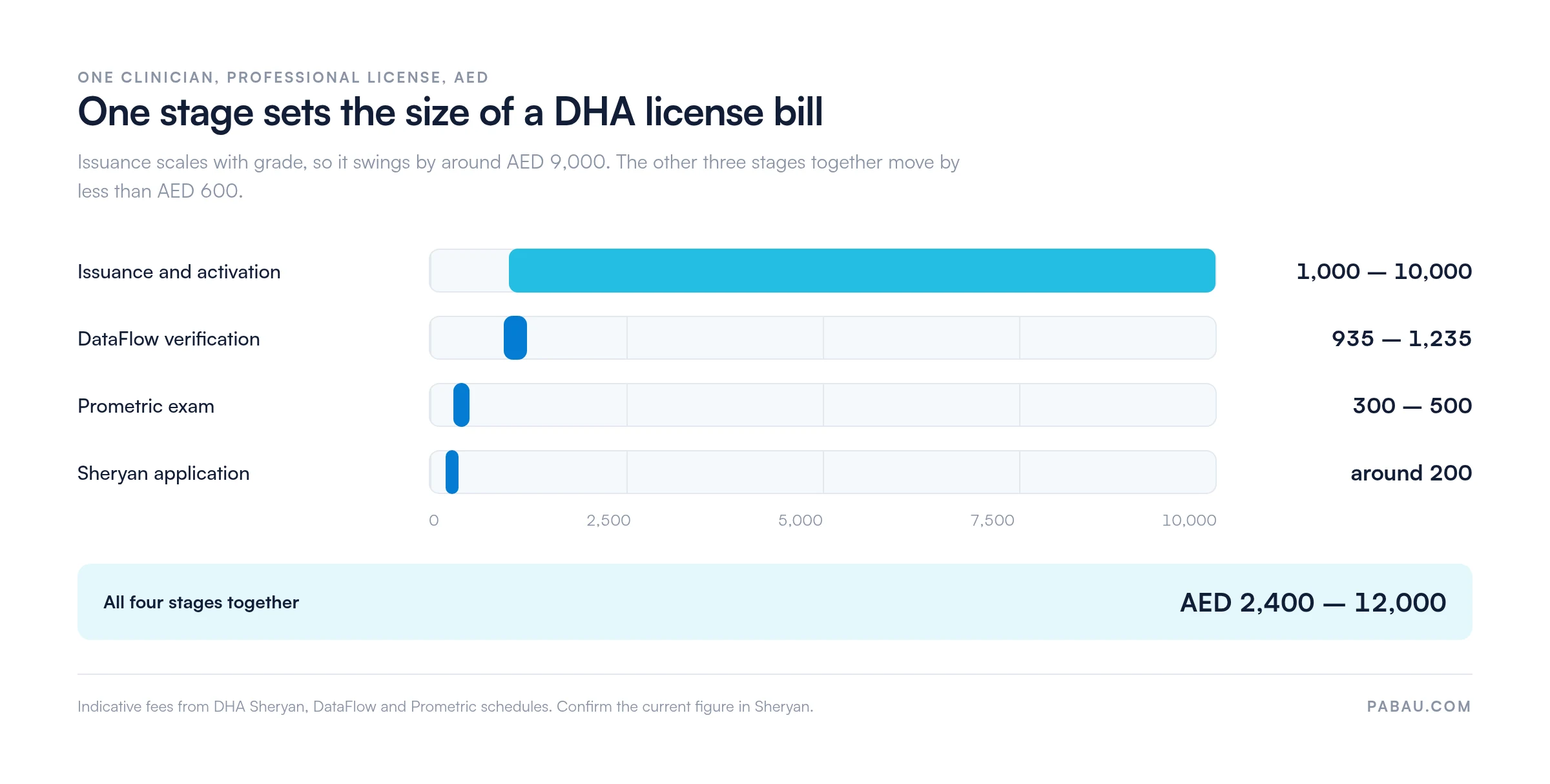
Nurses and allied health professionals renew more cheaply, at roughly AED 1,000, 1,500, or 2,500 for the same one, two, and three-year terms. Owners covering license costs for a team should budget per grade rather than per head. For a nurse’s first license, our guide to DHA nursing license requirements covers the titles, the exam, and the fees.
Plan for three to six months on the professional route, measured from the day DataFlow verification starts. Verification alone takes 30 to 60 days, and it runs longer whenever an issuing institution is slow to reply.
The exam adds a booking wait rather than a long delay. The slow parts are verification at the front and facility registration at the back, and neither is inside your control.
A facility timeline works differently, because the deadline is yours to miss. Once the inactive license is issued, you have one year to fit out, hire, connect your EMR, and pass the inspection. Abu Dhabi’s DOH licensing process starts on a shorter clock, since preliminary approval holds for six months before an extension is needed.
Read those two clocks together and the order sorts itself out. Verification for your first clinicians should start while the layout is still with the design consultant.
Renewal is a Sheryan service, and a facility license renewal opens three months before expiry. Leave it more than six months past expiry and the license is canceled outright, which means a fresh application rather than a renewal.
Professional licenses renew on the same one, two, or three-year terms, submitted in Sheryan by the clinician or the employing facility. The longer terms cost more up front and less per year.
For a practice with a dozen clinicians, renewal is a calendar problem rather than a form-filling one. Every license carries its own expiry date, and one lapsed clinician narrows the services you can legally offer.
Put both kinds of expiry in the same place your team already looks. A renewal that only exists in one person’s inbox is the one that gets missed during a busy quarter.
Search the person or the business in Sheryan’s public lookup. The Sheryan portal offers Search Health Professional and Search Health Facility, and both accept a name, a license number, or a specialization.
A professional result shows more than a yes or no:
Those last two fields are the useful ones for an operator. A locum whose license still names a previous employer has not been registered to you yet. An expiry date inside your next quarter is a hiring risk.
The same lookup works before you refer a patient to another practice, or sign a rental agreement with one. Check the facility’s status and the grade of the clinician you are naming.
NABIDH is DHA’s health information exchange, and connecting to it is an activation requirement rather than a follow-up task. Activation asks for evidence of an installed EMR meeting NABIDH’s Minimum Data Set and connectivity requirements. The inspection then asks for the email confirming that connection was tested.
Practices usually meet that in one of two ways. They commission an integration on top of their records system, or they buy a middleware layer to sit between the two. Both are projects, and both land in the same weeks as the fit-out and the hiring.
Pabau removes that project by reporting from inside the working day. Patient demographics leave as HL7 v2.5.1 messages at registration, update, and check-in. Visits, allergies, prescriptions, lab results, documents, and patient merges are available as opt-in message types.
Setup is a one-time entry rather than a build. You add your DHA NABIDH EMR code, your Sheryan facility license ID, the NABIDH endpoint, and an application key. Each practitioner’s Sheryan ID is mapped once and rides on their visit messages.
The outcome is one fewer blocker on the inspection checklist, and a delivery log for every message once you open. Owners comparing EMR software in Dubai should filter on NABIDH support first, then compare the EMR features their team will use daily.

Pabau sends NABIDH HL7 messages as your team registers and treats patients, and logs the delivery of each one. So your Dubai practice can evidence tested connectivity when DHA asks for it.

Work backwards from the inspection date, not forwards from the application. The slowest requirements sit at the end of both routes, and the one-year activation window is shorter than a fit-out schedule makes it look.
The trade-off worth remembering is that the two licenses look alike in Sheryan and behave differently. A clinician’s license is switched on by a facility. A facility’s license is switched on by an inspection that wants a NABIDH email.
So pick the records system early, while the layout is still in draft. Book a demo to see how Pabau reports to NABIDH from the work your team already does.

Opening a second site in Abu Dhabi? What is Malaffi explains the emirate’s own health information exchange and what connecting to it asks of your records system.
Choosing software for a Dubai practice? Medical spa software in the UAE compares what a UAE practice needs from its records system.
Moving off a system that cannot report to NABIDH? EMR conversion covers how to move patient data between systems without losing history.
Preparing the policies an inspector asks for? Clinical documentation software explains how notes and policies stay audit-ready day to day.
Building the compliance side of a new practice? Compliance management software shows how consent, records, and access controls sit in one system.
Eligibility is measured against DHA’s Professional Qualification Requirements, which set the qualification, experience, and licensing history needed for each profession and grade. Sheryan’s free self-assessment tells you where you stand before you pay any fees.
Yes. You can apply, complete verification, and pass the exam before you have an employer. The license only becomes active once a DHA-licensed facility registers you, and a pass holds for about a year while you find one.
Because DataFlow has to hear back from the universities, regulators, and employers that issued your documents. The file stays open until those institutions reply, so a slow response abroad extends the whole application.
The license stays yours, but the registration behind it does not. It is linked to the facility that registered you, so a new employer has to register you in Sheryan before you start treating patients there.
It is canceled, and reopening means a fresh application rather than an extension. Unsubmitted drafts expire faster still, since an application left untouched for 90 days cancels itself automatically.
No. A DHA license covers practice in Dubai, and the other emirates license healthcare through their own authorities. Working or opening a site elsewhere in the UAE means a separate application to that regulator.