Informed consent action network
The Informed Consent Action Network (ICAN) is a US vaccine-policy advocacy group...

Last Updated: Oct 14, 2026

A MOHAP license covers the northern emirates, so it does not let you practice in Dubai or Abu Dhabi.
A working practice needs two licenses at once, one for the premises and one for every clinician on the roster.
DataFlow verification sets the pace of a professional application, and it runs for weeks after the paperwork is in.
Professional renewals are due at least three months before expiry, and facility renewals around two months before.
A MOHAP-licensed facility has to keep an active Riayati connection, and that is checked when the license comes up for renewal.
A MOHAP license is what lets a clinician practice, or a practice open its doors, in the UAE’s northern emirates. The Ministry of Health and Prevention issues it. It is the wrong license for Dubai or Abu Dhabi, which run their own regulators.
Most guides to this license are written for one doctor relocating from abroad. This one is written for the practice. A practice owner is not making one application. They are keeping a facility license and a roster of individual licenses valid at the same time, on dates that never line up.
So this guide covers the AED fees for both licenses and the stages each one runs through. It also sets out the MOHAP license calendar, which works backwards from the date printed on your license.
A MOHAP license is the Ministry of Health and Prevention’s permit to practice, or to run a health facility, in the UAE’s northern emirates. Those emirates are Ajman, Umm Al Quwain, Ras Al Khaimah, Fujairah and Sharjah. Sharjah is the one to check, because the Sharjah Health Authority now issues its own licenses.
Two separate licenses sit under the same name. Clinicians hold a professional license, assessed against their own qualifications. Premises hold a facility license, assessed against the building, the equipment and the staff working in it.
Anyone searching for a medical license in the UAE runs into this quickly. There is no single national health license. Where you intend to work decides which of four regulators you apply to.
An MOH license and a MOHAP license are the same document, because the Ministry of Health became the Ministry of Health and Prevention. The older name still turns up on job adverts, recruitment sites and the ministry’s own web addresses.
You will also see MOH license UAE used as shorthand for the northern emirates route. Both names point at the same application and the same portal. The certificate itself is a PDF you download once the license is approved.
Your emirate decides your regulator, and the UAE has four of them rather than one national licensing body. Getting this wrong costs months, because the application does not transfer.
| Where you practice | Licensing authority | Licensing system |
|---|---|---|
| Ajman, Umm Al Quwain, Ras Al Khaimah, Fujairah | MOHAP, the Ministry of Health and Prevention | MOHAP portal and smart app |
| Sharjah | SHA, the Sharjah Health Authority, alongside MOHAP | SHA e-services |
| Dubai, outside Dubai Healthcare City | DHA, the Dubai Health Authority | Sheryan |
| Dubai, inside Dubai Healthcare City | DHCR, the free zone’s regulatory arm | DHCR e-services |
| Abu Dhabi, Al Ain, Al Dhafra | DoH, the Department of Health | TAMM |
Sharjah sits between two of them. The Sharjah Health Authority has been taking over licensing inside the emirate, and facilities are moving across from MOHAP at different times. Ask the facility hiring you which regulator it licenses staff under.
Licenses do not transfer between these authorities. A DoH license in Abu Dhabi has no standing in Sharjah, and a MOHAP license has none in Dubai. Moving between emirates means a fresh application, although a verified DataFlow report usually carries over.
If you are licensing a Dubai practice instead, the process runs through Sheryan and the fee lines look different.
A DHCC license authorizes practice inside Dubai Healthcare City only, and it carries no weight on the Dubai mainland or in any other emirate. Practitioners there are licensed by DHCR, not by DHA and not by MOHAP.
Mainland practices in the northern emirates hold one health license from MOHAP. That sits alongside the trade license from their emirate’s economic department, which is a separate document from a separate authority.
Free zones work differently. In Dubai Healthcare City the commercial license comes from the Dubai Healthcare City Authority. The facility license and every professional license come from its regulatory arm.
Free-zone status also changes the ownership rules, since free zones permit full foreign ownership of the entity. Mainland ownership rules vary by emirate and have been relaxed in recent years, so confirm the current position with the economic department.
Clinicians hold a professional license, premises hold a facility license, and a working practice in the northern emirates needs both at once. Neither one substitutes for the other.
The two are assessed on different evidence. A professional license is judged on qualifications, verified experience and, for most categories, an exam. A facility license is judged on the premises, the equipment, the waste handling and the staffing plan.
They also depend on each other. A facility cannot open with unlicensed clinicians. A clinician’s license only becomes active once a licensed facility registers them against it.
MOHAP asks a clinician for proof of qualification, experience and standing. It asks a practice for proof of premises, equipment and staffing. The two document sets barely overlap.
A clinician applying for a professional license is normally asked for:
A practice applying for a facility license is normally asked for:
MOHAP evaluates the file before it issues a license. The MOHAP evaluation certificate that comes out of that step confirms which professional title you qualify for. Your license category in the UAE then sets both your scope of practice and your fee.
Thresholds differ sharply by profession. Nurses face different experience requirements from physicians, and Dubai’s nursing license requirements show how far these vary between regulators.
MOHAP will not assess an application until DataFlow has verified your credentials at source and a good standing certificate confirms your record. Both steps happen outside the ministry, which is why they take the time they do.
The good standing certificate comes from the regulator you were last licensed under. It confirms you left with no open disciplinary case. It usually has to be less than six months old on the day you submit it.
DataFlow handles primary source verification, known as PSV. It writes to every university, regulator and employer named in your file, then waits for each one to reply. That waiting is what sets your timeline.
Reported turnaround runs from about two to four weeks at the fast end. It stretches to six or twelve weeks when institutions abroad are slow to answer. MOHAP DataFlow fees are charged per profession, and rise with each extra document you submit.
The professional route runs through the MOHAP portal from start to finish, and takes most applicants two to three months. The eleven steps below run in order, and several of them wait on someone outside the ministry.
The portal is the only route in. There is no paper submission, and the MOHAP login is the same UAE PASS identity you already use for other federal services.
You can follow a MOHAP application status in the portal at every stage. That matters most while DataFlow is running, because the file can sit untouched for weeks even when the application is fine.
MOHAP routes most license categories through a computer-based Prometric assessment, with a pass mark reported between 60 and 70 percent depending on the specialty. Prometric delivers the test at its own centers.
You book a slot once MOHAP clears you to sit it, so the exam adds a scheduling wait rather than an instant step. There is no negative marking, which means an unanswered question scores the same as a wrong one.
Some senior categories are exempt. Consultants with the right credentials are often assessed on their file instead, which is why their fee lines carry no exam charge.
Licensing premises is a staged process, and MOHAP approves each stage before you are allowed to start the next. Building ahead of an approval is the expensive mistake here.
Start the staff licenses while the fit-out is still running. A file that only opens after the building is finished leaves it sitting empty while DataFlow works through the roster.
Your records system is part of the inspection too. MOHAP expects a licensed facility to be connected to Riayati, the national health information exchange the ministry runs.
Onboarding is not a switch you flip. It involves an information security assessment, a data participation agreement with MOHAP, and end-to-end HL7 testing before the connection counts as live.
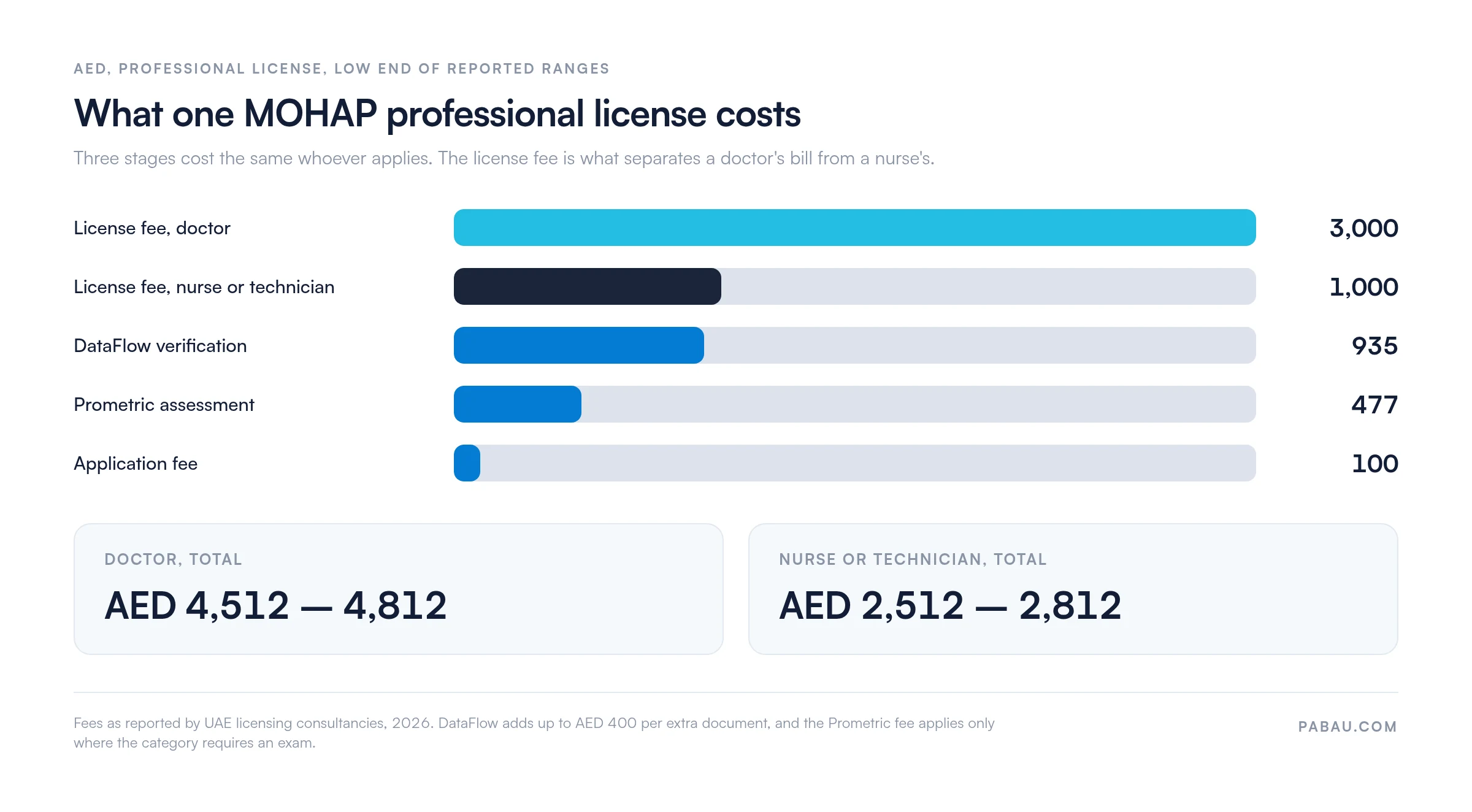
Licensing one doctor typically totals AED 4,512 to AED 4,812, while a nurse or technician lands between AED 2,512 and AED 2,812. The license fee for a general practice starts at AED 5,000 on top of that. The table below puts both sides in one place.
| Stage | Professional license (AED) | Facility license (AED) |
|---|---|---|
| Application fee | 100, flat | 100 |
| DataFlow verification | 935 to 1,235, plus up to 400 per extra document | Charged per clinician on the roster |
| Prometric assessment | From 477, where the category requires an exam | Not applicable |
| Plan verification | Not applicable | 1,000 to 2,000, by size |
| Inspection | Not applicable | 1,000 for practices, 2,000 for hospitals |
| License issue | 3,000 for doctors, 1,000 for nurses and technicians | 5,000 general practice, 6,000 specialist |
| Reported total | 4,512 to 4,812 for a doctor, 2,512 to 2,812 for a nurse or technician | 7,200 to 8,600 for a small facility |
| Annual renewal | 1,000 for nurses, 3,000 for physicians and dentists | Charged by facility category |
These figures were reported by UAE licensing consultancies in 2026, rather than published by the ministry. Treat them as a planning range. MOHAP publishes its own schedule, and the fee charged in the portal is the one that governs. Confirm it on the ministry’s services pages before you budget.
Two lines surprise practice owners. DataFlow is charged per clinician, so a six-person roster pays it six times. And a physician pays AED 3,000 to renew every year, the same as the license fee itself. The stack below shows where a single clinician’s money goes.
A professional MOHAP license usually takes two to three months, and DataFlow rather than the ministry sets that pace. Splitting the wait by stage makes it easier to plan around.
MOHAP’s own steps are quick. Reported figures put the ministry’s review at around five working days, and issuance of the license at two. Those are the only parts the ministry controls.
DataFlow is the long pole. It runs two to four weeks when institutions reply promptly, and six to twelve weeks when they do not. The exam adds a scheduling wait on top of that.
Facility licensing is measured in months rather than weeks. Reported ranges run three to six months for a practice, and six to twelve for a hospital, driven mostly by construction and approvals.
A MOHAP license runs for one year, and the professional renewal has to be filed at least three months before it expires. The facility license runs on the same annual cycle, with its renewal due around two months out.
Neither window includes the work that has to happen first. That is why a MOHAP license calendar beats a single date in the diary. Work backwards from the date printed on the license.
Only two of those dates belong to MOHAP. The rest are what has to happen for those two to be met on time.
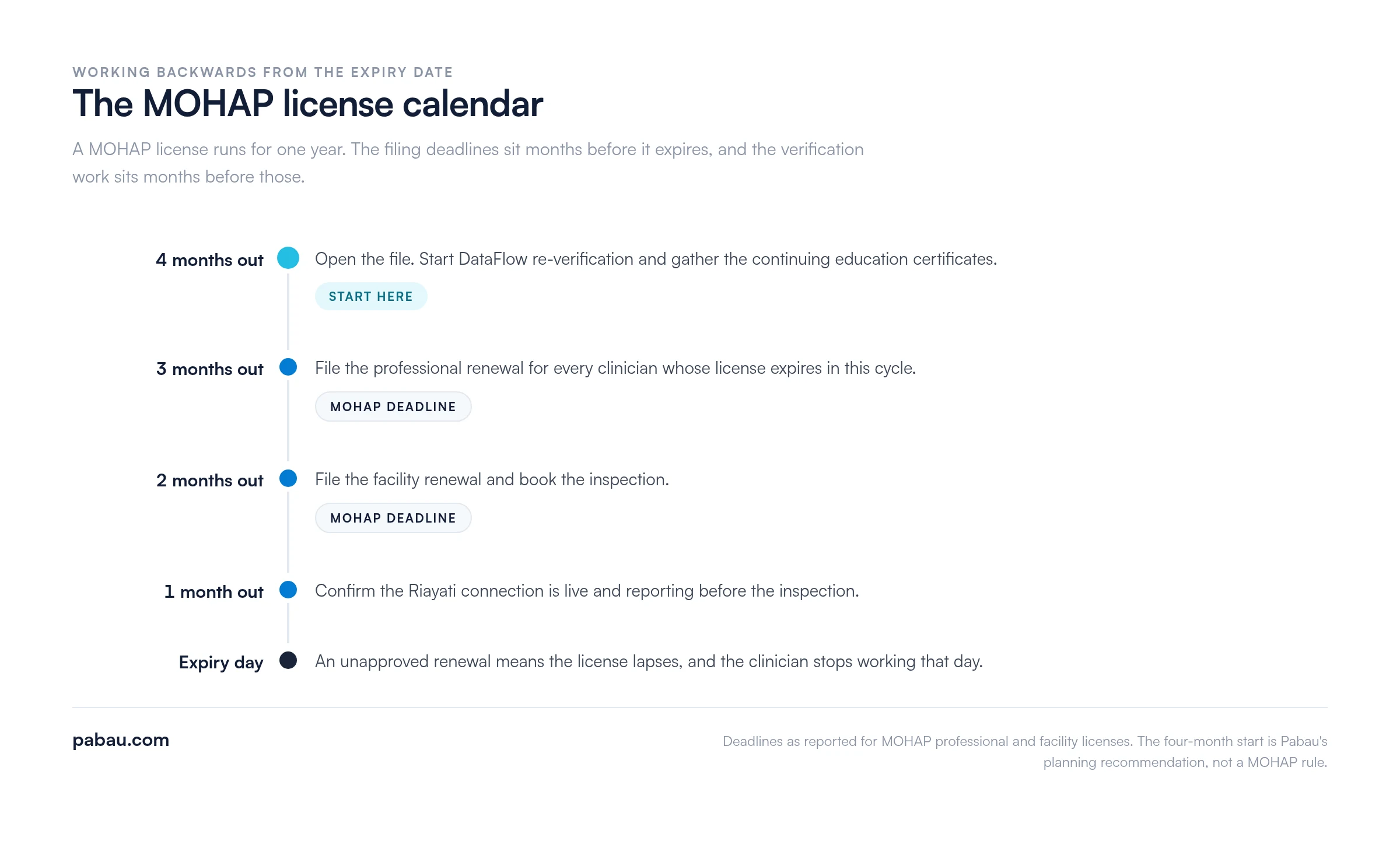
Renewal is a list, not a date. Every clinician on the roster expires on their own anniversary, set by when they were first licensed. A practice with eight clinicians is tracking nine renewals, counting the facility’s own.
A lapsed individual license becomes a facility problem quickly. The clinician has to stop working, and MOHAP finds an unlicensed practitioner on the roster at the next inspection.
Professional renewal also asks for continuing medical education, known as CME. Physicians are commonly asked for 40 CME hours across the year, alongside current malpractice insurance and a valid labor card.
Collecting those certificates as they are earned is far easier than reconstructing a year of them in December. Practices past a handful of clinicians usually move this into compliance software for practices rather than a shared spreadsheet.
MOHAP publishes a public register, so you can confirm a practitioner’s license and its expiry date before you hire or refer. Employers are expected to check it, not to take a certificate at face value.
Each regulator keeps its own register. A Dubai practitioner appears in Sheryan and not in MOHAP’s records, which is a common source of confusion when a group hires across emirates.
Applicants want a different view. Your MOHAP application status sits in the portal, and it shows which stage your own file has reached.
Most practices track license expiry dates in a spreadsheet that one person maintains. It works until that person is on leave in the month a renewal falls due.
Practice management software like Pabau holds staff records alongside the calendar and the patient file. Each clinician’s license number and expiry date sits on their staff record, so a renewal surfaces before it becomes urgent.
An inspection asks for more than licenses. MOHAP looks at consent, treatment notes, waste handling, and how patient records are stored and kept secure. EHR security is part of what an inspector assesses.
Pabau keeps consent forms, treatment notes and before-and-after photos on the patient record itself. An inspector sees one timeline instead of four systems, so the practice spends the visit answering questions rather than assembling files.
That structure matters for Riayati as well. A records system already holding coded, complete encounters has something clean to send. The connection becomes a configuration job rather than a data cleanup.

Pabau keeps each clinician’s license number and expiry on their staff record. Consent forms and treatment notes sit on the patient record, ready for an inspection. So renewals surface early instead of arriving as a surprise.

The MOHAP route is slow rather than difficult, and almost all of the waiting sits with parties other than the ministry. DataFlow decides when a professional file moves. Municipality and Civil Defence approvals decide when a building does.
So the start date is what a practice can control. A practice that opens its renewal file four months out can absorb a slow university reply without anyone stopping work. One that starts at the three-month deadline has no room left.
Treat the license as an annual operating dependency rather than setup you finished once. Book a demo to see how Pabau tracks license expiry across a whole clinical roster.

Opening a site in Abu Dhabi too? What is Malaffi explains the emirate’s own health information exchange and what connecting to it asks of your records.
Not sure what a Riayati connection involves? What is Riayati covers the national unified medical record and how facilities onboard to it.
Wondering how long to hold patient files? How long to keep medical records sets out the retention periods an inspection will ask about.
Licensing a practice in the UK instead? How to get CQC registered walks through the equivalent regulator registration for England.
A MOHAP permit and a MOHAP license are the same document in everyday use. You apply through the MOHAP portal using UAE PASS. Submit your credentials to DataFlow, sit the assessment if your category requires one, then pay the fee once approved.
MOHAP registration is the account and verification stage that comes before any license is issued. You create a portal profile, upload your documents and complete the DataFlow checks. The license itself is granted at the end of that process.
Use the licensing section of the MOHAP website or smart app, and search by name, license number or facility. Check the expiry date as well as the status line. Dubai practitioners sit in Sheryan instead, not in MOHAP’s register.
No. A MOHAP license covers the northern emirates only. Working in Dubai means a separate application to the Dubai Health Authority, or to DHCR if the practice sits inside Dubai Healthcare City.
One year. Professional renewals are due at least three months before the expiry date, and facility renewals around two months before. Renewal also asks for continuing education hours and current malpractice insurance.
No. Dubai Healthcare City is a free zone with its own regulator, so its clinicians and premises are licensed by DHCR. A MOHAP license has no standing inside the free zone.