Professional development record
A professional development record is a structured log of a healthcare practition...

2
Last Updated: Oct 8, 2026
A DOH Abu Dhabi license is the personal license you need before you can treat patients in the emirate. The Department of Health – Abu Dhabi issues it to doctors, dentists, pharmacists, nurses and allied health professionals.
If the job ad called it a HAAD license, that is the same credential. HAAD stands for the Health Authority – Abu Dhabi, which is what the regulator used to be called.
A first application runs about two to three months through four stages. This guide sets out that order, what a DOH license in Abu Dhabi costs, and the points where published figures contradict each other.
It also sets out the Four-Authority PQR Map, which names the four regulators that co-issue the qualification standard rather than the usual three.

A DOH license and a HAAD license are the same credential, because HAAD is the regulator’s former name.
The Professional Qualification Requirement is issued jointly by four regulators, and DOH names SHA alongside DHA and MOHAP.
A first application usually takes two to three months, and DataFlow primary source verification is the longest stage.
DOH publishes no fee schedule, so totals quoted by licensing consultancies range from about AED 2,190 to AED 5,335.
Reported validity periods disagree across published guides, so read the expiry date printed on your own license in TAMM.
A license lets you practice, but your employer’s clinical privileging committee decides which procedures you may perform.
A HAAD license and a DOH license are the same credential, because the Health Authority – Abu Dhabi is now the Department of Health – Abu Dhabi.
Recruiters, colleagues and older job ads still say HAAD Abu Dhabi, and both names circulate freely in the region. Licensing guides date the rename to 2017, while other published accounts give 2018. No primary source we could reach settles the year.
What the regulator itself does is clearer. The Department’s own Professional Qualification Requirement page does not use the word HAAD once. The old name survives in recruitment, not in regulation.
The same applies to the test. What older guides call the HAAD exam is the DOH licensing exam, set by the same regulator under a newer name.
A DOH license authorizes you to practice your profession. A license on its own does not authorize every procedure you were hired to perform.
DOH puts that second decision with your employer. A facility’s clinical privileging committee grants privileges based on your credentials, experience and demonstrated competence, and the same committee can modify, suspend or withdraw them. DOH separately grants permission for a short list of services, including dental implantology and pharmacist-administered vaccines.
Privileging decides what you do on your first day, so raise it before you sign an offer. Physicians, dentists, advanced practitioner professionals and paramedics with advanced training all need privileges granted, according to the Department’s own guidance.
One more distinction is worth drawing early. The license this guide covers is personal. A separate facility license covers the premises, so if you plan to open a practice in Abu Dhabi, you need both.
DOH Abu Dhabi licenses healthcare professionals working in Abu Dhabi city, Al Ain and Al Dhafra. Dubai licenses through its own authority, and the northern emirates run through the federal ministry.
Almost every guide on this subject stops at three regulators. The Department of Health Abu Dhabi names four.
The Professional Qualification Requirement, or PQR, is the shared standard the regulators use to judge your qualifications, experience and licensing history. DOH’s own PQR page states that the requirement is issued jointly by MOHAP, DOH, DHA and the Sharjah Health Authority. That four-way structure is what we call the Four-Authority PQR Map.
The fourth row is where guides disagree with the regulator. Three-regulator articles fold Sharjah into MOHAP’s territory, which is how the northern emirates are usually described. DOH’s PQR page names SHA as a co-issuing authority in its own right.
For a job in Abu Dhabi, none of this changes what you do. For a job in Sharjah, check with SHA before assuming the federal ministry handles your file.
The practical consequence is that a license is tied to one emirate. A DHA license does not let you practice in Abu Dhabi, and a MOHAP license does not either.
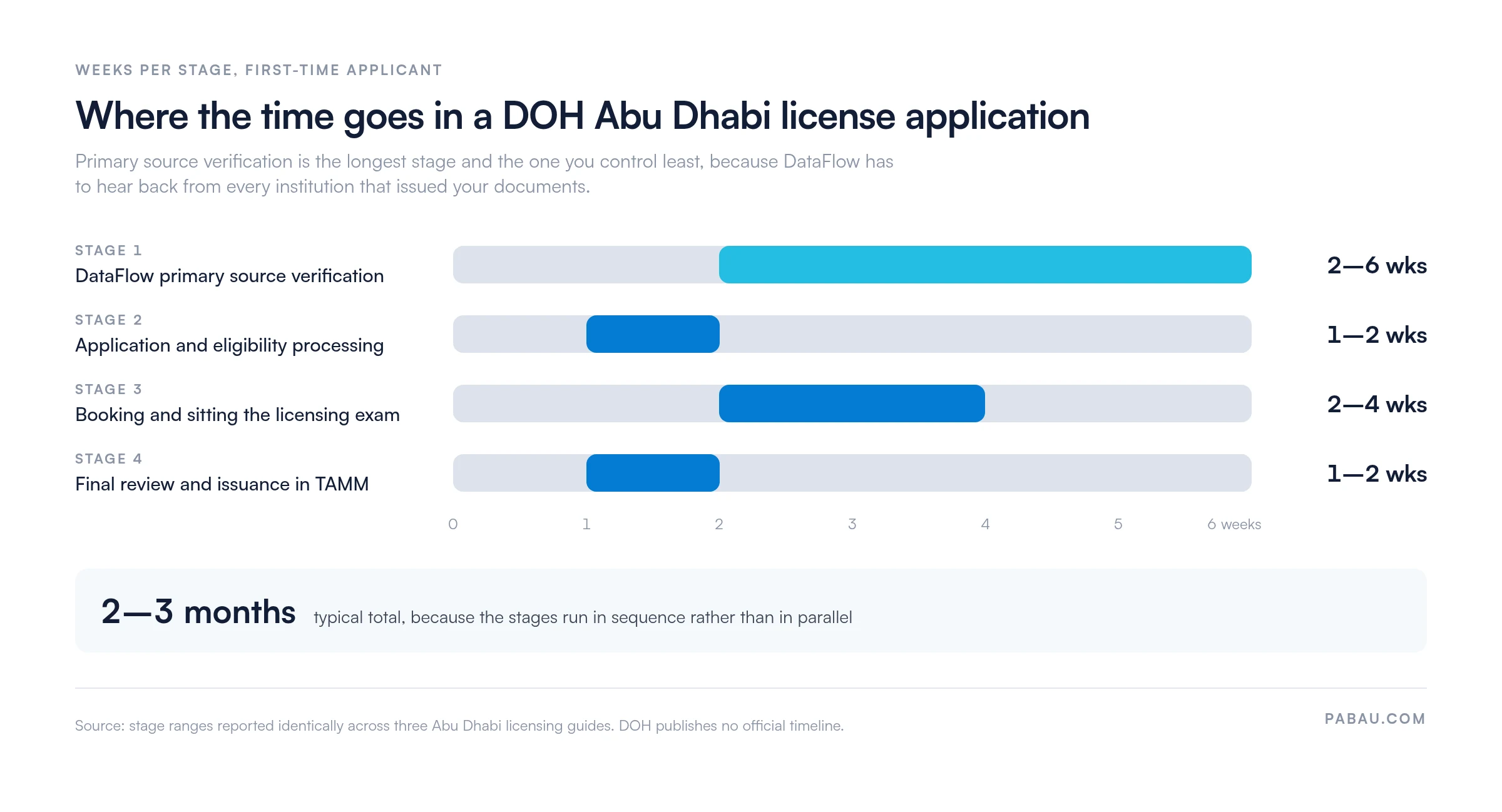
Getting a DOH license in Abu Dhabi runs through four stages: DataFlow verification, a PQR eligibility review, the licensing exam, and issuance through TAMM.
The stages run in sequence, and each one waits on the last. The sequencing is why the total lands at two to three months rather than a few weeks.
DOH’s own guidance points applicants to one route for both facility and professional licensing. Sign in to TAMM with a digital ID, then open the Department’s electronic services page.
Stage one is where most of the waiting happens, and it is the stage you control least. The chart below plots each stage against the week range reported for it.
Across the practices we onboard in the region, applications stall on paperwork far more often than on qualifications. A missing transcript or an unsigned experience letter leaves DataFlow chasing a former employer after the file is already open. Ask your universities and former employers for those documents before you submit.
PQR eligibility depends on your role: general practitioners need two years of post-internship clinical experience, specialists need three, and consultants need five.
Three of the four licensing guides we reviewed agree on the two-year and three-year figures. The five-year consultant requirement appears on one page only, so treat that one as indicative.
The DOH PQR document is the standard those years are measured against. DOH publishes the current edition as the third version of the Unified Healthcare Professionals Qualification Requirements. The document sits behind a download rather than on the page.
Whatever your profession, DataFlow has to verify the same core set of documents:
A No Objection Certificate is your existing employer’s written confirmation that they do not object to you taking the new role. Without one, an application from inside the UAE can sit unresolved.
Language evidence comes up often and is less settled. One guide lists IELTS 6.5, TOEFL 79 to 80, or OET grade B as the thresholds. DOH does not publish those scores on its PQR page, so confirm what your profession needs before you book a test.
The DOH licensing exam, still called the HAAD exam by many candidates, is a computer-based test delivered through Pearson VUE before a license is issued.
Pearson VUE’s own DOH page sets out the booking order, and it is worth reading before you plan around a start date. DOH’s Health Professionals Licensing Department approves you for the exam first. You then pay the pre-booking fee in TAMM. Only after that can you choose a date, time and test center.
That sequence explains a delay applicants often find surprising. You cannot book a DOH exam seat as soon as you decide to sit it, because the approval and the payment both come first.
Three details about the DOH examination circulate widely but each rests on a single source, so treat them as indicative rather than settled:
The exemption point matters most, because an applicant who assumes it applies can lose weeks. Confirm your own exemption with DOH in writing before you plan a start date around it.
Published totals for a first DOH license run from roughly AED 2,190 for a nurse to about AED 5,335 for a physician. No official fee schedule confirms those figures.
None of those numbers comes from the regulator. DOH’s PQR page carries no fees at all, and the totals above are reconstructed by licensing consultancies from their own itemized breakdowns.
Competing guides publish these totals to the dirham without naming a source, which reads as more precision than the underlying figures support. Two components sit behind them and are quoted more consistently. Primary source verification through DataFlow is reported at AED 990 to 1,680, and renewal is reported at AED 100.
Treat the table as a budgeting range, then confirm the current charge in TAMM. The service page is where the fee gets charged, so that figure is the only one that binds you.
Facility licensing is a separate budget entirely. Licensing a premises is reported at AED 7,000 to 40,000 and takes three to six months, including inspections.
A first DOH license application usually takes two to three months, and DataFlow verification is the stage most likely to stretch.
Validity is where the published guides stop agreeing. Two of them date the license at one year from issue or renewal. A third puts it at five years from the date you pass the exam.
A four-year difference is not a small discrepancy, and no authority citation resolves it. DOH’s PQR page does not mention validity at all.
So read your own license rather than an article, this one included. The expiry date printed on your card in TAMM is the only figure that governs when you renew.
Start your DOH license renewal two to three months before the expiry date on your card, and finish your continuing education hours before you apply.
Sources give different lead times. One says at least 60 days ahead, two say three months, so a two-to-three month window covers both. A renewal left more than six months past expiry is reported to lapse, which turns a renewal into a fresh application.
Continuing medical education, known as CME, is the other precondition. One licensing guide publishes annual hours by profession, and DOH does not list them on its PQR page:
Renewal and verification both run through TAMM. DOH’s own licensing guidance tells applicants to sign in with a digital ID. From there, open the Department’s electronic services page, where the current license and its status are visible.
Renewal also tests how well a practice files its paperwork. A practice that keeps CME certificates, license expiry dates and staff documents in one system spends minutes on it. A practice working from a shared drive spends an afternoon, which is the annual cost of not keeping compliance audit-ready.
Moving between emirates means a conversion, not a transfer of the same card. DOH licensing, DHA licensing and MOHAP licensing are separate processes with separate files.
The Dubai-to-Abu Dhabi direction is the best documented. One guide reports a transfer fee of AED 1,000 to 2,500 depending on profession, and a timeline of three to six weeks. That breaks down as two to four weeks of document verification plus five to 10 working days of review.
The document that trips people up is the Good Standing Certificate. A DHA certificate has to be dated within six months and pulled from Sheryan, so requesting it too early wastes the request.
One guide also reports that conversion to DHA or MOHAP becomes possible after a year on a DOH license. That condition appears on a single page, so confirm it with the receiving authority.
The Four-Authority PQR Map has a loose end here. If SHA co-issues the PQR, a Sharjah conversion is a fourth possibility, and none of the guides we reviewed describes one. We would rather flag that as an open question than invent a process for it.
A DOH license proves you are qualified. What a regulator or a privileging committee looks at afterwards is the record behind each patient you treated.
In most practices that record is scattered. Consent forms sit in a filing cabinet, before-and-after photos sit on a practitioner’s phone, and treatment notes sit in a document nobody else can find.
Practice management software like Pabau holds all of it against one client record. Consent forms, treatment notes, photos and invoices attach to the same file, so producing a patient’s history takes one screen rather than four searches.
Abu Dhabi also runs its own health information exchange. Malaffi shapes what a records system in the emirate has to be able to produce, which is worth understanding before you choose one.

Pabau keeps consent forms, treatment notes, before-and-after photos and invoices on one client record. Your documentation is ready when a regulator or a privileging committee asks for it, instead of being reassembled from four places.

The sequence is fixed, so the only part you control is when it starts. Every week spent gathering transcripts and experience letters before you open the DataFlow file comes off the back end.
What deserves your skepticism is the numbers. Fees, validity periods and renewal windows are published with a confidence no source supports. A figure repeated on five sites is still one unsourced figure. Budget from a range, then confirm in TAMM.
A license only gets you to the starting line. Your employer still has to grant privileges, and your records still have to stand up when someone asks to see them. Book a demo to see how Pabau keeps consent, notes and photos on one client record from your first patient onwards.

Working across more than one emirate? What is Riayati covers the UAE’s national unified medical record and which providers have to report into it.
The requirements for a HAAD license are now published as DOH’s Professional Qualification Requirement. You need a verified primary qualification and the post-internship experience set for your grade. You also need a Good Standing Certificate dated within six months, plus a pass in the licensing exam unless you are exempt.
DOH in the UAE is the Department of Health Abu Dhabi, the regulator for healthcare in Abu Dhabi city, Al Ain and Al Dhafra. DOH licenses both healthcare professionals and facilities, and it co-issues the UAE’s shared qualification standard with three other authorities.
Sign in to TAMM with your digital ID and open the Department of Health’s electronic services page, which is the route DOH’s own guidance gives. Your current license and its status appear there, and the same page is where renewal is filed.
Possibly, but do not plan on it. One licensing guide reports exemptions for applicants licensed in the United States, Australia or New Zealand, subject to conditions. No official source we could reach confirms that list, so get your exemption confirmed by DOH in writing first.