Ethical consent form: free template and what to add
An ethical consent form is a written record that a patient or participant agreed...

3
Last Updated: Oct 26, 2026

DOH licenses every clinic in the Emirate of Abu Dhabi, so a Dubai practice needs DHA and the northern emirates need MOHAP.
Licensing runs in two DOH stages, preliminary approval within 20 working days and the permanent license within 25 working days.
Preliminary approval holds for 6 months, and a clinic can extend that window to a maximum of 18 months.
No clinic may treat patients or advertise its services while preliminary approval is still running.
Renewing more than 30 days late costs 25% of the license fee every month, and an insurance fine can stack on top.
To open a clinic in Abu Dhabi, you deal with one regulator and two licensing stages. The Department of Health – Abu Dhabi, known as DOH, grants preliminary approval first and the permanent license second. Both applications go through TAMM, the Abu Dhabi government services portal.
Get the emirate wrong and you lose months. Dubai practices answer to the Dubai Health Authority, and the northern emirates answer to MOHAP. Neither one covers an Abu Dhabi address.
This guide maps the whole route. You get the regulator for each emirate, the DOH stage order, and the timings and penalties DOH publishes. Every figure comes from DOH’s Standard for Healthcare Facility Licensure, version 6, effective September 2025.
DOH licenses every clinic in the Emirate of Abu Dhabi. Dubai practices need a DHA license, and the northern emirates need MOHAP.
The emirate is larger than the city. DOH’s licensure standard requires every provider practicing in the Emirate of Abu Dhabi to hold a DOH facility license. That remit covers Abu Dhabi city, Al Ain and Al Dhafra. A unit in Al Ain is therefore a DOH application, not a federal one.
Each regulator runs its own portal and its own records exchange, so a license does not travel between emirates. The highlighted row is the one this guide covers.
Picking the wrong regulator is not a small correction. A trade name reserved with the wrong authority has to be reserved again with the right one.
If your address is in Dubai, stop here. Apply to Dubai Health Authority through its Sheryan licensing portal instead, because DHA will not accept a paper or email application. Our guide to a DHA license in Dubai covers the requirements, fees and timeline in full.
Dubai carries a second layer. Practices inside the Dubai Healthcare City free zone answer to that zone’s own regulator rather than to DHA.
MOHAP covers the five northern emirates, and it publishes a medical facilities directory. That directory is where you check a MOH license status in the UAE. Our guide to MOHAP license requirements sets out the federal route in full.
You need a DED trade name certificate, a TAMM facility account with PRO access, and DOH preliminary approval. Compliant engineering drawings and a permanent license bundle follow.
DOH publishes the requirement set in one standard, and the checklist below follows the order that standard uses.
PRO stands for public relation officer. DOH defines the PRO as facility staff who submit applications, follow up transactions and handle paperwork with the facilities licensing department.
The last item on that list sits outside the DOH standard, so treat it as a specialty question. Abu Dhabi Civil Defence handles fire safety clearance for the premises, and specialty equipment can pull in other bodies.
Two requirements come up often outside the DOH standard. Guides commonly cite Federal Authority for Nuclear Regulation authorization for ionizing imaging equipment, with MRI exempt. They also cite a Tadweer contract for clinical waste. Confirm both against your specialty before you budget.
With the requirement list in hand, the order becomes the thing to get right. DOH runs preliminary approval first and the permanent license second, and each stage unlocks the services that follow.
One widely copied step list puts the final trade license before the DOH healthcare license application. DOH’s standard puts the valid DED trade license inside the permanent license bundle instead. It sits next to the malpractice and pest control contracts, so follow the standard.
Preliminary approval is not a soft launch. During that period, DOH bars the facility from receiving or treating any patient. The same bar covers promoting or advertising your health services.
Step 6 is where new practices lose time, because two of the required approvals live in other people’s systems. One is the Monitor and Control Center. The other is Malaffi, and a records connection is not a one-week job.
All of this runs through one portal. TAMM’s healthcare catalog for new businesses lists three DOH services, and two of them are the licensing stages above. Ambulance and medicine transportation registration is the third.
A few of the requirements above are easy to get subtly wrong. Work through them before the application goes in.
Each one is quicker to fix before you file than after the review starts.
DOH licenses five facility groups, and your group sets both your drawings route and your extension ceiling. The groups are hospitals, centers, clinics, tele-medicine and virtual clinics, and home care services.
Clinic is a defined category, not a loose word. DOH splits it into general, specialized, general dental and specialized dental. A polyclinic-style operation usually falls into the center group instead, and that changes both columns below.
Every category starts on the same 6-month approval, so the extension ceiling is what really separates a clinic from a hospital build. Figures from DOH’s licensure standard.
A pre-qualified consultant has to file the engineering drawings for the higher-acuity categories. DOH names them individually.
Every other facility type selects the DOH option from the consultant list instead. DOH’s planning section then stamps the drawings, and the Health Quality team reviews them during the inspection visit.
A narrower group also needs a pre-qualified consultant to run the 90% inspection. Hospitals, one day surgery centers, fertilization centers, dialysis centers and oncology services sit in that group.
DOH’s two review windows total 45 working days, or roughly two months of pure review. Your design, drawings and staff files decide how much longer it takes.
The stage that sets your opening date is the one DOH does not put a clock on.
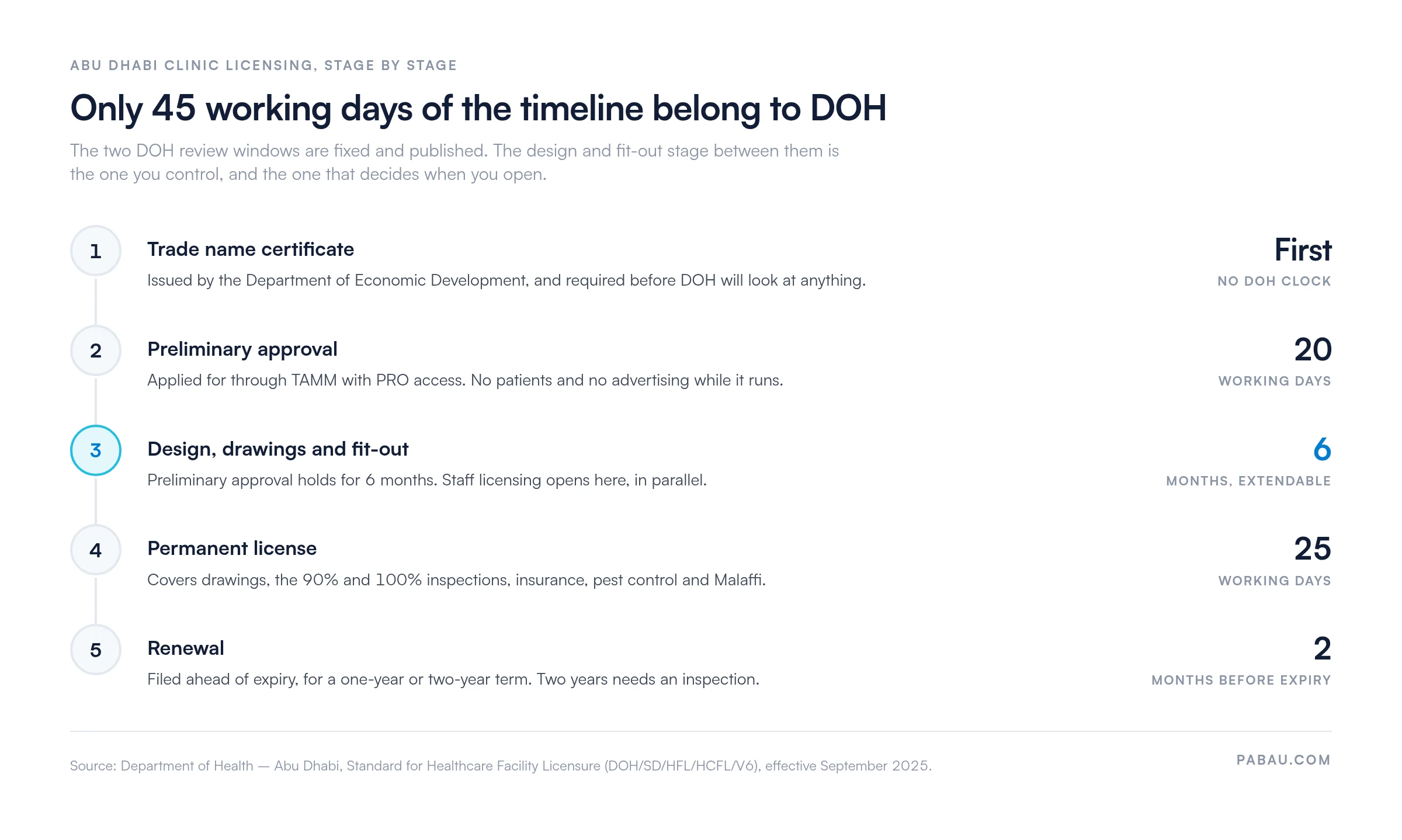
Two stages carry a published DOH clock, and the other four are set by you or by DED. Time frames from DOH’s licensure standard.
Preliminary approval holds for 6 months whatever you are building. You apply for an extension through TAMM, two months before the approval expires, and you attach a project completion report.
DOH can also take the approval away. The standard names three triggers, and each one reads better as a deadline than as a warning.
The extension ceilings tell you what DOH expects. A clinic taking a fitted unit gets 18 months at most, so DOH treats a clinic fit-out as a matter of months.
By contrast, a new-build hospital gets up to 5 years. Two projects in the same standard can run on completely different scales, and your category tells you which one you are.
One sequencing detail saves weeks. Staff licensing opens the moment preliminary approval is issued, so your team can work through clinician files while the fit-out runs.
No published DOH fee schedule sets the cost of opening a clinic in Abu Dhabi. The figures DOH does publish are the penalties for renewing a license late.
Your facility category, your floor area and your fit-out drive the cost. Higher-acuity categories add a pre-qualified consultant fee on top, because DOH will not accept their drawings any other way.
You pay DOH fees at two points. An application fee falls due at preliminary approval, and a final licensing fee at the permanent license stage.
Two running contracts are fixed costs from day one. Medical malpractice insurance and pest control each have to run for 13 months, so you buy both before the license is issued.
A Dubai cost estimate is no substitute here. DHA sets its own fee schedule, so the cost of opening a clinic in Dubai tells you nothing usable about an Abu Dhabi budget.
Miss a renewal by more than 30 days and three charges start running, all set out in DOH’s licensure standard.
Those first two fines stack. Secondary guides usually report one late fee, but the standard sets a licensing penalty and an insurance penalty separately.
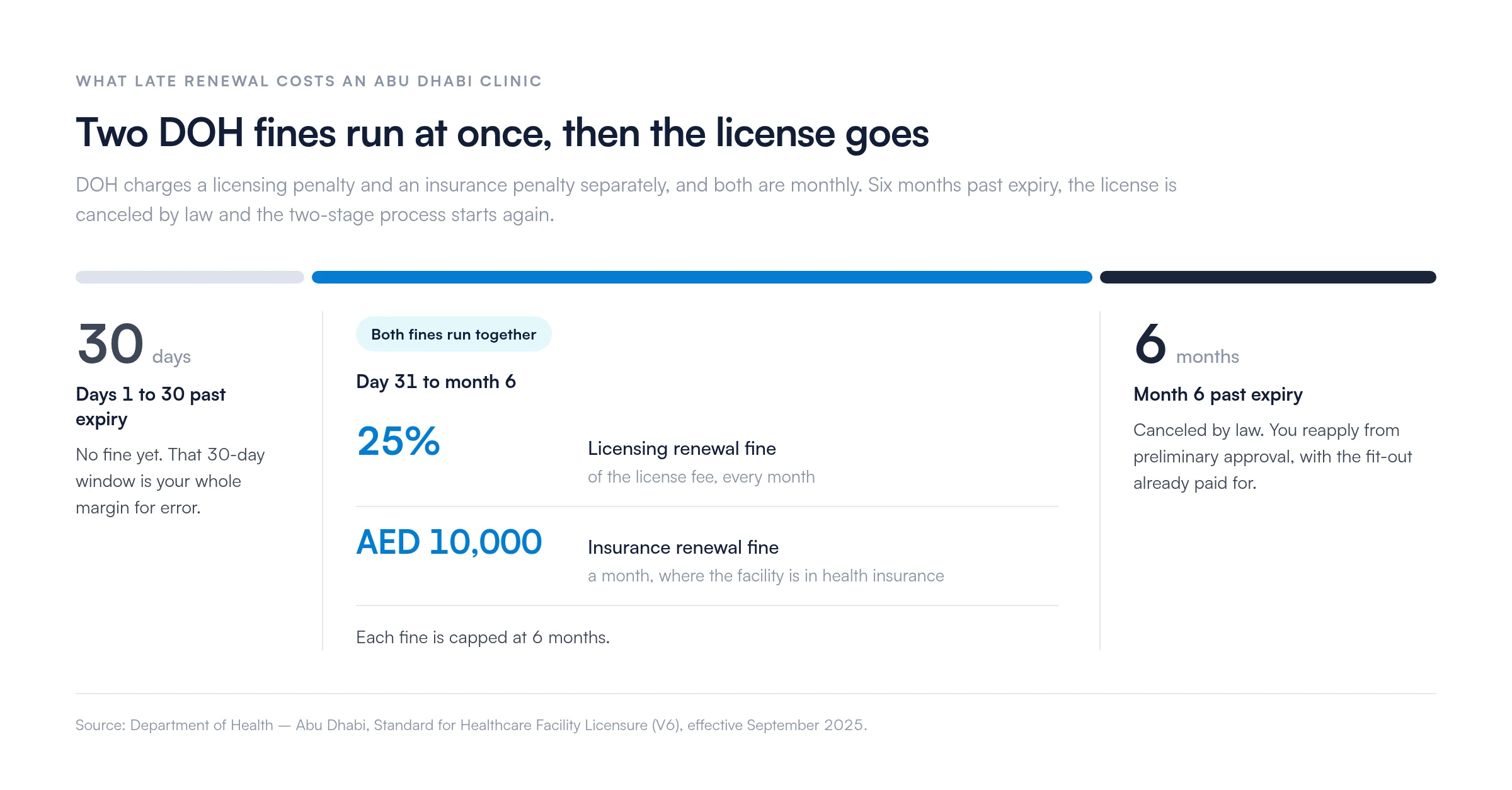
Cancellation by law is the expensive outcome. A canceled license means starting the two-stage process again, with a fit-out already paid for and no patients allowed through the door.
A DOH license is a standing obligation rather than a one-off. Clinician licenses on your roster expire, and patient records have to reach Malaffi. Consent has to be on file when an inspector asks for it.
In the practices we onboard, the license register is the record that slips first. Expiry dates end up in a spreadsheet nobody owns, and the reminder arrives from the regulator rather than from the practice.
Practice management software like Pabau keeps each clinician’s license number and expiry on their own staff record. Renewal dates surface early, so your practice manager is not reconstructing the roster two weeks before an inspection.
Patient records, treatment notes and consent forms sit on one patient file in Pabau. Your team stops opening a filing cabinet and a shared drive before every follow-up, and the audit trail builds as you work.
A new practice buys its systems once. Software for growing practices has to cover records, scheduling, consent and payments from the first week of trading.
If you are still shortlisting, our roundup of medical practice management software sets out what each option covers.

Pabau stores each clinician’s DOH license number and expiry on their staff record. Patient records, treatment notes and consent forms sit on one patient file. So renewals and inspections stop arriving as surprises.

Get the jurisdiction right and the rest of this becomes a sequence you can plan around. DOH licenses the Emirate of Abu Dhabi, in two stages, through TAMM.
The published clocks are short. Those 45 working days of DOH review are not what delays an opening. Treat the drawings, the fit-out and the clinician files as your critical path.
The one date worth putting in a calendar today is the renewal, two months before expiry. Late renewal is the only part of this process that arrives with a price list attached.
The admin does not stop once the license is in hand. Book a demo to see how Pabau keeps DOH license dates, patient records and consent in one system.

Need the records side of the permanent license? What is Malaffi explains Abu Dhabi’s health information exchange and what connecting asks of your patient records.
Licensing in the northern emirates instead? How to get a MOHAP license in the UAE walks through the federal route, its requirements and its fees.
Wondering where the national record fits in? What is Riayati covers the UAE’s own health information exchange and how facilities connect to it.
Opening in Canada rather than the Gulf? How to open a medical clinic in Ontario sequences the equivalent provincial route to opening day.
Planning how the practice will run day to day? Medical practice operations covers the workflows a new clinic has to set up in its first months.
Yes, but it means two registrations rather than one. The Department of Economic Development registers the company and the trade name. DOH then licenses the facility with you named as primary owner, and that name must match your Emirates ID. Changing the primary owner later triggers new-license fees.
Both sit inside the permanent license stage, and DOH runs them before the license is issued. Hospitals, one day surgery centers, fertilization centers, dialysis centers and oncology services need a pre-qualified consultant for the 90% inspection. Every other facility type runs it without one.
Apply to Dubai Health Authority through its Sheryan portal, and only for premises in Dubai. A DHA license has no standing at an Abu Dhabi address. Practices inside the Dubai Healthcare City free zone go to that zone’s own regulator instead.
That is the DOH professional license, held by an individual clinician rather than by the premises. The facility registers each clinician through TAMM using Super PRO access, once preliminary approval is issued. Registration can start before the building is finished.
One year or two years, and you pick the term at renewal. A two-year term needs DOH approval and a Health Quality team inspection visit. File the renewal two months before the expiry date, because monthly fines start once you pass 30 days late.