Nitrates medication list
A nitrates medication list is a point-of-care reference that sets out the main c...

Last Updated: Oct 6, 2026

Progress notes are official medical records. They document a client’s status, the treatment delivered, and the response to it after every encounter.
A compliant note carries the date, time, duration, service type, presenting concerns, interventions, client response, risk screening, and next steps.
Five formats cover most settings: SOAP, DAP, BIRP, GIRP, and PIE. Pick one and standardize on it across the practice.
The free pack on this page holds a blank template for all five formats, a required-element checklist, and three filled examples.
Practice management software like Pabau pulls client and session data into the note template, so clinicians retype less and miss fewer required fields.
Twelve printable pages: blank SOAP, DAP, BIRP, GIRP, and PIE templates, a required-element checklist, step-by-step writing guidance, and three filled examples from therapy and nursing. Rebuild the sections in your EHR, or print the pack for paper charts.
Download templateProgress notes do three jobs at once. They record what happened in the encounter, and they show that the billed service took place. They also protect the clinician if the record is ever questioned.
A thin or missing note delays payment. It also weakens continuity of care when a client sees more than one provider.
This guide covers the five progress note formats used across mental health, nursing, and allied health. You get the required elements, two worked examples, and the download above, which holds a blank template for each format.
Progress notes are structured clinical records written after each patient or client encounter. Unlike digital intake forms, which capture background information once, a progress note is written again after every appointment, session, or clinical contact.
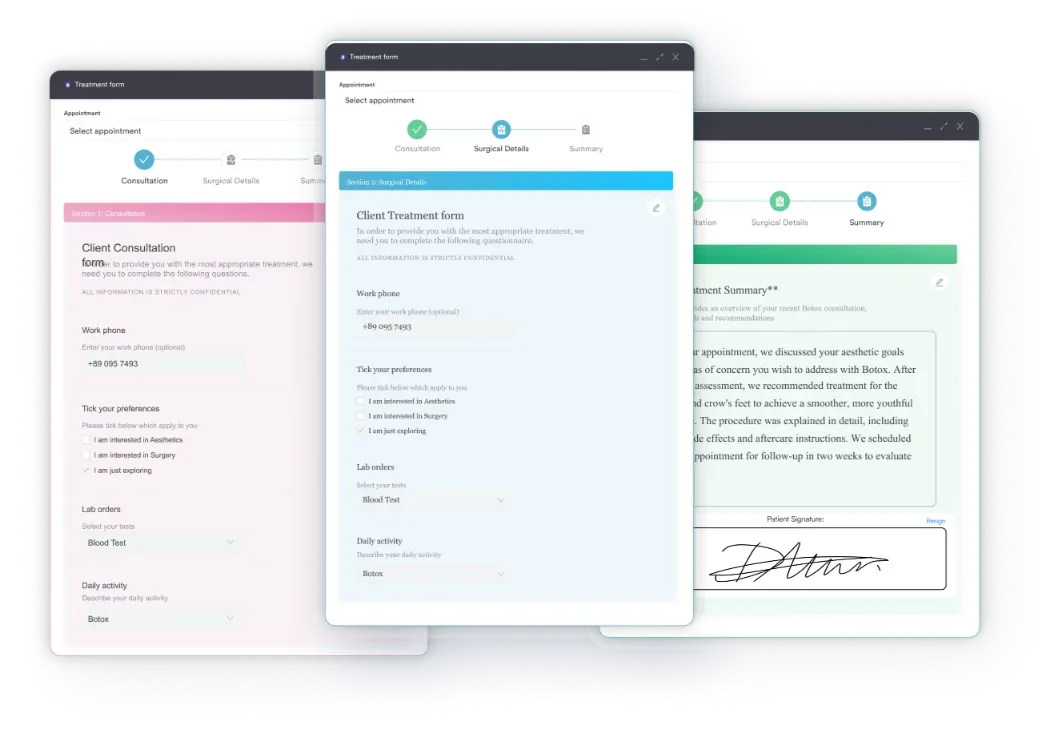
A progress note is part of the official medical record. It is shared with insurers, with other providers, and with the client on request. That makes it different from psychotherapy notes, sometimes called process notes, which are the clinician’s private reflections. Psychotherapy notes sit outside the official record and carry extra protection under HIPAA, and they are never the documentation a claim rests on.
A compliant progress note answers three questions. What did the client present with today? What did the clinician do about it? How did the client respond?
Insurers and regulators expect specific elements in every note. A single missing element can trigger a denial or a compliance finding.
Practice management software like Pabau builds these elements into note templates for therapy practices, and populates the client and session fields from the appointment. Clinicians then spend their time on the clinical content rather than the header.
Five formats structure most clinical documentation. Each follows a different logical flow, and each has settings where it fits best.
SOAP remains the default choice for its clarity and its acceptance across payers. The chart below maps each setting to a format, so you can see where the five overlap.
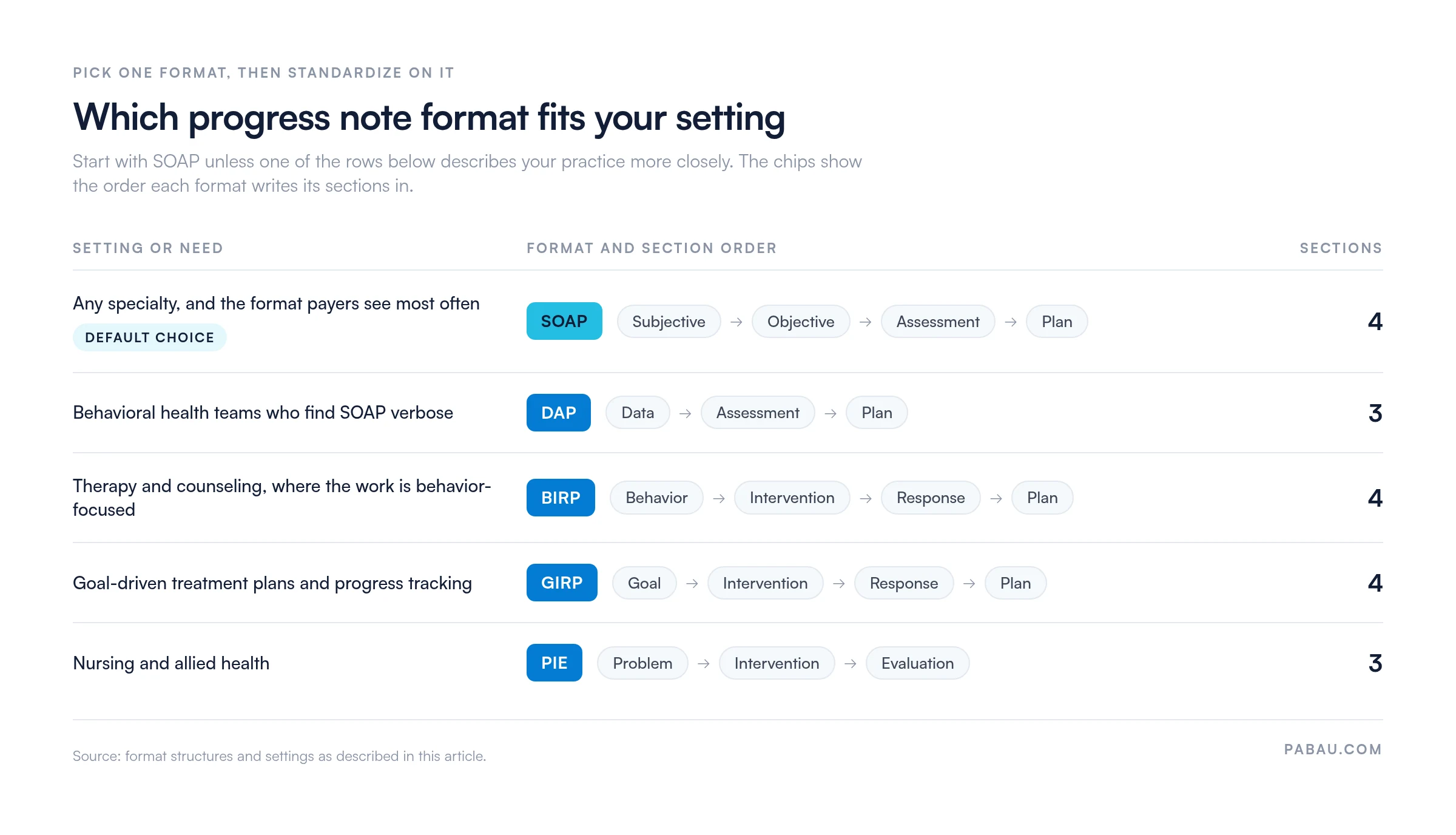
Pick the format that matches your workflow, then keep it. Most organizations standardize on one format across the practice, because consistency shortens staff training and makes audits easier to answer. Our SOAP note examples show how that structure reads once it is filled in.
Both examples below are fictional, and both appear in the downloadable pack alongside a third example in BIRP format.
Date and time: 2026-08-24, 14:00 to 14:50 | Duration: 50 minutes | Type: Individual therapy, in person
Subjective: Client reports ongoing anxiety about work presentations. States that she knows the fear is irrational but still catastrophizes about being judged. Rates anxiety 6/10 this week, down from 8/10. Sleep improved on the routine agreed last session. Denies suicidal ideation.
Objective: Alert and oriented, mood anxious, affect congruent and reactive. Good eye contact and normal speech. Brought the completed thought-distortion worksheet and engaged with cognitive restructuring throughout. GAD-7 today 11, down from 15 three weeks ago.
Assessment: Generalized anxiety with a performance trigger, responding to cognitive behavioral intervention. The GAD-7 drop supports the client’s own report. Insight into automatic thoughts is improving, and avoidance of speaking situations remains the main barrier. No safety concerns identified.
Plan: Continue weekly individual therapy. Client to restructure one work-related thought daily and log the outcome. Next session starts graded exposure with a short update to her own team. Re-administer the GAD-7 in four weeks, and consider a group exposure referral if avoidance holds.
Date and time: 2026-08-24, 09:30 to 10:00 | Duration: 30 minutes | Type: Post-operative assessment, in person
Problem: Post-operative pain and wound review, day two after right knee arthroscopy. Patient rates pain 4/10 at rest and 6/10 on movement. Right knee flexion measured at 70 degrees, against a 90-degree target for day seven.
Intervention: Assessed the surgical site, which was clean, dry and intact with no erythema or discharge. Redressed using aseptic technique. Elevated the limb and reviewed the analgesia schedule and ice protocol. Supervised ankle circles and quadriceps sets, ten repetitions each.
Evaluation: Pain fell to 2/10 after elevation and ice. Wound healing as expected, with no infection markers present. Flexion improved to 78 degrees after the exercises, so the day-seven target remains realistic. Problems stay open for review at the next home visit.
Most notes take 8 to 15 minutes once the structure is fixed. AI-assisted clinical documentation shortens that further by drafting sections from the session, leaving the clinician to review, correct, and sign.
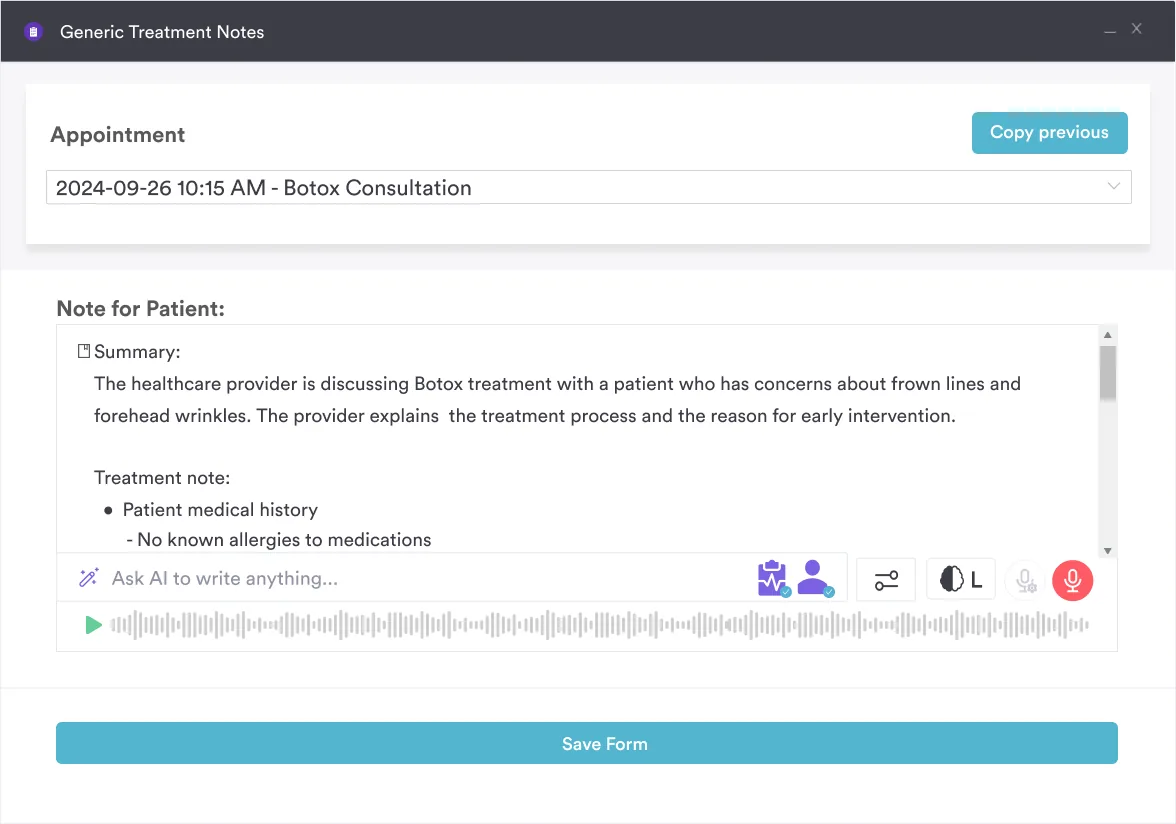
Set one practice standard: every progress note is due within 24 hours of the session. Use your EHR task list to flag notes that are still open and remind the clinician who owns them. Timely notes shorten billing delays and make audits simpler to answer.
Insurers require progress notes to justify billable services. HIPAA sets separate rules for the record itself. Store it securely, give clients access on request, and hold psychotherapy notes separately if you keep them.
CMS and commercial payers deny claims when the note lacks required elements or contradicts the billed service. A session billed as 60 minutes of individual therapy needs a note showing 60 minutes of direct service. When the two disagree, the claim is the part that gets reviewed.
Telehealth sessions are documented the same way as in-person visits, with the same required elements and the same formats. What changes is the claim. Your EHR should flag the visit as virtual, so the claim carries the correct place-of-service code. Add modifier 95 where the payer asks for it.
The psychotherapy code itself does not change for video. Codes 90834 and 90837 are selected by session length, so a 45-minute video session is still 90834.
Record any technical problem briefly, for example a five-minute interruption from a client connectivity issue and the resumed session length. Note observations that are specific to the format, such as a client distracted by the home environment or fully engaged on a stable connection.
Documentation load is one driver of clinician burnout. A fixed template and one house format take a slice of that load away, which is time returned to patient care.
In many practices, every note starts from a blank page. The clinician retypes the client name, the date, the duration, and the service type. All four already sit in the appointment record. Notes drift past the 24-hour mark, and the late ones are the ones payers question.
Pabau, our practice management platform, removes that retyping with three features that work together:
Notes, client records, scheduling, and billing sit in the same system, so a signed note flows into the claim without an export step. Clinicians finish documentation sooner, and the practice sends cleaner claims for the work it has already done.

Pabau note templates pull client and session data from the appointment, then prompt for every required element. Pabau Scribe, our AI scribe, can draft the note for review. Clinicians sign sooner and claims go out with the documentation behind them.

The format matters less than the discipline behind it. Pick SOAP if you have no reason to choose otherwise, hold every note to the required elements, and write it within 24 hours. A practice that holds to those three habits rarely loses an audit argument.
The trade-off worth remembering is speed against specificity. Templates and AI drafting make notes faster, and they also make it easy to ship a note that reads like every other note. The clinician still owns the clinical detail that makes the record defensible.
Download the pack above, choose one format, and standardize on it this month. Book a demo to see how Pabau turns that format into a template your team fills in minutes rather than hours.

Want a closer look at the SOAP structure? SOAP notes meaning breaks down what each of the four letters asks you to record.
Charting inside a nursing team? Our nursing documentation guide covers the standards and the entries an inspector looks for.
Need a narrative alternative to PIE? The DAR note template gives you a data, action, and response structure for shift charting.
Comparing tools to write your notes in? Clinical documentation software weighs the options for practices leaving paper behind.
A progress note is an official medical record of what happened in a clinical session. It covers the client’s presenting concerns, what the clinician did, and how the client responded. The required elements are the date, time, duration, service type, presenting concerns, interventions, client response, risk screening, and next steps. A missing element can trigger a billing denial or a compliance finding.
Five formats cover most settings. SOAP is Subjective, Objective, Assessment, Plan, and it is the most widely accepted. DAP is Data, Assessment, Plan. BIRP is Behavior, Intervention, Response, Plan, and it suits therapy. GIRP is Goal, Intervention, Response, Plan. PIE is Problem, Intervention, Evaluation, and it suits nursing. Most practices standardize on one format.
Around 200 to 400 words is typical, and each section runs two to four sentences. Length is not the measure of quality. A vague or padded note draws more attention in an audit than a short, specific one.
After every direct clinical encounter: individual therapy, a group session, an intake, a follow-up call, or a procedure. Administrative time with no direct service needs no progress note. Document within 24 hours of the session.
Yes. Insurers treat templated notes as standard practice, provided every required element is present and each note is individualized for that client and that session. A template that produces identical notes week after week is the problem, not the template itself.