Patient reported outcome measures
Patient reported outcome measures (PROMs) are validated questionnaires that reco...

Last Updated: Oct 13, 2026

A plan of care is a structured clinical document covering a patient’s diagnoses, goals, interventions, and evaluation criteria. It keeps every member of the care team working toward the same outcomes.
The five core components of any plan of care are assessment, nursing diagnosis, goals and expected outcomes, interventions, and evaluation. Nurses know that sequence as ADPIE.
Medicare requires a physician-certified plan of care for home health services, reviewed and recertified every 60 days.
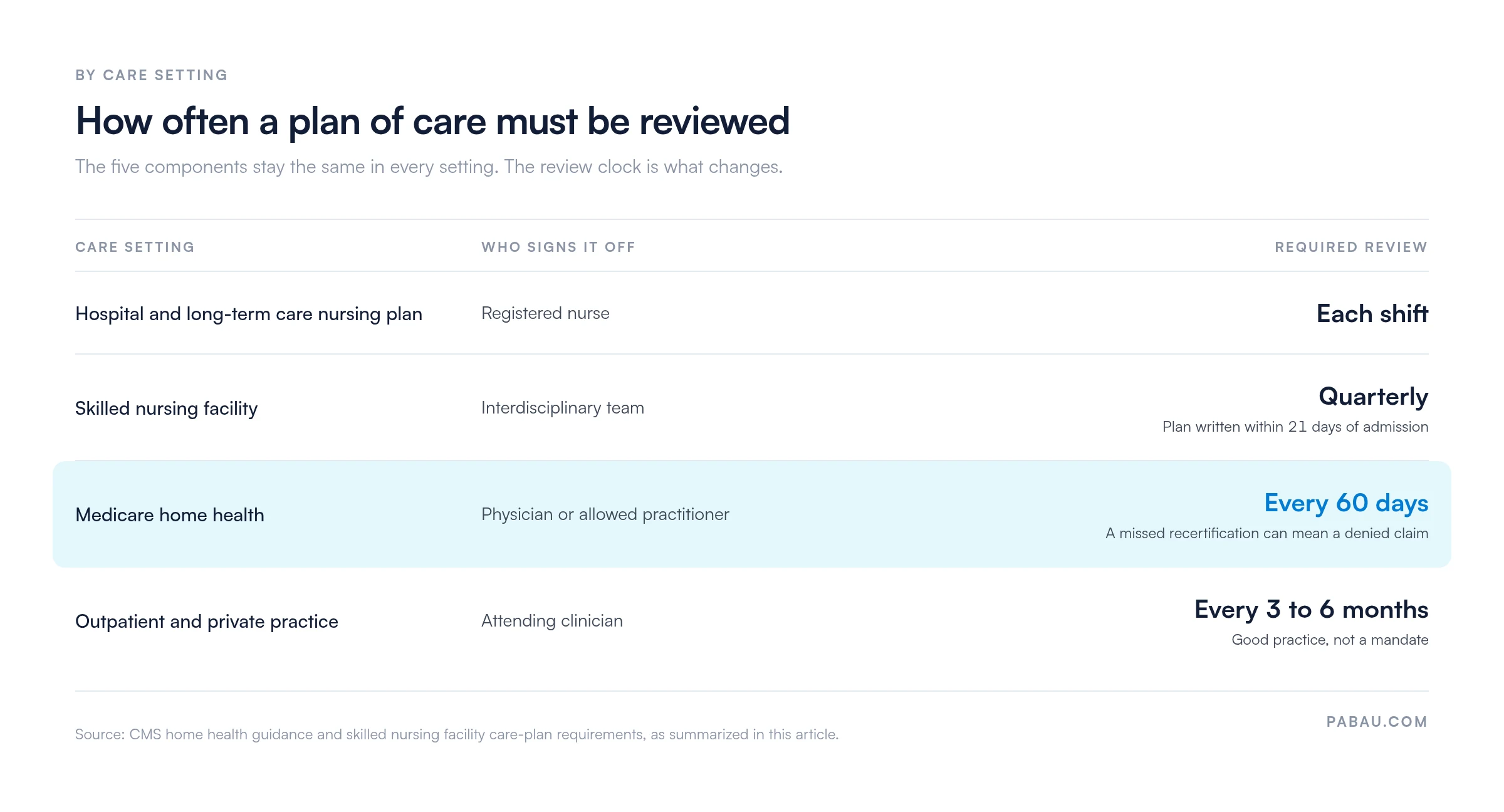
Review cadence changes by setting. Hospital nursing reviews each shift, a skilled nursing facility quarterly, and outpatient practices every three to six months.
Care planning software like Pabau centralizes clinical documentation, automates review reminders, and gives multi-practitioner teams shared access to one patient record.
A plan of care is a structured, individualized document setting out the medical and supportive services a patient needs. It names their diagnoses, the goals they are working toward, the interventions that get them there, and the date the plan gets reviewed. Every member of the care team works from that one document, from the attending clinician to the practice manager.
Documenting what happened at a visit is routine. Documenting what happens next, across the whole course of treatment, is what a plan of care adds. That is the difference between a record of care and a plan for it.
The term shows up across nursing, home health, long-term care, and outpatient practice. In each setting it does the same job. Care gets coordinated around goals the patient agreed to, rather than tasks the clinician assigned.
This guide covers the standard components, the main types, a step-by-step writing approach, Medicare requirements, and how software handles the process without adding documentation work.
In clinical practice, the two terms are interchangeable. “Plan of care” tends to appear in regulatory and Medicare documentation. “Care plan” is more common in nursing education and outpatient settings.
The CDC’s caregiving guidelines use “care plan” throughout, while CMS home health regulations use “plan of care.” Neither term implies a different document structure.
One distinction is worth noting. In nursing home and home health settings, a plan of care carries specific regulatory weight, including physician certification, required fields, and mandatory review cycles.
A care plan in an outpatient physical therapy or aesthetics practice may follow the same structure without the formal regulatory wrapper. The substance is the same. The compliance stakes differ by setting.
Every plan of care follows a five-component framework, whatever the clinical setting. Nursing educators call it ADPIE: assessment, diagnosis, planning (goals), implementation (interventions), and evaluation. Understanding each component helps practices build documentation that is clinically sound and auditable.
Each component feeds the next. A weak assessment produces a vague diagnosis, which leads to goals nobody can measure. The structure only works when every row above is filled with specifics rather than clinical shorthand.
The plan of care adapts to the clinical setting. The core ADPIE structure stays constant. What changes is who creates it, how formal it has to be, and how often it needs review.
Review cadence is where these types diverge most, and it is the detail practices get caught out by. The comparison below puts the four common settings side by side. Hospital and long-term care teams should also read their plans against wider nursing documentation standards, which govern what each entry has to contain.
Writing a plan of care is a repeating clinical process rather than a single event. The CDC recommends five steps for creating and maintaining a care plan. Assess the person’s needs, set goals, identify resources and support, put the plan in writing, then review and update it regularly. Here is how each step works in a clinical setting.
That last step is the one most often left half-finished. For a worked example of it, the evaluation nursing care plan template shows how progress against each goal gets recorded, dated, and signed. When care ends, a closing clinical note records whether each goal was met and where the patient goes next.
A patient-centered plan of care puts the patient’s preferences, values, and self-defined goals at the center of every clinical decision. That differs from a clinician-dictated plan, where the practitioner sets the goals and the patient is expected to comply. Patients who help set their own goals tend to stay with the treatment longer.
The practical difference shows up in goal-setting. A clinician-dictated goal reads: “Reduce HbA1c to below 7% within three months.” A patient-centered version reads: “Patient’s priority is walking to school with their children by summer. Clinical goal: improve HbA1c and energy levels to support this.” Both lead to similar clinical actions. Only one of them reads like the patient’s own goal.
Key characteristics of a patient-centered plan of care:
Aesthetic and wellness practices follow the same logic. The practitioner’s clinical expertise shapes the options, and the patient’s goals, lifestyle, and values shape the plan.
Practices operating in Medicare-regulated settings need to know the formal requirements. Medicare mandates a plan of care for any patient receiving home health services under the Medicare home health benefit.
According to CMS guidance, the plan must be established and periodically reviewed by a physician or allowed practitioner. It has to cover the patient’s diagnoses, the types and frequency of services required, functional limitations, goals, and any medications relevant to the plan.
Two compliance details are worth spelling out:
Coverage paperwork runs on a separate clock from the certification period. Medicaid asks beneficiaries to confirm eligibility once a year, and an annual coverage renewal form keeps that check consistent across patients.
These specific rules do not reach private aesthetic practices, wellness practices, or outpatient therapists. The structural discipline behind them still applies. Documented goals, named interventions, scheduled reviews, and a named owner are good clinical practice in any setting, and private insurers increasingly expect to see them.
Build your plan of care review schedule into your appointment calendar at the point of plan creation. Set a recurring reminder 55 days after the plan start date for Medicare home health cases, or at your agreed review interval for private patients. Review conversations are far more productive when both clinician and patient have been prompted to think about progress in advance.
A standard plan of care template covers seven fields. The table below shows the minimum viable structure for an outpatient or private practice. Regulated settings such as home health and nursing homes require additional fields mandated by CMS.
Many practices start with a paper template and move to digital later. The change that pays for itself is replacing typed-from-scratch plans with structured digital templates. Those templates pre-fill patient data and trigger review reminders on their own.
Paper and Word-document care plans create three recurring problems. Nobody knows which copy is current, the file sits with whoever last edited it, and reviews slip because nothing prompts them. Care planning software solves all three.
Dedicated clinical documentation software handles the full plan of care lifecycle. Here is what that looks like day to day.
Writing the plan is rarely where practices come unstuck. The review is. A plan gets typed once, filed, and then sits untouched until the patient’s condition changes or an auditor asks to see it.
In Pabau, the plan of care sits in the client record alongside the appointment history, the consent forms, and the treatment notes. Structured note templates hold the ADPIE fields, so each encounter updates goal progress in the same place. Review dates become calendar reminders for the named clinician instead of a note in somebody’s diary.
Every Pabau subscription includes the care pathway feature in Pabau GO, our iOS app for practitioners. It guides patients through forms, consents, and photo prompts before a visit, and what they complete flows straight into their record.
Care Plus adds further patient-care capabilities on top of that. Pabau Scribe, our AI scribe, records the consult, transcribes it, and structures the output into a chart note.
The outcome is a plan that stays current without anyone policing it. Your team spends the review appointment talking to the patient, rather than reconstructing what happened last time.

Pabau’s client records and structured clinical notes hold the whole plan of care in one place. Review reminders reach the clinician who owns it. Book a demo to see it working on your own patient list.

A plan of care is the operational backbone of coordinated treatment. Without one, decisions rest on memory and informal handoffs. With one, every clinician and every visit connects back to the same documented goals.
If you change one field in your plans this week, make it the review date. It is what turns a document into a working tool, and it is the easiest field to leave blank. The trade-off is worth naming: a review cycle you commit to in writing is a review cycle an auditor can hold you to.
Structured records and clinical documentation tools give practice teams a way to create, store, and review care plans without extra overhead. Book a demo to see how Pabau keeps every plan of care current and every review date on the calendar.

Need structured templates for clinical consultations? Medical forms for your healthcare practice covers how digital forms replace paper-based intake and documentation across practice types.
Writing the notes that feed the plan? SOAP notes examples shows how each encounter note should read so goal progress is easy to track.
Coordinating care with a family caregiver? Caregiver care plan is a ready-made form for recording who does what between visits.
A plan of care is a structured clinical document. It outlines a patient’s diagnoses, treatment goals, planned interventions, responsible care team members, and scheduled review dates. It coordinates everyone involved in a patient’s care around the same outcomes, and it is updated as the patient’s condition changes.
The terms are interchangeable in most clinical contexts. “Plan of care” is the preferred term in Medicare and home health regulatory documentation. “Care plan” is more common in nursing education and outpatient settings. Both describe the same structured document covering assessment, diagnosis, goals, interventions, and evaluation.
The plan of care is usually created by the lead clinician or the nursing team, often with input from an interdisciplinary team. In Medicare home health settings, a physician or allowed practitioner must certify the plan before care can be provided. In outpatient private practices, the attending clinician normally develops and owns the plan.
Medicare requires a physician-certified plan of care for all patients receiving home health services under the Medicare home health benefit. The plan must be reviewed and recertified by a physician every 60 days. A plan that lapses without recertification puts the Medicare claim for that period at risk of denial.
Review frequency depends on the clinical setting. Medicare home health requires recertification every 60 days. Nursing home residents must have plans reviewed quarterly, or after any significant change in condition. Outpatient and private practice plans should be reviewed at least every three to six months, and sooner if the patient’s goals or clinical status shift.
A patient-centered plan of care is one where the patient’s own goals, preferences, and values shape the clinical objectives. Goals are co-produced in conversation with the patient. The plan reflects the patient’s language and priorities, and the patient receives a copy and takes part in reviews.