Anja Dodevska
Head to toe assessment cheat sheet: Printable nursing guide
A head to toe assessment cheat sheet gives you one fixed order at the bedside, s...

6
Last Updated: Oct 23, 2026
Free PDF 1 page, print-ready Clinician-reviewed
A SMART treatment plan is a clinical document in which every goal is specific, measurable, achievable, relevant, and time-bound. It gives you and the patient the same definition of progress. It also gives a payer the evidence it needs to keep authorizing sessions.
The framework is simple. Writing goals that survive a review is the harder part. This guide covers the wording, plus worked examples for depression and anxiety. It ends with a five-question check to run before you sign a plan. A mental health EMR with built-in treatment planning can carry the finished document, but the wording is still yours.
A ready-to-use form for setting specific, measurable, achievable, relevant, and time-bound treatment goals. It carries sections for goal definition, clinical indicators, objective statements, interventions, and progress monitoring timelines.
Upload this PDF, or any form you already use, and Pabau's AI Form rebuilds it with tick boxes, text fields and a signature. Attach it to the treatment once, and every patient gets it on time.
AI Form rebuilds the consent, history and aftercare forms you already use. You review each one, then publish.
Patients complete forms on their phone before they arrive, so the front desk stops retyping paper.
Every signed form is versioned and attached to the treatment record, ready when you need it.
Set how long a consent stays valid. Returning patients skip forms they have already signed.
Supports HIPAA and GDPR compliance AES-256 encryption 4.8 on G2 4.7 on Capterra Trusted by 4,000+ practices worldwide

A SMART treatment plan is a clinical document where every goal is specific, measurable, achievable, relevant, and time-bound.
Measurable goals give the patient something concrete to work toward, and give a payer the evidence that treatment is medically necessary.
Goals are broad outcomes, such as reducing anxiety. Objectives are the short, dated steps that get the patient there.
Five checks before you sign a plan will catch the vague wording that gets treatment plans sent back.
Pabau keeps goals, progress notes, and appointment history in one client record, so a goal review takes minutes.
A SMART treatment plan sets out a patient’s therapeutic goals and the measurable steps to reach them. SMART is an acronym, and each letter is a test the goal has to pass:
Insurance payers, therapy practice management standards, and accreditation bodies such as the Joint Commission all expect treatment goals to follow this shape. Without those criteria, a plan can be rejected for lack of medical necessity, or flagged as incomplete in a compliance audit.
Goals and objectives get used interchangeably, and that is where a plan usually comes apart. The hierarchy matters to your clinical reasoning, and it matters to the reviewer reading the file.
Most plans need two or three goals, with three to five objectives under each one. That layering shows a reviewer the pathway from the presenting problem to measurable change.
Writing to the framework feels mechanical for the first few plans, then it becomes automatic. Work through it in this order:
A drafted goal is not a finished goal. Read it back against the five tests below and add whatever the wording is missing. The version at the foot of the audit is the one a payer can act on.
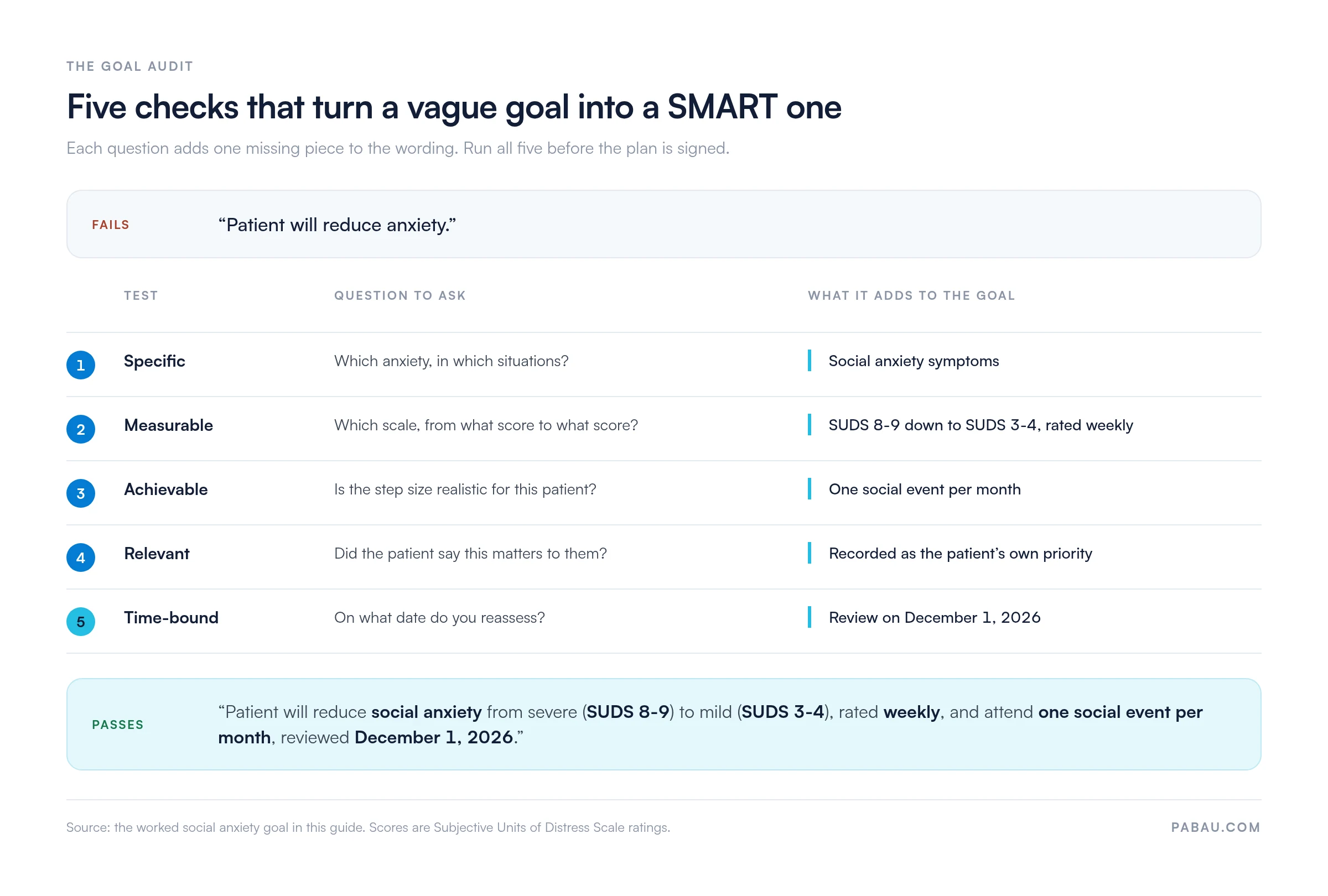
Notice what changed. The draft named a feeling. The audited version names the scale, the two scores, the behavioral marker, and the review date. That is the difference between a goal you can review and a goal you can only discuss.
Both examples below follow the same pattern: one outcome goal, then dated objectives that build toward it.
Depression plans usually hang on a single instrument, so the PHQ-9 does most of the measuring here.
Anxiety responds to behavioral targets. Count the episodes, then track the coping skills the patient uses between sessions.
Wording the goal is half the work. A payer reads the plan for completeness and clinical reasoning, so the file around the goal has to hold up too.
The review cadence ends when treatment does. An end-of-treatment note written at the final session records each goal as met, partially met, or not met, quantified where the scale allows.
Structured goal-setting is standard practice across behavioral health for a plain reason. A patient who knows the target can tell you whether they are getting closer to it.
For clinicians: A measurable target tells you whether the treatment is working, not only whether the patient turned up. It also removes the vague wording that gets claims denied and plans flagged in audits.
For patients: A goal the patient helped write is a goal they can picture reaching. Co-writing the objectives makes the between-session work far more likely to happen.
For payers: Specific goals with documented progress justify the frequency and duration of treatment. Claims move faster when the reviewer can follow the pathway without asking for more.
A plan that lives in a PDF on a shared drive gets written once and read never. Practice management software like Pabau keeps the plan inside the client record, next to the notes and the appointment history.
Pabau’s digital intake forms capture the baseline scores a goal depends on, then hold the goals beside them in a structured record. Open the record before a session and the goal, the last PHQ-9 score, and the previous note are all on one screen.
Documentation is the other half of the job. Pabau Scribe, our AI medical scribe, drafts session notes and treatment plans from the consultation. You review and approve what it writes before it reaches the record, so the paperwork behind each goal takes minutes rather than an evening.
The outcome is a plan you can read in the two minutes before a session. The same file answers a payer’s questions without a hunt through three systems.


Pabau holds SMART goals in the client record, alongside session notes and appointment history. Goals and progress stay in step, with no separate spreadsheet to update.

The wording of a goal decides how much work it saves you later. A goal with a scale and a date reviews itself. A goal without them turns every review into a fresh conversation about what progress means.
So spend the extra few minutes at the drafting stage. Run the five checks, write the review date in, and get the patient to say out loud why the goal matters. That is a few minutes at the start against a much shorter review every month.
Download the template above to start from a structured file, or see how Pabau’s patient record system keeps goals and progress notes together. Book a demo to watch a goal review happen inside a live client record.

Need to measure clinical progress objectively? Patient engagement strategies show how clear goals and progress tracking drive compliance and treatment adherence.
Struggling with insurance claim denials? HIPAA compliance best practices include proper documentation and audit trails that protect your treatment plans during payer audits.
Want to cut charting time? AI medical scribe drafts session notes and treatment plans from the consultation, so documentation keeps pace with the plan.
A SMART treatment plan is a structured clinical document where goals are Specific, Measurable, Achievable, Relevant, and Time-bound. It sets out what the patient will accomplish in treatment and how progress will be tracked.
Start with the diagnosis, then define a broad outcome goal. Add the measurement criteria, either a scale or a behavioral indicator. Confirm the goal is achievable and matters to the patient, then set a review date. For example: patient will reduce a PHQ-9 score from 18 to 9 or lower by December 1, 2026.
A goal is a broad, longer-term outcome, such as reducing anxiety to mild. Objectives are the specific, shorter-term steps that lead to it. Examples include practicing grounding techniques daily or completing exposure tasks weekly.
Most payers require treatment goals to follow the SMART framework, or a similar structure, to justify medical necessity and approve claims. Vague or unmeasurable goals are a common reason for claim denials.
Review and document goals every 30 to 60 days, depending on payer requirements and treatment intensity. Update a goal if it is achieved early, proves unrealistic, or needs adjusting in light of clinical progress.
Validated scales give you objective measurement: the PHQ-9 for depression, the GAD-7 for anxiety, the PCL-5 for PTSD, and the Subjective Units of Distress Scale. Frequency counts and behavioral milestones also work as indicators.