Journal prompts for mental health
Journal prompts for mental health are guided questions that help people process ...

2
Last Updated: Oct 13, 2026

A CBT cheat sheet is a quick-reference guide covering core cognitive behavioral therapy concepts, techniques, cognitive distortions, and session structures for therapists.
The most common cognitive distortions, such as all-or-nothing thinking, catastrophizing, and mind reading, are listed in an easy-scan table for quick identification in session.
The ABC model (Activating Event-Belief-Consequence) is CBT’s foundational framework, and thought records plus behavioral activation are two of its primary intervention techniques.
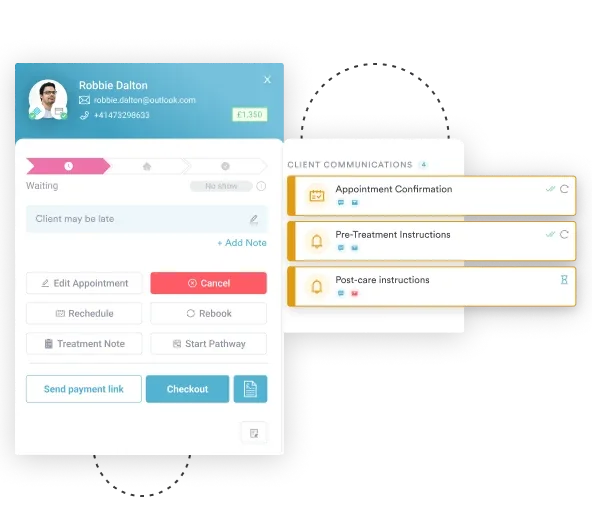
Practice management software like Pabau stores your cheat sheet alongside session notes and homework, so your clinical workflow stays in one place.
NICE, the APA, and the BABCP all recommend CBT for anxiety, depression, OCD, PTSD, and many other conditions, so this template applies across specialties.
A ready-to-use quick-reference guide covering core CBT concepts, cognitive distortions, key techniques and interventions, session structure, and condition-specific applications. Use it in session, during supervision, or as a training aid for new therapists.
Download templateA client describes racing thoughts, and for a second you’re weighing three interventions at once. A CBT cheat sheet exists for exactly that moment: one page holding the ABC model, the common distortions, and your core techniques. You scan it mid-session, without losing the thread of the conversation.
New therapists lean on it to build fluency fast. Experienced clinicians reach for it when a case sits outside their usual specialty. Here’s what belongs on that page, and how to fold it into your practice records once you’ve built it.
A CBT cheat sheet is a one- to three-page clinical reference. It lists the concepts, techniques, and decision points you need to deliver cognitive behavioral therapy without pausing mid-session to recall whether a client’s thinking counts as catastrophizing or mind reading. Many clinicians keep it inside their therapy practice management software, right alongside the session notes it supports.
The American Psychological Association and NICE’s guidance on depression both treat CBT as one of the most evidence-based talking therapies available, with results shown for anxiety, depression, OCD, and PTSD across hundreds of trials.
Still, the technique list is long: thought records, behavioral experiments, graded exposure, cognitive restructuring, Socratic questioning. A cheat sheet keeps that list at hand, so session time goes to the client, not to recall.
Most versions cover the same six building blocks:
Together, these sections turn years of training into something you can scan in seconds, which is the whole point of keeping one on hand.
Using a cheat sheet is straightforward, but folding it into your clinical workflow takes some intent. Here are five practical steps:
A cheat sheet supports clinical training and supervision rather than replacing them. Use it as a memory aid and decision-tree tool to speed up technique selection and keep your approach consistent across clients.
A CBT cheat sheet serves several audiences, not just one:
It works the same way regardless of setting: one-to-one therapy, group therapy, coaching, or consultation.
A well-designed cheat sheet speeds up clinical decisions. When a client describes racing thoughts, you can name the pattern, mind reading, say, and choose an intervention such as a thought record plus behavioral experiment, without the mental scramble. That speed reads to the client as confidence. They see you as decisive and knowledgeable.
Consistency. Using the same reference across every client keeps your application of CBT principles uniform. New clients get the same evidence-based techniques as long-term ones, and supervisees feel supported. They know what you expect and why.
Training efficiency. Training a new therapist is faster with a shared reference tool. Hand them the cheat sheet on day one, and by the end of the week they understand your practice’s CBT framework and technique sequencing.
Client engagement. Naming a client’s cognitive distortion and explaining why you’re recommending a specific technique makes the client feel heard and educated. They’re less likely to drop out.
Documentation clarity. If your cheat sheet lives in your clinical notes system, for example inside your mental health EMR alongside session notes, auditors and supervisors can see that your interventions follow an evidence-based protocol. That is a compliance and quality-assurance win.
Create a laminated pocket version of the distortions and techniques section. Many therapists print the 1-page summary, laminate it, and keep it in their therapy bag or office drawer for quick reference. Digital versions (stored in your phone or laptop) also work, but paper stays visible during sessions and avoids the distraction of switching between screens.
All CBT interventions rest on one idea: your thoughts, feelings, and behaviors are connected. Albert Ellis developed the ABC model to map that connection, and it remains the backbone of Rational Emotive Behavior Therapy.
Aaron Beck built a related but separate framework, Cognitive Therapy, centered on automatic thoughts and the cognitive triad. Your cheat sheet teaches Ellis’s ABC model because it maps cleanly onto a single session.
CBT works by changing B. You teach clients to identify their thought, test whether it’s accurate (is there evidence? is there an alternative explanation?), and replace it with a more balanced one. The feeling follows from there: calmer thoughts lead to calmer feelings.
You can also work backward. If a client avoids a feared situation, you gradually expose them to it, expecting their catastrophic belief to be disconfirmed by reality. Either direction, changing the thought or changing the behavior, shifts the whole pattern.
Cognitive distortions are habitual, inaccurate thought patterns. Everyone has them, but people with anxiety or depression lean on them heavily. Your cheat sheet catalogs the most common ones, so you can name them in session and teach clients to spot them.
In session, you might say: “I’m noticing you’re catastrophizing, jumping to the worst possible outcome without evidence. Let’s test that prediction with a behavioral experiment.” Naming the distortion validates the client’s experience while making clear the thought is a pattern, not a fact.
A cheat sheet organizes the primary techniques therapists use. Here are the six most universal:
The cornerstone CBT homework tool. A thought record uses seven columns: Situation, Feeling, Automatic Thought, Evidence For, Evidence Against, Alternative Thought, and New Feeling.
Clients fill it out when they notice strong emotions, which helps them spot and challenge distorted thinking.
Instead of telling a client their thought is wrong, ask questions: “What evidence supports that belief? What evidence contradicts it? Is there another explanation? If a friend had this thought, what would you tell them?” This guides clients to their own conclusions and builds conviction in the new thought.
For depression, inactivity worsens mood. Behavioral activation means scheduling concrete, valued activities, exercise, socializing, creative projects, regardless of motivation. As the client becomes active, mood typically improves. Build a hierarchy: start with small, achievable activities before tackling bigger challenges.
For anxiety, avoidance reinforces fear. Exposure means facing the feared situation in a graduated, safe way. A client who fears public speaking might start with a friend, then a small group, then a larger audience. Each successful exposure disconfirms the catastrophic prediction and reduces anxiety.
Test a belief in real life. If a client believes “if I leave the house, something terrible will happen,” design an experiment: go to the store for 15 minutes and observe what actually happens. Real-world evidence carries more weight than logical argument alone.
Directly challenge and replace distorted thoughts with realistic alternatives. “I’m worthless” becomes “I made a mistake in this one area, which is fixable, and I have real strengths.” Restructuring works best once clients have identified and labeled their distortion.
Your cheat sheet pairs each technique with the conditions it addresses: behavioral activation for depression, exposure for anxiety, restructuring for perfectionism, Socratic questions for shame. That pairing helps you pick the right tool quickly.
A structured session keeps the work focused and time-bound. Automated workflow reminders can prompt you through each step, but here is the manual template:
A 50-minute session usually breaks down into five chunks. Budget 5 minutes for agenda-setting, 5 for the mood check and bridge, 30 for skills teaching, 5 for homework, and 5 to summarize and give feedback. Adjust the timing to fit the client, but keep the skills-teaching block in every session instead of spending the hour only talking through problems.
Your cheat sheet maps common presentations to primary interventions. Use this table when a client presents with a new diagnosis, or when you’re shifting focus within therapy:
This table isn’t exhaustive. CBT applies to many conditions beyond these, but these seven cover most clinical presentations. Practice management software with structured diagnostic coding can help populate the right technique recommendations automatically, keeping your notes aligned with evidence-based care.
A thought record is the homework tool clients use between sessions. Here’s how to teach and use it:
In supervision or peer consultation, check whether a client’s thought records show the pattern clearly, whether they’re practicing the skill, and whether ratings drop over time. Thought records create accountability and give you concrete progress data. The goal isn’t to erase the negative feeling, but to bring it down to a workable level.
A printed cheat sheet helps, but a digital one stored inside your practice management system changes how you use it day to day. Your CBT reference then sits next to session notes, homework, and client records in one searchable place.
With Pabau.
Build structured digital intake forms that carry thought record templates, activation logs, and exposure hierarchies. Use AI-powered clinical documentation to transcribe session work and pull technique names and homework straight into your notes. Assign homework, such as “complete a thought record this week,” and Pabau can send the reminder automatically, which keeps follow-through higher.
The same setup works for telehealth sessions. Keep the reference open in a second window while Pabau’s telehealth software runs the video call, so you’re never scrambling for a technique mid-session.
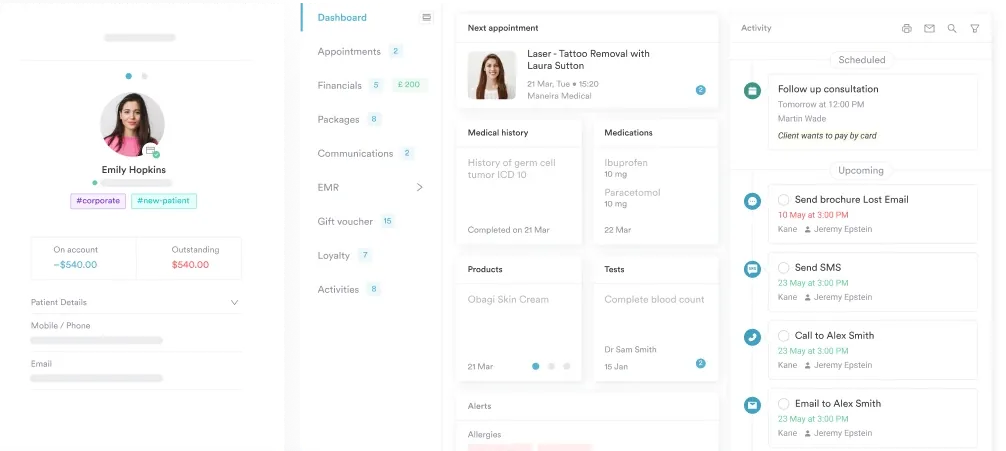
Picture the workflow. The client arrives, and you pull up their chart with the cheat sheet already attached. You see last week’s thought record and review their progress. You assign new homework through the digital form, and Pabau sends the reminder automatically, so they submit it before the next appointment.
No lost papers, no clients forgetting homework, no hunting through desk drawers for your reference guide.

Pabau’s client records and digital forms let you store your cheat sheet, session notes, and client homework in one searchable system, so nothing gets lost across scattered PDFs and desktop folders.

A CBT cheat sheet earns its place on your desk. It compresses years of training into a page you can scan between clients, and it keeps your technique choices consistent across a full caseload, whether you’re building competence or managing a long-running practice.
The real payoff comes when that reference lives where you already work, inside your client records, next to session notes and homework. Pabau keeps your cheat sheet, forms, and documentation in one searchable system, so nothing gets left in a separate file.
Book a demo to see how it fits your practice.

Working with clients at risk? A suicide safety plan gives you a structured format for documenting risk factors and a crisis response alongside your CBT work.
Want a fast way to screen coping style? The Brief-COPE template helps you spot avoidant or maladaptive coping before you pick a CBT technique.
Treating couples alongside individual CBT? A couples therapy workbook extends cognitive and behavioral techniques to relationship-focused sessions.
It depends on the diagnosis and severity. NICE’s guideline on depression (NG222) notes individual CBT usually runs to 16 sessions for more severe cases, while anxiety-focused courses often run shorter, closer to 6 to 12 sessions.
Homework drives much of the outcome, but partial completion is common. Use session time to explore what got in the way of finishing it. That often reveals the exact distortion behind the avoidance, which is useful clinical information on its own.
Yes, with adaptations. Younger clients usually need simpler language for the ABC model, shorter thought records, and more visual or play-based exercises than the adult format this cheat sheet covers.
A thought record captures one situation and challenges the belief behind it. A mood log simply tracks emotional intensity over days or weeks, without necessarily challenging the thinking.
Yes, most clients show two or three overlapping distortions at once, such as catastrophizing paired with mind reading. Treat the cheat sheet as a shortlist to check against, not a single label to land on.