Monika Lazarevska

Shame worksheets: 6 types and when to use each one
Shame worksheets are structured writing exercises that help patients notice, nam...

Last Updated: Nov 2, 2026
Free PDF 2 pages, print-ready Clinician-reviewed
A leaves on a stream worksheet is a printable ACT exercise that helps patients watch unwanted thoughts drift past instead of getting pulled into them. The patient pictures each thought on a leaf floating downstream, writes it on the page, then answers five reflection questions. Therapists reach for it when rumination, worry or self-criticism keeps someone stuck. It teaches cognitive defusion, a core skill in Acceptance and Commitment Therapy, in one short exercise.
A two-page ACT worksheet with written instructions, seven Thought/Leaf boxes and five reflection questions for the debrief. Print it, or fill it in on screen during the session.
Start from scratch, or upload this PDF or any form you already use, and Pabau's AI Form rebuilds it with tick boxes, text fields and a signature. Attach it to the treatment once, and every patient gets it on time.
AI Form rebuilds the consent, history and aftercare forms you already use. You review each one, then publish.
Patients complete forms on their phone before they arrive, so the front desk stops retyping paper.
Every signed form is versioned and attached to the treatment record, ready when you need it.
Set how long a consent stays valid. Returning patients skip forms they have already signed.
Supports HIPAA and GDPR compliance AES-256 encryption 4.8 on G2 4.7 on Capterra Trusted by 4,000+ practices worldwide

The leaves on a stream exercise uses the image of leaves on moving water to practice cognitive defusion, a core ACT skill.
It comes from the ACT tradition, generally traced to Hayes, Strosahl and Wilson (1999). ACT has trial evidence, but this exercise has little research on its own.
A session moves from a guided visualization to thoughts written in the worksheet’s seven boxes, then a structured debrief.
The exercise suits patients stuck in rumination, worry or self-criticism. Adapt it for trauma, dissociation or psychosis, and hold it during acute distress.
Present it as practice in noticing thoughts, so a thought that keeps coming back reads as part of the exercise rather than a failure.
The leaves on a stream exercise is a cognitive defusion technique. The patient imagines sitting beside a stream, places each unwanted thought on a leaf and watches it float away. The aim is to treat a thought as a passing mental event, rather than an order to obey or a fact to argue with.
The exercise comes out of the Acceptance and Commitment Therapy (ACT) tradition and is generally traced to Hayes, Strosahl and Wilson’s 1999 ACT text. Russ Harris’s book The Happiness Trap helped popularize it with a wider audience. Its first appearance is hard to pin down, so cite it as an ACT exercise rather than one author’s invention.
The metaphor is simple, which is part of its value. Patients can picture it in a few seconds and come back to it between sessions. For the wider theory, our guide to cognitive defusion covers the other techniques in the same family.
Cognitive defusion is one of the six core processes in ACT’s model of psychological flexibility, which the ACT hexaflex template lays out on one page. Defusion changes how a patient relates to a thought, without debating whether the thought is accurate.
That distinction matters in the room. A patient who believes “I always ruin things” can spend an hour disputing it and leave just as hooked. Watching the same sentence float past on a leaf gives them distance from it, and nobody has to win the argument.
ACT as a whole has a solid evidence base. A 2015 meta-analysis of 39 randomized controlled trials found it may work as well as established therapies for anxiety, depression, addiction and physical health problems.
That evidence covers the full therapy, though, not this exercise. Leaves on a stream has little research on its own, while defusion as a component has some experimental support. Read the primary literature and your professional guidance before using it for a specific diagnosis.
Clinicians commonly use leaves on a stream where patients are fused with difficult thoughts. Typical targets are worry, rumination, self-criticism and intrusive thoughts.
When the same worry loop returns week after week, a ruminating thoughts worksheet helps the patient map it alongside this exercise. Once they can step back from a thought, the ACT bullseye worksheet turns that new distance toward what they value.
ACT has been studied in psychosis with some positive results, so the exercise isn’t ruled out there. For psychosis or dissociative presentations, adapt it with care and supervision. The checklist below sorts the common cases.
A few minutes of setup decides whether the exercise lands. Start by checking where the patient sits in the table, then run through the list below.
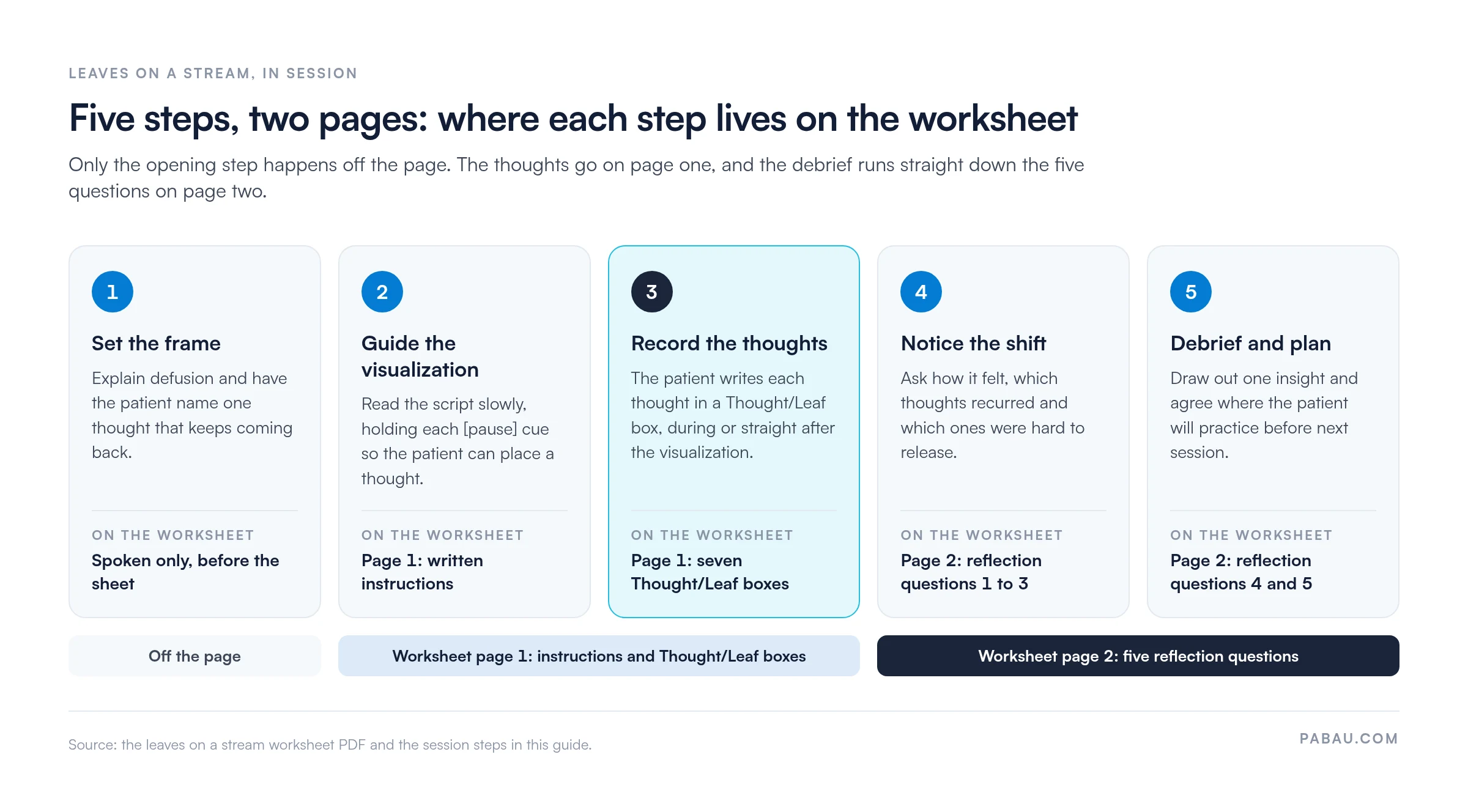
The leaves on a stream worksheet runs over two pages, and the session follows them in five steps. Adjust the pace to the patient’s readiness, and plan for it to fill a short segment of the session.
Only the first step happens off the page, so the worksheet doubles as your running order. The diagram shows where each step sits, which helps the first time you run it.
For groups, read the script once, then give each participant the worksheet to complete on their own. Keep the debrief to pairs or a short round, so no one feels pressed to share more than they want.
The script below is a condensed version you can read aloud. Invite the patient to close their eyes, or to keep them open with a soft downward gaze. Pause for several seconds at each [pause] cue, and slow down if the patient seems rushed.
Close by asking the patient to notice that thoughts came and went without needing to be acted on. If they’re writing as they go, add a pause after each leaf so they can note the thought in a box.
Sessions stall at the debrief more often than at the visualization. Here’s how a short exchange might run with a patient who wrote “I’m going to fail this interview” in three of the seven boxes.
Notice what the clinician leaves out. There’s no debate about whether the interview will go badly, and no praise for getting rid of the thought. The conversation stays on how the thought felt, which is the skill you want the patient to take home.
Most of these show up in the first few runs, and each one has a simple fix.
Once a patient finishes the worksheet, a paper copy can easily end up in a folder nobody opens before the next session. Pabau, the therapy practice management system we build, files the completed sheet on the patient’s record next to your session notes.
You can also rebuild the worksheet as a digital form, so patients write their leaves and reflection answers from home between sessions. Their answers land on the same record, so you start the next session knowing which thoughts kept returning.
Clinicians in psychology practices can keep ACT session notes alongside intake and consent records. Pabau handles the admin, while clinical decisions stay with the practitioner.

Pabau files completed worksheets, session notes and intake forms against each patient, so you can review progress before the next session. Send the worksheet as a digital form that patients complete from home.

Leaves on a stream earns its place because it’s quick to teach and easy to repeat. The worksheet turns a few minutes of visualization into something you can review, and the debrief is where the skill takes hold.
Start with one sticky thought, read slowly, and keep the debrief on how the thought felt instead of whether it was right. Some patients will find the first round awkward, so treat that as part of the practice.
Book a demo to see how Pabau keeps ACT worksheets and session notes together, so each session picks up where the last one ended.

Want the theory behind the exercise? What is cognitive defusion? explains the wider family of defusion techniques and when to use each one.
Mapping all six ACT processes? ACT hexaflex template puts defusion in context alongside acceptance, values and committed action.
Ready to move from defusion to values? ACT bullseye worksheet helps patients rate how closely they are living by what matters to them.
Need a next step in the session? Choice point worksheet shows patients the moment they can move toward or away from their values.
Is the patient stuck in a worry loop? Ruminating thoughts worksheet gives them a structured way to catch and track repetitive thinking.
Yes, it draws on mindfulness, but its main job in ACT is cognitive defusion. Mindfulness trains attention on the present moment. Leaves on a stream adds one specific move: noticing a thought as words passing by, then letting it go.
It comes from the ACT tradition and is generally traced to Hayes, Strosahl and Wilson’s 1999 ACT text. Russ Harris’s book The Happiness Trap helped popularize it. Its exact first appearance is hard to confirm, so check primary sources before citing an origin.
Visualization isn’t essential. Patients with little mental imagery can write each thought in the worksheet’s boxes instead. Another option is to say it aloud, starting with “I’m having the thought that”. The defusion skill stays the same.
Yes, with a few adjustments. Shorten the script, use plain language, and let younger patients draw the leaves instead of writing in the boxes. Keep the debrief to one or two questions so it doesn’t feel like homework.
Short, regular practice is easier to sustain than occasional long sessions. Ask for two minutes a day at a set time, plus one noted moment of defusion to bring to the next session.