Tanja Lepcheska

million dollar facial
What is a million dollar facial template? A million dollar facial template is a ...

Last Updated: Nov 13, 2026
Free PDF 2 pages, print-ready Clinician-reviewed
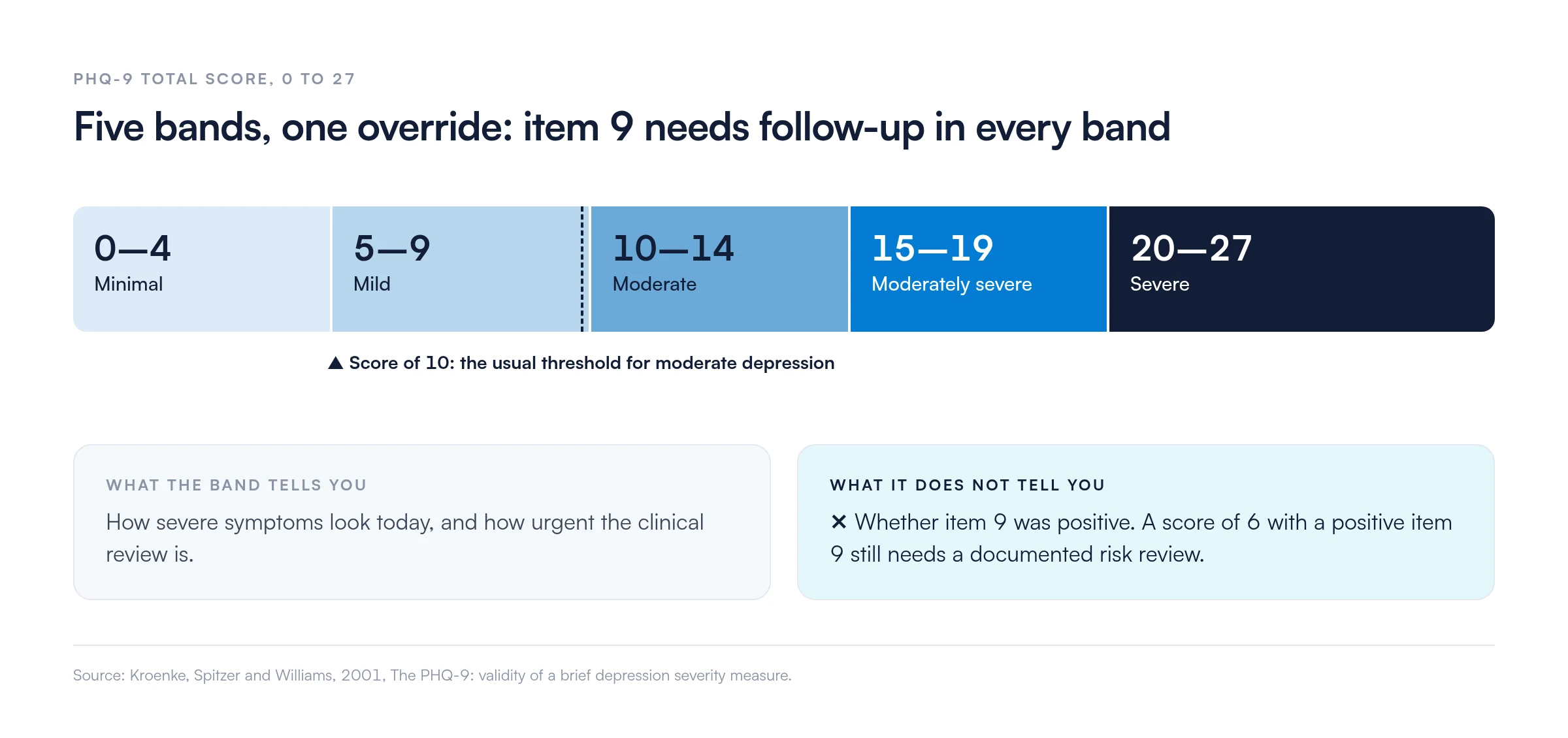
A patient health questionnaire 9 interpretation converts a PHQ-9 total into a depression severity band. Totals range from 0 to 27 and fall into five bands: minimal, mild, moderate, moderately severe and severe. A total of 10 or more starts the moderate band and is the usual cutoff for flagging likely major depression. The band sets how quickly a clinician reviews the patient, but any positive answer on item 9 needs follow-up whatever the total.
A two-page PDF with the nine-item PHQ-9 and difficulty question, a scoring and severity-band guide, and a score log for tracking change from baseline.
Start from scratch, or upload this PDF or any form you already use, and Pabau's AI Form rebuilds it with tick boxes, text fields and a signature. Attach it to the treatment once, and every patient gets it on time.
AI Form rebuilds the consent, history and aftercare forms you already use. You review each one, then publish.
Patients complete forms on their phone before they arrive, so the front desk stops retyping paper.
Every signed form is versioned and attached to the treatment record, ready when you need it.
Set how long a consent stays valid. Returning patients skip forms they have already signed.
Supports HIPAA and GDPR compliance AES-256 encryption 4.8 on G2 4.7 on Capterra Trusted by 4,000+ practices worldwide

The PHQ-9 total score ranges from 0 to 27 across nine items.
A total of 10 or more starts the moderate band and is the usual cutoff for flagging likely major depression.
Item 9 asks about self-harm and needs follow-up whatever the total.
Practice management software like Pabau can collect PHQ-9 responses through digital forms before a visit.
The first step in any patient health questionnaire 9 interpretation is matching the total to its band. The bands below come from the original validation study (Kroenke, Spitzer and Williams, 2001).
A score of 10 or more is the usual cutoff for flagging likely major depression, and it marks the start of the moderate band. That study found sensitivity and specificity of 88% at this cutoff for major depression. The chart below shows where each band sits on the 0 to 27 scale, and why item 9 sits outside them.
The PHQ-9 is a nine-item self-report questionnaire that asks how often a patient has been bothered by depressive symptoms over the previous two weeks. Each item scores from 0 (not at all) to 3 (nearly every day), giving a total from 0 to 27.
Kroenke, Spitzer and Williams developed the tool, and clinicians use it in primary care and mental health settings to screen for and monitor depression severity. It is a screener rather than a diagnostic instrument, so a score supports clinical judgment and does not replace it. The instrument and its terms of use are published at phqscreeners.com, and the site states it can be reproduced and distributed without permission. The PHQ-9 was developed with an educational grant from Pfizer, so check the terms for your version. To compare the PHQ-9 with the WHO-5 and Zung scales, see our depression self-assessment guide.
Scoring is mechanical once the responses are in front of you. Work through these steps in order:
Keep the raw item scores on file, so a later reviewer can recheck the total against the answers.
The band shows where the patient sits, but the next step depends on clinical context, history and the patient’s own goals. In the UK, NICE guideline NG222 on depression in adults sets out how to structure these decisions.
Item 9 asks whether the patient has had thoughts of being better off dead or of hurting themselves. A positive answer is not a suicide risk assessment, but it calls for a direct conversation and a documented risk review. Record the response and the action taken, whatever the total.
Clear entries help the next clinician. Our guide to safer clinical notes covers how to write them so others can follow.
A single score is a snapshot. Repeat the questionnaire at each review and compare the new total with the baseline. A change of 5 points is often treated as clinically meaningful, though you should confirm the figure against your local guidance. Keep a simple log with:
Paper, digital and telehealth versions all use the same nine items, so the interpretation does not change with the format. Digital administration makes it easier to keep the score in the record. Pabau Scribe, our AI scribe, can help clinicians draft notes from a consultation, but the clinician should always check the score themselves. Read more about AI-powered clinical documentation.
Data handling matters too. If you collect responses online, check how your platform protects health information against HIPAA compliance requirements for practice software before you go live.
Validation for the PHQ-9 is strongest in adult primary care and mental health populations. Evidence is more limited for adolescents, perinatal patients and some cultural or linguistic groups. Check the validation for your population before relying on a cutoff.
Physical illness can also inflate some somatic items, so read the total in context. When you need a fuller clinical picture, pair the questionnaire with a structured psychiatric evaluation template.
Audit ten recent PHQ-9 records this month. Check that each total matches its item scores, that item 9 has a documented action, and that the severity band is recorded. Gaps usually show up in item 9 documentation first, so start there and fix the template before the next review cycle.
Teams that apply the same interpretation process across clinicians end up with records that compare cleanly over time. A shared template also shows a reviewer how each score led to a decision, which makes audits quicker.
Use the score log above to set one consistent process. If you want to see how a mental health practice keeps these records together, explore our mental health EMR software.
A paper PHQ-9 has to be re-keyed into the patient record. That is where mistyped totals and missing item 9 actions creep in.
Pabau’s digital forms let patients complete a medical questionnaire before the visit, and the response is stored in the patient record. Your clinician can then review the answers, record the band and log the follow-up action beside the rest of the patient’s history.
Because the form and the record sit in one place, a later reviewer can recheck the total against the answers without chasing a separate file.

Book a demo to see how Pabau stores questionnaire responses and follow-up actions in the patient record, so your team reviews progress in one place.

A PHQ-9 total is only as useful as the decision it leads to. The band sets how quickly you review a patient, but item 9 and the change from baseline carry more clinical weight than any single score.
If you change one habit, audit ten recent records for a documented item 9 action. It is the gap that costs most when a record is reviewed, and an afternoon closes it.
Book a demo to see how Pabau keeps questionnaire responses, scores and follow-up actions together in the patient record for mental health practices.

Working in psychiatry? Psychiatry EMR software outlines how psychiatry practices structure ongoing monitoring.
Running a psychology practice? Psychology practice software looks at scheduling and records for talking therapies.
Comparing depression screening tools? Depression self-assessment sets the PHQ-9 beside the WHO-5 and Zung scales.
A patient health questionnaire 9 interpretation matches a PHQ-9 total score to a severity band and decides the follow-up step. It covers the total, item 9 and any change from the baseline score.
Repeat it at each planned review, or as your local protocol requires, and compare the total with the baseline. Repeated scores show whether symptoms are changing over time.
Yes, the same nine items can be completed online or during a telehealth visit. Choose a platform that protects patient data before you use it this way.
No single validation covers every population. Evidence is strongest in adult primary care and mental health settings and more limited for adolescents and perinatal patients.
A score of 20 to 27 falls in the severe band, so urgent clinical review is usually needed, along with active treatment and safety planning. Check item 9 at the same time and document the action taken.
Yes, a PHQ-2 score of 3 or more is the usual prompt to complete the full PHQ-9. A lower PHQ-2 score usually means the longer questionnaire is not needed at that visit.