Anja Dodevska

Operative note: Required elements, templates and CMS rules
An operative note is the surgeon’s signed record of an operation, covering...

Last Updated: Nov 12, 2026
Free PDF 2 pages, print-ready Clinician-reviewed
A standard authorization form is a written document in which a patient lets a healthcare provider use or share their protected health information. Only the patient signs it, and it grants permission without creating a treatment agreement the way a consent form does. Practices need one before releasing records for a purpose HIPAA does not otherwise permit, such as a request from a lawyer or an employer.
A two-page authorization form with sections for patient identification, the disclosing entity and recipient, the reason and scope of disclosure, and expiration. It also carries the revocation and re-disclosure statements, dated sign-off lines, and the personal representative's relationship.
Start from scratch, or upload this PDF or any form you already use, and Pabau's AI Form rebuilds it with tick boxes, text fields and a signature. Attach it to the treatment once, and every patient gets it on time.
AI Form rebuilds the consent, history and aftercare forms you already use. You review each one, then publish.
Patients complete forms on their phone before they arrive, so the front desk stops retyping paper.
Every signed form is versioned and attached to the treatment record, ready when you need it.
Set how long a consent stays valid. Returning patients skip forms they have already signed.
Supports HIPAA and GDPR compliance AES-256 encryption 4.8 on G2 4.7 on Capterra Trusted by 4,000+ practices worldwide

Only the patient signs a standard authorization form, and it permits sharing specific health information with a named party.
HIPAA requires six core elements and three statements under 45 CFR 164.508, and a form missing one is invalid.
A patient asking for their own records makes an access request under 45 CFR 164.524, which needs no authorization.
Patients can revoke a signed authorization in writing, except where the practice has already acted on it.
Pabau sends authorizations to patients before the visit and stores each signed copy in the patient record.
A standard authorization form records a patient’s written permission for a provider to use or disclose specific health information. Under HHS guidance on the Privacy Rule, an authorization is required for any use or disclosure the rule does not otherwise allow.
That usually means a purpose outside treatment, payment and health care operations, or a release to a third party the patient names. A lawyer, an employer and a life insurer are typical recipients. The same rule sets the elements a valid authorization must contain, covered below.
The form differs from a medical consent form, which records agreement to a treatment, with risks and responsibilities on both sides. An authorization covers permission to share information, and only the patient signs to grant it.
A practice’s notice of privacy practices tells patients which disclosures need no authorization at all, such as sharing records with another clinician for treatment.
Practices handle three kinds of authorization paperwork. Each one governs a different kind of request, so a single form rarely covers every case.
A HIPAA authorization must be written in plain language and must include the six core elements listed in 45 CFR 164.508. Missing any one of them makes the authorization invalid.
The form must also carry three statements. It explains the patient’s right to revoke in writing, whether treatment can be conditioned on signing, and that the recipient may re-disclose the information. The patient receives a copy of the signed form.
Our HIPAA authorization form sets out the same elements for practices that want a version written around HIPAA alone.
Insurers use prior authorization forms to confirm coverage before a service is delivered. No single national form covers every health plan. CMS publishes a model coverage determination request form for Medicare Part D drug coverage only, and plan sponsors may use their own versions.
Some states set one standard form for health care services. In Texas, health benefit plan issuers must accept the Texas standard prior authorization form whenever a plan requires prior authorization.
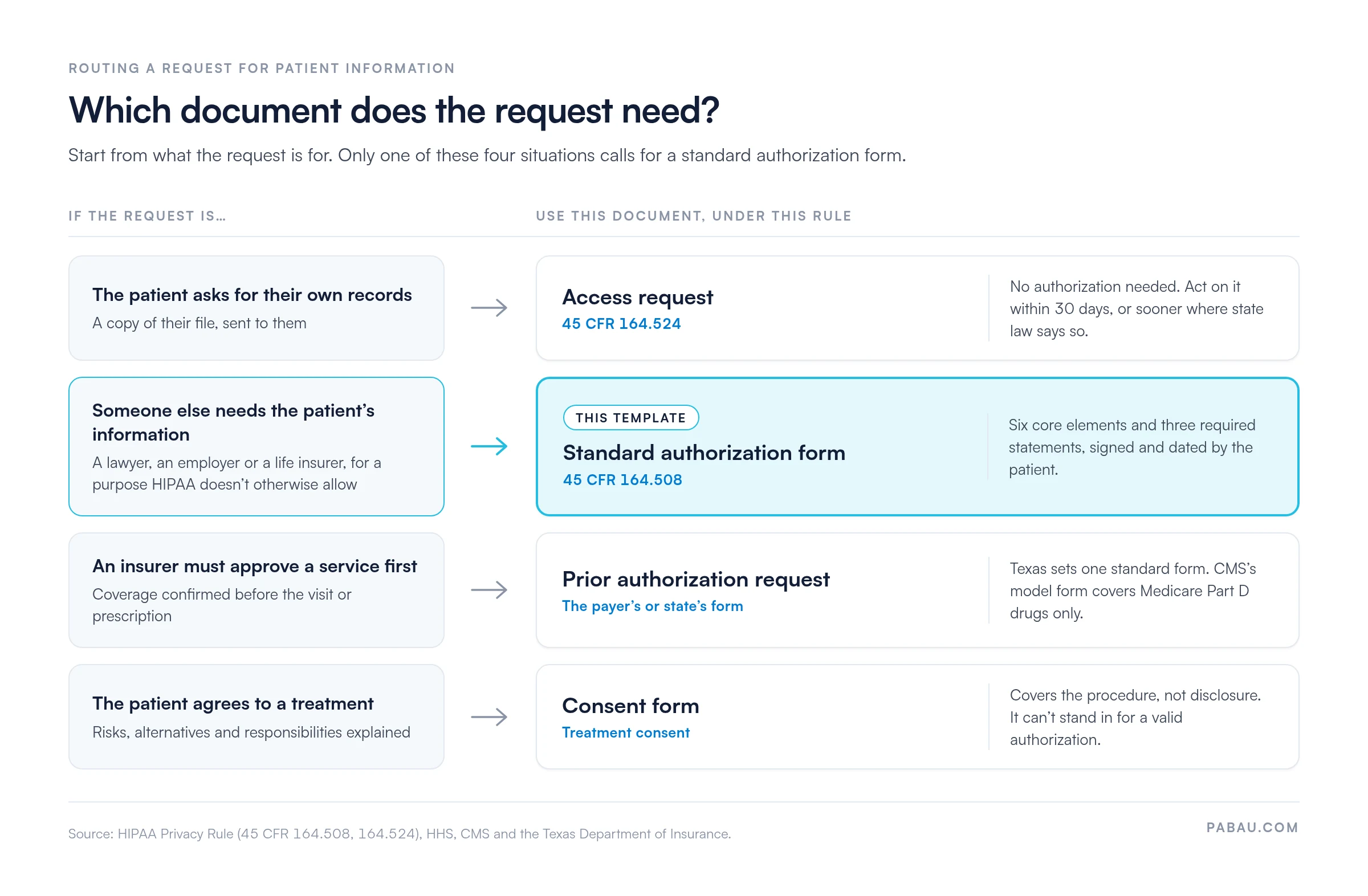
A records release authorization lets a practice send a patient’s file to a named recipient, such as a lawyer or an employer. A patient asking for their own records makes an access request under 45 CFR 164.524 instead. Providers must act on it within 30 days, and state rules may set shorter timelines.
The chart below routes each kind of request to the document it needs.
Every field on the form carries a legal function. The template groups them into four sections, and each needs checking before a patient signs.
The template sets a one-year expiration when no date or event is filled in. That default keeps a rushed form from running open-ended.
Completion is a short process, but skipping a field can invalidate the whole document. Staff should check each step before filing.
If a parent, guardian or other personal representative signs, record their relationship on the form. An authorized representative form keeps their standing authority on file for later requests.
HIPAA sets a federal floor, and state law can add requirements on top. Oregon, for example, specifies a format for certain authorizations under ORS 192.566. Before you adopt any template, check your state health department and medical board guidance.
Paper authorizations travel badly. The form is printed, signed at the front desk, scanned and filed in a folder that the next records request has to find. An expired form often goes unnoticed until someone opens that folder.
Pabau, the practice management platform we build, turns this form into a digital form the patient completes and signs on their own device. Its patient intake software sends the authorization before the visit, and patients can also fill it in through the patient portal.
The signed copy lands in the patient’s medical records, next to the notes it relates to. When a lawyer’s request arrives, staff confirm the recipient, scope and expiry from the patient file in one place.

Pabau sends authorization forms to patients ahead of the appointment and files each signed copy in the patient record. Staff can check scope and expiry without searching paper files.

Many requests for patient information never need this form. A patient asking for their own file makes an access request, and an insurer’s pre-approval runs on the payer’s form. Keep the standard authorization form for releases HIPAA does not otherwise permit, and fill every core element before the patient signs.
Precision is the trade-off worth accepting. A scope of “all records” is quicker to write but harder to defend, and a missing expiration can void the document. Book a demo to see how Pabau collects signed authorizations before the visit and keeps them with the patient record.

Handling mental health or substance use records? Authorization for release of confidential information covers patient details, the information released, the purpose and the recipient.
Practicing in Massachusetts? HIPAA release form for Massachusetts names who may receive records, what they cover, and when the permission ends.
Moving consent onto patients’ phones? E-consent form shows what a signed-on-screen consent must include and how to send it.
An authorization form is a signed document in which a patient permits specific health information to be used or disclosed to a named party. It differs from a consent form, which covers agreement to a treatment.
A consent form agrees to a treatment and carries mutual responsibilities. An authorization form is one-directional and only grants permission to share information.
Yes, a HIPAA authorization must state an expiration date or event. Once it expires, staff should not rely on it for new disclosures.
Yes, patients can revoke a signed authorization in writing, subject to limited exceptions under 45 CFR 164.508(b)(5). The form should explain how to do this.