Talkaholic scale
The talkaholic scale is a 16-item self-report questionnaire that measures compul...

1
Last Updated: Oct 8, 2026
A fear setting worksheet is a three-part exercise, laid out here as a three-page worksheet. It helps you name your worst-case scenarios, plan how to prevent them, and decide how you would recover if they happened.
Tim Ferriss popularized the method in his 2017 TED talk, “Why You Should Define Your Fears Instead of Your Goals.” It builds on the Stoic practice of premeditatio malorum, or the premeditation of evils. Use it when anxiety is stalling a career move, a business pivot or another big decision. The free PDF below follows the steps this guide explains.
A three-page worksheet with space to define your worst-case scenarios, list preventive actions, plan your recovery and weigh the cost of inaction. Print it or fill it in on screen.
Download template
A fear setting worksheet is a three-part Stoic decision-making exercise, laid out here as a three-page worksheet.
Page 1 defines your fears and worst cases, Page 2 lists preventive actions, and Page 3 plans recovery and weighs the cost of inaction.
Some therapists and coaches adapt the worksheet as a structured exercise to help patients move past decision paralysis.
Pabau’s digital forms let therapists and coaches send worksheets for patients to complete on any device, with responses saved to the patient record.
Fear setting is a decision-making framework that flips the usual goal-setting approach. Instead of asking “What do I want to achieve?”, it asks “What am I afraid of, and what would I do if it happened?” Grounded in Stoic philosophy, the reframe shows that many fears are preventable, survivable or both.
Tim Ferriss brought this ancient practice into modern business and personal development. In his TED talk, he shows how the exercise turns abstract anxiety into concrete categories you can act on. “I’m afraid of starting my own business” becomes a list of specific, workable risks.
The practice draws on Stoic writers such as Seneca and Marcus Aurelius and their use of negative visualization. The Stoics taught that imagining hardship in advance weakens its hold and clarifies your options. A daily Stoic journal keeps the habit going between bigger decisions.
This worksheet follows Tim Ferriss’s three-part structure (define, prevent, repair), laid out here as one page per stage. Each page targets a different stage: Naming the fear, preventing it, and recovering from it. The flow below shows how Ferriss’s steps map onto the three pages.
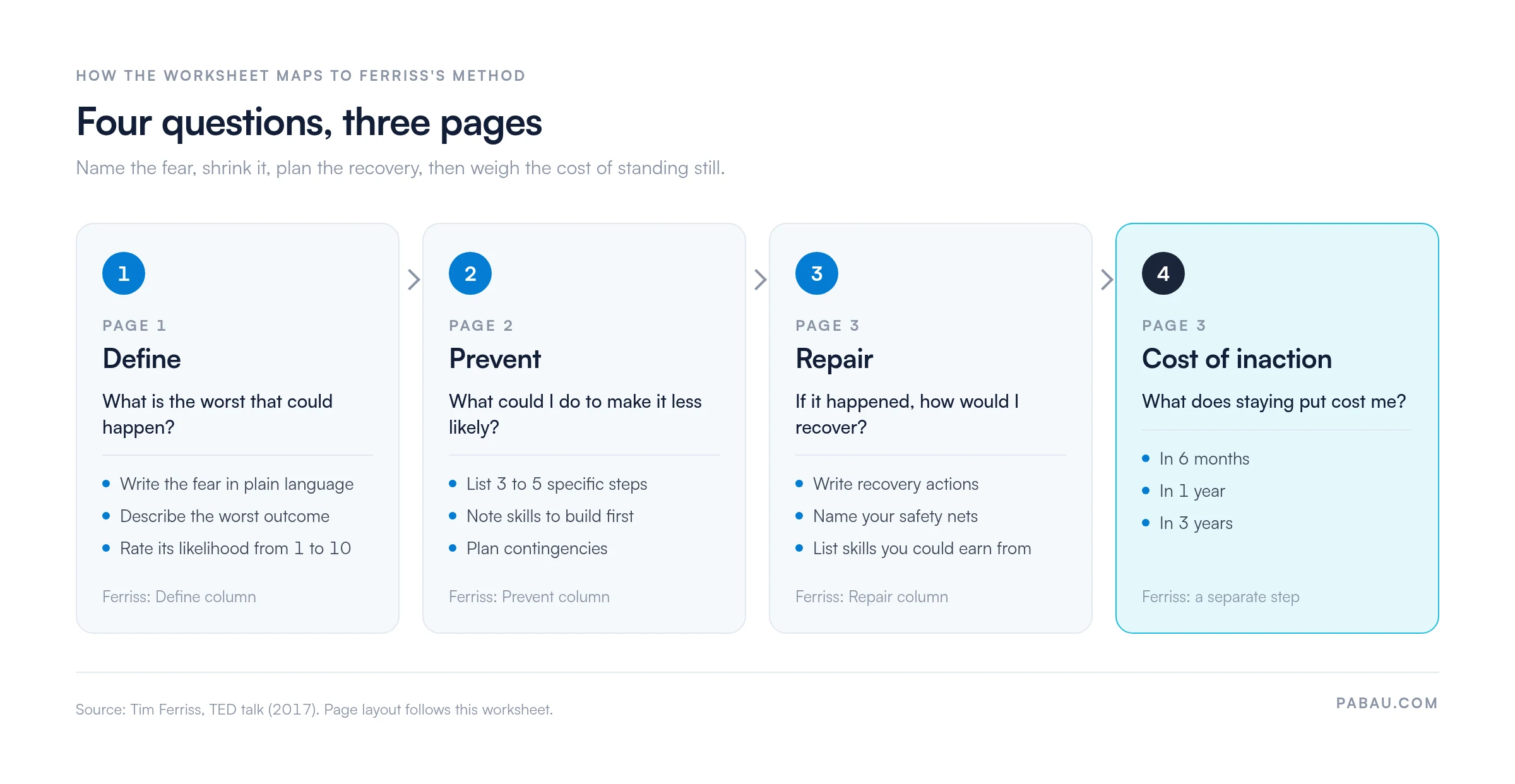
The first page asks you to list your fears explicitly. For each fear, you write out the worst-case outcome you can imagine. Think of it as deliberate catastrophizing on paper.
The second page shifts from naming fears to reducing them. For each worst-case scenario, you identify concrete preventive actions that make it less likely to happen.
The final page assumes your worst case has happened. Instead of trying to remove every risk, you plan how you would recover. Seen on paper, many catastrophes turn out to be survivable.
Ferriss adds a separate cost-of-inaction step to the three columns. This worksheet places it on Page 3. His version also asks what an attempt or a partial success could bring you, so note those benefits beside your recovery plan.
Completing the worksheet takes 20-30 minutes. Set aside uninterrupted time when you are calm, rather than mid-crisis, so you can think clearly. Pen and paper work fine, or use a digital form you can save and revisit.
Repeat the process quarterly for ongoing decisions, or update the same worksheet as your situation changes and new actions emerge.
Some therapists and coaches adapt fear setting as a structured exercise alongside their usual methods. It suits decision anxiety in particular, which often stems from undefined uncertainty. A vague “what if” is hard to solve because it has no edges.
The worksheet gives patients structure. Asking “What is the specific worst case?” pushes an anxious mind to name the fear instead of circling it. Asking “What would you do if it happened?” often reveals coping capacity the patient hadn’t recognized.
The exercise shares some ground with cognitive behavioral therapy (CBT) techniques such as cognitive restructuring and imaginal exposure. Even so, it is not a clinical treatment itself. When the aim is to challenge one distorted thought, a cognitive restructuring worksheet is the closer fit.
Practitioners can send the worksheet as a digital intake form before a session. Through a patient portal, patients complete and submit it from any device. The practitioner then reviews the answers and uses the session to plan next steps.
When to use it with patients: Anxiety about major life decisions, such as a career change, relocation or commitment. It also helps with decision paralysis, fear-based procrastination, perfectionism, or fear of failure blocking a goal.
Goal setting and fear setting answer different questions and clear different barriers, so they work best together.
Reach for fear setting when goal setting hasn’t moved you forward because fear is in the way. A goal might read “I want to start a business by year-end.” The fear setting version reveals “I’m afraid I’ll fail, so I haven’t started the market research.” It then breaks that fear into preventable risks and survivable outcomes. If direction is what’s missing, start with goal-setting worksheets instead.
Fear setting works best when you face uncertainty and anxiety is delaying a decision. Common triggers include:
Complete the worksheet when you can set aside focused time and are ready to move past the stalling point.
Many practitioners still hand out worksheets on paper or as email attachments. The completed copy then sits in a drawer or an inbox, away from the session notes it belongs with.
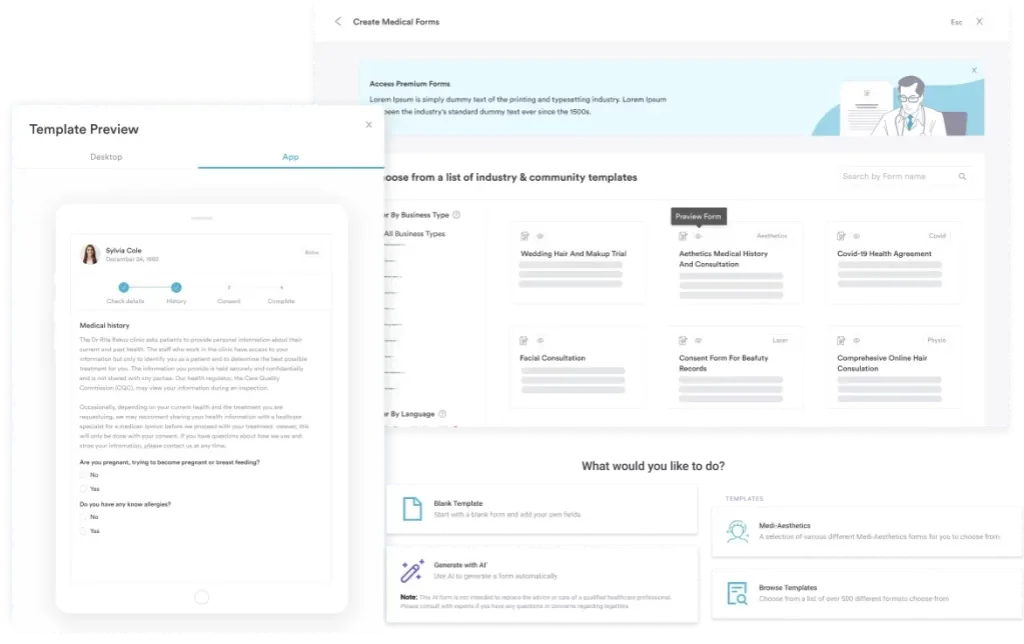
Pabau, the therapy practice management platform we build, turns the worksheet into a digital form. You send it before a session, and patients fill it in on their phone or laptop. Their answers are saved to the patient record, next to your notes.
You can read the answers before the session starts, which leaves the hour itself for the conversation. The same forms, booking and notes setup also runs as psychology practice software, so psychologists get the same workflow.

Pabau’s digital forms send fear setting worksheets to patients ahead of each session. Answers save to the patient record, so you start the session ready to plan.

Fear setting earns its place when fear, more than missing information, is what has stalled a decision. Putting the worst case, the prevention steps and the recovery plan on paper turns a vague dread into a list you can act on.
Start with one decision you’ve been postponing and give it 30 minutes with the worksheet above. Remember the trade-off: It sharpens a decision but doesn’t treat clinical anxiety. A therapist or coach can help you turn your recovery plan into next steps.
For practitioners, the worksheet is most useful when patients complete it before the session. Book a demo to see how Pabau sends worksheets as digital forms and keeps the answers on the patient record.

Running a coaching or therapy practice? Pabau’s coaching software combines digital forms, a client portal and session notes in one platform.
Working through a specific fear step by step? The fear hierarchy worksheet helps patients rank feared situations from least to most distressing.
Dreading an upcoming event? The anticipatory anxiety worksheet helps patients work through worry about what comes next.
Need a quicker decision check? The 10-10-10 worksheet asks how a choice will feel in 10 minutes, 10 months and 10 years.
Weighing whether to change at all? The decisional balance worksheet lays out the pros and cons of changing versus staying the same.
Fear setting is a modern application of negative visualization, a Stoic practice. Negative visualization imagines worst outcomes for reflection. Fear setting adds prevention and recovery planning, which makes it a practical decision-making tool.
A fear setting worksheet addresses decision anxiety tied to specific, uncertain choices. It is not a substitute for treatment of generalized anxiety disorder or other clinical anxiety conditions. If you have an anxiety diagnosis, work with a mental health provider. Some therapists adapt fear setting alongside broader CBT work.
Complete one worksheet per major decision, or when decision anxiety first sets in. Revisit it every two to four weeks as you take prevention actions and gather new information. A quarterly review of all three pages keeps your recovery plan current.
Goal setting answers “What do I want?” Fear setting answers “What am I afraid of, and can I handle it?” Use goal setting when you lack direction, and fear setting when anxiety blocks a known goal. Use both: Set your goal, then use fear setting to clear the emotional barriers.
Yes. Some therapists and coaches adapt fear setting as a structured exercise alongside their usual methods. The worksheet gives both sides a shared framework for discussing catastrophic thinking, coping strategies and next steps. Sending it as a digital form lets patients complete it before the session.