Anemia nursing care plan
An anemia nursing care plan is a structured document that guides a nurse from as...

1
Last Updated: Oct 9, 2026
A newborn assessment is a structured head-to-toe check of a baby’s health, done right after birth and repeated at 24 and 72 hours. It records vital signs, the APGAR score, a physical exam, reflexes, gestational age, and screening results. The aim is to catch problems early and document what’s normal.
Midwives, neonatal nurses, pediatricians, and family physicians use a standard form so every clinician checks the same items in the same order. The free form below follows that sequence, and this guide gives the normal ranges and red flags for each step.
A printable form for recording APGAR scores, vital signs, a head-to-toe exam, primitive reflexes, and newborn screening results. It closes with a clinical summary and a signed sign-off section.
Download template
A newborn assessment documents vital signs, physical findings, reflexes, and screening results to catch health concerns early and guide care planning.
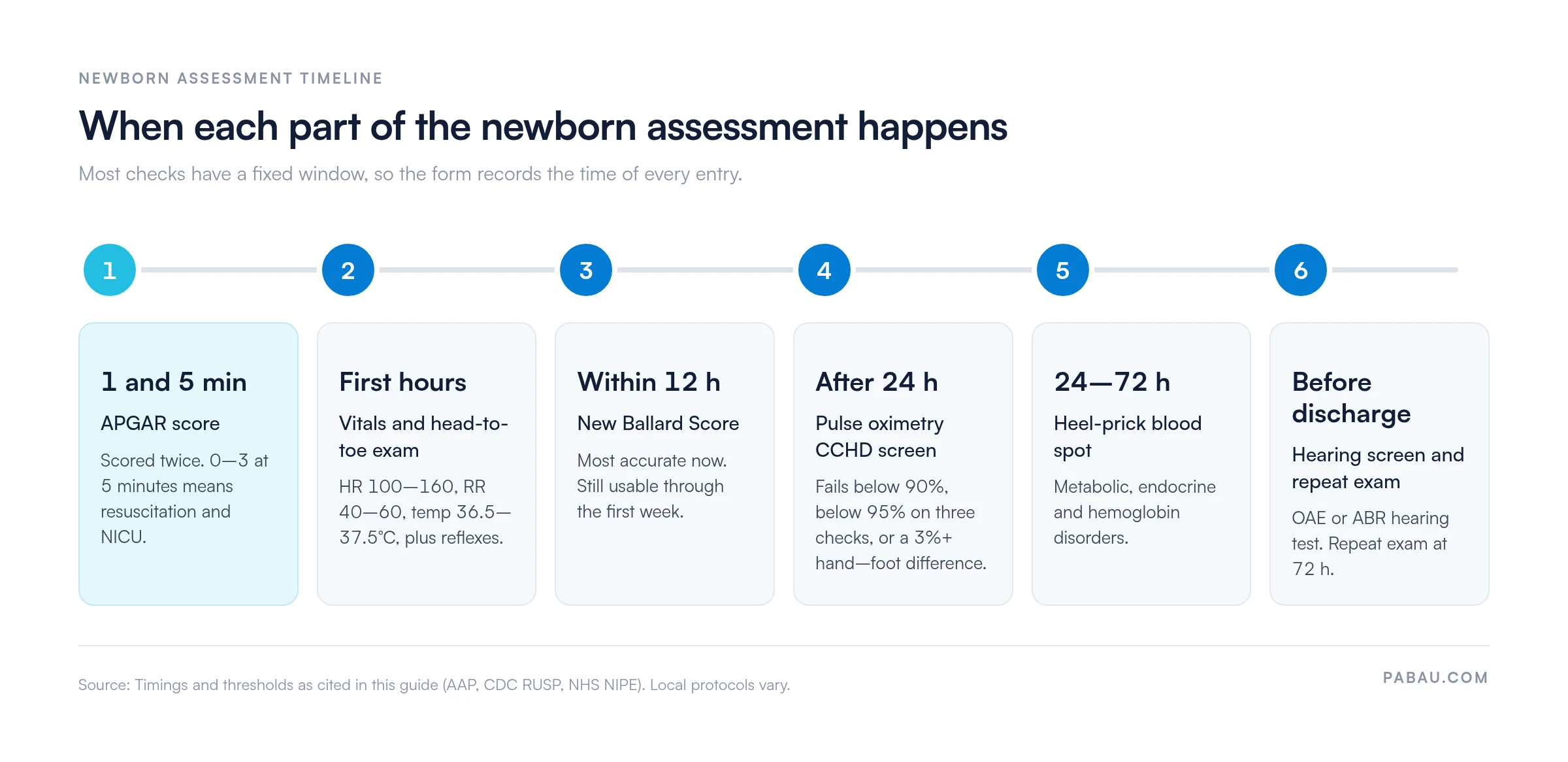
The APGAR score (appearance, pulse, grimace, activity, respiration) is taken at 1 and 5 minutes, and a score of 7-10 is reassuring.
Normal term newborn vitals are a heart rate of 100-160 bpm, respiratory rate of 40-60 breaths/min, temperature of 36.5-37.5°C, and SpO2 above 95%.
The New Ballard Score and primitive reflex testing (Moro, rooting, Babinski, tonic neck) check gestational maturity and neurological function.
Practice software such as Pabau stores the completed assessment on the baby’s record, so the next clinician sees every finding without re-entering it.
A newborn assessment is a full clinical evaluation of a newborn’s health, worked through systematically from head to toe. It starts immediately after birth, is repeated at 24 hours, and continues through the first week as part of routine screening and follow-up.
It does three jobs. It catches congenital anomalies and complications early, documents normal development, and sets a baseline for tracking growth and health changes.
The assessment combines four kinds of data. Objective measurements cover vital signs, weight, and head circumference. Observation covers color, tone, and activity. Structured tests cover reflexes and gestational maturity, while screening covers hearing, metabolic disorders, and pulse oximetry.
Each component informs the others. Abnormal vital signs may prompt closer reflex testing or earlier screening. Abnormal reflexes may point to neuroimaging or further genetic workup. Most checks also have a fixed time window, which is why the form records when each one was done.
Incomplete newborn documentation creates three risks. Treatable conditions get missed, care breaks down between providers, and the practice is exposed if findings are questioned later. A standard form makes sure every component is checked and leaves a record the whole care team can read.
The APGAR score, named after Dr. Virginia Apgar, is the first and most time-critical check in newborn care. It’s taken at 1 minute and again at 5 minutes after birth. The score shows how the baby is adapting to life outside the womb and guides decisions on resuscitation.
Each of the five components scores 0, 1, or 2 points. If you want the scoring sheet on its own, our APGAR score template covers it.
Score interpretation: These bands follow the American Academy of Pediatrics (AAP) and the American College of Obstetricians and Gynecologists (ACOG). A score of 7-10 is reassuring, and the baby usually needs routine care only. A score of 4-6 is moderately abnormal and may call for stimulation, oxygen, or closer monitoring.
A score of 0-3 is low and calls for immediate resuscitation under Neonatal Resuscitation Program (NRP) guidelines. The 5-minute score predicts short-term outcomes. A score that stays at 0-3 after resuscitation warrants urgent transfer to a neonatal intensive care unit (NICU).
Baseline vital signs are the foundation of the assessment. These reference ranges apply to healthy term newborns in the first week of life. Preterm, small-for-gestational-age, or ill newborns may fall outside them.
The physical exam follows a head-to-toe sequence. Examine the baby in a warm room, undressed but covered to hold their temperature. Start with observation of general appearance, color, and activity, then move to palpation and auscultation as needed.
Primitive reflexes show how mature the nervous system is and whether it’s working as expected. Expected reflexes should be present and symmetrical, and pathological reflexes should be absent.
The New Ballard Score estimates gestational age from neuromuscular and physical maturity signs. It’s most accurate within 12 hours of birth but stays useful through the first week.
The six neuromuscular signs are posture, square window (wrist), arm recoil, popliteal angle, scarf sign, and heel to ear. The six physical maturity signs are skin, lanugo, plantar surface, breast, eye and ear, and genitals.
Each sign is scored, the scores are summed, and the total maps to a gestational age between 20 and 44 weeks. The Ballard scale newborn template lays out the full scoring grid for both sets.
Newborn screening combines routine metabolic and genetic tests with checks for critical conditions. Timing and protocols vary by jurisdiction, so confirm your local guidance. In the US, that’s the CDC Recommended Uniform Screening Panel (RUSP). In the UK, it’s the NHS Newborn and Infant Physical Examination (NIPE) programme.
The form follows the order of a bedside newborn exam, in five steps. Each section prompts the clinician through the full assessment so no component gets skipped.
AI-powered clinical note-taking tools can speed up this step. You dictate exam findings in plain language, the system fills the structured fields, and you review and sign the note. This can shorten documentation time while preserving clinical detail.
Most newborns are healthy and need only routine care and observation. Some findings, though, call for immediate escalation to a pediatrician, neonatologist, or emergency department.
Clinical judgment weighs these findings against maternal history, delivery circumstances, and how the baby is trending. When in doubt, document your clinical reasoning and the consultation advice in full, so the next provider has clear context.
On paper, a newborn exam gets written at the bedside, typed into the EHR later, and copied again into a handover letter. Each copy is another chance for a reading to change or a finding to drop.
Pabau, the practice management platform we build, lets the midwife or pediatrician complete the assessment as a digital form on the baby’s record. Findings, vital sign trends, and screening results sit in integrated patient records, so the whole care team reads the same version. Teams that move newborn checks onto one record can see faster handover and fewer re-entry errors.
For women’s health practices, Pabau’s OBGYN EMR software keeps the mother’s antenatal notes beside the baby’s first assessment. The same platform runs fertility clinic software, so a family’s care from IVF to the newborn check can sit in one system.
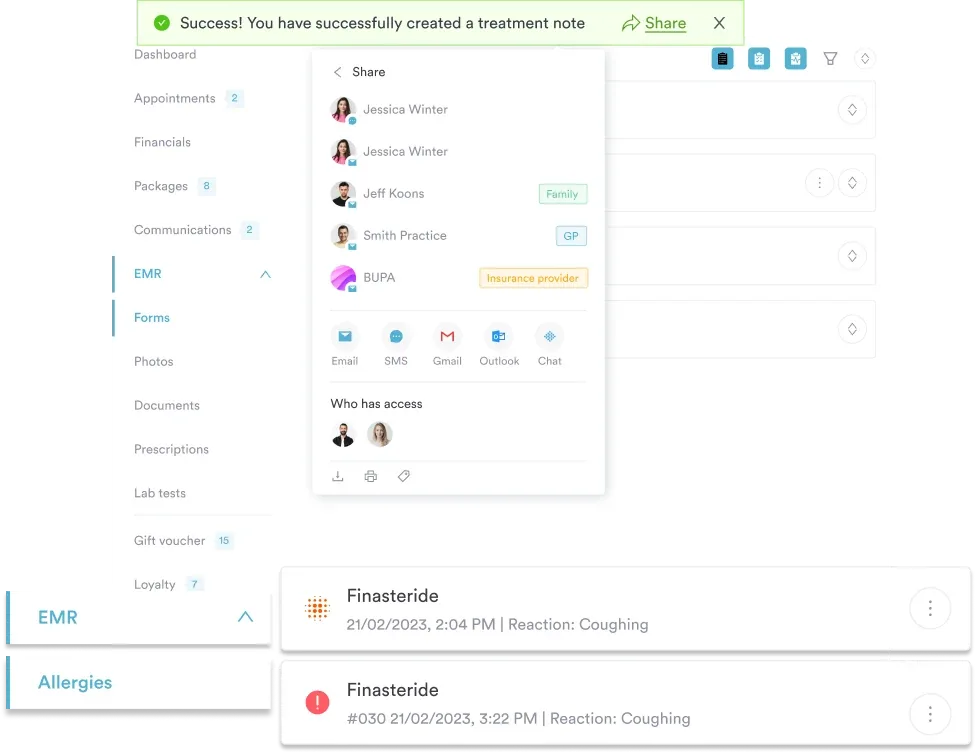

Pabau’s digital forms and integrated patient records let your team complete, sign, and share newborn assessments without copying findings between systems.

A newborn assessment only protects the baby if it’s complete, timed, and readable by whoever takes over next. Download the form, make it the default for every birth, and audit a week of completed forms against the red flags list.
The trade-off is a few extra minutes at the bedside. In return, a missed APGAR, an unrecorded reflex, or a late CCHD screen shows up before discharge instead of after it.
Book a demo to see how Pabau turns your newborn assessment form into a signed record the whole care team can read.

Need the full gestational age grid? Ballard scale newborn template walks through scoring all 12 maturity signs.
Scoring APGAR on its own? APGAR score template gives you a printable sheet for the 1- and 5-minute scores.
Planning the mother’s recovery too? Postpartum checklist covers the key milestones of the fourth trimester.
Documenting labor itself? Pain scale for giving birth shows how to score labor pain consistently.
Monitoring the baby before birth? Nonstress test guide explains the procedure and how to read the results.
A newborn assessment includes APGAR scoring at 1 and 5 minutes and vital signs (heart rate, respiratory rate, temperature, oxygen saturation, blood pressure). It also covers a head-to-toe exam, reflex testing, and gestational age estimation with the New Ballard Score. Screening results round it out, including the heel-prick metabolic screen, hearing screen, pulse oximetry CCHD screen, and eye exam.
The APGAR score (range 0-10) shows how well a newborn is adapting to life outside the womb at 1 and 5 minutes after birth. A score of 7-10 is reassuring and usually means routine care. A score of 4-6 is moderately abnormal and may need intervention or closer monitoring. A score of 0-3 is low and calls for immediate resuscitation and NICU admission.
A newborn should show the rooting, Moro, palmar grasp, Babinski, tonic neck, and stepping reflexes. Rooting turns the head toward a touch near the mouth, and Moro is a startle in which the arms abduct and extend. Palmar grasp closes on a finger, and Babinski extends the great toe when the sole is stroked. Tonic neck extends the arm on the side the head turns, and stepping produces alternating leg movements. Presence, symmetry, and on-time disappearance indicate normal neurological development.
Healthy term newborns in the first week have a heart rate of 100-160 bpm and a respiratory rate of 40-60 breaths per minute. Axillary temperature is 36.5-37.5°C, oxygen saturation is >95% on room air, and systolic blood pressure is 50-70 mmHg. Preterm and ill newborns may fall outside these ranges, so compare each value to the range for the baby’s gestational and postnatal age.
The New Ballard Score estimates gestational age from physical and neuromuscular maturity signs. It’s most accurate within 12 hours of birth and helps classify a baby as preterm, term, or post-term. Gestational age then guides screening protocols, feeding advancement, and the risk of conditions like respiratory distress syndrome.
Routine screening includes the heel-prick blood spot test for metabolic and genetic disorders and universal hearing screening before discharge. It also includes pulse oximetry for critical congenital heart disease (CCHD) after 24 hours, a newborn eye exam, and a review of maternal serology. Panels vary by country and region, so check local guidance, such as the CDC RUSP in the US or NHS NIPE in the UK.
Escalate immediately for an APGAR of 0-3 at 5 minutes, or oxygen saturation <90% on room air (or persistently <95% after 5 minutes). A respiratory rate >70 breaths/min, marked retractions or persistent grunting, and absent or asymmetric reflexes also need escalation. So do seizures, cyanosis not responding to oxygen, severe jaundice within 24 hours, signs of infection, and signs of hypoxic-ischemic encephalopathy. Document your clinical reasoning and transfer to the right level of care, such as NICU or critical care.
The two terms are used interchangeably in clinical practice. Both mean a systematic evaluation of a newborn’s health, vital signs, physical findings, and neurological function. In the UK, “NIPE” (Newborn and Infant Physical Examination) is the standardized national screening programme. In the US, “newborn assessment” or “newborn exam” covers APGAR scoring, vital signs, and the physical exam.