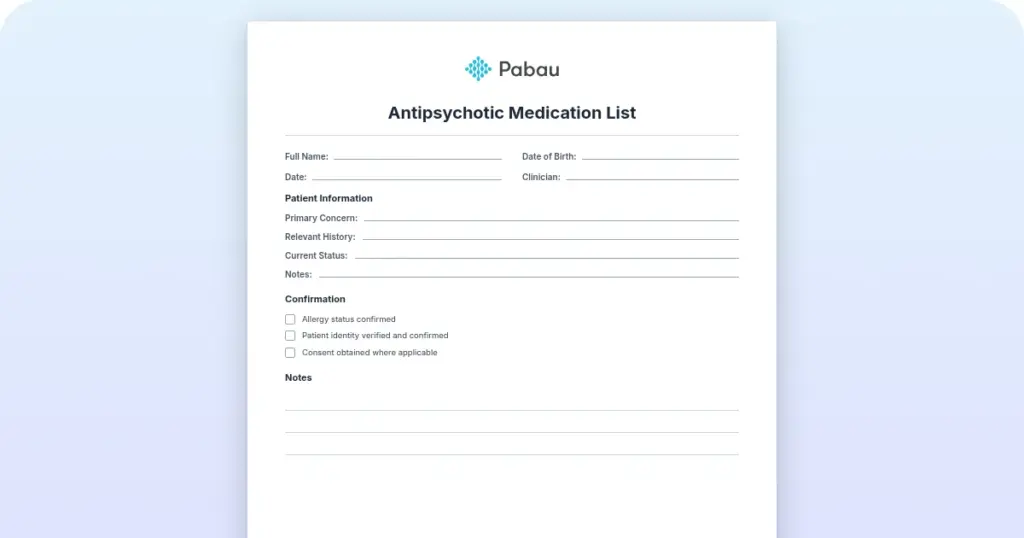
Antipsychotic medication list
An antipsychotic medication list is a structured reference that organizes psychi...

2
Last Updated: Oct 13, 2026

The 8 dimensions of wellness worksheet assesses physical, emotional, social, intellectual, occupational, financial, environmental, and spiritual health – the SAMHSA-adopted holistic framework.
Clinicians use this worksheet during intake assessments to identify underserved life areas and inform treatment planning beyond symptom reduction alone.
The assessment helps clients set realistic wellness goals for each dimension and track progress over time, supporting both mental health recovery and preventive care.
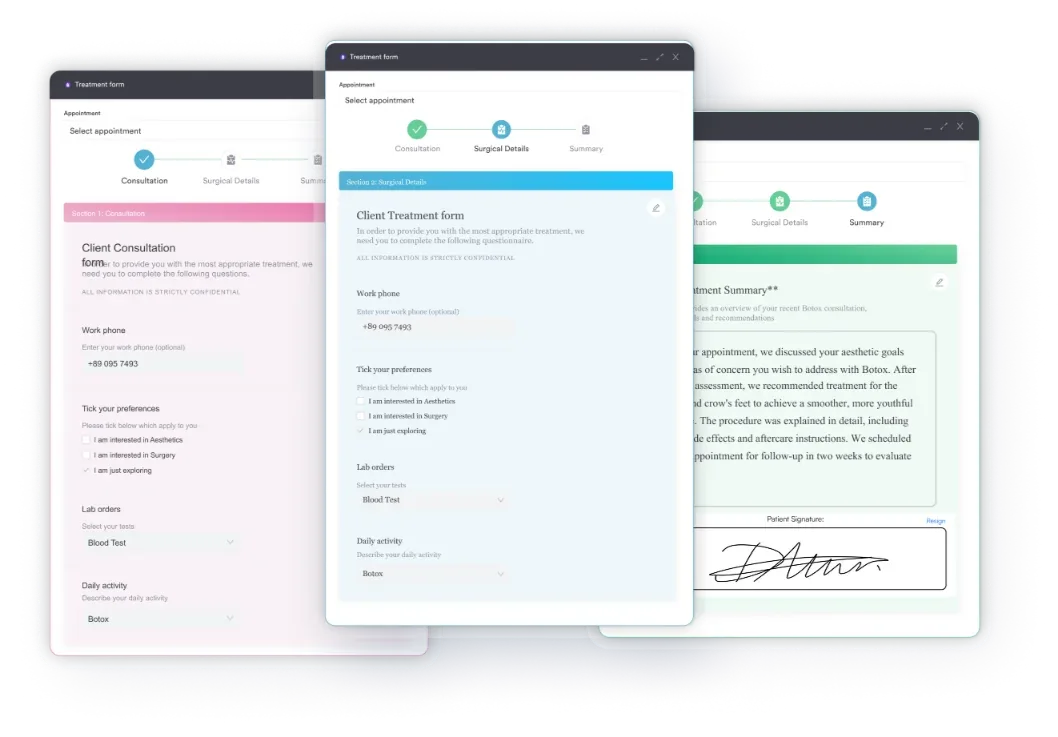
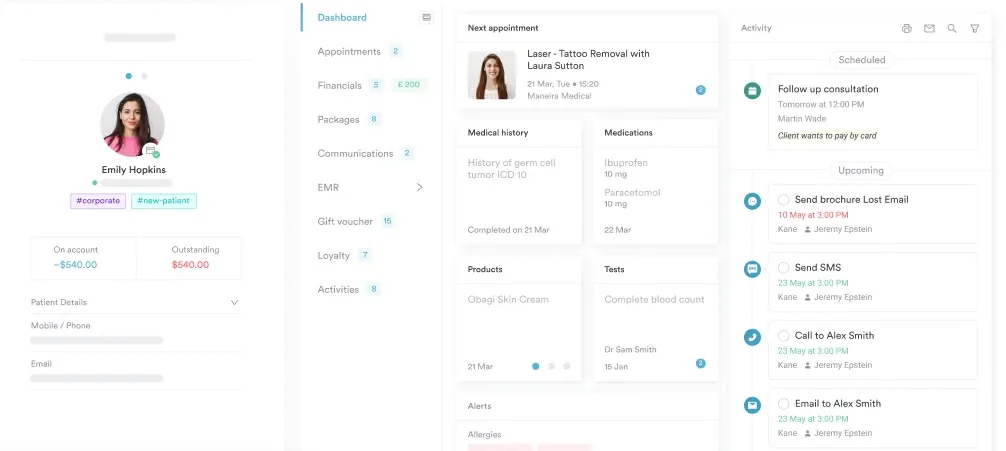
Practice management software like Pabau lets practitioners deliver the 8 dimensions of wellness worksheet assessment electronically through digital forms and a client portal, store responses securely, and automate follow-up workflows.
A ready-to-use assessment tool for therapists, counselors, wellness coaches, and behavioral health practitioners. The worksheet guides clients through reflection on eight interconnected wellness dimensions: physical health practices, emotional resilience, social relationships, intellectual engagement, work satisfaction, financial stability, living environment quality, and sense of purpose. Includes self-rating scales, reflection prompts, and goal-setting templates.
Download templateThe 8 dimensions of wellness worksheet is a clinician-led assessment that moves beyond symptom-focused therapy to address the whole person. With our roundup of medical spa systems, wellness centers that add aesthetic treatments can choose software to hold each completed worksheet. This framework was adapted from a wellness model developed by Dr. Peggy Swarbrick and promoted by the Substance Abuse and Mental Health Services Administration’s (SAMHSA) Wellness Initiative.
It recognizes that lasting recovery and wellbeing emerge when clients feel supported across all eight life areas, not just their presenting concern. Whether you’re running a therapy practice, coaching practice, primary care office, or wellness center, this worksheet opens the conversation about what true holistic health looks like for each client.
This worksheet is a structured reflection tool that guides clients through a comprehensive assessment of their wellbeing. Rather than treating mental health as isolated from other life areas, the model recognizes that emotional recovery, financial stability, meaningful work, supportive relationships, physical health, intellectual stimulation, environmental safety, and spiritual purpose are all interconnected.
Struggling in one dimension often affects the others: financial stress triggers anxiety, isolation feeds depression, and lack of purpose dims motivation.
Clinicians use this worksheet during intake, mid-treatment, and discharge to create a baseline, identify priorities, and measure progress holistically. The tool is non-diagnostic and non-judgmental. Its purpose is discovery, not deficit-labeling. SAMHSA’s original guidance on the 8 dimensions positions wellness as a recovery orientation: clients envision themselves thriving across all domains, not merely abstaining or stabilizing.
Each dimension within the worksheet maps to a specific life domain. Here’s what practitioners assess:
Practices that also offer light-based treatments sometimes log sessions with a LED light therapy chart to track intensity and duration alongside the physical wellness dimension.
The wellness worksheet prompts clients to rate themselves on each dimension using a simple scale (often 1-5), then reflect on strengths and growth areas. This creates space for clients to own their own insights rather than being told they “need to fix” something.
Here’s a five-step workflow for administering the worksheet:
When exercise is the priority dimension, pairing the goal-setting step with a resistance band exercise chart gives clients a structured starting routine instead of a vague fitness goal.
This worksheet works across multiple contexts:
Many practitioners pair this worksheet with a wellness wheel diagram, a circular visual representation of the eight dimensions. The wheel makes it instantly clear which areas are balanced and which are depleted.
A client might see at a glance: “My occupational and social wellness are strong, but financial and environmental wellness are draining me.” This visual often sparks insights faster than numbers alone. Some clients photograph their completed wheel to track visual change over weeks or months.
Therapists addressing low emotional or social wellness scores sometimes bring in a focused tool like an attachment theory worksheet to unpack relational patterns further.
Clients whose intellectual or occupational wellness scores point to attention or focus difficulties may also benefit from a dedicated ADHD worksheet to explore executive functioning in more depth.
Whether you use a printable wheel or a digital version embedded in digital intake forms, the combined worksheet-plus-wheel approach creates a richer assessment experience. Wellness clinics especially benefit from this multi-modal presentation, as it meets visual learners and encourages deeper self-reflection.
Practitioners using SAMHSA‘s Wellness Initiative model and similar university-based wellness programs report several outcomes from multidimensional assessment:
When emotional wellness ratings reveal significant mood cycling, a bipolar spectrum diagnostic tool can help clarify whether further psychiatric evaluation is warranted.
This worksheet transforms clinical documentation from deficit-focused (“patient presents with depression and anxiety”) to outcome-focused (“patient has set goals in emotional resilience, social connection, and financial stability, with progress tracked across all eight wellness dimensions”). This strengths-based language shifts both the therapist’s and client’s mindset toward recovery as expansion, not just symptom management.
To embed this worksheet into routine practice. This saves session time, surfaces client priorities before the first meeting, and creates a documented baseline for progress tracking.
Many practices print the completed worksheet and file it alongside treatment plans, making it a reference point at every clinical review.
Practices treating clients on psychiatric medication alongside wellness goals often pair this worksheet with an ADHD medication list to keep prescribing details current and easy to reference.
Practices tracking the physical wellness dimension closely sometimes pair it with a vital signs record template to monitor objective health markers alongside self-reported wellbeing.
Some practices add a simple rating update to their mid-treatment review: ask clients to rate each dimension again and compare to baseline. Growth, even small improvements, reinforces progress and resilience.
Between sessions, clients working through emotional or intellectual wellness goals sometimes keep a brain dump journal to offload racing thoughts and track patterns worth discussing at the next session.

Store, distribute, and track the 8 dimensions of wellness worksheet securely. Automate client reminders, embed progress tracking in clinical notes, and measure outcomes across all wellness dimensions.

Some practices use the earlier 6 Dimensions of Wellness model (Hettler, 1976: physical, emotional, social, intellectual, spiritual, and occupational) or focus on wellness wheels covering only four or five domains.
The 8 dimensions of wellness worksheet adds financial wellness and environmental wellness as explicit clinical priorities on top of Hettler’s original six, recognizing that money stress and unstable living conditions profoundly affect mental health.
For practices serving clients in recovery from substance use, SAMHSA’s 8-dimension framework is particularly valuable because it aligns with evidence-based recovery orientation: wellness as multidimensional expansion, not abstinence alone.
The 8 dimensions of wellness worksheet transforms how you measure and support client progress. Instead of tracking only symptom reduction, you’re building a map of the whole person: where they’re thriving and where they need support. This holistic approach deepens therapeutic work, increases client engagement, and produces more sustainable outcomes.
Download your free template today and start incorporating multidimensional wellness assessment into your next client intake. When your practice measures wellness comprehensively, clients feel truly seen. Seen clients heal faster. Book a demo with Pabau to learn how digital wellness assessment and automated follow-up workflows can scale this practice across your entire client base.

Want to assess intellectual wellness in more depth? The Boredom Proneness Scale helps clients pinpoint where a lack of stimulation or engagement is dragging down motivation.
Building group or family sessions around social wellness? Empathy bingo is a simple activity for strengthening connection and perspective-taking between sessions.
Working on stress and emotional regulation? A hypno script for deep relaxation gives clients a guided technique to pair with their emotional wellness goals.
Physical, emotional, social, intellectual, occupational, financial, environmental, and spiritual wellness. Each represents a domain of life that contributes to overall wellbeing and recovery.
SAMHSA has promoted this framework (originally developed by Dr. Peggy Swarbrick) as part of its Wellness Initiative for behavioral health recovery.
Yes. Therapists, counselors, coaches, psychiatrists, and primary care practitioners all use this worksheet in intake, treatment planning, progress tracking, and discharge. It works across all mental health and wellness settings.
After rating each dimension, identify one or two priority areas. For each, define a specific, measurable goal (e.g., “exercise three times per week” not “get healthier”). Track progress at follow-up visits.
Hettler’s 6-dimension model (physical, emotional, social, intellectual, spiritual, occupational) predates SAMHSA’s 8-dimension model. The 8-dimension version adds financial and environmental wellness as explicit clinical priorities, especially valuable for substance use disorder and behavioral health recovery.
Use the download button at the top of this page. The worksheet is provided free for clinical and personal use. No account or email required.