Exilis patient treatment record: Free PDF for RF sessions
An Exilis patient treatment record is the session log for BTL’s radiofrequ...

1
Last Updated: Oct 23, 2026

A 7-color LED light therapy chart maps each wavelength to one skin concern, one mechanism, and one session length.
Red light at 630 to 660nm reaches 1 to 2mm into the dermis, where it drives collagen production.
Blue light at 415 to 450nm stays in the epidermis and destroys acne bacteria through porphyrin activation.
Wavelength decides the layer you treat, but device power output and skin type decide the result you get.
Screen for photosensitizing medication, then record the color, duration, and skin response at every session.
Two printable pages. Page one lists all seven wavelengths with their target concern, mechanism, and session length, next to a pre-treatment screening checklist. Page two gives you a concern-first lookup table and a blank session log.
Download templateA 7-color LED light therapy chart tells you which wavelength treats which concern, and how long the session should run. The most useful fact on it is depth. Red at 630 to 660nm reaches 1 to 2mm into the dermis, so it can work on collagen. Blue at 415 to 450nm stays in the epidermis, where acne bacteria live.
Wavelength decides the layer you treat, and no session length makes up for the wrong color. For an esthetician or a practice owner, the difference shows up over a course of treatments. One protocol produces visible change, the other just feels pleasant.
The chart below covers all seven colors, the screening each one needs, and how to log a session.
LED light therapy works through photobiomodulation, which means light energy triggers a cellular response in the skin. The wavelength decides how far that energy travels.
Red light reaches 1 to 2mm into the dermis, while blue light stops at the epidermis. So the color you see on the panel is a label for a depth.
Depth is only half the story. Once the light arrives, each wavelength activates a different pathway. Red drives collagen synthesis, while blue destroys bacteria inside the follicle.
That is why one device can treat acne on Tuesday and fine lines on Thursday. Only the color changes.
Here is the master reference. Wavelengths are the ranges most 7-color devices emit, and session lengths are typical in-practice durations rather than device limits.
Print it, or keep it open on the treatment room screen. Either way, one shared chart is what makes two practitioners reach the same decision about the same client.
Four colors cover the majority of what walks through the door. Purple, cyan, and white handle the rest, and they come further down this page.
Red is the most researched wavelength for skin rejuvenation. It penetrates 1 to 2mm into the dermis, activates mitochondria, and pushes fibroblasts to produce more collagen and elastin.
Clients on a regular red course report firmer skin, softer fine lines, and better texture. It is the wavelength to reach for in any aging-skin consultation.
Blue targets Cutibacterium acnes, the bacterium behind breakouts. Porphyrins inside the bacterial cell wall absorb blue wavelengths and release reactive oxygen species, which destroy the organism.
Because blue stays in the epidermis, it suits surface acne and congestion better than deep cystic lesions. Sessions run shorter at 10 to 15 minutes for the same reason.
Green light at 520 to 530nm modulates melanin overproduction and calms vascular redness. That makes it useful on dark spots, hyperpigmentation, and rosacea-prone skin in the same appointment.
Many practices run green after a more aggressive treatment, or as a standalone course for post-inflammatory hyperpigmentation.
Yellow at 580 to 590nm activates the lymphatic system and reduces inflammation. After a laser treatment or a chemical peel, it calms erythema and shortens recovery. It adds no further stress to a compromised skin barrier, which is why it suits sensitive and reactive clients so well.
Purple emits red and blue together, so it treats acne and early collagen loss in one session. Cyan sits at 490 to 520nm and does one job well, which is calming inflamed or reactive skin.
Three questions settle whether either belongs in your protocol:
Start from the concern the client names, not from the color they ask for. Then work outward to the wavelength, the session length, and the frequency. Laid out on the spectrum, the reasoning is easy to see and easy to explain out loud.
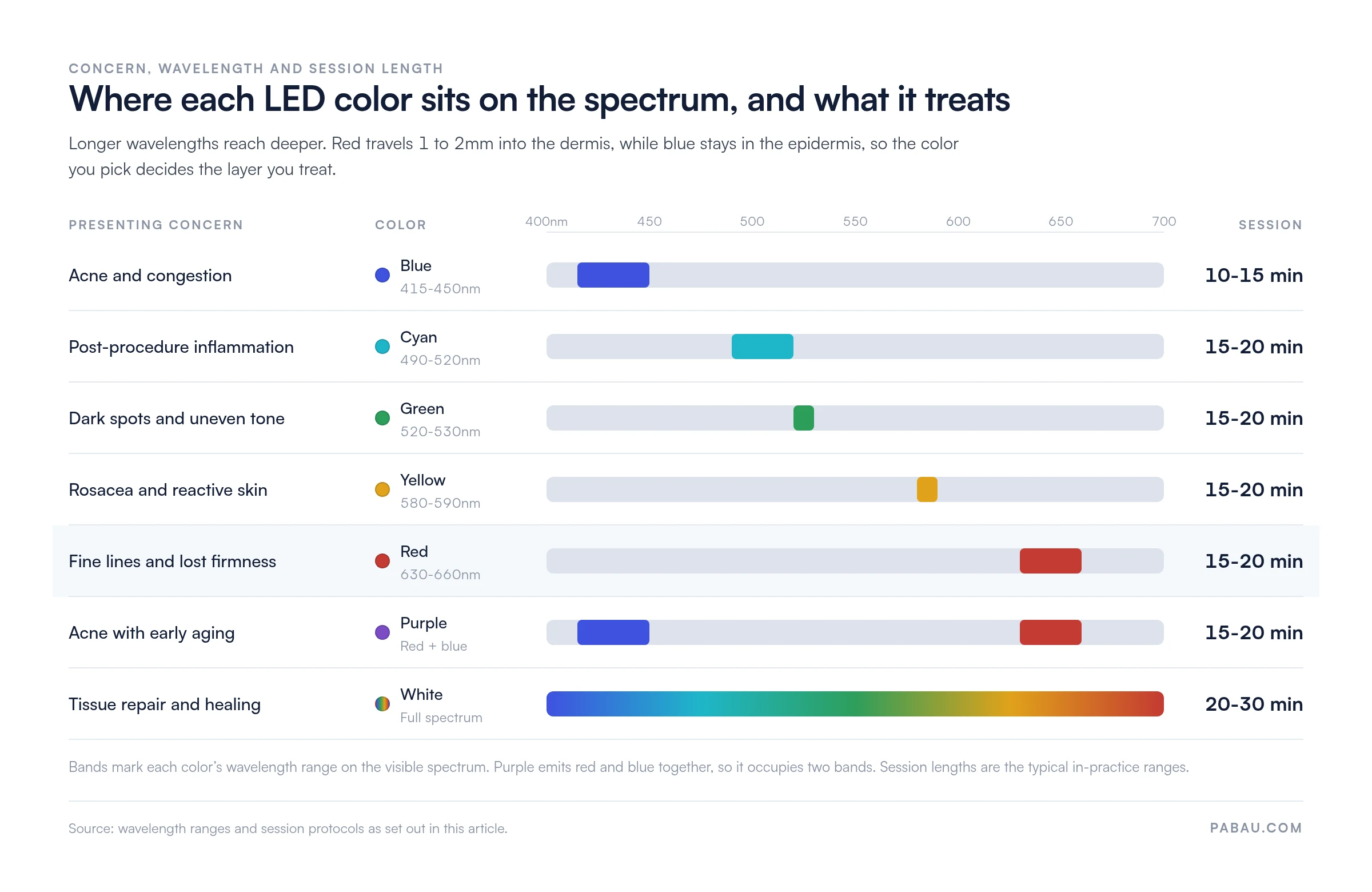
The same decisions read like this, with a starting frequency for the initial phase:
Reassess after four sessions. If the skin has not moved, check power output and adherence before you change color. Write the agreed concern and color into the consultation record while the client is still in the chair.
A med spa consultation form gives you somewhere consistent to put it.
Wavelength sets the depth, and two other variables decide whether the client sees a change. The first is device power output, measured in mW/cm². The second is the skin itself, since melanin content and skin thickness both affect how much light gets through.
Red and near-infrared wavelengths reach deepest, and the biological response they trigger builds slowly across a course. Blue and green act at the surface, where changes show sooner but stay shallow.
The National Institutes of Health hosts a review of light therapy in skin. It sets out how each wavelength maps to the tissue it can reach.
Two practical notes follow from that. Irradiance drops as the panel moves away from the skin, so ask your supplier for the figure at treatment distance rather than at the diode.
Teat any device sold as a wrinkle solution on blue light alone with suspicion, because blue never reaches the dermis where wrinkles form.
Power and coverage are the whole difference. Clinical-grade panels deliver higher irradiance and treat a larger area in less time, while at-home masks spread light across the face at lower intensity. Home devices therefore need longer, more frequent sessions to add up to the same exposure.
Use the chart for both. Recommend in-practice sessions for the intensive phase, then an at-home device for maintenance between visits.
Say that out loud in the consultation and the home mask stops competing with your treatment plan. It becomes part of it.
Choosing the right color is the easy part. These four execution problems come up often enough to design out of your process:
The first three are protocol problems, and a laminated chart in the room fixes them. The fourth is a record problem, and it is the one that compounds across a client list.
LED therapy is non-invasive and well tolerated, and a short screen is what keeps it that way. Work through this list at the consultation, before anyone books a course:
Record consent and the screening answers against the client file before each treatment, not at the end of the day. Digital intake forms keep those answers with the record instead of on a clipboard.
The chart usually lives on a laminated card, and the wavelength lives in someone’s memory. The appointment note says LED.
Six weeks later the client asks whether the redness has improved, and nobody can point to which color ran or for how long.
Practice management software like Pabau, which is software for med spas and skin clinics, keeps the protocol and the record in one place.
You attach the 7-color chart to the client file, so any practitioner opening that record sees the same protocol. Session notes then capture the color, the duration, and the skin response as you go.
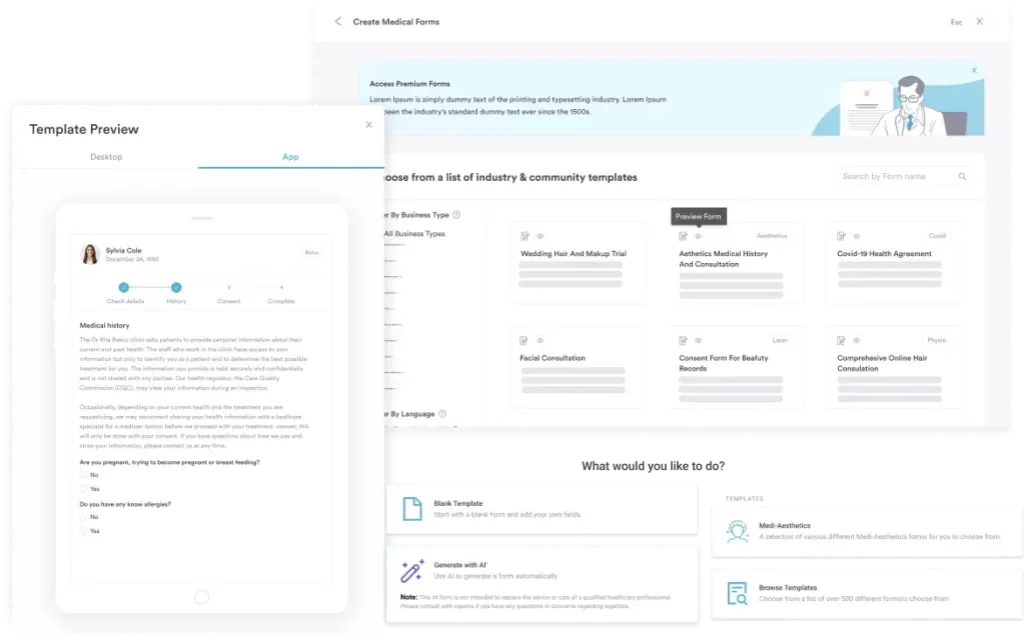
Because those notes write back into the client records, the treatment history builds itself session by session. Over a course you can see which wavelengths work best on which skin types, and which clients stall around session four.
When a series finishes, Pabau flags the client for rebooking, so continuity does not rest on someone remembering.

Log the color, duration, and skin response at every session, then pull a client progress report without rebuilding the history by hand.

A 7-color device is only as good as the decision made in front of it. Once the chart is on the wall and the screening sits inside the consultation, the treatment becomes something you can plan, defend, and repeat. That is the return on getting this right.
The trade-off worth remembering is patience. Red needs a course rather than a session, and switching color at week two throws away the evidence you were building. Hold the protocol, log each visit, and let the record make the argument for you.
Download the chart above, then decide where the session data will live before the first client sits down. Book a demo to see how Pabau logs LED color, duration, and skin response against the client record.

Need a baseline before the first session? Skin assessment tools covers how to document skin condition before an LED course starts.
Choosing between a panel and a mask? Best facial device compares the equipment your LED protocol will run on.
Starting a blue light course for acne? Acne treatment consent form gives you consent wording to pair with the protocol.
Want the skin findings in writing? Skin analysis form records tone, texture, and sensitivity at every review point.
Building LED into a membership? Med spa package ideas shows how to bundle color courses into tiered plans.
Yes. Sequential protocols are common, and the usual order runs from the most active wavelength to the most soothing. Blue first for acne, then red for collagen, then yellow to settle the skin. Watch tolerance as you go and stop if the skin flushes.
No. Near-infrared sits past the visible spectrum, above roughly 700nm, so you cannot see it working. It reaches deeper than red and often shares a panel with it. A 7-color device may or may not include it, so check your specification.
It varies by concern. Surface changes such as reduced congestion appear soonest, because blue light acts on bacteria that are already there. Collagen change takes longest, since fibroblasts have to build new tissue. Book red light clients as a course, and say so upfront.
The FDA clears LED therapy devices for named uses, most often acne and wound healing. Most go through the 510(k) pathway, and clearance is tied to that model’s wavelengths and output. It does not transfer to another device, so check your own documentation before marketing an outcome.
Treat it as the default. Bright visible light at close range is uncomfortable, and manufacturers usually specify goggles or shielded eyewear. Follow the device instructions, then record that you supplied protection.