Monika Lazarevska

Panic and agoraphobia scale: Free PDF template & scoring guide
Download your free Panic and Agoraphobia Scale template A two-page form with all...

1
Last Updated: Nov 4, 2026
Free PDF 2 pages, print-ready Clinician-reviewed
The flourishing scale is an eight-item self-report questionnaire that measures psychological flourishing. It captures a person's sense that life is going well across purpose, relationships, competence and optimism. Ed Diener and colleagues published it in 2010.
Each statement is rated from 1 (strongly disagree) to 7 (strongly agree). Scores run from 8 to 56, with higher totals showing greater flourishing. There is no published cut-off score, so practitioners use the total to open a conversation about wellbeing and to track change over time.
A two-page PDF with the eight statements, the 1 to 7 response scale, a total score box and the scoring rule. It also has fields for patient details, notes and the clinician's signature.
Start from scratch, or upload this PDF or any form you already use, and Pabau's AI Form rebuilds it with tick boxes, text fields and a signature. Attach it to the treatment once, and every patient gets it on time.
AI Form rebuilds the consent, history and aftercare forms you already use. You review each one, then publish.
Patients complete forms on their phone before they arrive, so the front desk stops retyping paper.
Every signed form is versioned and attached to the treatment record, ready when you need it.
Set how long a consent stays valid. Returning patients skip forms they have already signed.
Supports HIPAA and GDPR compliance AES-256 encryption 4.8 on G2 4.7 on Capterra Trusted by 4,000+ practices worldwide

The flourishing scale is an eight-item self-report measure of psychological flourishing by Ed Diener and colleagues.
Each item is rated from 1 to 7, so totals run from 8 to 56.
Diener et al. publish no score bands or cut-offs, so a higher total simply means more psychological resources and strengths.
Harvard’s Flourish Index and Secure Flourish Index are separate measures, and the Global Flourishing Study uses the Secure Flourish Index.
Compare each total with the same patient’s earlier totals, since no study has set a minimum change that counts as meaningful.
The flourishing scale is a brief self-report questionnaire that measures psychological flourishing, the sense that life is going well in several areas at once. Practitioners use it alongside symptom measures, so the record shows strengths as well as problems.
Ed Diener and colleagues, including Robert Biswas-Diener, published the eight-item version in 2010 in Social Indicators Research (Diener et al., 2010). Earlier versions circulated as the Psychological Well-Being scale before the authors renamed it the Flourishing Scale. That is why the scoring note on the form still calls the top score the “highest psychological well being possible”.
The scale comes out of subjective wellbeing research, so it captures how a person rates their own functioning rather than the absence of illness. Diener also co-developed the satisfaction with life scale, a five-item measure of overall life satisfaction.
Each statement covers one area of psychological functioning. The eight areas are:
A low rating in one area signals something to explore with the patient. It is not a diagnosis.
To score the scale, add the eight ratings together. The total runs from 8, the lowest possible, to 56, the highest.
Here is how that works for one set of answers. A patient rates the eight statements 6, 5, 6, 4, 5, 6, 5 and 4, which gives a total of 41.
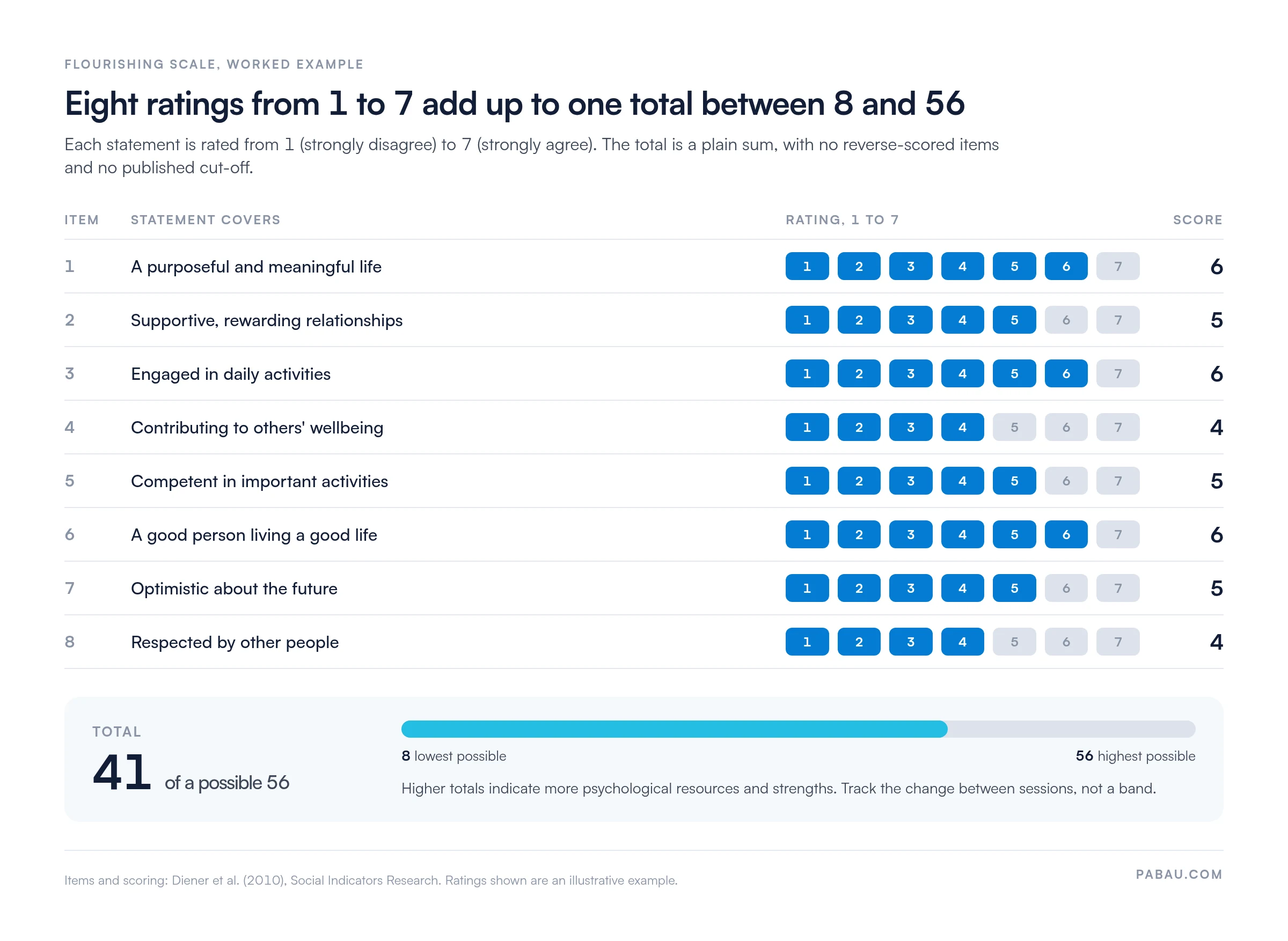
Treat those two items as prompts for the conversation, not as scores in their own right. The total is the score, and single items only point to where the discussion starts.
Diener et al. publish no score bands or cut-offs. Higher totals indicate more psychological resources and strengths, and the scale claims nothing beyond that. If you meet score bands elsewhere, treat them as a publisher’s rule of thumb rather than a finding from the original study. Never use them to diagnose a condition.
The original study does give one point of reference. Its 689 university students averaged 44.97 out of 56, with a standard deviation of 6.56. That figure describes a student sample, so it is not a norm for patients.
No study has set a minimum change that counts as meaningful on this scale. A shift of a point or two between sessions may be noise, so look for a sustained trend across several totals.
With scoring settled, the next question is how to give the scale. It works best as a structured opener for a conversation about wellbeing, and these steps keep administration the same from one session to the next.
Point out the 1 to 7 response labels when you hand the PDF over. On the form, the instructions and all seven labels run together in one unbroken line, so a patient can miss what each number means. The scoring note at the foot of the form also runs straight on from its heading.
Run the scale at intake and again at a set review point, using the same scoring steps each time. Record the date and the PDF version with every total, so you can tell a change in the patient from a change in method. Agree in advance who administers the scale, so the score reflects the patient rather than the person holding the form. If a patient scores low in one area, note it and return to it at the next session rather than rewriting the whole plan.
Psychology and therapy practices use the scale at intake, alongside symptom measures, to record a patient’s strengths from the first session. Our psychology practice software page covers how these practices structure their records.
Coaches use it to set a baseline at the start of a program and to check progress with clients at agreed points. Wellness teams use it in much the same way.
Where a practice runs several measures side by side, therapy practice management software keeps intake forms, notes and repeat scores on one timeline.
Yes, for internal consistency. Diener and colleagues reported a Cronbach’s alpha of approximately 0.87 in the original validation study, in a sample of university students. In plain terms, the eight items tend to move together, so the total is a stable summary.
The same study found that the items measure one overall factor. That is why the total, not any single item, is the score to record and compare. A single item is less reliable than the total, so read it as a prompt.
Internal consistency does not prove that the scale detects change in a particular patient or setting. It shows that the items hang together, not that the scale suits every population.
Scores also tend to run high. Most people agree with most of the statements, so totals cluster toward the top of the range. That limits how well the scale shows improvement in someone who already scores high.
Other researchers have tested the scale in different countries and age groups. Review studies with samples like yours before you cite specific results.
The Harvard Human Flourishing Program uses its own measures, the Flourish Index and the Secure Flourish Index. The Flourish Index asks 10 questions, two from each of five domains, each rated from 0 to 10. The domains are happiness and life satisfaction, mental and physical health, meaning and purpose, character and virtue, and close social relationships.
The Secure Flourish Index adds two items on financial and material stability, for 12 in total. Some writers call either version the Harvard Flourishing Index for short.
The Global Flourishing Study, run with the Harvard program, uses the 12-item Secure Flourish Index across more than 20 countries. Check which instrument a study used before you compare its results with a Diener total.
On paper, the scale gets printed, handed over, added up by hand and filed. Earlier totals sit in a folder, so comparing them takes time. Pabau, the practice management platform we build, moves that workflow into digital forms.
Send the scale through Pabau’s digital forms so patients complete it before the session. Add up the eight responses yourself and record the total in the record. The total then sits with the rest of the patient’s history in the patient record, beside the session notes.
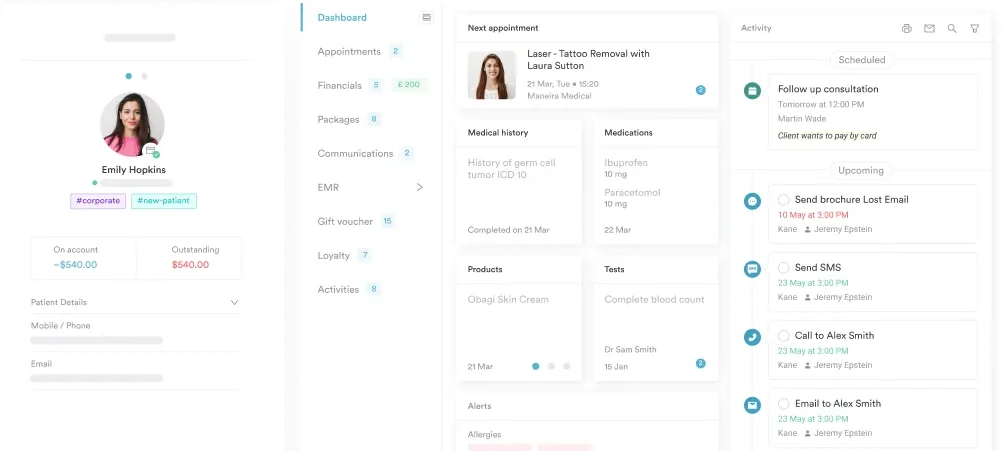
Digital forms save admin, but they do not change the scoring rules. Keep the same method you use with the PDF, and check the total you record against the eight responses. Our mental health practice software page shows how forms, scores and notes sit together.

Send the flourishing scale as a digital form and keep each total in the patient record, beside the notes from that session.

The flourishing scale earns its place when you use it the same way every time. Keep the same eight items, the same plain sum and the same review points. The change between totals tells you more than any single score, and far more than a borrowed band.
The trade-off is scope. The scale shows how a patient rates their own functioning, not what is wrong, so pair it with your symptom measures.
Book a demo to see how Pabau keeps each flourishing total beside the session notes, ready for the next review.

Need a structured evaluation framework? Psychiatric evaluation template sets out a step-by-step approach to full clinical assessments.
Measuring overall life satisfaction too? Life satisfaction scale covers Diener’s five-item companion measure.
Building a strengths-based session? Positive psychology worksheet offers exercises that follow on from a low-rated area.
Tracking outcomes across therapy? Outcome questionnaire helps you monitor change from session to session.
The flourishing scale has eight items scored from 8 to 56, while WEMWBS has 14 items scored from 14 to 70. WEMWBS asks about the past two weeks. The flourishing scale asks for a general self-rating with no time frame.
Diener et al. set no fixed interval. Pick review points that match the treatment or coaching plan, such as the end of each block of sessions. Keep them consistent so totals compare fairly.
Yes. Diener states that the scale is copyrighted but free for researchers and practitioners to use without permission or charge. You only need to credit the authors.
Yes, with care. The original validation used university students, but later studies have tested the scale with adolescents. Check that the wording suits the young person’s reading level, and follow your consent rules for minors.
No. Diener et al. publish no cut-off, so a total below any number has no diagnostic meaning. Treat a low total as a prompt to explore the lowest-rated items, and compare it with the same patient’s earlier totals.