Hyperbole and a Half pain scale: Every level + free template
The Hyperbole and a Half pain scale is Allie Brosh’s humorous pain chart, ...

Last Updated: Oct 5, 2026

A resistance band exercise chart lists each move, the muscle group it works, and the sets, reps and rest to use.
Band color maps to a named resistance level, and yellow is extra-light while red is light and green is medium.
The right band lets you finish 10 to 15 reps, with the last two or three feeling hard.
Two sets per exercise, three days a week, is enough volume for a beginner’s first six weeks.
A practice can issue the same chart as a handout, then record which version each client received and how they progressed.
A beginner resistance band exercise chart PDF names each exercise, the muscle it works, and the sets and reps to aim for. That turns band training into a routine you can repeat instead of a guess. The plan below runs three days a week at two sets per exercise, covering upper body, lower body, core, and one full body day.
One detail decides whether it works, and that is the band you pick. Yellow is extra-light rather than light, so plenty of beginners spend six weeks pulling against almost no resistance.
Below you will find the exercise tables, the safety checks, the progression rule, and a printable sheet for logging every session.
Page one is a blank reference sheet for the exercises, sets, reps and resistance levels you approve, with a sign-off line. Page two logs each session by date, time, exercise and who recorded it.
Download templateA resistance band exercise chart is one sheet that groups band exercises by muscle group and then fixes the volume for each.
Upper body, lower body and core each get their own block, with sets, reps and rest spelled out. Once you start, you follow the sheet instead of improvising.
Bands suit beginners because the resistance climbs in small steps. A lighter band works for someone building a base, and the next color up is a modest jump rather than a leap.
Research summarized by the American College of Sports Medicine (ACSM) shows bands produce strength gains comparable to free weights in untrained people.
For a practice, the same sheet does double duty. The client leaves with something to follow. You keep a record of what you prescribed, and that is what you check against at the next review.
Three band types turn up in beginner kits, and they are not interchangeable. Loop bands are closed circles, flat bands are sheets of latex, and tube bands have handles at each end.
Loops suit hip and glute work, and flat bands suit rehab and stretching. Tubes suit pressing and rowing, because the handles give you something to grip.
Color is where the confusion starts. On the TheraBand scale, yellow is extra-light, red is light, green is medium, blue is heavy, and black is extra-heavy.
The same brand also makes lighter tan bands and heavier silver and gold ones. Other manufacturers set their own scale, so read the packaging instead of assuming yellow means the same thing everywhere.
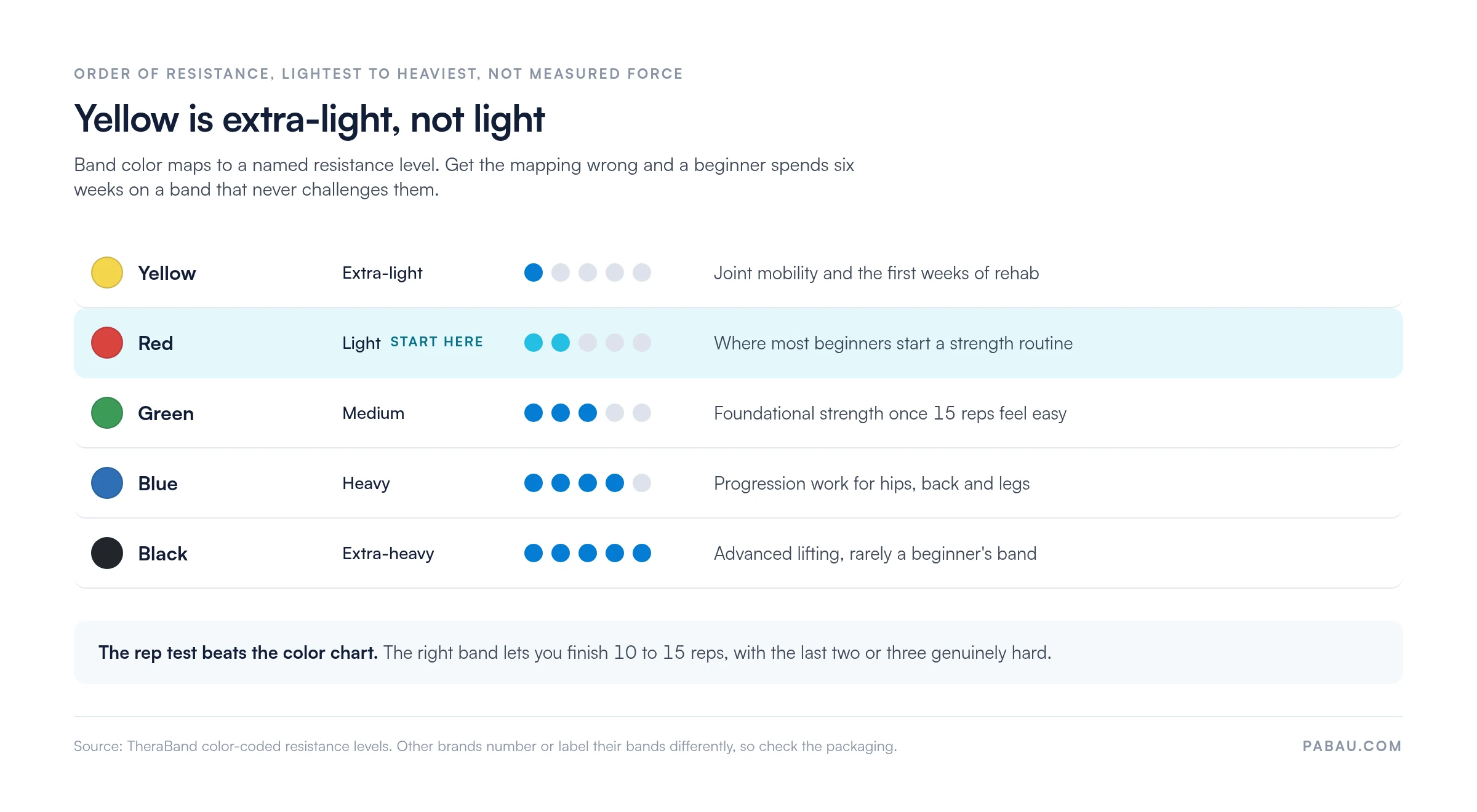
Ignore the color for a moment and test the band instead. The right resistance lets you finish 10 to 15 reps with moderate effort, and the last two or three should feel hard. If you could manage 10 more, move up a color.
When you cannot finish the set, move down one.
Band training is low-impact, but a band that snaps mid-rep still hurts. Run the latex through your hands before every session and look for tears, fraying, or a patch that has gone cloudy.
Then anchor it to something that will not move, such as a door anchor, a heavy piece of furniture, or a fixed bar.
Anyone with a history of joint injury or ongoing pain should check with a physical therapist first. In a practice, that check is the point of the initial assessment, and the chart is what leaves the room with the client afterwards.
Five band exercises cover chest, shoulders, back, biceps and triceps. The table gives you the move, the muscle group it targets, and the beginner volume to start at.
Each region comes up twice in the weekly plan below, once on its own day and again on the full body day. Leave at least one rest day in between, because muscle adapts while you recover.
Glutes, quadriceps, hamstrings and calves all respond well to bands. Lateral walks and glute bridges earn their place at the front of a beginner’s plan. Both train hip stability, and every squat and stair depends on it.
Put the lateral walk first, while the hips are still fresh. Form slips quickly once the glutes tire, and a sloppy lateral walk stops training the muscle it was chosen for.
Band work is gentler on the neck than a floor crunch, which is why it suits beginners and anyone coming back from injury. The three moves below train the core to resist movement rather than curl through it, and that is the job it does all day.
Three exercise days cover every muscle group and still leave room to recover. Here is how the week fits together.
The four days you are not training matter as much as the three you are. Muscle adapts during recovery, and this three-day pattern matches ACSM guidance on training frequency for novices.
Change one variable at a time. After four to six weeks at the chart’s volume, take the reps from 12 to 15. Hold there for a week or two, then add a third set. Only after that should you move up a band color.
Take the chest press as an example. Weeks one to five sit at two sets of 12 with a red band. Week six moves to two sets of 15, and week eight adds the third set. By week 10 you switch to green and drop back to 12 reps.
If you would rather track a number than a feeling, repeat a strength measure instead. Recording a muscular strength test at week one and again at week six shows whether the extra volume moved anything.
Older adults. Drop to a light band, push the reps to 15 or 20, and pick moves that also challenge balance. Our guide to resistance training for seniors goes deeper on the rep ranges and the balance work worth adding.
Limited standing tolerance. Anchor the band to a chair leg and work seated. A set of seated exercises covers the same muscle groups for clients who cannot stand safely for 30 minutes.
Coming back from injury. Start on therapy-grade bands and follow the protocol your physical therapist set, not the generic volume in the table. The chart is still useful here, because it gives you somewhere to write the modified sets and reps down.
Say a routine out loud and the client forgets half of it before they reach the car. A sheet in their hand keeps the exercise names, the rep counts and the band color in front of them at home. It also settles the small disputes at review, because the sheet shows the plan rather than someone’s memory.
The same logic scales up to the practice. Handing over a document shows the plan was thought through, and it cuts the follow-up messages asking what came after the rows.
Where a client needs more than band work, a broader home exercise program template covers the whole plan on one sheet.
Most practices print the chart, hand it over, and hope it comes back at the next visit. Practice management software like Pabau, which runs scheduling, client records and patient messages in one place, keeps the document attached to the client instead.
You build the chart once as a digital form, then store the version each client received on their record.
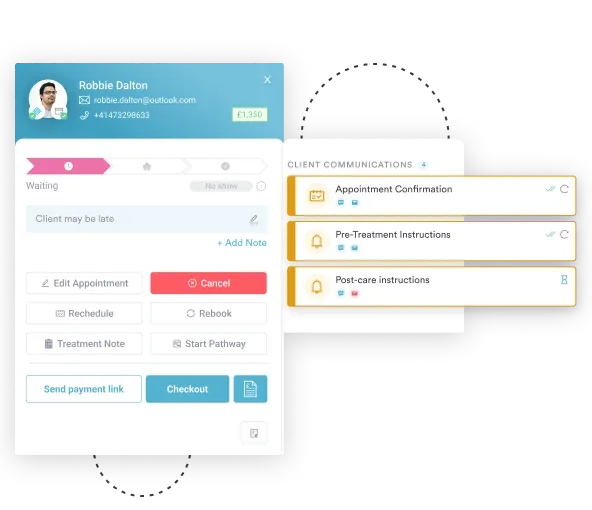
Sending it out then stops being a separate task. Pabau’s patient communications can attach the chart to the post-appointment message, so it reaches the client while the session is still fresh. Nobody has to remember to email it two days later.
At review, the chart and the treatment notes sit side by side. You can see the band color you prescribed, the sets the client logged, and the date you last changed the plan.
Moving someone from red to green becomes a note on a record, not another sheet of paper. A purpose-built physical therapy EMR holds that history across a whole caseload.

Pabau stores each client’s exercise chart on their record, sends it out with the follow-up message, and logs every progression you make. Your team stops chasing paper handouts between appointments.

The chart is the easy part. Your band choice and the weeks you stick to the plan decide whether it works. That is why the color scale and the rep test matter more than the exercise list.
So start at two sets, three days a week, and leave the volume alone for six weeks. Print the sheet, log each session, and let the record tell you when to progress instead of guessing at it.
If you hand charts out across a caseload, the admin is what breaks first. Book a demo to see how Pabau keeps each client’s exercise chart on their record and sends it out with their follow-up message.

Need a full program, not one chart? Home exercise program gives you a template for the whole plan a client takes home.
Want to grade strength before you prescribe a band? The MRC scale for muscle strength template records a 0 to 5 score at baseline.
Working with older clients? Resistance training for seniors covers the rep ranges and balance work that suit them.
Looking for a progress measure with no equipment? The 30-second chair stand test tracks lower body strength from a chair.
Client cannot stand for a full session? Seated exercises adapt the same movements to a seated position.
There is no set lifespan, so inspect the band before every session. Replace it at the first tear, cloudy patch, or sticky spot on the latex. Sunlight, heat and sweat all speed that up, so store bands rolled up in a drawer rather than in a car.
You can, but not the same muscles. Strength work needs a rest day in between so the muscle can recover and adapt. Light mobility work with an extra-light band is fine daily, and so is alternating upper and lower body days.
A thin latex loop rolls because it sits on a curved, sweaty surface. Position it flat just above the knee, wear leggings rather than bare skin, or switch to a wider fabric loop. Fabric loops grip better and are worth the extra cost for lower body work.
Indirectly. Bands build and hold on to muscle, which supports your metabolism, but the calorie side of weight loss comes from diet and daily activity. Treat band sessions as the strength half of the plan rather than the whole of it.