

CCSD code G5100: Bypass of duodenum billing guide
CCSD code G5100 bills a bypass that leaves the duodenum in place CCSD code G5100...

Last Updated: Oct 16, 2026
V2780 is the HCPCS Level II code for oversize lens, per lens. It is an add-on billed next to a base spectacle lens code from V2100-V2499, with one unit for each oversize lens.
Medicare pays for it only after cataract surgery or for aphakia, and only when the treating practitioner documents why the larger lens is medically necessary. Each Medicare line carries KX, GA, GY or GZ, plus RT or LT.
Let Pabau's smart automation suggest the right codes, reduce claim denials, and keep your practice compliant—effortlessly.
Automate repetitive tasks and focus on what matters most—your patients.
Reduce coding errors and ensure compliance with the latest regulations.
Clean claims, fewer denials, and faster reimbursements.
Powerful insights and reporting to help your practice thrive.
HIPAA compliant SOC 2 certified GDPR-compliant Trusted by 4,000+ clinics worldwide

V2780 is an add-on code for an oversize spectacle lens. It is billed per lens, next to a base lens code from the V2100-V2499 range.
Medicare pays for V2780 only after cataract surgery or for aphakia, and only when the treating practitioner documents why a larger lens is medically necessary.
Every Medicare V2780 line needs a KX, GA, GY or GZ modifier. A bilateral pair goes on two lines, RT and LT, with one unit each.
Pabau, the practice software we build, keeps the optical order, the ABN and the invoice on one patient record. V2780 claims then go out with their proof attached.
HCPCS Code V2780 is the Level II code for a spectacle lens that is larger than the standard lens size. Its official descriptor is Oversize lens, per lens. It sits in the V2700-V2799 vision services range of HCPCS Level II codes maintained by CMS. Coatings, tints and progressive designs sit in the same range.
V2780 never describes a lens on its own. The base lens code from V2100-V2499 identifies the lens type and power, as V2100 does for a single vision sphere. V2780 reports the extra size on top of it. Practices usually need it when a patient picks a frame with a large eye size. The lab then has to cut the lens from a bigger blank.
V2780 covers the added size of a spectacle lens when the lens exceeds the standard size the base lens code assumes. It is a per-lens feature, like a coating or a tint, so each oversize lens takes its own unit.
These items look close to V2780 but are billed with other codes:
The ocular prosthesis mix-up deserves a closer look. Medicare covers post-cataract eyeglasses under its prosthetic device benefit, and CPT even calls aphakic glasses a “spectacle prosthesis.” That shared wording does not make V2780 an artificial eye or a replacement lens. It stays a size add-on for glasses.
Traditional Medicare excludes routine eyeglasses, so V2780 is payable only inside the post-cataract benefit. Under the Refractive Lenses LCD (L33793), Medicare covers lenses for patients with aphakia, congenital aphakia or pseudophakia. Polarization on the same pair stays non-covered as routine vision. The polarized lens is billed with V2762 and the GY modifier.
For a patient with an implanted intraocular lens, coverage is limited to one pair of eyeglasses or contact lenses after each cataract surgery. Replacement lenses outside that pair are not covered.
Even within that benefit, V2780 faces an extra test. The LCD covers oversize lenses only when they are medically necessary for the individual patient and the treating practitioner documents that need. A large frame the patient chose for its look does not meet it.
The Refractive Lenses policy article (A52499) rejects V2780 lines that carry none of the KX, GA, GY or GZ modifiers as missing information. Pick the one that matches the chart, then add the side. Three questions, asked in order, settle which modifier applies.
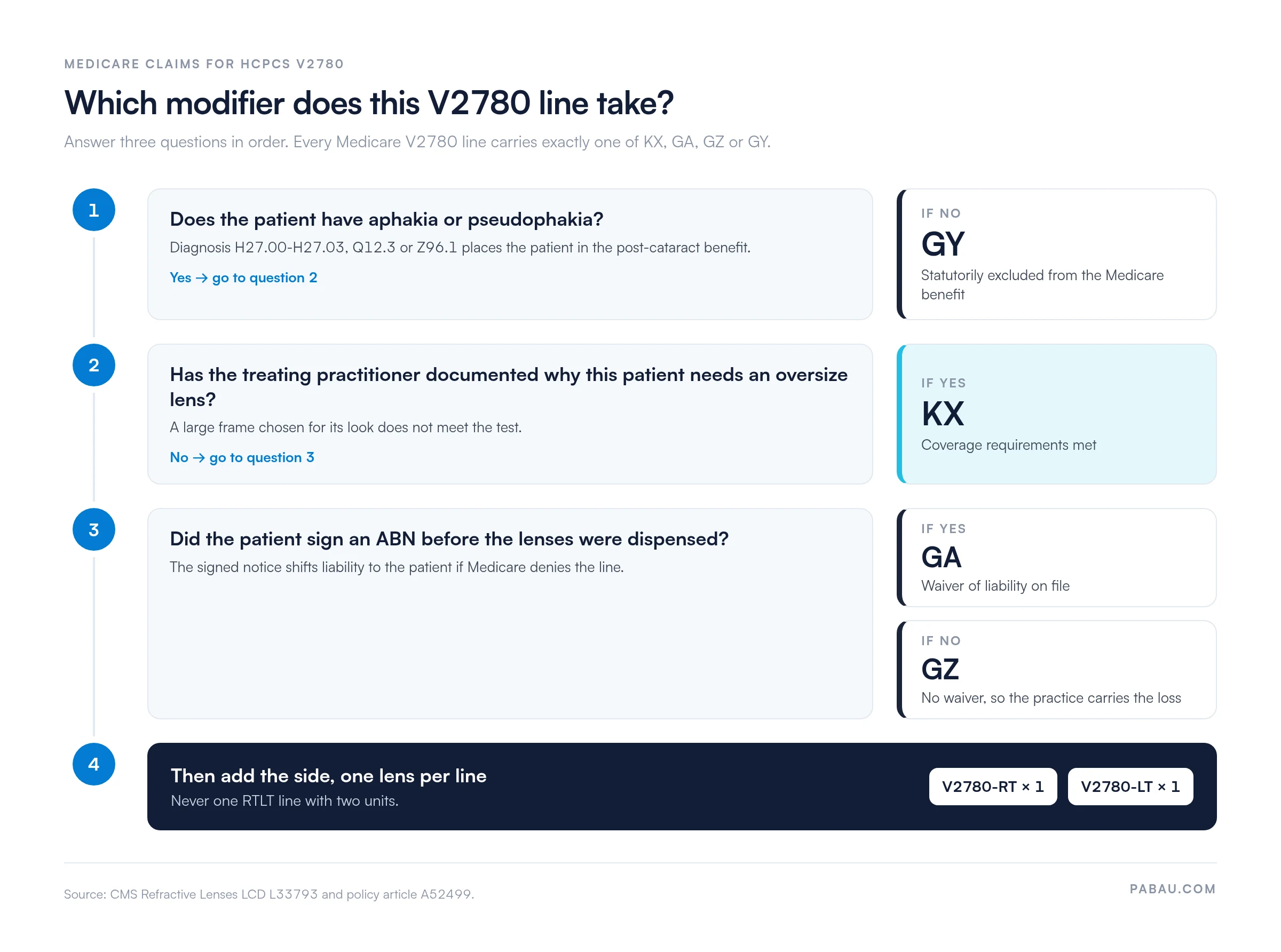
Bilateral pairs trip up a lot of V2780 claims. For dates of service from March 1, 2019, Medicare wants each lens on its own claim line. One line carries RT, the other carries LT, and each has one unit. A single line with RTLT and two units is rejected as incorrect coding.
State Medicaid programs set their own optical benefits, and coverage for lens add-ons like V2780 varies from state to state. Check the state’s current vision provider manual before dispensing, including any prior authorization step.
Commercial vision plans also set their own rules for lens options such as oversize lenses. Some include them in a covered tier and others leave them to the patient, so confirm the benefit at the eligibility check.
When the payer won’t cover the oversize lens, tell the patient before the lab order goes out. Collecting the difference at dispensing is far easier than chasing it after a denial.
A clean V2780 claim lines up four facts: the base lens, the lens size, the coverage route and the side. Work through them in this order before the claim is built.
Electronic claims carry V2780 like any other HCPCS Level II code, so the clean claim basics apply. The code, modifiers, units and diagnosis pointer all have to match the dispensing record.
For Medicare, the diagnosis has to place the patient inside the post-cataract or aphakic benefit. A52499 lists these codes as support for refractive lenses.
Refractive diagnoses such as myopia or presbyopia (H52 codes) do not open the Medicare benefit, so those lines take GY. Vision plans cover routine eyewear, so their claims often carry a refractive diagnosis instead.
V2780 covers the lens supply only. The professional services around it take CPT codes:
The neighboring V-codes describe lens material, design and frames, while V2780 describes size alone. Confirm each descriptor in the current CMS file or the AAPC HCPCS range lookup before you stack codes. A progressive lens that is also oversize, for example, carries both V2780 and V2781 on the same claim.
Check the lens size at frame selection, not at pickup. Is the lens oversize, with no necessity note in the Medicare chart? Have the patient sign the ABN before the lab order goes out.
A V2780 claim is only as strong as the order behind it. The record has to show that the lens was oversize, on which side, and why Medicare should pay for it.
Keep the frame measurements with the order. They are the quickest proof that the lens exceeded the standard size when a reviewer asks.
Medicare sets allowed amounts for V2780 in the DMEPOS fee schedule, which CMS publishes by state and updates during the year. Look up the current amount for your state rather than reusing last year’s figure.
Medicare pays 80% of the allowed amount after the Part B deductible, and the patient owes the remaining 20%. When the oversize lens isn’t covered, the patient pays the practice’s charge under the signed ABN.
Vision plans and Medicaid pay their own contracted or published rates. Check the amount in the payer portal or the state fee schedule before you quote the patient.
V2780 denials follow a few predictable patterns, and most are fixed by matching the claim to the dispensing record. The table maps each one to its fix. For the reason codes on the remittance, see our guide to denial codes in medical billing.

Medicare appeals start with a redetermination request to the contractor, filed within 120 days of receiving the initial determination. If that fails, the next step is reconsideration by a Qualified Independent Contractor within 180 days.
Repeat denials usually point to one step in the workflow. A quarterly billing compliance review and a steady denial management process catch the pattern before it reaches an audit.
Many V2780 errors start at the frame display. The patient chooses a large frame and the lab order notes an oversize lens. Later, the claim goes out without the right modifier or the second line.
Pabau keeps the appointment, the optical order, the invoice and the patient’s signed documents on one record. The ABN and the practitioner’s note are already filed when the biller builds the V2780 lines.
Pabau’s claims management software also tracks claims by code and status. When V2780 rejections cluster around one payer or one error, you can fix that step instead of reworking claims one by one.

Pabau keeps the optical order, the necessity note and the ABN on the patient record. V2780 claims go out with the right modifier and proof attached.

Bill V2780 as the size add-on it is, not as a lens type or a prosthesis. Each oversize lens gets its own line, its own side modifier and its own unit, next to a base lens code.
On Medicare claims, the deciding moment comes at frame selection. If the practitioner can’t document why the patient needs a larger lens, get the ABN signed then and bill GA. A KX claim the chart can’t support costs more than the lens.
Book a demo to see how Pabau keeps the order, the ABN and the claim for every oversize lens on one patient record.

Want to read the reason codes on a denied lens claim? Denial codes in medical billing breaks down the most common CARC codes and how to respond to each one.
Billing a lens coating on the same pair? HCPCS code V2760 covers the scratch-resistant coating add-on, also billed per lens.
Is the oversize lens also high-index? HCPCS code V2782 explains the material add-on for index 1.54 to 1.65 plastic or 1.60 to 1.79 glass.
Need to understand how claims reach a payer? Medical claims clearinghouse explains how electronic claims move from practice to payer.
Want to reduce rework on HCPCS submissions? Superbill documentation covers how a well-structured superbill captures the fields that prevent billing errors.
HCPCS code V2780 covers an oversize spectacle lens, billed per lens. It is an add-on to a base lens code from V2100-V2499. It applies when the lens is larger than the payer’s standard size, usually because of a large frame. It does not cover artificial eyes, intraocular lenses or contact lenses.
V2780 is billed per lens. For Medicare, a bilateral pair goes on two separate claim lines, one with RT and one with LT, each with one unit. A single line with RTLT and two units is rejected as incorrect coding.
Medicare covers V2780 only inside the post-cataract benefit, for patients with aphakia, congenital aphakia or pseudophakia. The treating practitioner must also document why an oversize lens is medically necessary, and the line carries KX. Without that note, bill GA after a signed ABN, or GZ without one.
Medicare expects KX, GA, GY or GZ on every V2780 line, and lines without one are rejected as missing information. Add RT or LT to show which lens is oversize. Commercial vision plans set their own modifier rules.
The Medicare refractive lens policy lists aphakia (H27.00-H27.03), congenital aphakia (Q12.3) and presence of an intraocular lens (Z96.1). A refractive diagnosis alone, such as myopia or presbyopia, falls outside the Medicare benefit and takes the GY modifier.
No. Artificial eyes are billed with V2623-V2629, and implanted intraocular lenses with V2630-V2632. V2780 only reports the extra size of a spectacle lens.
Yes, when the same lens is both oversize and made from a coded material. V2782 and V2783 report high-index plastic or glass, and V2784 reports polycarbonate. Each add-on needs its own line and its own support in the dispensing record.
Keep the signed prescription, the itemized optical order showing the oversize lens and the frame’s eye size, and proof of delivery. Medicare claims billed with KX also need the treating practitioner’s necessity note, and GA claims need the signed ABN.



