CCSD Code H3334: Low anterior resection billing guide
CCSD Code H3334: Definition and clinical scope CCSD Code H3334 covers an open an...

Last Updated: Oct 16, 2026
V2318 is the HCPCS Level II code for an aniseikonic trifocal lens. This special-order spectacle lens equalizes the image size each eye sees, with distance, intermediate and near zones.
The code sits in the V2300-V2399 trifocal series and is billed with an RT or LT modifier for each eye. Claims rest on documented aniseikonia (H52.32), and many commercial payers want a medical-necessity letter and prior authorization first. Medicare covers the lens only within its aphakia and pseudophakia benefit.
Let Pabau's smart automation suggest the right codes, reduce claim denials, and keep your practice compliant—effortlessly.
Automate repetitive tasks and focus on what matters most—your patients.
Reduce coding errors and ensure compliance with the latest regulations.
Clean claims, fewer denials, and faster reimbursements.
Powerful insights and reporting to help your practice thrive.
HIPAA compliant SOC 2 certified GDPR-compliant Trusted by 4,000+ clinics worldwide

HCPCS code V2318 is the official code for an aniseikonic trifocal lens, a special-order lens that equalizes the image size each eye sees.
The supporting diagnosis is aniseikonia (H52.32), often caused by anisometropia or by aphakia or pseudophakia in one eye.
Medicare pays for refractive lenses only for aphakia or after cataract surgery, and every lens line needs an RT or LT modifier.
Commercial payers usually want a medical-necessity letter and prior authorization before the lab starts on a special-order lens.
Pabau’s claims management software submits V2318 claims to payers through Claim.MD and tracks each one by code, so stalled lens claims surface early.
HCPCS code V2318 is the Level II code for an aniseikonic trifocal lens. The official CMS descriptor reads Aniseikonic lens, trifocal. It describes a trifocal spectacle lens built to change the size of the image one eye sees, so both eyes see images of matching size.
The descriptor names two features, and the dispensed lens needs both of them:
V2318 sits in the V2300–V2399 trifocal series of the HCPCS Level II vision codes. The descriptor does not mention lens material or cylinder power, so glass and plastic lenses use the same code. Level II codes are maintained by CMS and updated quarterly, so confirm the descriptor in the CMS HCPCS files before you bill.
Aniseikonia means each eye forms an image of a different size. The brain struggles to fuse the two images, and patients report eyestrain, headaches, double vision or poor depth perception. A size difference of a few percent can be enough to cause symptoms.
Common causes include:
A standard lens changes image size only as a side effect of its power. An aniseikonic lens, also called an iseikonic or size lens, is ground with a chosen base curve, center thickness and vertex distance. Those settings tune each lens’s magnification so the two images match. The trifocal version suits a presbyopic patient who also needs intermediate vision, such as a computer user.
These lenses are custom-made by a specialist lab, which is why payers treat them as special-order items. The order carries more design data than a standard trifocal, and the claim has to show why a standard lens would not work.
Each code around V2318 describes a lens feature or a power range, and lens material plays no part. Use the table to check that V2318 fits the lens the lab made.
Start with the lens design, then the special feature. A trifocal that only corrects power belongs in V2300–V2314. Medicare’s policy article lists V2318 as an add-on code, billed in addition to the basic lens code. Other payers may handle the pairing differently, so confirm their rule before you build the claim. A bifocal size lens takes V2218 instead.
Medicare Part B does not cover routine eyeglasses. It covers refractive lenses only for aphakia, congenital aphakia and pseudophakia, under the DME MAC Refractive Lenses Policy Article (A52499) and LCD L33793. For pseudophakia, coverage is limited to one pair of eyeglasses or contact lenses after each cataract surgery with an intraocular lens implant.
The policy article lists V2318 among its add-on codes for lens features. The CMS HCPCS file gives V2318 coverage code C, which leaves the decision to the contractor’s judgment. In practice, a Medicare V2318 claim has to fit the post-cataract benefit. That is a common scenario, because surgery on one eye often leaves the two eyes with different image sizes.
Commercial vision plans and Medicaid programs set their own rules. Many treat aniseikonic lenses as special-order lenses that sit outside the standard lens benefit. Run an insurance eligibility verification before the lens is ordered. Then send the letter of medical necessity and request prior authorization.
Check each payer’s vision manual, and never apply one state’s Medicaid rules to another. The two claim types differ on almost every line, as the comparison below shows.
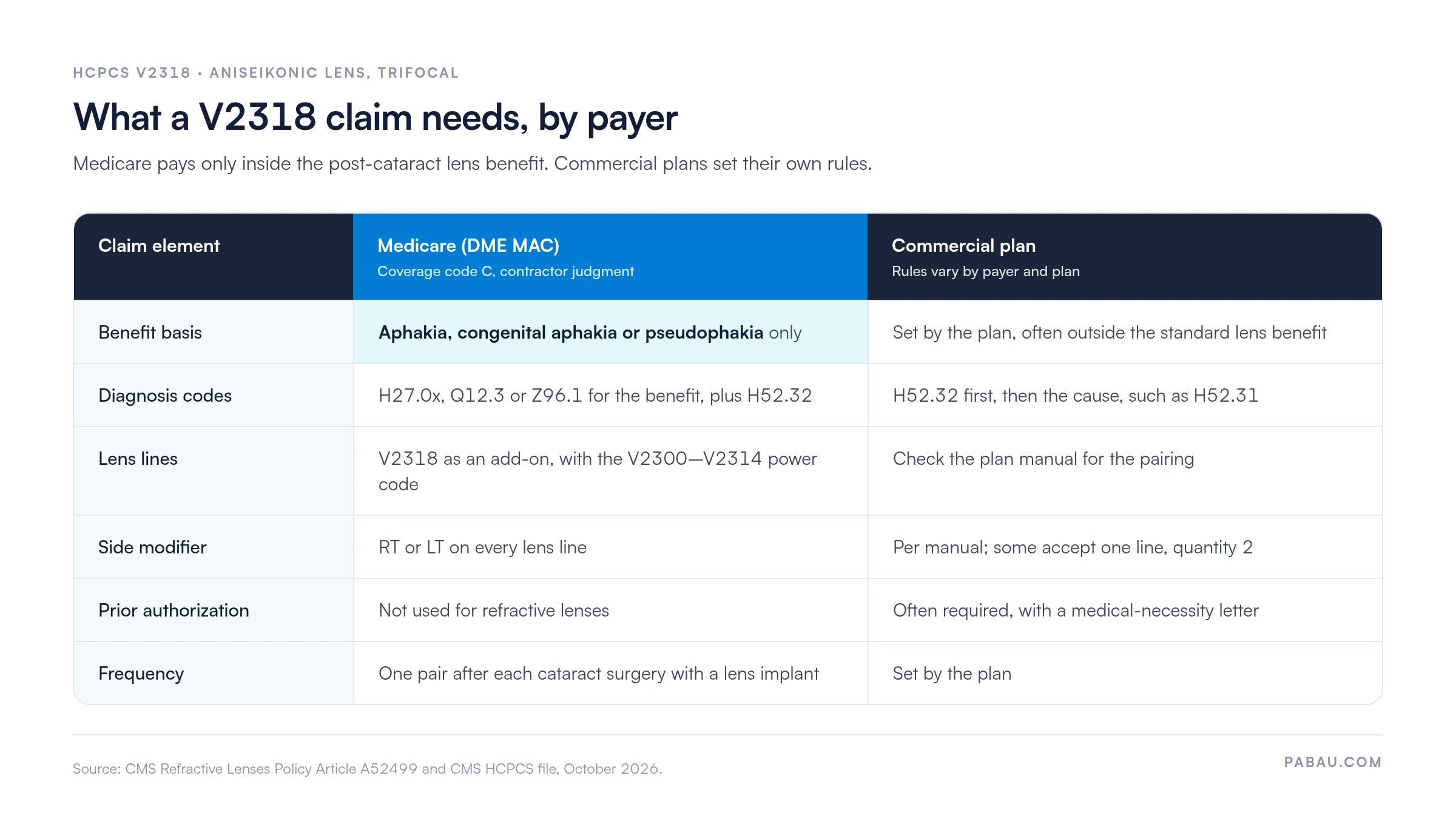
The diagnosis has to explain why the patient needs an image-size correction. Presbyopia explains the trifocal design, but it does not justify an aniseikonic lens by itself. Pairing V2318 with the right ICD-10-CM code is a basic medical billing compliance step.
List aniseikonia first on a commercial claim, because it is the reason for the special-order lens. On a Medicare claim, the aphakia or pseudophakia code establishes the benefit. Add H52.32 so the record explains the lens choice. You can check each diagnosis against our ICD-10-CM codes library before you submit.
Prior authorization rules for V2318 depend on the payer and the plan. Medicare does not use prior authorization for refractive lenses. Commercial plans and Medicaid managed care organizations often do, because a custom-made lens costs far more than a standard trifocal.
A medical-necessity letter for V2318 usually covers these points:
Record the authorization number before the lab starts the order. Enter it in box 23 of the CMS-1500 form, or in the matching field of the electronic claim.
A clean claim for V2318 needs records that prove two facts. The patient has documented aniseikonia, and the dispensed lens was a trifocal designed to correct it.
Retention periods depend on who pays. Medicare’s Program Integrity Manual requires DMEPOS suppliers to keep proof of delivery for seven years from the date of service. For other payers, follow the retention period in the payer contract or state law, whichever is longer.
Medicare requires the RT or LT modifier on every lens code in the policy, including V2318, so each line names the eye it is for. When the patient receives both lenses, bill two lines, one with RT and one with LT. Commercial payers may accept one line with a quantity of 2, so follow their manual.
Two more Medicare modifiers apply when the coverage criteria are not met:
Medicare uses the KX modifier on lens add-ons such as anti-reflective coating, tints and oversize lenses. A52499 does not list KX for V2318, so do not add it to the lens line.
Most V2318 denials trace back to the diagnosis, the authorization or the code choice. Each one can be caught before the claim goes out.
Run your denial management check before the lab order goes out. Once a custom lens is made, it cannot be returned, so an unpaid claim becomes a direct loss.
Audit your V2318 claims each quarter. Compare each claim against the aniseikonia measurement and the lens order on file. A claim without both points to a training need at the front desk.
Special-order lens claims are slow to resolve, and a missing letter or authorization number can stall one for weeks. Many practices track them on a spreadsheet, which falls behind as soon as the front desk gets busy.
Pabau, the practice management platform we build, keeps the prescription, letters and invoice on the patient record. Its claims management software submits the claim you have coded to payers through Claim.MD. It then tracks the claim’s status by code, so you can see every open V2318 claim in one list.
Your team chases denials while the documents are still fresh. Fewer custom lenses end up as unpaid stock.

Pabau submits your lens claims to payers through Claim.MD and tracks each one by code. Stalled special-order claims get chased before the lens is written off.

V2318 is a narrow code for a specialist lens. Bill it only when the chart documents aniseikonia and the lab made a trifocal designed to correct it. A standard trifocal belongs in the V2300–V2314 power codes, however complex the prescription looks.
The costly mistakes on a V2318 claim happen before it is filed. Settle the diagnosis, the letter and the authorization before the lab starts, because a custom lens cannot be returned. Book a demo to see how Pabau submits and tracks your special-order lens claims through to payment.

Want to understand how claims flow from code entry to payment? Revenue cycle management in healthcare explains the end-to-end process from eligibility check through remittance posting.
Need to handle ERA adjustment codes after a V2318 denial? Electronic remittance advice covers how to read ERA files and act on CARC denial codes.
Looking to reduce claim errors across your practice? Medical billing explained covers the workflow steps where errors most commonly occur and how to address them.
Billing a high-minus trifocal instead? HCPCS code V2315 covers the myodisc trifocal lens and its coverage rules.
No trifocal code fits the lens? HCPCS code V2399 explains how to bill a specialty trifocal by report.
HCPCS code V2318 is the Level II code for an aniseikonic trifocal lens. It is a special-order spectacle lens that corrects a difference in image size between the two eyes, with distance, intermediate and near zones.
Only within the refractive lens benefit. Medicare covers lenses for aphakia, congenital aphakia and pseudophakia, with one pair after each cataract surgery with an implant. A V2318 claim outside those diagnoses is not covered.
V2318 is an aniseikonic trifocal lens that corrects unequal image size. V2319 reports a trifocal segment wider than 28 mm. They describe different lens features, so one does not replace the other.
Yes. The V2318 descriptor does not name a lens material, so glass and plastic aniseikonic trifocals use the same code. Material upgrades such as polycarbonate have their own add-on codes.
It depends on the payer. Medicare does not use prior authorization for refractive lenses. Commercial plans and Medicaid managed care organizations often require it, along with a letter of medical necessity, for special-order lenses.
H52.32 (aniseikonia) is the primary diagnosis. Add the cause, such as H52.31 (anisometropia), and on Medicare claims the aphakia or pseudophakia code (H27.0x, Q12.3 or Z96.1). Presbyopia alone does not support the lens.