CCSD code E4800: Therapeutic bronchoscopy billing guide
CCSD code E4800: definition and clinical scope CCSD code E4800 is the Classifica...

Last Updated: Oct 16, 2026
V2218 is the HCPCS Level II code for aniseikonic, per lens, bifocal. It covers one bifocal spectacle lens designed to equalize the image size each eye sees, so a pair is billed as two units.
Coders most often confuse it with V2118, the single-vision aniseikonic code, and V2318, its trifocal counterpart. The segment count on the lab order decides the code. Medicare pays only when the patient is aphakic or pseudophakic.
Let Pabau's smart automation suggest the right codes, reduce claim denials, and keep your practice compliant—effortlessly.
Automate repetitive tasks and focus on what matters most—your patients.
Reduce coding errors and ensure compliance with the latest regulations.
Clean claims, fewer denials, and faster reimbursements.
Powerful insights and reporting to help your practice thrive.
HIPAA compliant SOC 2 certified GDPR-compliant Trusted by 4,000+ clinics worldwide

V2218 is the HCPCS Level II code for one aniseikonic bifocal spectacle lens, billed per lens, so a pair is two units.
An aniseikonic lens is custom-designed to equalize the image size each eye sees, and V2218 applies only when that lens is also a bifocal.
Single-vision aniseikonic lenses go to V2118 and trifocal ones to V2318, so the segment count on the lab order decides the code.
Original Medicare pays only for lenses that replace a missing natural lens, such as after cataract surgery, under the DME MAC Refractive Lenses LCD (L33793).
Most V2218 claims go to vision plans, Medicaid, or commercial payers, so confirm coverage and any prior authorization before the lens is ordered.
HCPCS Code V2218 is the Level II code for an aniseikonic bifocal spectacle lens. The official long descriptor from the Centers for Medicare & Medicaid Services (CMS) reads “Aniseikonic, per lens, bifocal.” Each unit is one lens, and the code sits in the V2200-V2299 bifocal range of the HCPCS Level II codes.
The reference data below comes from the CMS alpha-numeric HCPCS file. Check it against your payer’s fee schedule before quoting a patient.
The per-lens unit matters on every claim. A complete pair of aniseikonic bifocals is billed as two units of V2218, one for each eye. When only one eye needs the aniseikonic design, the other lens takes the code that matches its own prescription.
Aniseikonia is a difference in the size or shape of the image each eye perceives. Patients describe eyestrain, headaches, double vision, or poor depth perception. It often follows a large difference in prescription between the eyes, known as anisometropia.
A standard lens corrects focus but also magnifies or minifies the image as a side effect. An aniseikonic lens, also called an iseikonic or size lens, is designed to control that magnification. The lab adjusts factors such as base curve, center thickness, and vertex distance until the two images match more closely.
These lenses are custom-made and relatively rare. Common scenarios include unequal refraction after cataract or refractive surgery on one eye, and long-standing anisometropia. V2218 applies when the patient also needs a bifocal segment for near work.
V2218 describes the finished lens itself: an aniseikonic design combined with a bifocal segment. Other parts of the eyewear and most lens features are coded separately.
Lens codes split first by segment count and then by lens design or power. V2218 is defined by design, so the sphere and cylinder powers on the prescription do not change it. The descriptors below are taken verbatim from the CMS HCPCS file.
V2118 and V2318 are the closest near misses, because they share the aniseikonic design. Read the segment count on the lab order before choosing among the three. A bifocal order means V2218.
A bifocal built with a variable aspheric surface instead of an aniseikonic design is coded V2430, billed per lens on its own claim line. It is not stacked on a V2200-series line for the same lens.
V2219 and V2220 are not alternatives to V2218. They describe extra bifocal features and are reported on their own lines when the lens has them. Payers differ on whether they pay separately, so confirm before billing. The chart below runs the three checks for one lens, from segment count to the Medicare diagnosis.
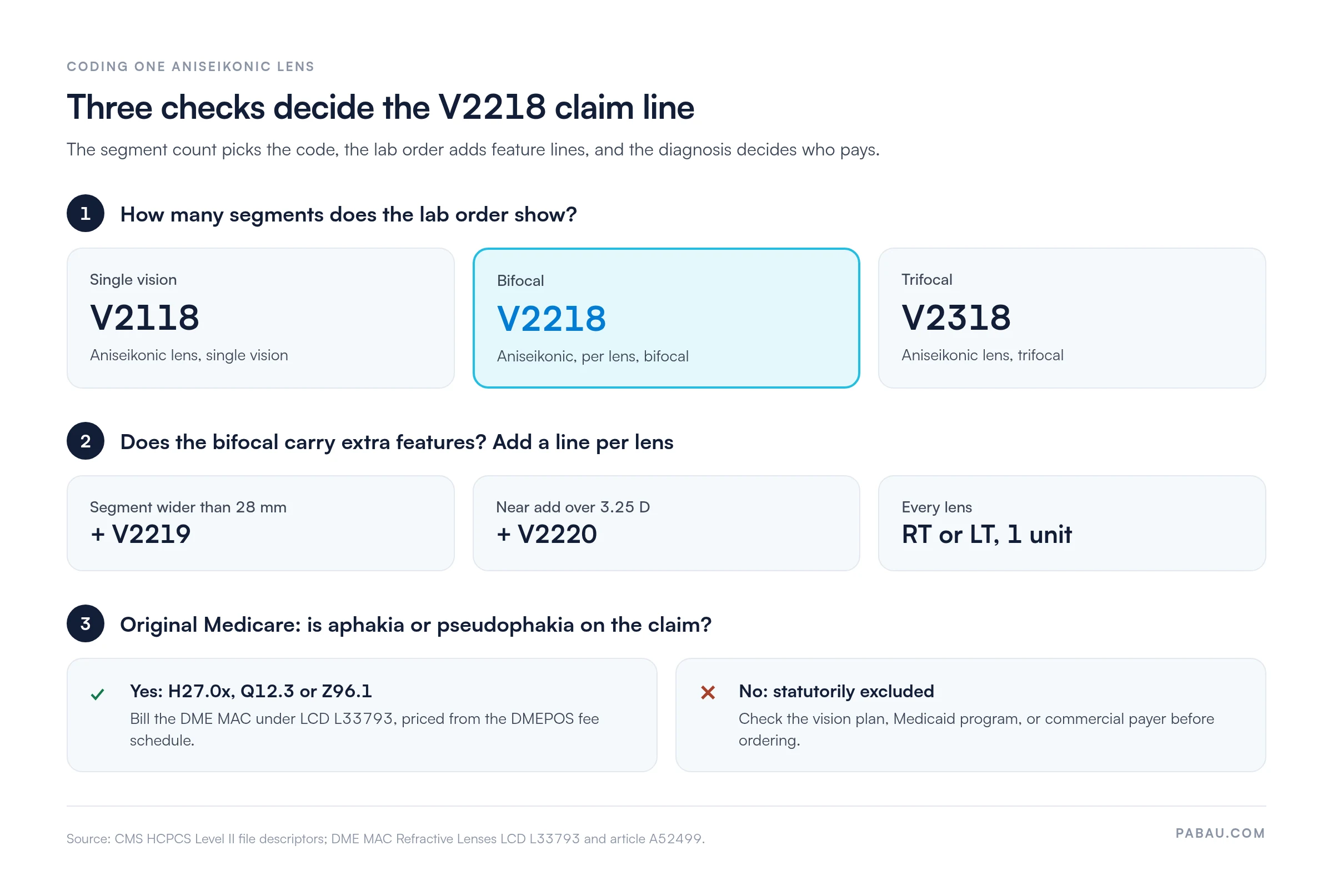
Build the claim from the lab order and the dispensing record. A typical claim for a pair of aniseikonic bifocals in a standard frame looks like this:
Medicare DME MACs require the RT or LT modifier on lens codes and want bilateral lenses on two lines of one unit each. Many commercial and Medicaid payers follow the same pattern. Capturing every line on the superbill at dispensing keeps lens features from going unbilled.
Medicare treats deluxe frames and most cosmetic lens options as upgrades. The DME MACs publish modifier rules for these, including GA, GY, GZ, and KX, so check the current DME MAC guidance before billing them.
Original Medicare does not cover routine eyeglasses. It covers refractive lenses only when they restore the vision normally provided by the eye’s natural lens. That means patients with aphakia, congenital aphakia, or pseudophakia after cataract surgery with an intraocular lens (IOL).
The DME MAC Refractive Lenses LCD (L33793) and its policy article (A52499) set these rules. Supporting diagnoses include H27.00-H27.03, Q12.3, and Z96.1. For pseudophakia, coverage is limited to one pair of eyeglasses or contact lenses after each cataract surgery with an IOL.
An aniseikonic bifocal can fit this benefit, for example after cataract surgery on one eye leaves the two images unequal. Claims go to the DME MAC, not the Part B MAC, and are priced from the DMEPOS fee schedule. A V2218 lens for a patient with neither aphakia nor pseudophakia is statutorily excluded.
Medicare Advantage plans must cover the same post-cataract benefit. Many also add a routine eyewear allowance, often through a vision benefit manager. Check the plan’s Evidence of Coverage, because allowances and covered lens types vary.
Medicaid vision benefits are set state by state. Some programs cover adult eyeglasses, while others limit lenses to children under the EPSDT benefit. Specialty lenses such as V2218 often need medical necessity documentation or prior approval.
Check the state’s Medicaid provider manual or fee schedule before dispensing. Rhode Island, for example, publishes the bifocal lens codes its Medicaid program recognizes. Never assume one state’s rules apply to a patient in another state.
Look up V2218 on the CMS DMEPOS fee schedule before quoting a Medicare patient. Allowables vary by state and change each calendar year, so last year’s figure can lead to a billing dispute.
Whether V2218 needs prior authorization depends on the payer. Original Medicare does not require it for refractive lenses, and the DME MAC applies the LCD criteria when it processes the claim. Many Medicaid programs, managed care plans, and vision plans do require approval for specialty lenses.
Each V2218 claim should be backed by a complete record before it is submitted. Good records also support the medical billing compliance checks payers run in post-payment audits.
Most V2218 denials come from a short list of avoidable errors. The table below pairs each with a common claim adjustment reason code (CARC) and the fix. Exact codes vary by payer, and denial management in healthcare workflows help track them.
Front-end checks cost far less than appeals. A clean claim review covering coverage, authorization, modifiers, and diagnosis linkage catches most of these before submission.
The diagnosis on a V2218 claim should explain why the patient needs an aniseikonic bifocal. The codes below cover the usual scenarios. Code the patient’s documented condition, not the list.
On a Medicare claim, an aphakia or pseudophakia code must be present for the lens to be covered. Aniseikonia alone describes the visual problem but does not meet the LCD criteria. Pair it with the surgical status code where both apply.
The facts that decide a V2218 claim tend to sit in separate places. The aniseikonia finding is in the exam notes, the lens design is on the lab order, and the code is often picked from memory.
Pabau, our practice management and billing software, keeps the prescription, the exam notes, and the claim on one patient record. The biller adds the HCPCS code, the RT or LT modifier, and the ICD-10 code against that record. That makes it quick to confirm the order says aniseikonic and bifocal before choosing between V2118, V2218, and V2318.
Before a claim goes out, Pabau’s practice claims management software checks that details insurers need, such as member IDs and authorization codes, are in place. In the US, claims are sent through Claim.MD, with eligibility checks and claim status tracked in one dashboard.
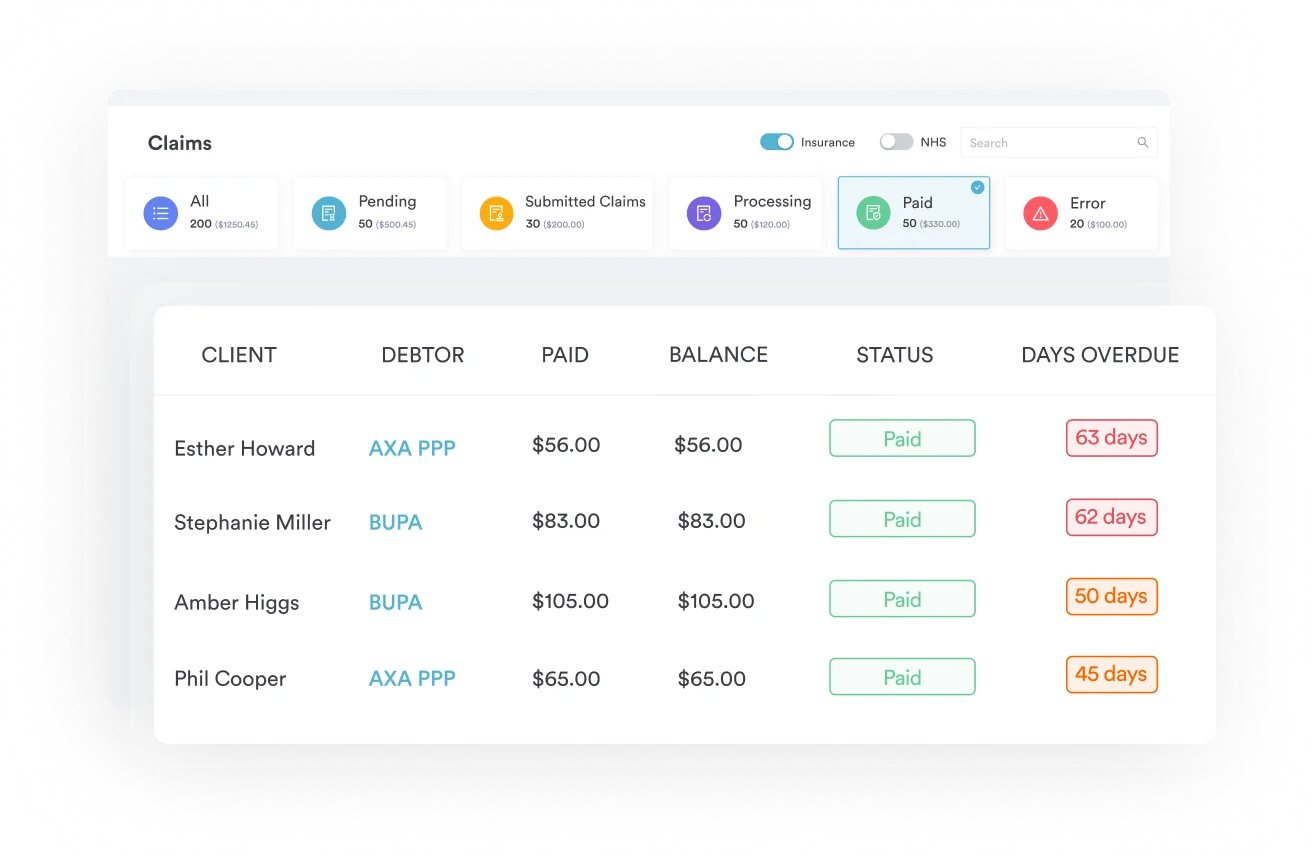
The result is fewer V2218 claims returned for the wrong segment code, a missing modifier, or a unit error. Billing staff catch the mismatch in the queue, which costs far less than working a denial.

Pabau checks each claim for missing details before it’s sent and tracks its status afterward, so your team spends less time on rework.

Code an aniseikonic lens by its segment count, not its power. A bifocal order is V2218, a single-vision order is V2118, and a trifocal order is V2318. Bill one unit per lens with RT or LT.
Settle coverage before the lab starts work. These are expensive custom lenses, and Medicare pays only when the patient is aphakic or pseudophakic. For other patients, confirm the vision plan, Medicaid program, or commercial payer and any authorization first.
Keeping the prescription, lens order, and claim in one record makes both checks quick. Book a demo to see how Pabau handles vision supply claims for your optometry practice.

Need to understand how denial reason codes map to corrective actions? Denial codes in medical billing explains the most common CARC and RARC codes affecting optical and specialty claims.
Looking to streamline the full claim lifecycle for your practice? Revenue cycle management explained covers how practices structure billing workflows from patient intake through payment posting.
Want a guide to staying compliant during payer audits? Medical billing compliance outlines the documentation retention and coding accuracy standards that apply to optical and optometry billing.
Billing a bifocal that no specific code describes? HCPCS Code V2299 explains how specialty bifocals are billed by report.
HCPCS Code V2218 covers one aniseikonic bifocal spectacle lens, billed per lens. An aniseikonic lens is designed to equalize the image size each eye sees. Frames, coatings, and tints are billed with their own codes.
Original Medicare covers V2218 only when the lens restores vision after the natural lens is missing. That means aphakia, congenital aphakia, or pseudophakia after cataract surgery with an intraocular lens. The rules are in the DME MAC Refractive Lenses LCD (L33793), and routine eyeglasses are excluded.
Both codes describe aniseikonic lenses, but V2118 is single vision and V2218 is bifocal. V2318 covers the trifocal version. The segment count on the lab order decides which code applies.
Yes, when the lens has those features. V2219 reports a bifocal segment wider than 28 mm, and V2220 reports a bifocal add over 3.25 diopters. Payers differ on whether they pay these separately, so confirm before billing.
It depends on the payer. Original Medicare does not require prior authorization for refractive lenses. Many Medicaid programs, managed care plans, and vision plans do require approval for specialty lenses, so check before ordering.
H52.32 (aniseikonia) is the most direct supporting diagnosis, often alongside H52.31 (anisometropia) and H52.4 (presbyopia). Medicare claims also need an aphakia code (H27.0x or Q12.3) or Z96.1 for pseudophakia.