HCPCS code J1180: Dyphylline injection billing guide
What HCPCS code J1180 covers: the official descriptor explained HCPCS code J1180...

Last Updated: Oct 16, 2026
V2299 is the HCPCS Level II code for specialty bifocal (by report).
The phrase "by report" is the operative element. It signals that no standard descriptor in the bifocal range captures this lens. The submitting provider must attach a written narrative explaining what makes the lens specialty in nature.
The code sits at the tail end of the bifocal lens range, functioning as a catch-all for specialty configurations. Billers should verify the current code status annually with the AAPC HCPCS code directory, as CMS reviews HCPCS Level II codes each year.
Let Pabau's smart automation suggest the right codes, reduce claim denials, and keep your practice compliant—effortlessly.
Automate repetitive tasks and focus on what matters most—your patients.
Reduce coding errors and ensure compliance with the latest regulations.
Clean claims, fewer denials, and faster reimbursements.
Powerful insights and reporting to help your practice thrive.
HIPAA compliant SOC 2 certified GDPR-compliant Trusted by 4,000+ clinics worldwide

HCPCS code V2299 covers specialty bifocal lenses that do not fit a standard bifocal descriptor and must be billed by report.
A narrative report documenting medical necessity, lens specifications, and prescribing physician details must accompany every V2299 claim.
Medicare covers V2299 only in narrow circumstances, primarily medically necessary eyewear after cataract surgery. Routine vision care stays excluded under Medicare Part B.
V2299 is carrier-priced, so the allowed amount comes from your MAC or the CMS DMEPOS fee schedule rather than the physician fee schedule.
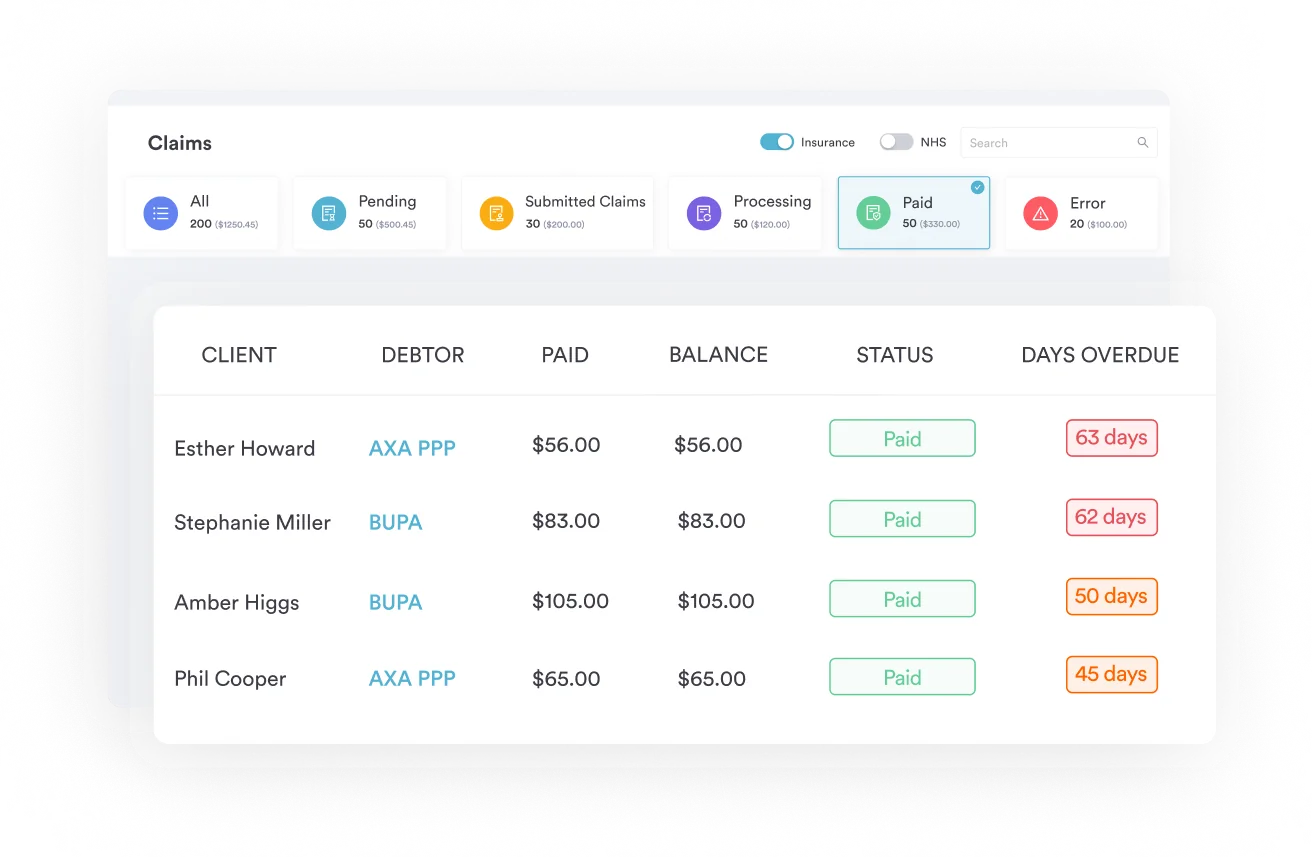
Pabau’s claims management software streamlines specialty lens billing by organizing documentation, tracking claim status, and reducing denial rates.
Any HCPCS code carrying “by report” in its descriptor requires the submitting provider to include a written narrative with the claim. For HCPCS code V2299, that narrative must explain why a standard bifocal code is insufficient and what makes this lens specialty in nature.
Treat the narrative as clinical and technical justification rather than a freeform letter. Payers read it to decide whether the claim meets their medical necessity criteria. A missing or vague report is the single most common reason V2299 claims are denied.
A complete by-report narrative for V2299 billing typically includes the following elements:
Payer requirements for the by-report narrative vary. Verify format expectations directly with each payer before submission. Keep a signed copy of every narrative on file, because an auditor will ask for the report rather than the claim form alone.
Medicare Part B does not cover routine vision care, including standard eyeglasses or contact lenses. HCPCS code V2299 is not a routinely reimbursed service under Medicare. One exception exists. Medicare covers a single pair of eyeglasses or contact lenses after cataract surgery in which an intraocular lens was implanted. That benefit sits in Section 1861(s)(8) of the Social Security Act.
When V2299 is billed in this post-cataract context, coverage is governed by Local Coverage Determination (LCD) L33793, which addresses refractive lenses and post-surgical eyewear. The claim must show that the specialty bifocal is medically necessary for this patient. It must also show that no standard bifocal code captures the lens.
Check the patient’s benefits before the lens is ordered. Confirm whether the Medicare plan covers post-cataract eyewear, and whether a secondary payer picks up the balance.
Commercial payers set their own coverage policies for specialty bifocal lenses. Some cover V2299 with prior authorization, and others exclude it entirely. Never assume coverage from Medicare rules when billing a commercial plan. Record the allowed amount and the authorization rule for each payer, so the next specialty lens claim starts from a known position.
Before dispensing a specialty bifocal lens for a Medicare patient, confirm that the post-cataract exception applies. Obtain a signed Advance Beneficiary Notice (ABN) where coverage is uncertain. An ABN protects the practice if Medicare denies the claim and shifts financial responsibility to the patient.
Medicare publishes no national rate for V2299. The code is carrier-priced, which means the Medicare Administrative Contractor (MAC) processing the claim sets the allowed amount. V2299 is also excluded from the CMS Physician Fee Schedule Look-Up Tool, so a search there returns no payment amount for it.
Two sources carry the figure you need. The CMS DMEPOS fee schedule lists payment amounts for vision and durable medical equipment codes by state. Your MAC publishes its own fee schedule and will confirm the current allowed amount for V2299 on request.
Because V2299 is a “by report” code, the paid amount also reflects the payer’s review of the narrative. A claim with strong documentation may be reimbursed above a weakly supported submission for the same lens. Track allowed amounts by payer to spot patterns and negotiate rates where possible.
For 2026 rates, request the current allowed amount from your MAC or pull the DMEPOS fee schedule file for your state. Building that check into the annual billing update keeps the price you quote a patient accurate all year.
Documentation for HCPCS code V2299 carries more weight than for any standard bifocal code. The code relies on a narrative rather than a pre-defined descriptor. Every part of the claim record therefore has to show that the lens is specialty in nature and medically necessary.
Auditors reviewing V2299 claims compare the narrative report, the prescription, and the lens that was dispensed. Any disagreement between those three documents is an immediate audit trigger.
Hold the prescription, the narrative, the laboratory order, and the dispensing record together in the patient chart. An audit response then becomes a retrieval task rather than a reconstruction. Practice management software like Pabau keeps that packet in one record. Its claims management software attaches supporting documents to each claim and tracks approval status by payer.
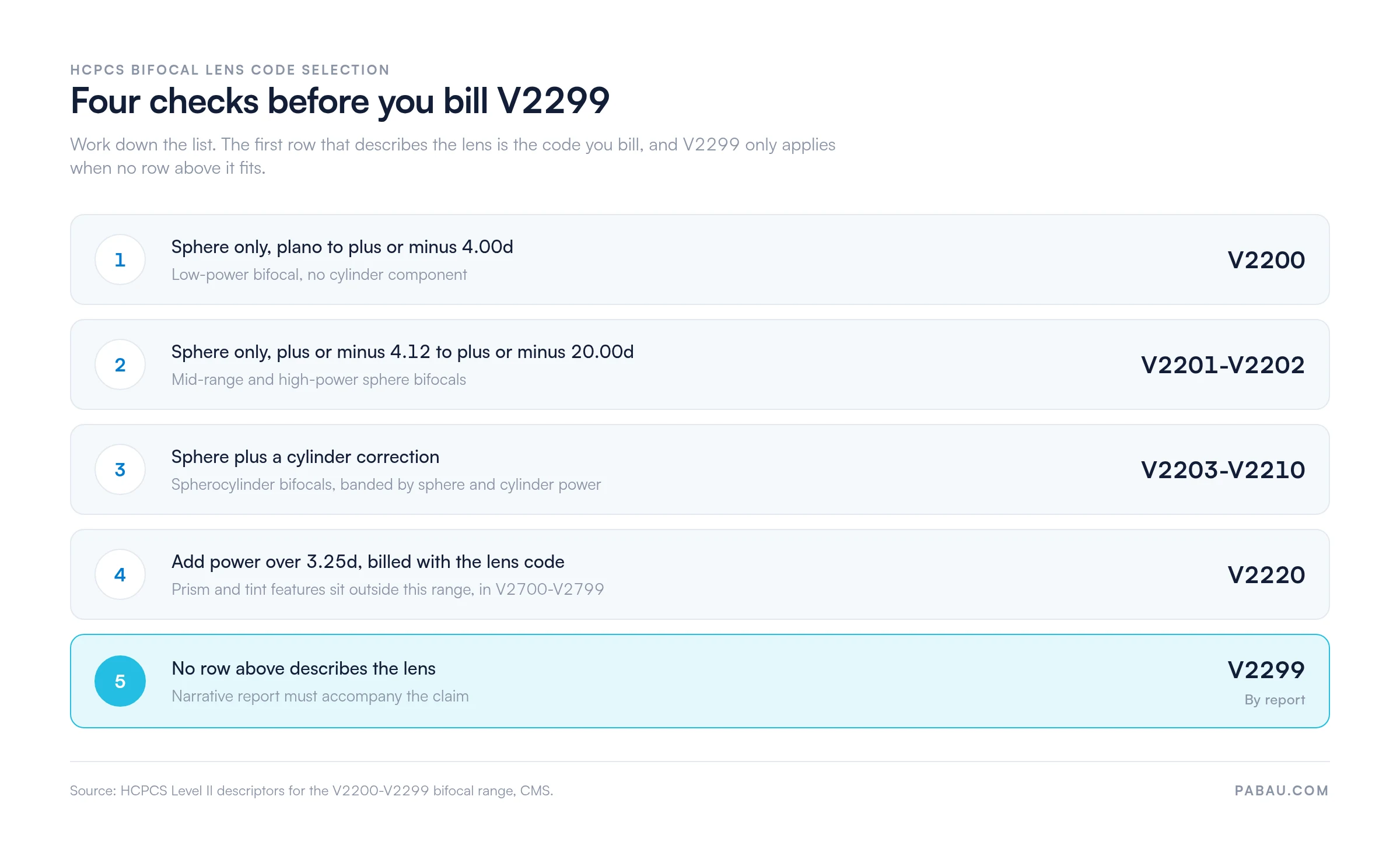
The V2200-V2299 range covers bifocal lenses across a spectrum of sphere and cylinder powers. Only bill V2299 after confirming that no specific code in this range captures the lens being dispensed. The table below groups the range by what each code actually describes.
Cylinder power alone does not push a lens into V2299. A plano to plus or minus 4.00d sphere carrying over 6.00d of cylinder already has its own code, V2206. A plus or minus 4.25 to plus or minus 7.00d sphere with 2.12 to 4.00d of cylinder sits under V2208.
Two features billers expect to find in this range sit somewhere else entirely. Slab-off prism is V2710 and photochromic tint is V2744, both within V2700-V2799. Each is billed as a separate add-on next to the lens code, never as a reason to reach for V2299.
Consulting the NLM HCPCS Level II API or a current code reference allows billers to search the full range programmatically. If a standard code captures the lens, using it instead of V2299 reduces audit exposure and simplifies the claim. Our HCPCS code library lists the other V-series codes a vision claim commonly needs.
V2299 belongs at the end of the code selection process. Auditors treat frequent V2299 billing from one practice as a red flag. Heavy use suggests standard codes are being skipped to win a larger allowed amount. The ladder below shows the order to work through before you bill it.
Post-cataract specialty bifocal lenses are the most common legitimate Medicare claim under V2299. Patients fitted with a standard monofocal intraocular lens often need an unusual add power or custom fabrication. Either can put the finished lens outside every standard descriptor.
Lenticular lenses are the common near miss here. A myodisc bifocal looks like a specialty item, but V2215 already describes it. An aniseikonic bifocal invites the same mistake. V2218 covers a bifocal lens designed to equalize the image size each eye sees.
Denials on V2299 cluster around a handful of causes, and practices filing these claims meet the same ones repeatedly. Recognizing them before submission costs far less than working an appeal afterwards.
The most common denial reasons for V2299 claims are:
Track every V2299 denial by payer and reason code, then read the pattern before the next submission cycle. A clean claim checklist written for V2299 turns that pattern into a pre-submission check the whole front desk can run.
Run a quarterly audit on all V2299 claims your practice has submitted. Pull the denial rate by payer and the most frequent adjustment reason codes. If one denial reason accounts for more than 30% of rejections, treat it as a workflow problem and fix it before the next submission cycle.
Most vision practices assemble a V2299 claim from four places. The prescription sits in the chart and the narrative in a word processor. The laboratory order sits in an email thread, and the claim status in a payer portal. Nobody sees the whole packet at once, so an incomplete submission still looks finished.
Pabau holds that packet as one record. The prescription and the clinical note stay on the patient’s chart. The narrative and the laboratory order attach to the claim itself, which carries its own status by payer. Staff can see what is still missing before the claim is submitted.
Two things change as a result. Fewer V2299 claims are denied for a narrative nobody attached. An audit request eighteen months later is answered from one screen instead of four systems.

Pabau helps optical and vision practices organize documentation, track claim status across payers, and reduce denied claims for specialty HCPCS codes including V2299. See how it works in a personalized demo.

HCPCS code V2299 asks more of a billing team than any standard bifocal code, because the narrative does the work a descriptor normally does. The practices that get paid on it treat that report as clinical evidence rather than paperwork.
Decide which of your specialty lenses genuinely fall outside the standard range. Write the narrative template for those cases before the next lens is dispensed. Keep one trade-off in view. Every V2299 claim invites a closer look, so the code should stay rare in your submission history.
To see how Pabau keeps specialty lens claims and their documentation together for optical and vision practices, book a demo with the team.

Need to understand denial patterns on vision billing claims? Denial management in healthcare explains how to categorize, track, and appeal claim rejections across payer types.
Want a structured approach to medical billing documentation? Superbill documentation guide covers what belongs on a superbill and how it connects to your HCPCS claim record.
Looking to reduce compliance risk across your billing workflows? Medical billing compliance outlines the audit triggers and documentation standards that protect practices during payer reviews.
Checking benefits before a specialty lens is ordered? Insurance eligibility verification walks through the checks that confirm post-cataract eyewear coverage before you dispense.
Want the wider view of how a claim becomes revenue? Revenue cycle management shows where coding sits between the appointment and the payment.
HCPCS code V2299 is used to bill for specialty bifocal lenses that do not fit any specific descriptor in the V2200-V2298 code range. It is an HCPCS Level II code in the Vision Services category. Every V2299 claim needs a narrative report explaining the specialty nature of the lens and why standard codes do not apply.
Medicare does not cover V2299 for routine vision care. Coverage may apply where the lens is medically necessary eyewear after cataract surgery with an intraocular lens implant. That case is governed by the statutory exception and by LCD L33793. All other specialty bifocal claims are excluded from Medicare Part B coverage.
Billing V2299 requires a physician prescription, full lens specifications, a laboratory or dispensing record, and a diagnosis code supporting medical necessity. It also requires a by-report narrative explaining why the lens is specialty in nature and why standard bifocal codes do not apply. Medicare patients need an Advance Beneficiary Notice when coverage is uncertain.
“By report” means the submitting provider must include a written narrative with the claim. The report explains the clinical indication, the lens specifications, and why no standard bifocal code applies. It also carries any other detail the payer needs to assess medical necessity. Without the narrative, the claim will be denied.
The codes V2200 through V2298 each describe a specific bifocal lens configuration by sphere power, cylinder, or add power. V2299 is the catch-all code for lenses that match none of those descriptors. Using V2299 when a standard code applies is a compliance error and a common audit trigger.
Reimbursement for V2299 varies by payer. Medicare covers it only in specific post-cataract circumstances, and the allowed amount comes from the MAC rather than a national rate. Commercial payers set their own policies, with some requiring prior authorization and others excluding specialty bifocal lenses entirely. Verify coverage with each payer before dispensing.