CCSD Code H3334: Low anterior resection billing guide
CCSD Code H3334: Definition and clinical scope CCSD Code H3334 covers an open an...

Last Updated: Oct 16, 2026
J1439 is the HCPCS Level II code for injection, ferric carboxymaltose, 1 mg. Each billed unit equals 1 mg of drug administered.
Ferric carboxymaltose, sold as Injectafer by American Regent, is an intravenous iron replacement. It treats iron deficiency anemia in adults and children aged 1 and older who can't tolerate or don't respond to oral iron. It's also approved for iron deficiency anemia in adults with non-dialysis-dependent chronic kidney disease. Adults with NYHA class II/III heart failure and iron deficiency qualify too.
Let Pabau's smart automation suggest the right codes, reduce claim denials, and keep your practice compliant—effortlessly.
Automate repetitive tasks and focus on what matters most—your patients.
Reduce coding errors and ensure compliance with the latest regulations.
Clean claims, fewer denials, and faster reimbursements.
Powerful insights and reporting to help your practice thrive.
HIPAA compliant SOC 2 certified GDPR-compliant Trusted by 4,000+ clinics worldwide

J1439 covers ferric carboxymaltose (Injectafer) injection and is billed per 1 mg administered, so a 750 mg dose equals 750 billable units.
Units are capped per labeled dose: 750 mg for adult IDA, and up to 1,000 mg for NDD-CKD or heart failure.
Medicare Part B pays J1439 at ASP+6% in the physician office, while a hospital outpatient department bills the drug on the UB-04 under OPPS.
Many Medicaid programs and commercial plans want the 11-digit NDC with qualifier N4 beside J1439, and a missing NDC is a frequent denial trigger.
Pabau, the practice management platform we build, validates each J1439 claim before submission and tracks it from Pending to Paid.
HCPCS code J1439 is a J-code in the HCPCS Level II code set, which the Centers for Medicare and Medicaid Services maintains. It identifies the drug ferric carboxymaltose, and its official descriptor is “Injection, ferric carboxymaltose, 1 mg.” Each unit represents 1 mg administered, not the vial size purchased. Physician offices report it on a CMS-1500 or 837P claim, and hospitals report it on the UB-04.
Ferric carboxymaltose (FCM) is an intravenous iron replacement. Its FDA label covers three patient groups, and coders need to know them because claims for off-label use are denied on medical-necessity grounds. Check these criteria at the point of scheduling, before the infusion is booked.
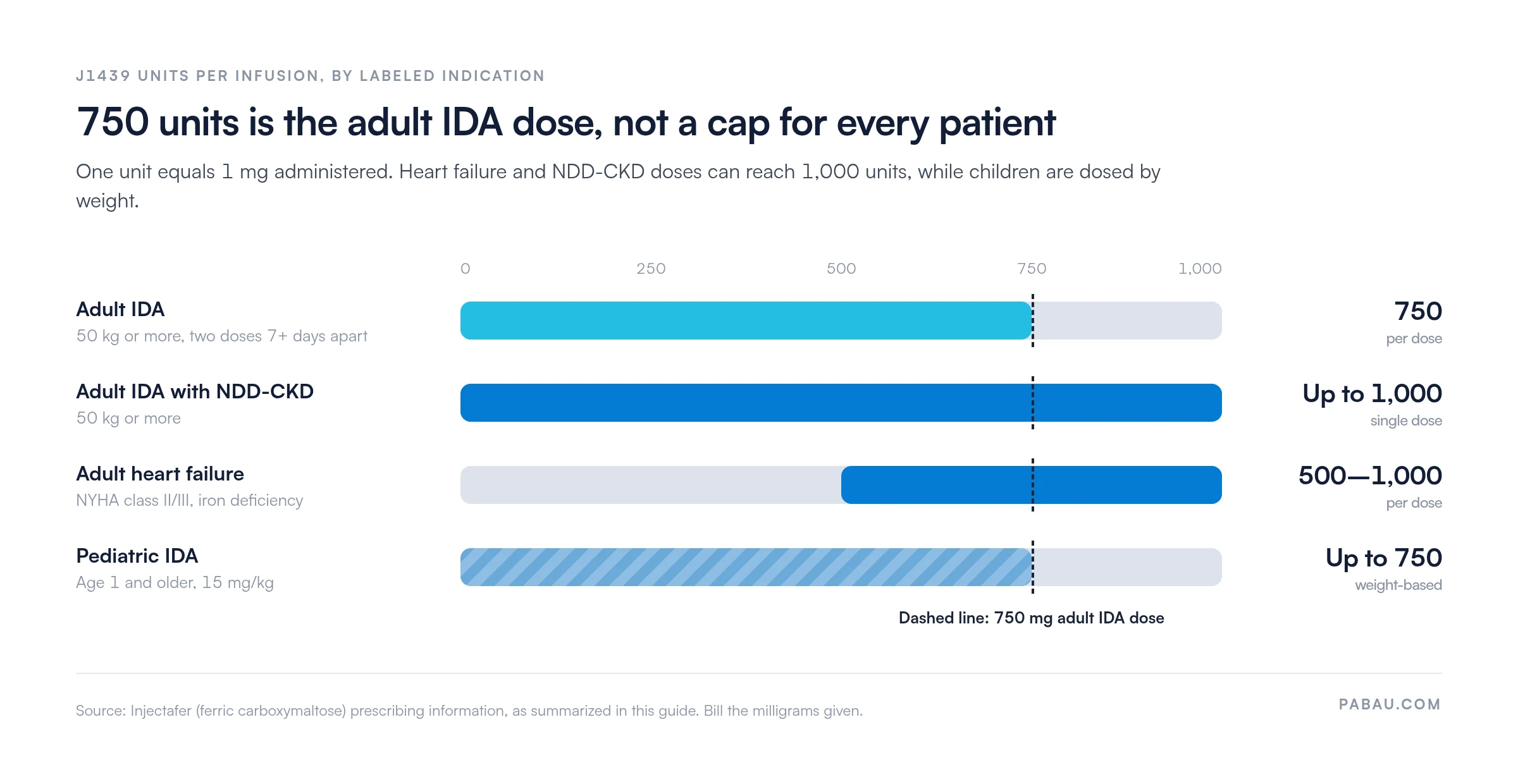
The drug is given intravenously, and the labeled dose depends on the indication and the patient’s weight. For adult IDA in patients weighing 50 kg or more, each dose is 750 mg. Two doses go at least seven days apart, for a course total of 1,500 mg.
Adults with NDD-CKD who weigh 50 kg or more may receive a single 1,000 mg dose instead. Heart failure doses run from 500 mg to 1,000 mg. Children receive 15 mg/kg per dose, capped at 750 mg. The unit ceiling is therefore set per labeled dose for the indication, and billing more units than that invites a payer audit.
J1439 unit math is simple: Bill one unit for every milligram administered. The common errors are billing the vial size instead of the dose given, or billing a whole course’s milligrams on one claim date.
Partial vials: Bill the milligrams administered on one line. Medicare takes any discarded amount from a single-dose vial on a separate line with the JW modifier. When nothing is discarded, it requires the JZ modifier instead.
Because the labeled dose changes with the indication, so does the most a single J1439 line should carry, as the chart below shows.
Every J1439 claim needs an ICD-10-CM diagnosis code that matches an FDA-approved indication. An unrelated or insufficiently specific diagnosis is a frequent denial reason for this drug code.
Important: Dialysis-dependent CKD is not an FDA-approved indication for Injectafer, so those claims are denied. Write “non-dialysis-dependent” explicitly in the physician order when billing for CKD patients.
The place of service (POS) code decides which Medicare payment system applies to J1439, so it must match where the infusion happens. A physician-office POS on an infusion given in a hospital outpatient department is a compliance risk and an audit trigger.
Medicaid POS rules are state-specific. North Carolina Medicaid, for example, publishes J1439 billing guidelines that specify approved settings. Verify each state program’s current policy before submitting.
HCPCS code J1439 covers the drug only. Giving the infusion is a separate service, usually coded with 96365 for the first hour. Billing J1439 without an administration code underpays the practice or triggers a payer edit.
Bundling caution: CPT 96365 and J1439 are complementary codes, and both must appear on the claim. Some payers apply a National Correct Coding Initiative (NCCI) edit when infusion and injection administration codes are billed for the same drug. Confirm the edit status with your MAC before adding more administration codes.
Medicare Part B pays for J1439 in the physician office using the Average Sales Price plus six percent (ASP+6%) methodology. CMS calculates the ASP each quarter from manufacturer-reported sales data, with updates in January, April, July and October. Because rates change every quarter, cite any per-unit dollar figure with its quarter and year.
To find the current rate, download the latest quarterly file from the CMS ASP pricing files and search for J1439. The file lists the per-unit payment limit, which is multiplied by the units billed.
Medicaid reimbursement is set by each state. Some states pay close to Medicare’s ASP+6%, while others use a state fee schedule or a managed Medicaid plan rate. Never apply one state’s published rate to another state’s claims.
Prior authorization (PA) for J1439 is not universal, but many commercial plans and Medicaid programs require it, so check the payer policy. A denied claim on a 750 mg Injectafer dose is a substantial write-off. Confirm insurance eligibility verification and PA requirements before scheduling the infusion, not after.
Most state Medicaid programs require the 11-digit National Drug Code (NDC) on the claim line alongside HCPCS code J1439. Many commercial plans now require it as well. A missing or incorrect NDC is a frequent denial reason on J1439 claims sent to Medicaid.
The NDC for Injectafer can change with packaging updates. Take it from the label of the vial used for the infusion, never from a stored record of an earlier purchase. Confirm current Injectafer NDC numbers with your pharmacy or wholesaler.
Track NDC numbers at the point of drug administration, not at claim submission. Nursing staff should scan or record the NDC from the vial label in the infusion note. Copying it from purchasing records after the visit introduces transcription errors and delays submission.
A frequent miscoding error is reporting J1756, the iron sucrose (Venofer) code, for a ferric carboxymaltose infusion. Another is reporting J3490 (unclassified drug) when a specific code exists. Each iron infusion drug has its own HCPCS code, and the wrong one is an upcoding or downcoding risk, depending on relative payment rates.
J3490 should never be used when J1439 applies. Reporting an unclassified code for a drug with a specific HCPCS code is an audit risk. It typically triggers a manual pricing review that delays payment.
J1439 denials cluster around six predictable errors, and a pre-submission checklist catches most of them. Strong denial management processes stop these before the claim leaves the practice.
A complete J1439 claim follows a consistent checklist, and each step below maps to a field or documentation element on the 837P transaction. Treating submission as a clean claim workflow reduces denials before they occur.
Incomplete documentation is a frequent audit finding on J1439 claims. A payer or Recovery Audit Contractor (RAC) expects a superbill documentation trail that reconstructs the clinical decision, the drug administered and the dose given.
Audit your J1439 infusion notes quarterly. Pull 10 random records. Check each one for a signed physician order, start and stop times, the vial-label NDC, and lab values within 90 days of the infusion. Any chart missing these elements is an appeal letter waiting to happen.
Many infusion practices still build a J1439 claim by hand from the nursing note, the drug invoice and the payer’s PA letter. Each copy step is a chance to drop the NDC, mistype the units or lose the authorization number.
Pabau’s error-catching claims management opens each claim pre-filled from the patient’s invoice. Claim validation flags missing or invalid details before you submit, and prior authorization codes follow the appointment onto the claim. Claims go out as CMS-1500s through Claim.MD, and you can check eligibility before the visit.
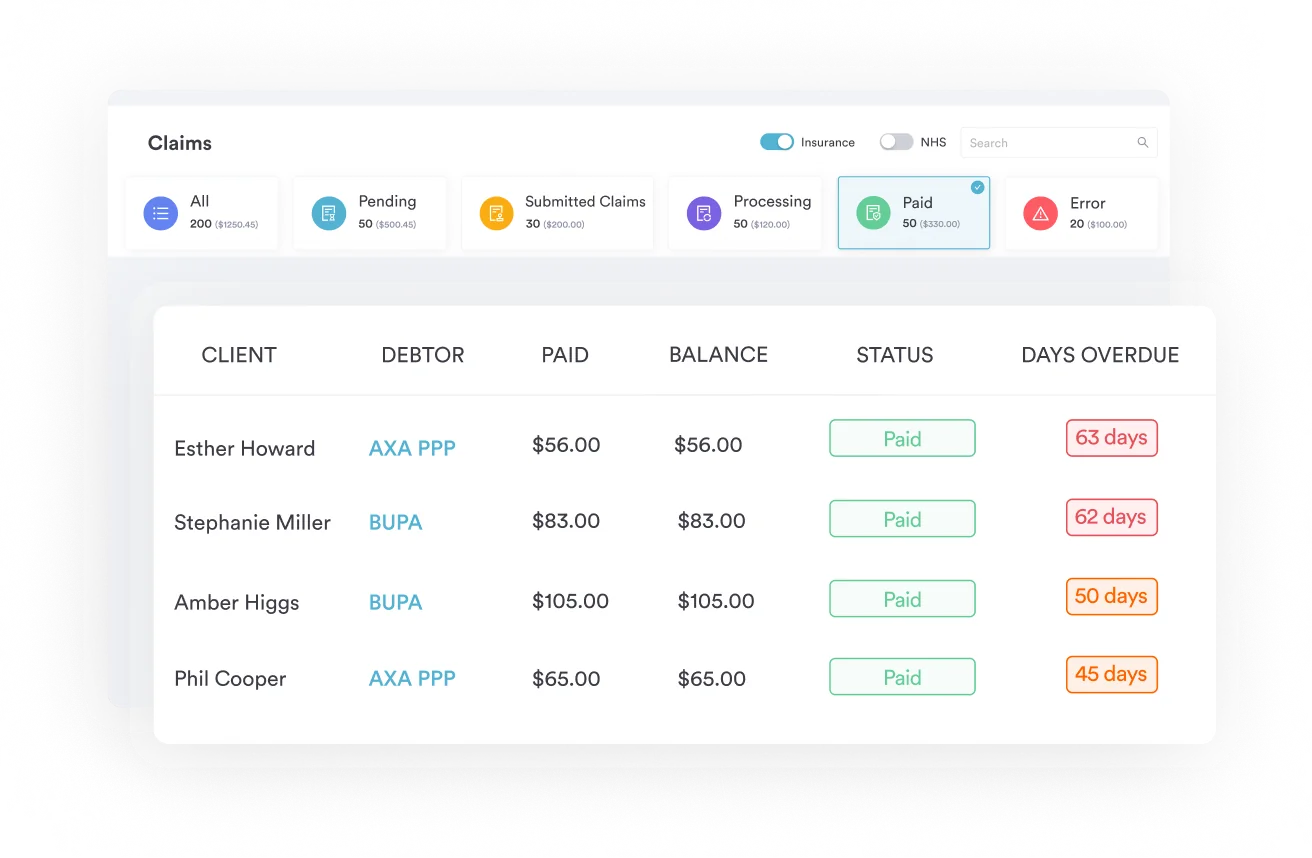
Once a claim is out, the dashboard tracks it from Pending to Paid. Payments settle straight from electronic remittance advice (ERA) files, so you can spot a short-paid drug line without matching payments by hand.

Pabau validates each J1439 claim before submission, carries the prior authorization code onto it and tracks payment from Pending to Paid. See how it fits your infusion practice.

Treat 750 units as one labeled dose, not a universal limit. When the units on the claim match the indication in the chart, a 1,000-unit heart failure or NDD-CKD line has the documentation to back it.
The NDC and the prior authorization number are easy to lose between the infusion chair and the billing desk. Capture both at the chair, and the claim leaves complete.
The trade-off is a few extra minutes of nursing documentation per infusion, set against a write-off on a high-cost drug. Book a demo to see how Pabau validates J1439 claims before they reach the clearinghouse.

Need to understand how claims move through the clearinghouse? Medical claims clearinghouse explained covers how 837P files are validated and routed to payers before payment.
Getting denials you can’t decode? Denial codes in medical billing breaks down CARC and RARC reason codes and the corrective actions that go with each.
Need to check what the payer paid on each drug line? Electronic remittance advice explains how 835 ERA files confirm payment and flag underpayments on drug claims.
Billing ferumoxytol instead? HCPCS code Q0138 covers Feraheme for patients who are not on dialysis.
Infusing iron dextran? HCPCS code J1750 explains INFeD billing, which counts units in 50 mg steps rather than 1 mg.
HCPCS code J1439 covers ferric carboxymaltose injection, billed per 1 mg administered. It reports the intravenous iron drug Injectafer for its FDA-approved indications. These are iron deficiency anemia (IDA) in adults and children aged 1 and older who can’t take or don’t respond to oral iron. They also include IDA in adults with non-dialysis-dependent chronic kidney disease, and iron deficiency in adults with NYHA class II/III heart failure.
Units for J1439 equal the milligrams of ferric carboxymaltose administered, so a 750 mg dose equals 750 units. Never bill the vial size, only what the patient received. The ceiling per date of service is the labeled dose for the indication. That’s 750 mg for adult IDA, and up to 1,000 mg for NDD-CKD or heart failure.
Medicare Part B pays J1439 at ASP+6% per unit in the physician office. CMS updates the per-unit ASP rate every quarter. Look up the current rate in the CMS ASP pricing files, and cite any dollar figure with its quarter and year.
Traditional Medicare Part B generally does not require prior authorization for J1439. Individual Medicare Administrative Contractors may publish Local Coverage Determinations with coverage criteria, and Medicare Advantage plans often require PA. Always verify with the specific plan before scheduling the infusion.
J1439 covers ferric carboxymaltose (Injectafer), while J1756 covers iron sucrose (Venofer). Both are billed per 1 mg administered, but they are distinct drugs with different FDA-approved indications and payment rates. Reporting one code for the other drug is a coding error in either direction.
Report the NDC printed on the label of the vial used at the infusion, not a number stored from an earlier purchase. Enter it in 11-digit format without hyphens, with qualifier N4 on the claim line.