

CCSD code G5100: Bypass of duodenum billing guide
CCSD code G5100 bills a bypass that leaves the duodenum in place CCSD code G5100...

Last Updated: Oct 16, 2026
Billable Code
E4800 is the CCSD code for therapeutic bronchoscopy (including laser, cryotherapy, lavage, snare, dilatation of stricture, insertion of stent). It applies when any of those six treatments is delivered through the bronchoscope, and one E4800 covers the whole session.
A bronchoscopy that only examines, biopsies, or washes the airway is coded E5180 instead, and E5180 cannot be billed alongside E4800. UK private medical insurers expect pre-authorization and an operative note that names the modality used.
Let Pabau's smart automation suggest the right codes, reduce claim denials, and keep your practice compliant—effortlessly.
Automate repetitive tasks and focus on what matters most—your patients.
Reduce coding errors and ensure compliance with the latest regulations.
Clean claims, fewer denials, and faster reimbursements.
Powerful insights and reporting to help your practice thrive.
HIPAA compliant SOC 2 certified GDPR-compliant Trusted by 4,000+ clinics worldwide

CCSD code E4800 covers therapeutic bronchoscopy across six modalities: Laser, cryotherapy, lavage, snare, dilatation, and stent insertion. Diagnostic bronchoscopy is coded E5180 instead.
Once any therapeutic intervention is performed during a bronchoscopy session, E4800 supersedes E5180, and the two codes cannot be billed for the same session.
Major UK private medical insurers require pre-authorization for E4800, and a claim without a valid authorization reference is routinely rejected.
The operative note must confirm the therapeutic modality used, the clinical indication, and the procedure outcome to support an E4800 claim.
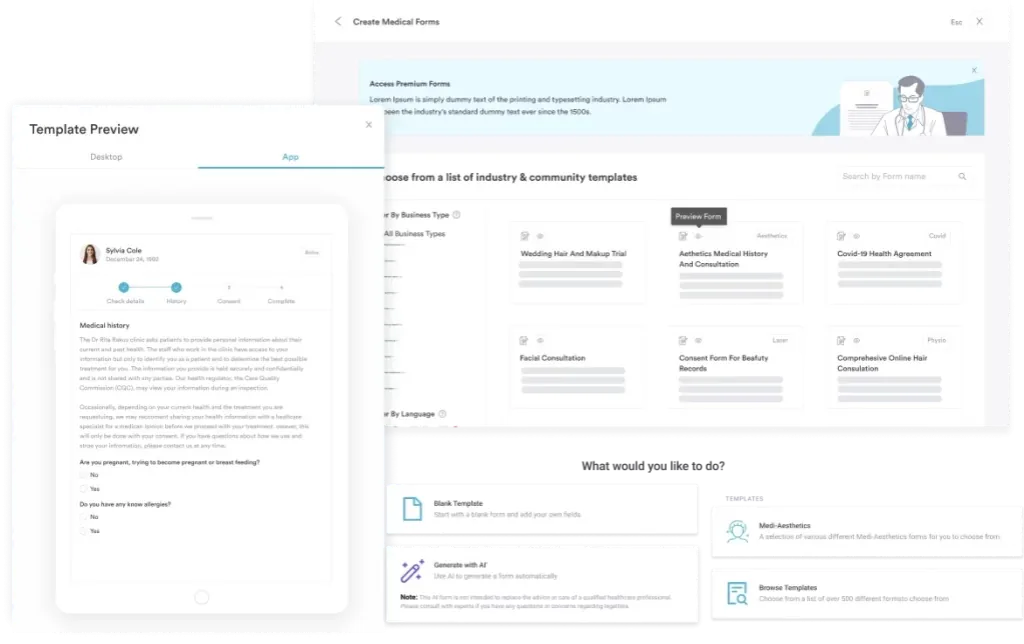
Pabau’s practice management software links procedure templates, pre-authorization tracking, and claims workflows, so each E4800 claim goes out with its documentation complete.
CCSD code E4800 is the therapeutic bronchoscopy code in the Clinical Coding and Schedule Development Group (CCSD) schedule of procedures for UK private healthcare. Its official descriptor covers laser ablation, cryotherapy, bronchoalveolar lavage, snare polypectomy, dilatation of bronchial stricture, and insertion of a bronchial stent.
These six modalities share a single code because each one is an active treatment delivered through the bronchoscope in one session. A bronchoscopy that only looks at or samples the airway is coded E5180 instead.
CCSD is the code set used by the UK’s private medical insurance (PMI) market. It is maintained by the Clinical Coding and Schedule Development Group and adopted by major UK insurers, including Bupa, AXA Health, Aviva, Vitality, and WPA. The code set is distinct from NHS OPCS-4 procedure codes and has no direct equivalent in US CPT coding.
Respiratory physicians (pulmonologists) and thoracic or cardiothoracic surgeons are the main billers of CCSD code E4800. Billing staff at private hospitals and independent practices submit the code for them, typically via Healthcode. It is the UK’s principal electronic billing clearinghouse for private practice.
Each modality within E4800 addresses a distinct clinical problem. Knowing what each involves helps coders see when the code applies and what the operative note must confirm.
Procedures may be performed via a flexible fiberoptic bronchoscope or a rigid bronchoscope. Rigid bronchoscopy is more common for laser ablation, snare resection, and stent insertion because it offers a larger working channel and better airway control. Flexible bronchoscopy is preferred for lavage and cryotherapy.
The operative note should specify which scope type was used. Bronchoscopic removal of an inhaled object has its own code, E4850, so it never goes on the claim as E4800.
CCSD code E4800 is appropriate when the main clinical purpose of the bronchoscopy session is therapeutic rather than diagnostic. Common presentations that justify the code include the following.
Purely investigative procedures do not qualify for E4800. That includes diagnostic bronchoscopy with biopsy only and endobronchial ultrasound (EBUS) without therapeutic intervention. The clinical record must explain why a therapeutic approach was chosen and what was done through the scope.
E5180 is the CCSD code for diagnostic bronchoscopy, with or without biopsy, when no therapeutic intervention is performed. E4800 applies the moment any therapeutic modality is carried out during the same scope session. E5180 is on the CCSD list of codes that cannot be billed alongside E4800.
The practical rule is simple. If the procedure report confirms a therapeutic action, use E4800. If the bronchoscopy was only to look, sample, or collect, use E5180, or the matching EBUS code where one applies.
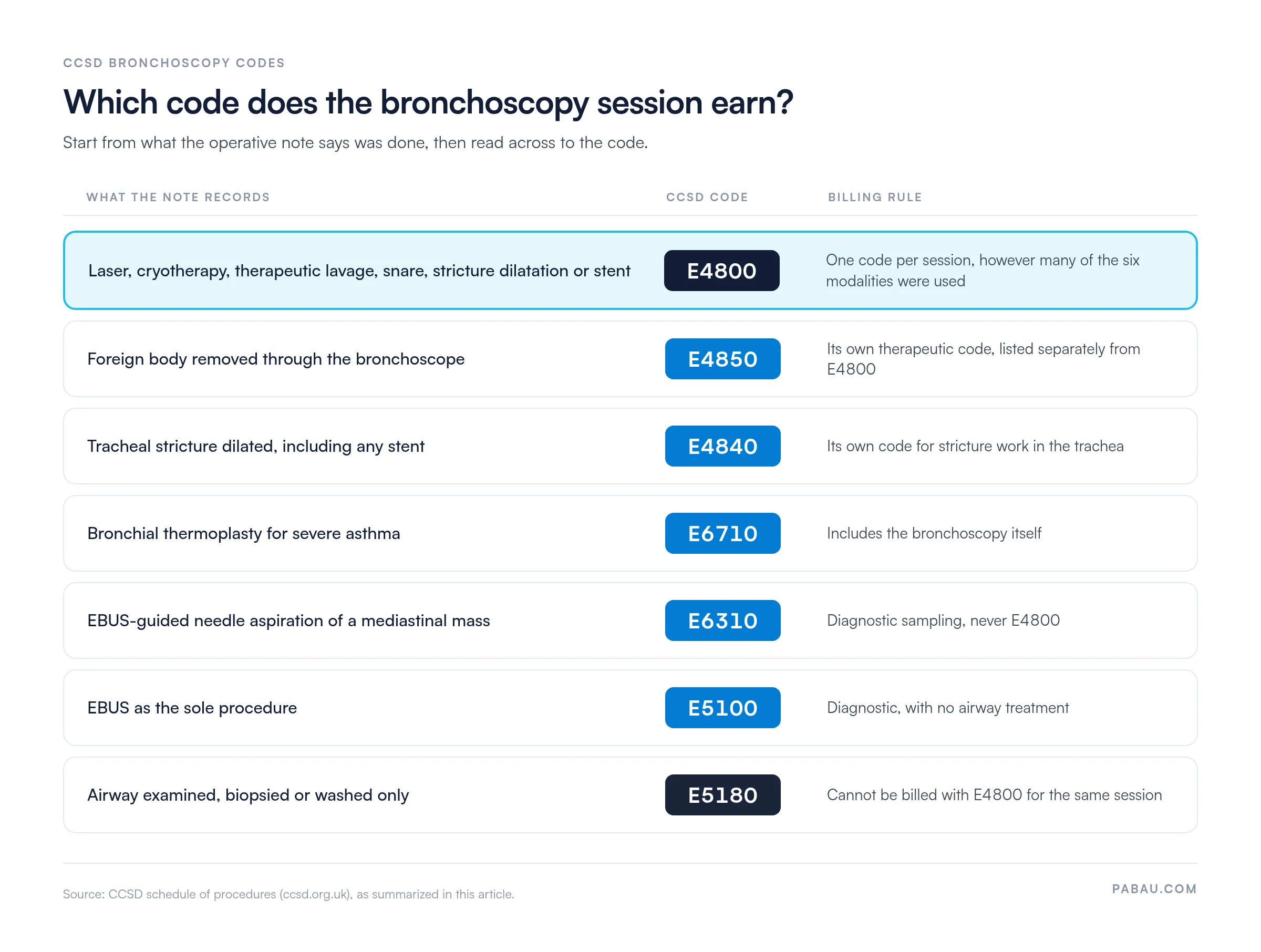
When in doubt, the operative note governs code selection, which is one more reason note quality matters for billing accuracy. Our Bupa CCSD billing guide adds context on code selection within the CCSD schedule. The decision table below runs the same rule across every neighboring bronchoscopy code.
The operative note is the legal and billing record for CCSD code E4800. UK PMI insurers routinely request it when adjudicating claims, and an insufficient note is a common denial reason. The record must contain all of the following elements.
The NHS Records Management Code of Practice advises keeping adult records for eight years after last treatment. UK GDPR sets no fixed period, only that data is kept no longer than needed.
Digital procedure templates with mandatory fields complete the record before the patient leaves the procedure suite. That removes the most common cause of documentation-related denials: A note written after the fact that leaves out key procedural details.
Major UK PMI insurers require pre-authorization before therapeutic bronchoscopy billed under CCSD code E4800. A claim submitted without a valid authorization reference is usually rejected outright. The table below summarizes typical requirements, so always check the insurer’s current provider portal, as policies change.
For urgent therapeutic bronchoscopy, most insurers offer an emergency authorization pathway. Document the clinical urgency clearly in the referral, then follow up with formal authorization within the window the insurer’s pathway sets. Keep the authorization reference number on file and include it on every claim submission.
A clean E4800 submission follows a consistent workflow. Practices that run these steps the same way every time see fewer first-pass denials.
Denial patterns for CCSD code E4800 are consistent across UK insurers. Most are preventable with the right documentation and process controls.
When appealing a denied E4800 claim, include the original operative note, the pre-authorization reference, and a covering letter from the treating consultant. The letter should explain the clinical rationale for the therapeutic intervention. Appeal timescales vary by insurer, and Bupa’s provider appeals team can be reached through its provider portal.
Tracking appeal outcomes by denial reason shows which documentation faults recur most often, so you know which template field to tighten first.
Flag every bronchoscopy procedure note at dictation for the specific therapeutic modality used. A simple checklist: (1) Laser ablation? (2) Cryotherapy? (3) Lavage therapeutic? (4) Snare polypectomy? (5) Dilatation? (6) Stent inserted? Any yes triggers E4800 and prevents a downstream E5180 error.
A single bronchoscopy session may involve more than one therapeutic modality. For example, a pulmonologist may debulk a tumor with laser ablation and then insert a stent to keep the airway open in the same procedure.
CCSD code E4800 is one all-inclusive code for the therapeutic bronchoscopy session: Multiple modalities in one scope episode go under a single E4800 code. They are never billed as separate charges.
Submitting E4800 twice for the same date of service is a bundling error and will be rejected. The E4800 fee reflects the value of multiple interventions. It is set higher than E5180 to account for the complexity and extra procedural time.
The key exception is a second, separate bronchoscopy on a different date. If dilatation was achieved at one session and a stent exchange follows at a later visit, E4800 can be billed again. A new pre-authorization is needed for that episode.
Insurer policies vary on the interval and documentation required between sessions, so confirm with the payer before submission.
The CCSD respiratory section contains several adjacent codes that coders and billing staff sometimes confuse with E4800. The distinctions matter, because applying the wrong one is a common denial trigger. Each one can be checked in our CCSD code library before the claim goes out.
Tracheal stricture work is the closest call, so check E4840 first when the narrowing sits in the trachea itself.
For a complex bronchoscopic procedure, the CCSD technical guide is the most reliable reference. It contains the complete descriptor language, unbundling rules, and guidance on co-billing scenarios that the code alone does not show.
Many respiratory practices still dictate the operative note after the list, chase the authorization reference by email, and key the claim in by hand. Each handoff is a chance for a missing modality or reference number to reach the insurer.
Pabau, the practice management platform we build, ties the note, the authorization, and the invoice to the booking itself. It helps with E4800 claims in five ways.
You can also run periodic audits of E4800 claims against operative notes in Pabau. Each audit confirms that the modality in the record matches the code on the invoice, so coding drift is caught before an insurer finds it.

Pabau’s procedure templates, pre-authorization tracking, and claims workflow help UK respiratory practices cut E4800 denials and get paid sooner after each procedure.

Let the operative note decide the code. If it names a laser, cryoprobe, therapeutic lavage, snare, dilatation, or stent, the session is E4800 and E5180 comes off the claim.
The trade-off is front-loaded work. Securing authorization before the list and finishing the note on the day takes minutes. A rejected claim means an appeal, a covering letter from the consultant, and a delayed payment.
Build both habits into your booking and note templates, and E4800 claims stop coming back. Book a demo to see how Pabau carries an E4800 case from pre-authorization to paid claim.

Billing a Bupa patient for a respiratory procedure? Bupa CCSD procedure codes and billing guide covers the Bupa code set, fee schedules, and submission requirements for UK private practice.
Was the scope purely diagnostic? CCSD code E5180: Diagnostic bronchoscopy billing guide explains the code to use when the airway is examined or biopsied without treatment.
Removing an inhaled object? CCSD code E4850: Therapeutic bronchoscopy for removal of foreign body sets out the separate code for foreign body extraction.
Dilating a tracheal stricture? CCSD code E4840: Dilatation of tracheal stricture with stent insertion covers stricture work in the trachea, stent included.
Dealing with a rejected claim? Denial codes in medical billing walks through the common denial reasons and how to resolve them.
CCSD code E4800 covers six therapeutic bronchoscopy modalities: Laser ablation, cryotherapy, bronchoalveolar lavage, snare polypectomy, stricture dilatation, and bronchial stent insertion. All six fall under the single E4800 code when performed during one bronchoscopy session. Purely diagnostic bronchoscopy is coded separately under E5180.
E5180 is the CCSD code for diagnostic bronchoscopy, with or without biopsy, when no therapeutic intervention is performed. E4800 applies whenever a therapeutic procedure is performed through the bronchoscope during the same session. The two codes cannot be billed together for one procedure episode, because E4800 supersedes E5180 once a therapeutic modality is carried out.
Yes, major UK PMI insurers, including Bupa, AXA Health, Aviva, and Vitality, require pre-authorization before therapeutic bronchoscopy billed under E4800. Claims submitted without a valid authorization reference are routinely rejected. For urgent procedures, most insurers offer a retrospective emergency authorization pathway, but the clinical urgency must be clearly documented.
Yes, but as a single E4800 code rather than multiple charges. CCSD code E4800 is an all-inclusive therapeutic bronchoscopy code: Laser ablation and stent insertion in the same session generate one E4800 claim. Submitting E4800 twice for the same date of service is a bundling error that insurers will reject. The combined clinical complexity is reflected in the E4800 fee.
The most common denial reasons are: Missing pre-authorization references and operative notes that do not confirm the therapeutic modality used. Claims also fail when E5180 is billed instead of E4800 after a therapeutic intervention, or when both codes are submitted for the same episode. Late submission beyond the insurer’s contractual window is another frequent administrative cause.
CCSD code E4800 is billed mainly by respiratory physicians (pulmonologists) and thoracic surgeons practicing in UK private healthcare. Interventional pulmonologists who specialize in central airway obstruction use the code most often. Practice billing staff or private hospital billing departments submit the claims on their behalf, typically via Healthcode.



