CCSD Code H3334: Low anterior resection billing guide
CCSD Code H3334: Definition and clinical scope CCSD Code H3334 covers an open an...

Last Updated: Oct 16, 2026
J1180 is the HCPCS Level II code for injection, dyphylline, up to 500 mg. One unit covers up to 500 mg of dyphylline, and a larger dose rounds up to the next whole unit.
Dyphylline is a bronchodilator used for asthma and for bronchospasm in COPD. It is a separate drug from theophylline, so a theophylline injection is never billed with J1180. Medicaid and many payers require the National Drug Code (NDC) on the claim, so check your MAC and payer rules before you submit.
Let Pabau's smart automation suggest the right codes, reduce claim denials, and keep your practice compliant—effortlessly.
Automate repetitive tasks and focus on what matters most—your patients.
Reduce coding errors and ensure compliance with the latest regulations.
Clean claims, fewer denials, and faster reimbursements.
Powerful insights and reporting to help your practice thrive.
HIPAA compliant SOC 2 certified GDPR-compliant Trusted by 4,000+ clinics worldwide

One unit of HCPCS code J1180 covers up to 500 mg of dyphylline, and any partial increment rounds up to the next whole unit.
Medicaid and many payers require the National Drug Code (NDC) on J1180 claims, so check your Medicare Administrative Contractor (MAC) and payer rules.
Dyphylline and theophylline carry different HCPCS codes, so billing J1180 for a theophylline injection is a coding error.
J1180 is absent from the October 2026 CMS average sales price (ASP) payment file, so your MAC sets the Medicare allowance.
Pabau’s claims management software checks each claim for missing or invalid details before submission and tracks it through to payment.
HCPCS code J1180 is the Healthcare Common Procedure Coding System Level II code for “Injection, dyphylline, up to 500 mg.” The Centers for Medicare & Medicaid Services (CMS) maintain it as part of the annual HCPCS code file. It belongs to the J-code series, which covers physician-administered drugs and biologicals in outpatient settings.
The phrase “up to 500 mg” in the descriptor sets the size of one billing unit, not a per-injection maximum. One unit of J1180 equals up to 500 mg of dyphylline administered. A dose below 500 mg still bills as one unit, and a dose above 500 mg rounds up to the next whole unit.
Dyphylline (also known as dihydroxypropyl theophylline or diphylline) is a xanthine derivative bronchodilator. It is indicated for the relief of bronchial asthma and reversible bronchospasm associated with chronic obstructive pulmonary disease (COPD). It works by relaxing bronchial smooth muscle and reducing airway resistance.
Despite its name, dyphylline is pharmacologically distinct from theophylline. It is not metabolized to theophylline in the body, it has a different half-life, and it carries its own HCPCS code. Billing J1180 for a theophylline injection is a coding error with compliance implications, so never treat the two drugs as interchangeable.
The injectable form is typically given in a physician office or outpatient setting during an acute bronchospasm episode or COPD exacerbation. Dyphylline’s clinical use has declined sharply in favor of newer bronchodilators, so payers look harder at J1180 claims. Document medical necessity, especially why the prescriber chose dyphylline over a first-line agent.
One unit of J1180 equals up to 500 mg of dyphylline administered. Bill one unit for each 500 mg increment in the total dose, rounding partial increments up to the next whole unit.
NDC reporting: Medicaid requires the National Drug Code (NDC) on drug claims, and many commercial payers and some MACs ask for it too. Check your MAC and payer rules for J1180. Where it is required, report the 11-digit NDC with the N4 qualifier, plus the NDC unit of measure and quantity administered.
Record the NDC from the vial label at the time of administration, not from the package insert or a formulary reference. Capture the lot number and expiration date in the clinical record as well. Auditors sometimes request them to confirm which lot was given.
CMS publishes a quarterly Medicare Part B payment limit file for drugs paid at average sales price (ASP) plus 6%. J1180 does not appear on the October 2026 file. When a code is missing from that file, your MAC sets the Medicare payment amount. Check each new release of the CMS ASP pricing files, and ask your MAC for the current J1180 allowance before you bill.
Commercial payer rates for HCPCS code J1180 vary by plan and contract. Some plans mirror Medicare pricing, while others use a contracted rate or wholesale acquisition cost (WAC). Check each payer’s remittance advice and contract terms to confirm the applicable rate.
Check each new quarterly ASP file for J1180 before you bill. The code was absent from the October 2026 file, so your MAC sets the Medicare allowance for now. Use the MAC’s current figure as your benchmark, not last quarter’s remittance.
Modifiers for HCPCS code J1180 tell the payer how the drug was given and how it relates to other services that day. Dyphylline injection is labeled for intramuscular use, and neither JA nor JB covers the intramuscular route.
Add JA or JB only when the route was intravenous or subcutaneous and the payer requires a route modifier. Medicare does not generally mandate them for every injectable. Check your payer’s billing manual or local coverage determination (LCD) before you submit.
For J1180, the clinical record must support both the drug administration and the medical necessity of dyphylline specifically. Auditors and payers look for the following elements.
A superbill documentation workflow should capture the NDC, dose, and route at the point of care. That heads off unit and NDC errors before a claim leaves the practice.
J3490 is the not-otherwise-classified (NOC) code for unclassified drugs, used when no specific J-code covers the drug given. For dyphylline, J1180 is the correct code in standard circumstances. The flow below runs the three checks that send a claim line to J3490 instead, then sets the units.
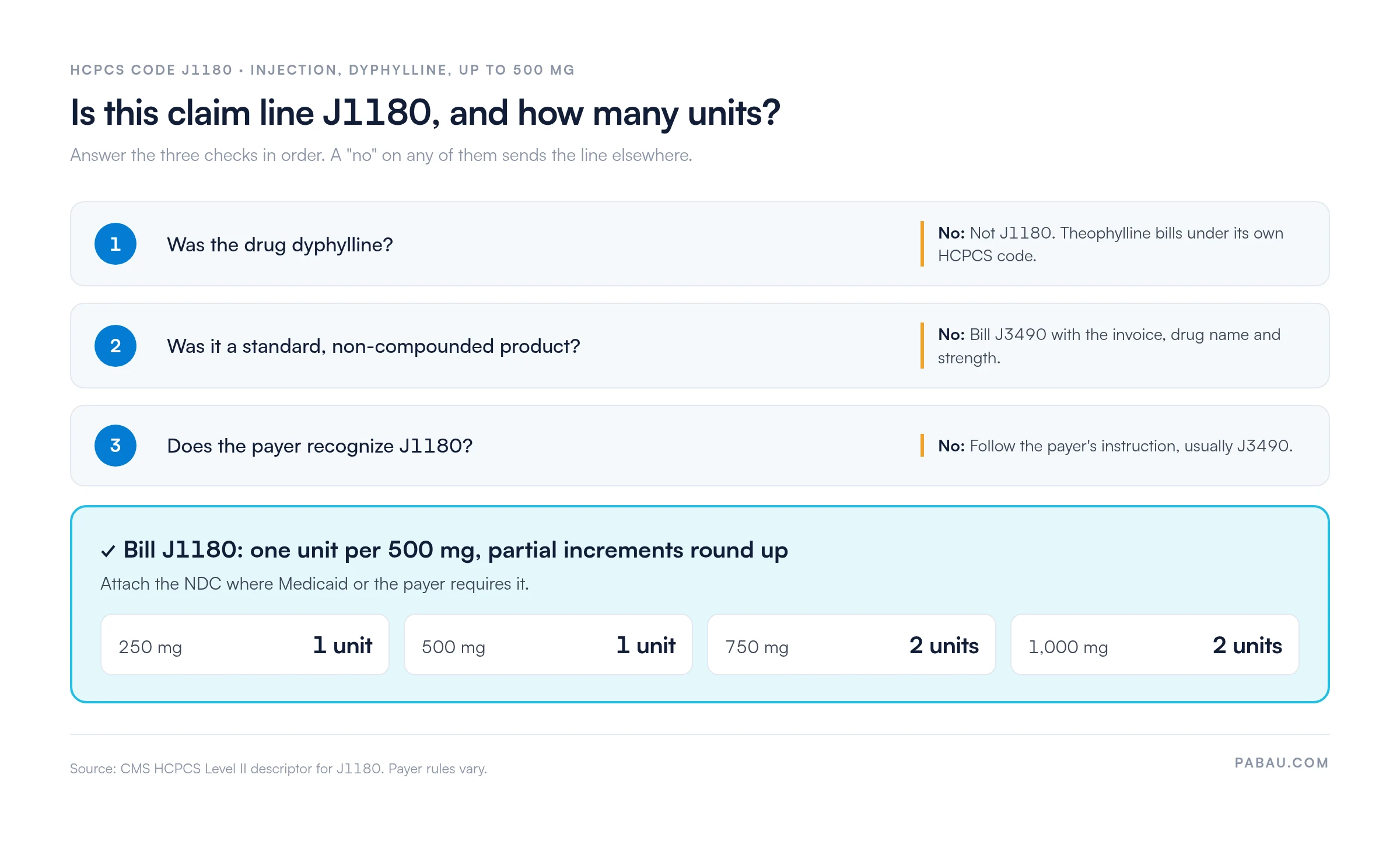
Never substitute J3490 for J1180 on a claim where J1180 is the correct code. Submitting the unclassified code for a drug that has a specific J-code may count as an improper billing practice and could trigger a compliance review. Confirm the applicable code with each payer before switching from J1180 to J3490.
J1180 denials tend to fall into five predictable categories. Sound denial management in healthcare means addressing each one when the claim is created, before any remittance arrives. The table below maps each denial reason to its corrective action.
Reviewing remittance data against medical billing denial codes after every batch submission catches systemic J1180 errors before they pile up into write-offs.
Medicare coverage for J1180 is set by each Medicare Administrative Contractor, which may publish LCDs and billing articles for the drug. These define which diagnoses support medical necessity and what documentation is required. Check the AAPC HCPCS code reference and your MAC’s coverage database for current J1180 policies, because they can differ between MACs.
For Medicaid, coverage varies by state. Some state programs cover dyphylline injection, while others require prior authorization or exclude it entirely. Verify with the applicable state Medicaid agency before billing.
Commercial payer prior authorization (PA) requirements for J1180 change frequently and vary by plan. Given dyphylline’s limited use today, some plans may list it as non-preferred and require PA before any administration. Confirm PA requirements directly with the payer rather than from prior remittance history. Good medical billing compliance means checking the current payer policy before every J1180 encounter.
Every J1180 claim needs a linked ICD-10-CM diagnosis code that shows medical necessity for dyphylline injection. Payers expect a respiratory indication, so a mismatched diagnosis invites a medical necessity denial. The codes below are the usual pairings. Verify them against your MAC’s LCD for the complete accepted list.
R06.2 (wheezing) is a symptom code. Use it only when a definitive respiratory diagnosis has not been established. Once the attending clinician documents asthma or COPD, switch to the specific code, such as J44.1 for a COPD exacerbation. Payers increasingly flag repeated wheezing-only pairings with J1180 as weak medical necessity documentation.
Most J1180 denial causes, from a missing NDC to incorrect units or absent documentation, can be prevented before submission. Pabau’s claims management software catches them while the claim is still in your hands.
For practices administering several injectable drugs alongside dyphylline, keeping clean claim submission in one platform helps. Each J-code’s unit rules, modifiers, and NDC formats then live in one place.
Run a J1180 denial audit each quarter. Pull every J1180 claim from the previous 90 days and sort the denials by reason code. If missing NDCs or incorrect units lead the list, fix point-of-care capture of the dose and NDC first. Billing review comes second.

Pabau pre-fills each claim from the invoice, checks it for missing or invalid details, and tracks it to payment. J1180 errors get caught before the payer sees them.

J1180 is rarely billed now, and that is the reason to treat each claim with care. A payer who seldom sees dyphylline will read the claim closely. The record has to explain why it was chosen over a first-line bronchodilator.
Before your next J1180 claim, confirm your MAC’s current allowance and NDC rule, then build both into the visit workflow. A few minutes at the point of care cost less than a single appeal.
If you want those checks to run before every claim leaves the practice, book a demo to see how Pabau validates and tracks J-code claims.

Need to understand how denial codes map to billing corrections? Denial codes in medical billing maps common CARC and RARC codes to root causes and appeal strategies.
Want a broader view of J-code and HCPCS billing compliance? Medical billing compliance covers the regulatory requirements that govern Part B drug claims.
Looking to understand the end-to-end claim lifecycle? Revenue cycle management explained walks through every stage from eligibility to payment posting.
HCPCS code J1180 is the Level II billing code for “Injection, dyphylline, up to 500 mg.” It is used when a physician administers dyphylline in an outpatient or office setting and bills the drug separately from the professional service. One unit equals up to 500 mg administered.
Bill one unit of J1180 for every 500 mg administered, rounding partial increments up to the next whole unit. A 250 mg dose bills as one unit, and a 750 mg dose bills as two units. Never bill in milligrams directly.
No. Dyphylline and theophylline are distinct drugs with different HCPCS codes. Billing J1180 for a theophylline injection is a coding error with compliance implications. Always bill J1180 for dyphylline only, and check the drug name in the physician order before selecting the J-code.
Use J3490 when the dyphylline formulation is compounded, or when a payer does not recognize J1180 and tells you to use the unclassified code. Never substitute J3490 for J1180 without a payer-specific instruction to do so.
The usual causes are a missing NDC where the payer requires one, wrong unit counts, and a diagnosis that does not support dyphylline. A missing modifier 25 on a same-day E&M also triggers denials. Add JA or JB only for IV or subcutaneous administration when the payer requires a route modifier.
Yes, provided the E&M service is significant and separately identifiable from the drug administration. Add modifier 25 to the E&M code to show it is distinct from the administration service. Without modifier 25, the payer may bundle the E&M into the administration and deny or reduce payment.