CCSD Code H3334: Low anterior resection billing guide
CCSD Code H3334: Definition and clinical scope CCSD Code H3334 covers an open an...

Last Updated: Oct 16, 2026
Billable Code
J0882 is the HCPCS Level II code for injection, darbepoetin alfa, 1 microgram, for patients with end-stage renal disease (ESRD) on dialysis. Each billed unit equals 1 microgram, and darbepoetin given to patients who are not on dialysis is billed with J0881 instead.
Darbepoetin alfa (Aranesp, made by Amgen) is an erythropoiesis-stimulating agent (ESA) used to treat anemia. Its boxed warning reports a greater risk of death and serious cardiovascular events when therapy targets hemoglobin above 11 g/dL. The label calls for the lowest dose that avoids red blood cell transfusions.
Let Pabau's smart automation suggest the right codes, reduce claim denials, and keep your practice compliant—effortlessly.
Automate repetitive tasks and focus on what matters most—your patients.
Reduce coding errors and ensure compliance with the latest regulations.
Clean claims, fewer denials, and faster reimbursements.
Powerful insights and reporting to help your practice thrive.
HIPAA compliant SOC 2 certified GDPR-compliant Trusted by 4,000+ clinics worldwide

J0882 covers darbepoetin alfa injections for ESRD patients on dialysis, while J0881 covers the same drug for patients who are not on dialysis.
Each unit of J0882 equals 1 microgram of darbepoetin alfa, so bill the administered dose in micrograms as units.
Modifier JA (intravenous) or JB (subcutaneous) is required on most J0882 claims, and leaving it off is a common denial cause.
Claims management software such as Pabau flags a missing modifier or diagnosis pairing before a J0882 claim goes out.
HCPCS code J0882 is defined by the Centers for Medicare and Medicaid Services (CMS) as “Injection, darbepoetin alfa, 1 microgram (for ESRD on dialysis).” That parenthetical limits the code to patients with end-stage renal disease (ESRD) who are on dialysis, and it’s what separates J0882 from J0881.
Within the Level II HCPCS codes, J0882 sits in the J0000-J9999 range for drugs administered other than by mouth.
J0882 and J0881 bill the same drug at the same 1-microgram unit. The only difference is patient population. J0881 covers darbepoetin alfa for patients who are not on dialysis, such as cancer patients with chemotherapy-induced anemia. J0882 is only for ESRD patients on dialysis.
Submitting J0882 for a cancer patient who is not on dialysis creates a mismatch against the diagnosis codes and the payer’s eligibility file.
Before selecting the code, confirm two facts from the patient’s record: The confirmed ESRD diagnosis and active dialysis status. Both must appear in the chart and on the claim. If dialysis status is unconfirmed, hold the claim until records are updated rather than guessing.
The ESA J-code family covers multiple drugs and patient populations. Selecting the wrong code within the family triggers the same denial as a wrong-code error anywhere else.
Each unit billed under HCPCS code J0882 equals exactly 1 microgram of darbepoetin alfa. Bill the number of units that equals the total dose administered. A 25 mcg dose is 25 units, and a 60 mcg dose is 60 units. Round to the nearest whole microgram based on the dose given, not the amount drawn up or wasted.
Watch for four common unit errors:
The prescription or medication administration record must specify the dose in micrograms. If the order is written in milligrams, flag it for clinical staff correction before billing. A mg-to-mcg transcription error produces a unit count 1,000 times too small, which triggers an underpayment that may not surface until audit.
HCPCS code J0882 requires a route-of-administration modifier on most claims. The two primary modifiers are JA for intravenous administration and JB for subcutaneous administration. A missing route modifier is a common reason J0882 claims come back denied, and it’s fixable before the claim is created.
Medicare and most commercial payers require JA or JB. Check your payer contract and the applicable Medicare Administrative Contractor (MAC) policy to confirm which modifiers are required in your jurisdiction. Some Medicare Advantage plans impose additional modifier requirements beyond the base Medicare rules.
Medicare coverage for separately billed ESAs is set out in Local Coverage Determinations (LCDs) issued by MACs. Meeting the clinical criteria isn’t enough on its own. They also have to be documented in the chart before the date of service.
No single LCD sets one checklist for J0882. These are typical payer and clinical documentation expectations, so confirm each one against your MAC’s LCD:
Always verify the current LCD version with your MAC before finalizing the coverage checklist. LCD criteria for ESA codes are revised periodically, and the version in effect on the date of service is the one that applies.
For dialysis facilities, ESA payment is bundled into the ESRD PPS rate. There, these checks support the clinical record rather than a separate drug claim.
The 10 and 11 g/dL steps below come from the FDA Aranesp label, not from a single CMS rule. CMS’s ESA claims-monitoring policy uses different cut-offs, and your MAC’s policy decides how hemoglobin affects payment.
The label’s boxed warning reports a greater risk of death and serious cardiovascular events when ESAs target hemoglobin above 11 g/dL. It tells prescribers to use the lowest dose that avoids red blood cell transfusions.
Run a monthly audit of ESA claims against the hemoglobin results in the chart. Flag any administration where Hgb approached or exceeded 11 g/dL without a documented dose reduction or interruption. Then check those claims against your MAC’s ESA policy, which sets the cut-offs that affect payment.
The ICD-10-CM codes on a J0882 claim must confirm both the ESRD diagnosis and active dialysis status. A J0882 claim whose diagnosis codes don’t show dialysis dependence is a coding mismatch. Most claims systems catch it at the edit stage, before adjudication. The standard pairing is N18.6 plus Z99.2 on every claim.
Do not use D63.0 (anemia in neoplastic disease) on a J0882 claim. That code supports J0881 (non-ESRD darbepoetin). Alongside missing modifiers, a mixed-up diagnosis pairing is one of the most frequent reasons J0882 claims are denied.
Medicare fee-for-service does not routinely require prior authorization for J0882 in the ESRD setting. Medicare Advantage plans and commercial payers often impose their own prior authorization (PA) requirements, and these vary by plan and contract year.
A Medicare fee-for-service rule doesn’t carry over to a Medicare Advantage plan automatically. Maintaining medical billing compliance means verifying PA requirements payer by payer at the start of each benefit year.
When a PA is required and not obtained, the resulting denial is rarely recoverable on appeal unless the plan acknowledges an administrative error. Build a pre-authorization workflow that fires automatically for ESA orders before the administration date.
The ESRD Prospective Payment System (PPS) took effect in January 2011. It bundles most drugs that dialysis facilities give ESRD patients into the per-treatment payment rate. Darbepoetin alfa (J0882) is included in that bundle.
A dialysis facility therefore generally cannot bill J0882 separately to Medicare for patients it treats. The drug cost is built into the bundled PPS rate.
The ESRD PPS bundling rules are complex and have been updated since the 2011 effective date. Dialysis facilities and their billing teams should review the current CMS ESRD PPS final rule. Consult your MAC before deciding whether separate billing is allowed for a given service.
Payers typically expect the items below in the patient’s medical record on or before the date of service. Confirm the exact list against your MAC’s LCD and each payer’s policy. Submitting a clean claim for J0882 means the chart supports every field on the claim form before the claim is created.
The superbill or charge capture document for ESA claims should include a documentation confirmation checkbox that the biller or coder reviews before submission. That review catches a missing lab or order before it turns into a documentation denial.
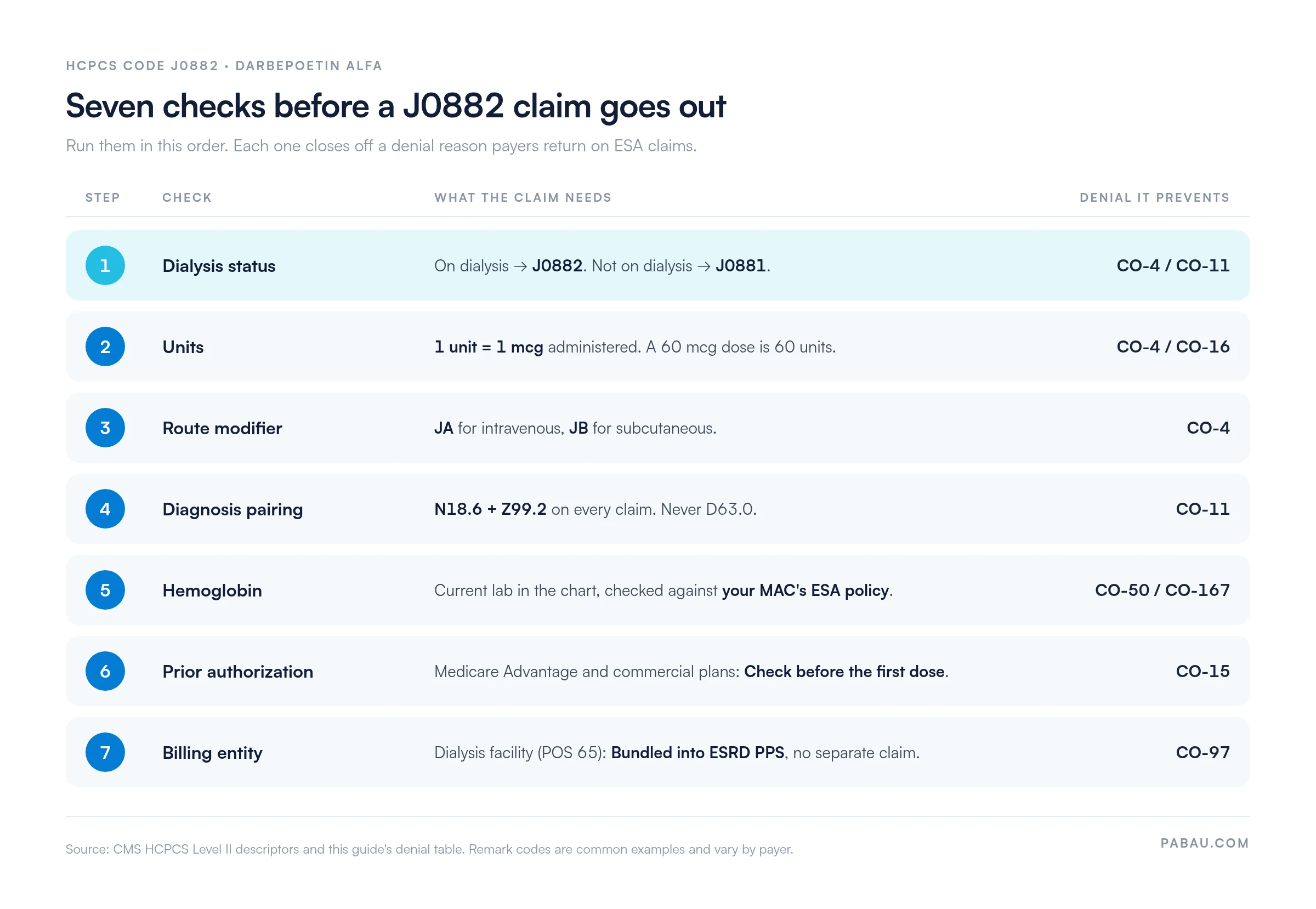
J0882 denials cluster around a small number of recurring errors. Good denial management in healthcare starts by finding the pattern behind repeated denials. The table below maps each denial type to its prevention step and the most common remark code you will see on an Explanation of Benefits.
Put in order, those prevention steps become seven checks you can run on every J0882 claim before it goes out.
Where J0882 is separately payable under Medicare Part B, mostly outside the ESRD PPS bundle, payment follows ASP+6%. That’s the average sales price of darbepoetin alfa for the billing quarter, plus 6%.
This is the statutory rate under Section 1847A of the Social Security Act, and it’s the basis for most Medicare Part B drug payments.
The ASP for darbepoetin alfa changes quarterly. CMS publishes the ASP Drug Pricing File each quarter, typically 30 days before it takes effect. Download the current quarter’s file from the CMS ASP pricing files page. Never rely on a static rate from a prior quarter or a third-party reference that may not have been updated.
For ESRD patients whose darbepoetin is administered at a dialysis facility, the bundled ESRD PPS composite rate applies. The dialysis facility’s cost for the drug is built into the PPS rate rather than reimbursed separately per claim. Separately payable contexts include some physician office administrations and specific hospital outpatient settings. Confirm the applicable payment pathway with your MAC before billing.
The denials covered above usually start at charge capture. A biller picks J0881 for a dialysis patient, leaves off the JA or JB modifier, or sends N18.6 without Z99.2.
Pabau, the practice management platform we build, checks each claim before it leaves the practice. Its claims management software flags a missing modifier or a diagnosis that doesn’t pair with the code, while the biller can still fix it.
That keeps corrections at the front of the process. Your team spends less time on rework and appeals, and ESA claims get paid without a second submission.

Pabau flags a missing modifier or diagnosis pairing before your J0882 claims go out, so fewer come back denied. See how it works for dialysis and infusion practices.

Confirm dialysis status first on a J0882 claim. Once the chart shows N18.6, Z99.2 and active dialysis, the code, the microgram units and the JA or JB modifier follow from the order.
The harder calls sit with payment. A dialysis facility’s darbepoetin is bundled into the ESRD PPS rate, and hemoglobin cut-offs come from your MAC’s policy rather than the drug label. Check both before you build billing rules around them.
If your team bills ESAs every week, move these checks to charge capture so a denial is never the first warning. Book a demo to see how Pabau flags missing modifiers and diagnosis pairings on drug claims before they go out.

Need to understand how claims move through the clearinghouse? Medical claims clearinghouse explained covers how claims are routed, validated, and returned for correction before payer adjudication.
Seeing repeat denials across multiple drug codes? Denial codes in medical billing maps the most common CARC codes to their root causes and prevention steps.
Want to understand the 837P claim file your system generates? 837 file structure and submission explains the electronic data format that carries J0882 claims from your practice to the payer.
Moving a dialysis patient to a biosimilar? HCPCS code Q5105 covers epoetin alfa-epbx (Retacrit) for ESRD patients on dialysis.
Billing epoetin alfa for a patient who isn’t on dialysis? HCPCS code J0885 is the epoetin alfa code for non-ESRD use.
HCPCS code J0882 covers an injection of darbepoetin alfa (Aranesp), billed at 1 microgram per unit, for patients with end-stage renal disease (ESRD) on dialysis. Darbepoetin given to patients who are not on dialysis is billed with J0881 instead.
J0881 and J0882 both bill darbepoetin alfa at 1 microgram per unit, but they apply to different patient populations. J0881 is for non-ESRD patients (such as those with chemotherapy-induced anemia). J0882 is exclusively for ESRD patients on dialysis. The code selection depends entirely on the patient’s dialysis status, not on the drug dose or route.
Bill 25 units. Each unit of J0882 equals 1 microgram of darbepoetin alfa, so the number of units billed equals the dose in micrograms. Bill the administered dose, not the vial size or the prescribed dose if a partial vial was used.
The standard pairing is N18.6 (end-stage renal disease) as the primary diagnosis and Z99.2 (dependence on renal dialysis) as a secondary code. D63.1 (anemia in chronic kidney disease) may be added as a supporting diagnosis. Do not use D63.0 (anemia in neoplastic disease) on a J0882 claim; that diagnosis supports J0881.
Medicare fee-for-service does not routinely require prior authorization for J0882 in the ESRD setting. However, Medicare Advantage plans and commercial payers commonly impose their own PA requirements. Always verify with the specific plan before administering the drug. A missing PA on a plan that requires one usually leads to a denial you can’t recover.
No single CMS rule sets one level. The FDA Aranesp label says to start therapy in dialysis patients when hemoglobin is below 10 g/dL. It says to reduce or interrupt the dose when hemoglobin approaches or exceeds 11 g/dL. CMS monitors ESA claims under its own policy, so check your MAC’s policy for the cut-offs that affect payment.
Generally no. Darbepoetin alfa is included in the ESRD Prospective Payment System (PPS) bundle for dialysis facilities. The drug cost is built into the per-treatment rate. Separate billing by the dialysis facility to Medicare is not permitted in most circumstances. Separate billing may apply in certain physician office or hospital outpatient contexts. Confirm the applicable payment pathway with your MAC.