CPT Code 51705: Change of cystostomy tube, simple
CPT Code 51705 at a glance CPT Code 51705 reports a simple change of a cystostom...

Last Updated: Oct 16, 2026
V2206 is the HCPCS Level II code for spherocylinder, bifocal, plano to plus or minus 4.00d sphere, over 6.00d cylinder, per lens. Its defining trait is a cylinder of more than 6.00 diopters, the top astigmatism tier in the low sphere band.
V2206 sits in the V2200-V2299 bifocal series, where codes are tiered by cylinder power within each sphere band. A cylinder of 6.00D or less drops the lens to V2203, V2204, or V2205. A sphere past 4.00D with the same high cylinder makes it V2210, not V2207. Most V2206 denials trace to that tier choice, a missing cylinder value in the prescription, or a Medicare claim without the post-cataract link.
Let Pabau's smart automation suggest the right codes, reduce claim denials, and keep your practice compliant—effortlessly.
Automate repetitive tasks and focus on what matters most—your patients.
Reduce coding errors and ensure compliance with the latest regulations.
Clean claims, fewer denials, and faster reimbursements.
Powerful insights and reporting to help your practice thrive.
HIPAA compliant SOC 2 certified GDPR-compliant Trusted by 4,000+ clinics worldwide

HCPCS code V2206 covers one spherocylinder bifocal lens with plano to ±4.00D sphere and more than 6.00D of cylinder, billed per lens.
The V2203–V2210 codes are tiered by cylinder power within each sphere band, so the cylinder value decides the code.
A V2206 lens whose sphere moves past ±4.00D, with cylinder still over 6.00D, becomes V2210, not V2207.
Medicare Part B covers V2206 only after cataract surgery with intraocular lens (IOL) insertion, and routine vision care is excluded.
Practice management software like Pabau keeps the prescription, lens order, and claim in one record, so power-range mismatches surface before submission.
HCPCS code V2206 is the Level II code for a spherocylinder bifocal lens with plano to ±4.00D sphere and over 6.00D cylinder, per lens. The official descriptor reads “Spherocylinder, bifocal, plano to plus or minus 4.00d sphere, over 6.00d cylinder, per lens.”
Spherocylinder means the lens corrects sphere and cylinder (astigmatism) in the same optic. Bifocal means it carries a reading segment. The cylinder is what sets V2206 apart: more than 6.00 diopters is the top cylinder tier in the low sphere band.
Each unit of V2206 represents one lens. When billing both eyes, submit two line items, one with the RT (right eye) modifier and one with LT (left eye). The code is active for 2026 billing and its descriptor has not changed in recent annual HCPCS updates.
V2206 covers a single spherocylinder bifocal lens for a prescription with plano to ±4.00D sphere and more than 6.00D of cylinder. The lens may be glass or plastic unless a payer contract restricts the material. Coatings, tints, and UV treatments are not part of V2206 and may need separate add-on codes.
What V2206 does not cover:
When the prescription carries no reading segment, the lens is coded from the V2100–V2199 single-vision range instead. A sphere of ±4.25D to ±7.00D with 2.12D to 4.00D of cylinder bills as V2108. A lab order for a variable asphericity bifocal moves the lens to V2430 in the V2410–V2499 range.
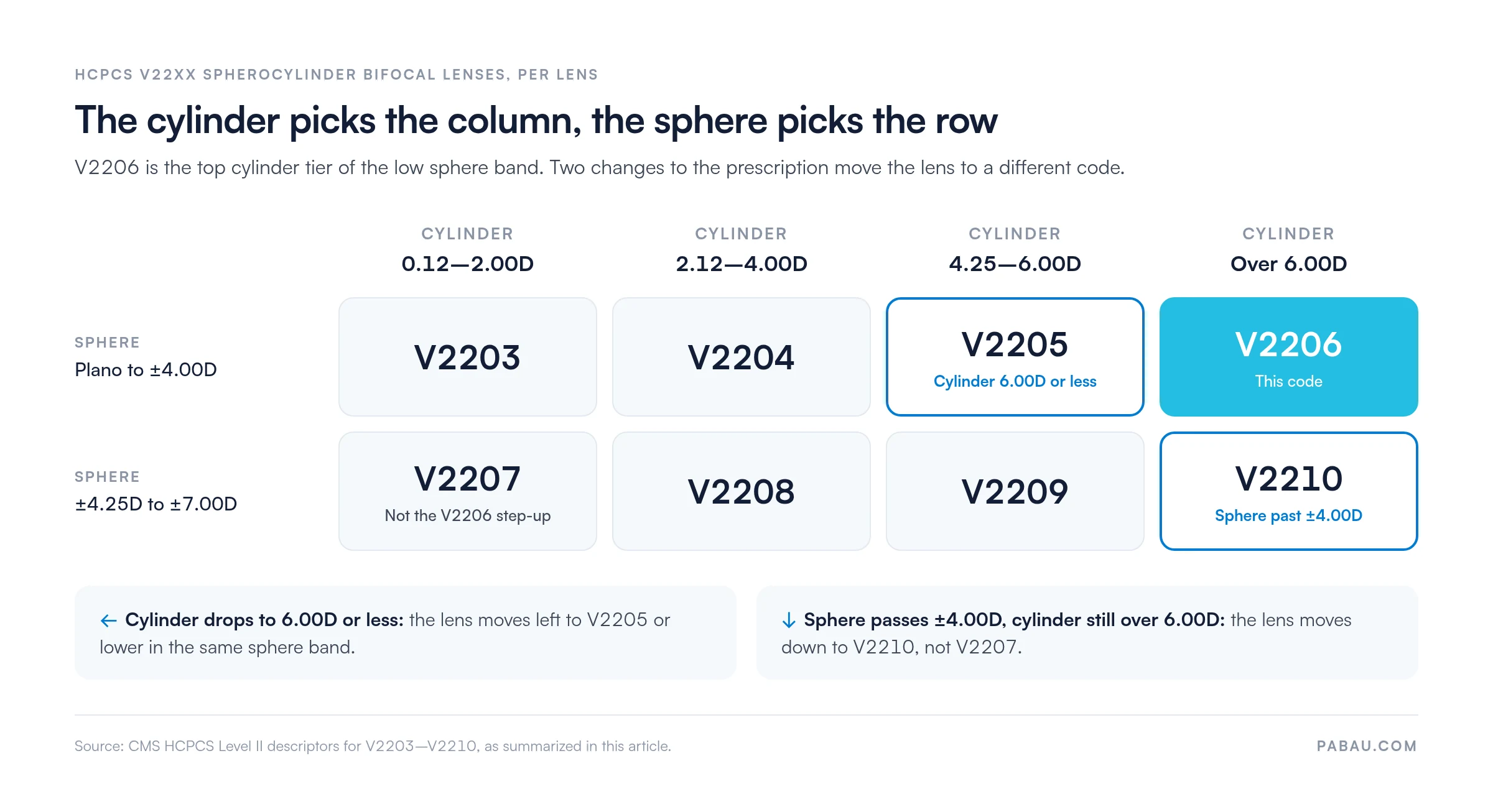
Because V2206 is defined by its cylinder, two checks decide the code: the cylinder value and the sphere band. A cylinder at or under 6.00D belongs to a lower tier. A sphere past ±4.00D moves the lens into the next band.
The V2203–V2210 codes are tiered by cylinder power within each sphere band. The same four cylinder tiers repeat in each band: 0.12–2.00D, 2.12–4.00D, 4.25–6.00D, and over 6.00D.
V2206 is the fourth tier of the plano to ±4.00D band. In the ±4.25D to ±7.00D sphere band, the 2.12D to 4.00D cylinder tier is V2208.
Two changes take a lens out of V2206. If the cylinder drops to 6.00D or less, the lens moves down to V2205 or lower in the same band. If the sphere passes ±4.00D and the cylinder stays over 6.00D, the lens becomes V2210, not V2207.
Confirm the sphere and cylinder boundaries against the AAPC HCPCS code database for the current year, since CMS occasionally refines descriptors in annual updates. Always use the most current CMS Alpha-Numeric HCPCS file as the authoritative source.
Medicare Part B covers V2206 only after cataract surgery in which an intraocular lens (IOL) was inserted. Routine vision care, including standard eyeglasses for refractive error, is explicitly excluded from Medicare coverage under Chapter 16 of the Medicare Benefit Policy Manual. The post-cataract exception exists under Section 1861(s)(8) of the Social Security Act.
Run insurance eligibility verification before dispensing lenses under Medicare. A coverage check confirms whether the patient’s record shows a qualifying cataract surgery. It stops a claim that Medicare would deny as non-covered routine vision.
Key Medicare coverage conditions for V2206:
If the patient has not had cataract surgery with IOL, Medicare denies a V2206 claim as a non-covered benefit. Medical necessity documentation does not change that outcome. No appeal will reverse a denial when the statutory exclusion applies.
Optical practices that accept Medicare should train front-desk and billing staff to verify this trigger when the lenses are dispensed, before the claim is built.
Medicaid coverage for V2206 varies by state. Some state Medicaid programs cover eyeglass lenses as a standard adult vision benefit. Others limit coverage to children or specific medical indications, and some exclude routine eyeglasses entirely for adults. There is no federal rule that standardizes Medicaid eyeglass coverage across states.
What to check before billing V2206 to Medicaid:
Veterans Affairs (VA) uses HCPCS codes including V2206 for optical benefits delivered through the Community Care program. VA optical billing follows VA-specific fee schedules and requires authorization through the referring VA facility before the community provider may dispense.
Commercial payers typically cover post-cataract eyeglasses similarly to Medicare but apply their own frequency limits, plan-tier rules, and PA requirements. Verify coverage per payer contract before dispensing.
CMS sets the Medicare allowable for V2206 through the annual Durable Medical Equipment, Prosthetics, Orthotics, and Supplies (DMEPOS) fee schedule. It is not priced on the Physician Fee Schedule. DMEPOS rates are set by state, so the allowable in Mississippi differs from the rate in New York.
Use the CMS DMEPOS fee schedule files to find the current rate for V2206 in your state. Rates are updated each January 1 and should be re-verified at the start of each calendar year. Any dollar figure printed here would age quickly, so take current amounts from CMS directly.
After a claim pays, review the electronic remittance advice (ERA) to confirm the allowed amount, any patient cost-sharing applied, and whether any adjustments were taken. Posting ERA data correctly means the patient is billed for what the payer adjudicated, instead of an estimated co-pay. Payer contractual adjustments for V2206 must be written off and never billed to the patient.
A V2206 claim needs documentation that establishes three things. The prescription must place the lens in V2206, the lens must have been dispensed, and the ordering provider must be identified. Missing any one of them is a denial trigger that a medical billing compliance process should catch before submission.
Required documentation elements:
Opticians may dispense eyeglasses based on a valid prescription from a licensed optometrist or ophthalmologist. The dispensing optician does not prescribe, so the prescribing clinician is identified separately on the claim. Some payers require the ordering and dispensing provider to be enrolled with the payer independently. Confirm enrollment status for both providers before billing.
The diagnosis code paired with V2206 decides whether the claim is covered or denied for medical necessity. For Medicare, the diagnosis must show the post-cataract context. A refractive diagnosis on its own signals routine vision care, which Part B excludes.
Pair the aphakia or IOL code with the refractive diagnosis on Medicare claims. The high cylinder that defines V2206 is documented by the astigmatism code, while the post-cataract code establishes coverage. Commercial and Medicaid plans may accept the refractive code alone, so check the plan rules.
Most V2206 denials fall into a small number of recurring categories. Each one maps to a check that billing staff can run before the claim goes out. Reading the common denial codes alongside these V2206 triggers makes remittance reasons faster to act on.
Check the segment type as well as the power when a wrong tier denial comes back. A single-vision lens in the ±4.25D to ±7.00D band with over 6.00D cylinder bills as V2110 instead.
When a V2206 claim is denied, classify the denial before you correct or appeal it. A denial is clinical (wrong eligibility), administrative (missing documentation), or technical (code or modifier error). Each category requires a different corrective action and a different appeal pathway.
Billing V2206 correctly requires confirming eligibility, selecting the right code, applying the correct modifier, and attaching the right diagnosis before the claim leaves the practice. Optical claims mix payer rules that differ from standard professional fee claims, so work through the steps below in order.
RT and LT are the most commonly required modifiers when billing V2206 for both eyes. Billing them as two line items (V2206-RT and V2206-LT) lets the payer adjudicate each lens independently. It also prevents a duplicate-claim denial when two units of the same code appear on one claim.
Some payers also require modifiers for specific lens treatments or for claims submitted by a supplier versus a physician practice. Confirm modifier requirements with the specific MAC or commercial payer contract before submitting.
Build a five-point V2206 check into your optical billing workflow. Confirm the sphere is plano to ±4.00D and the cylinder is over 6.00D. Confirm a signed prescription is on file, and verify post-cataract eligibility for Medicare patients. Apply RT and LT modifiers, and obtain prior authorization where the payer requires it. Running this check before submission removes the most common V2206 denial triggers in one step.
Medicare does not require prior authorization for V2206 eyeglass lenses dispensed following cataract surgery. However, Medicaid programs in many states require PA for adult eyeglass benefits. Some commercial plans also require pre-authorization for optical dispensing, whether or not the service follows surgery.
PA requirements vary enough by payer that no universal rule applies. Billing staff should check each payer’s provider portal or call the payer’s optical benefits line before dispensing when the patient’s plan type is unfamiliar.
When PA is required, the authorization number must appear on the claim. A claim submitted without a required PA will be denied, and the corrective action (retro-authorization or appeal) adds days to the payment cycle. A PA verification step at the point of dispensing prevents those delays.
In many optical practices, the prescription sits in the exam record and the lens order sits with the dispensing optician. The code is then chosen at billing. With V2206 that split is risky, because a cylinder misread by a quarter diopter changes the code. The error surfaces weeks later on a remittance advice.
Practice management software like Pabau keeps the prescription, the lens order, and the claim in one patient record. The HCPCS code and the RT or LT modifier are assigned against the recorded sphere and cylinder values. Eligibility checks and claims management software flag missing documentation before the claim leaves the office.
The outcome is fewer V2206 claims denied for the wrong tier, a missing modifier, or an absent cataract linkage. Billing staff fix the mismatch before submission, which is faster than appealing a denial afterward.

Pabau helps optical and ophthalmic practices check eligibility, manage claims, and flag a missing prescription or cataract link before a claim leaves the office. See how it works in a live demo.

V2206 is simple to code once the cylinder is read first. A cylinder over 6.00D in the plano to ±4.00D band is V2206, and the same cylinder past ±4.00D sphere is V2210.
The denials that cost optical practices the most time are avoidable ones. They come from a tier chosen by sphere alone, a Medicare claim without the cataract link, or a prescription missing at submission.
Move the cylinder check and the post-cataract check to the point of dispensing, and most V2206 rework never reaches the billing team. Book a demo to see how Pabau helps optical practices submit accurate lens claims the first time.

Need a structured approach to reducing claim rejections? Denial management in healthcare covers the end-to-end process for identifying, correcting, and appealing denied claims across payer types.
Unsure how the 837P transaction works for optical claims? 837 file submission explains the electronic claim format, required fields, and how to verify claim acceptance before payment.
Want to understand how remittance data feeds your revenue cycle? Electronic remittance advice breaks down how to read ERA files and post payments accurately after V2206 claims adjudicate.
Building the claim from a paper or PDF form? Superbill walks through the fields a superbill needs and how they carry onto the claim.
Want more lens claims paid on first submission? Clean claim explains what payers check at the front end and how to pass those edits the first time.
HCPCS code V2206 is the Level II code for one spherocylinder bifocal lens with plano to ±4.00D sphere and over 6.00D cylinder, billed per lens. CMS maintains it in the V-series for vision services, and it is active for 2026 billing.
V2206 and V2207 differ in both sphere band and cylinder tier. V2206 is plano to ±4.00D sphere with over 6.00D cylinder. V2207 is ±4.25D to ±7.00D sphere with 0.12D to 2.00D cylinder. A V2206 lens whose sphere passes ±4.00D, with cylinder still over 6.00D, becomes V2210, not V2207.
Yes, but only after cataract surgery in which an intraocular lens (IOL) was inserted. Medicare Part B excludes routine vision care including standard eyeglasses for refractive error. The post-cataract exception under Section 1861(s)(8) of the Social Security Act allows one pair of conventional eyeglasses or contact lenses per qualifying surgery.
Required documentation includes a signed prescription with sphere and cylinder values, proof that the lens was dispensed, and the dispensing date. The claim also needs the ordering and dispensing providers’ NPIs. For Medicare claims, documentation must also link the dispensing to a qualifying cataract surgery with IOL insertion.
Medicare does not require prior authorization for V2206 following cataract surgery. Many state Medicaid programs and some commercial plans do require PA for optical dispensing. PA requirements are payer-specific. Verify with the patient’s plan before dispensing to avoid a denial for missing authorization.
Generally yes, but payer rules differ. Some payers bundle the dispensing visit with the eye exam when both fall on the same date. Others allow the exam (billed with the appropriate eye exam CPT code) and the V2206 lens on the same claim. Confirm the bundling rules in the payer contract before billing both on one date.