

CCSD code G5100: Bypass of duodenum billing guide
CCSD code G5100 bills a bypass that leaves the duodenum in place CCSD code G5100...

Last Updated: Oct 16, 2026
88291 is the CPT code for cytogenetics and molecular cytogenetics, interpretation and report. It covers a physician or other qualified healthcare professional reviewing completed chromosome, FISH or other cytogenetic study results and signing a written interpretation report.
The laboratory study itself is billed separately under a code in the 88230-88299 range, such as 88230 or 88271. 88291 is a professional-component-only service worth 0.99 total RVUs under the 2026 Medicare Physician Fee Schedule.
Let Pabau's smart automation suggest the right codes, reduce claim denials, and keep your practice compliant—effortlessly.
Automate repetitive tasks and focus on what matters most—your patients.
Reduce coding errors and ensure compliance with the latest regulations.
Clean claims, fewer denials, and faster reimbursements.
Powerful insights and reporting to help your practice thrive.
HIPAA compliant SOC 2 certified GDPR-compliant Trusted by 4,000+ clinics worldwide

CPT 88291 covers the interpretation and signed written report of a cytogenetic study, not the laboratory procedure itself.
Bill 88291 alongside the underlying cytogenetics code, such as 88230 or 88271, because the two capture separately reportable services.
Without a signed interpretation report there is no billable 88291 service, so payers deny or recoup claims that lack one.
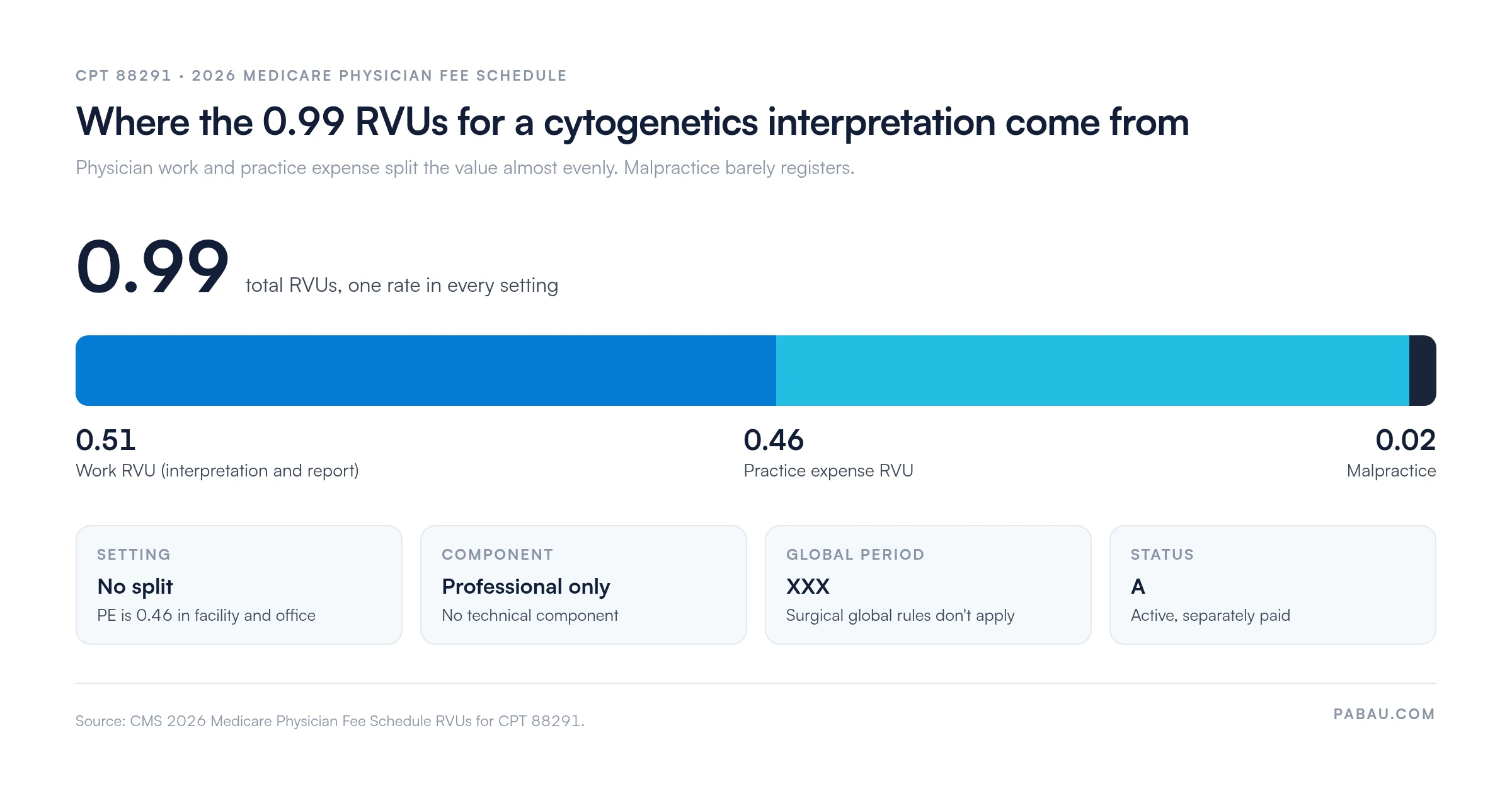
Under the 2026 Medicare Physician Fee Schedule, 88291 carries 0.99 total RVUs, with a 0.51 work RVU and no facility split.
Pabau, the practice management platform we build, submits claims through Claim.MD, runs eligibility checks and flags denied claims for rework.
CPT Code 88291 is defined by the American Medical Association as “cytogenetics and molecular cytogenetics, interpretation and report.” The service covers a physician or other qualified healthcare professional’s review of completed cytogenetic study results and preparation of a written interpretation report. It does not include any laboratory work.
88291 is the professional interpretation and documentation service. The chromosome analysis, FISH probe or other cytogenetic study is reported separately under the appropriate code in the 88230-88299 family. Both codes appear on the same claim when the pathologist or geneticist performs both components.
88291 covers the full interpretation and report service. The interpreting provider reviews the cytogenetic data, reaches a clinical conclusion and signs a written report that goes into the medical record. That signed report is what the payer pays for, so a claim without one has no service behind it.
The code’s exclusions matter as much as its scope:
The boundary between 88291 and the molecular pathology codes (81200-81479) needs the most care. Say a genetics practice orders a karyotype (88230) and a chromosomal microarray (81229) for the same patient. The 88291 interpretation applies to the karyotype only. 81229 already includes its own interpretation and report, so the array needs no extra interpretation code.
A billable 88291 service needs documented evidence of a completed interpretation. The interpreting specialist often works outside the ordering practice, so the record has to link the order, the study and the report. Every element below should appear in the medical record before submission.
88291 is a professional interpretation by a physician or other qualified healthcare professional. Medicare does not enroll genetic counselors as billing providers, so genetic counselor billing depends on payer policy and state law. Confirm with each commercial payer before a counselor bills under their own NPI.
The table below sets 88291 beside the study codes it is billed with. Embryo and fertility testing uses lab codes outside this family, covered in our guide to reproductive genetics procedure codes.
Three codes get mixed up with 88291 more than others. The study and its interpretation are clinically linked but billed as separate services, which is where the confusion starts.
The 88291 vs. 81229 mix-up carries the most risk. Both are ordered to evaluate chromosomal abnormalities, but they follow different coding pathways. Microarray (81229) is a molecular pathology service, while karyotype and FISH studies (88230-88280) are cytogenetic procedures. Adding 88291 to a microarray claim invites a denial or a later audit finding.
Under the 2026 Medicare Physician Fee Schedule, CPT Code 88291 carries 0.99 total RVUs. The 0.51 work RVU reflects interpretation time only, because the laboratory study is paid under its own code. Look up your locality rate with the CMS Physician Fee Schedule lookup tool or the FastRVU 2026 lookup tool. The breakdown below shows how that total splits.
Commercial rates for 88291 vary by contract. Some payers pay a percentage of Medicare, while others negotiate specialty-specific rates. Check each contracted rate in your payer agreements before assuming it matches Medicare.
Compare your contracted 88291 rates with the current Medicare Physician Fee Schedule national rate once a quarter. A commercial payer paying below Medicare gives you a concrete figure to raise at renegotiation.
Some commercial payers require prior authorization for cytogenetic testing, and their rules vary. Running insurance eligibility verification before the study is ordered lowers the risk of submitting a non-covered claim.
Medical necessity for 88291 typically requires documentation of one of these clinical indications:
ICD-10-CM codes that often support 88291 medical necessity include the following.
In a developmental delay workup, F79 fits only while the record leaves the degree of intellectual disability unstated. Once the provider documents a mild to profound severity, code F70-F73 instead.
Check individual payer policies before assuming coverage. Medicare Administrative Contractors (MACs) such as Novitas Solutions and Palmetto GBA publish Local Coverage Determinations (LCDs). These list the ICD-10 codes each contractor accepts for genetic testing services. Refer to the AAPC’s CPT coding resources for crosswalk guidance between cytogenetics codes and their supported diagnosis codes.
Each denial below traces back to a documentation or code-pairing rule covered earlier, so each one can be caught before submission. When a denial does arrive, our guide to medical billing denial codes decodes the reason code. Clear denial management workflows then get the claim corrected and resubmitted.
CPT 88291 and the underlying procedure codes represent distinct services and are separately reportable. The interpretation (88291) and the chromosome analysis or FISH procedure (88230-88280) capture different work products. Both may appear on the same date of service without triggering a National Correct Coding Initiative (NCCI) bundling edit.
However, only one unit of 88291 is billable per patient encounter. Say a genetics practice reviews a karyotype and a FISH study for the same patient on the same date. One interpretation report covering both studies is the right documentation. Billing two units of 88291 will generate an MUE (Medically Unlikely Edit) denial from Medicare. Your superbill generation workflow should flag a second 88291 unit before the claim goes out.
Check five points on every 88291 claim before batch submission. (1) The report is signed and filed. (2) The ordering provider’s NPI is in Box 17. (3) The underlying cytogenetic study code is billed. (4) The ICD-10 code matches your MAC’s LCD. (5) A PA number is documented where the payer requires one.
Every 88291 claim needs a signed report, the ordering provider’s NPI and a diagnosis code that meets the payer’s policy. Tracked by hand across spreadsheets and inboxes, each one is a point where a claim can stall before it reaches the payer. Claims management software catches those problems while the claim is still being prepared.
Pabau’s billing tools send claims through Claim.MD, our US clearinghouse partner, to thousands of US insurance payers. Your team can run 270/271 eligibility checks before the study is ordered, and electronic remittance advice shows what each payer paid.
Denied claims are flagged for rework, and denial tracking shows which 88291 claims came back. Your billing team corrects and resubmits them while the report and the order are still easy to find. Over time, that supports steadier revenue cycle management for the practice.

Pabau submits claims through Claim.MD, runs eligibility checks before the visit and flags denied 88291 claims for rework. Your team spends less time chasing cytogenetics claims.

Treat the signed interpretation report as the anchor of every 88291 claim. If the report isn’t signed, dated and tied to a specific study, hold the claim until it is.
At 0.99 total RVUs, 88291 is a modest line on any claim, so repeated rework on denials quickly eats into what it earns. Checking the report, the study code and the diagnosis before submission costs far less than an appeal.
Book a demo to see how Pabau’s eligibility checks and denial tracking keep your cytogenetics claims moving.

Need to understand how clearinghouse submission works for lab claims? Medical claims clearinghouse explained covers how 837P claims travel from practice to payer and where cytogenetics claims commonly stall.
Building a denial reduction strategy for your genetics practice? Denial codes in medical billing decodes the CARC reason codes your 88291 appeals will reference.
Want cleaner claims across your full lab code set? What makes a clean claim outlines the pre-submission criteria that keep cytogenetics and other specialty claims out of the denial queue.
CPT code 88291 covers a physician or other qualified healthcare professional’s interpretation of cytogenetic study results and the written report. It does not cover the laboratory procedure itself. The karyotype, FISH probe or chromosome analysis is reported under the appropriate code in the 88230-88299 range and billed separately.
Under the 2026 Medicare Physician Fee Schedule, 88291 carries 0.99 total RVUs: 0.51 work, 0.46 practice expense and 0.02 malpractice. Medicare multiplies those RVUs by the conversion factor and adjusts them for your geographic practice cost index (GPCI). Check your locality rate in the CMS Physician Fee Schedule lookup tool, because rates change every year. Commercial rates depend on each payer contract.
Medicare does not require prior authorization for 88291 itself, and commercial payer rules vary. The underlying cytogenetic study may need authorization under a payer’s genetic testing policy. Check each payer before the study is ordered, because an approved study is often what gets the interpretation claim accepted.
The usual triggers are a missing signed interpretation report, no ordering provider NPI on the claim, or no matching cytogenetic study code for that date. A diagnosis code that fails the payer’s medical necessity policy, or a missing prior authorization, also leads to denials. Fixing these before submission cuts rework.



