

CCSD code G5100: Bypass of duodenum billing guide
CCSD code G5100 bills a bypass that leaves the duodenum in place CCSD code G5100...

Last Updated: Oct 16, 2026
A4606 is the HCPCS Level II code for an oxygen probe for use with an oximeter device, replacement. It covers the sensor that clips or wraps onto a finger, toe or earlobe and sends a home pulse oximeter its oxygen saturation reading.
Medicare does not pay for it. The DME MAC oxygen policy article (A52514) denies oximeters and replacement probes as non-covered monitoring devices. Payment, where it exists, comes from Medicaid or commercial plans, each with its own unit limits.
Let Pabau's smart automation suggest the right codes, reduce claim denials, and keep your practice compliant—effortlessly.
Automate repetitive tasks and focus on what matters most—your patients.
Reduce coding errors and ensure compliance with the latest regulations.
Clean claims, fewer denials, and faster reimbursements.
Powerful insights and reporting to help your practice thrive.
HIPAA compliant SOC 2 certified GDPR-compliant Trusted by 4,000+ clinics worldwide

HCPCS code A4606 is a replacement oxygen probe for a pulse oximeter, the sensor that sends the device its saturation reading.
A4606 covers the probe alone, while the oximeter itself is billed under E0445.
Medicare denies A4606 as non-covered because the DME MAC oxygen policy treats oximeters and their probes as monitoring devices.
Medicaid programs and commercial plans that pay for A4606 set their own unit limits, modifiers and prior authorization rules.
A4606 has no Medicare fee schedule amount, so each payer’s own fee schedule sets what a replacement probe pays.
HCPCS code A4606 is the HCPCS Level II code for a replacement oxygen probe used with an oximeter device. CMS maintains the code, and its official long descriptor reads Oxygen probe for use with oximeter device, replacement.
The probe is the sensor that clips or wraps onto a finger, toe or earlobe. It shines light through the tissue and passes the oxygen saturation reading to the oximeter. Because the probe measures oxygen and delivers none, the code never describes a mask.
You can check the descriptor against your claim on the AAPC A4606 code page. The rest of this guide covers who pays for the probe and how to document it.
A4606 covers one item: a probe that replaces the original sensor on a pulse oximeter the patient already has. Reusable clip probes and single-patient adhesive probes both report under this code. Some Medicaid programs tell the two apart with a modifier.
Several items are often coded as A4606 by mistake. Each one has its own code:
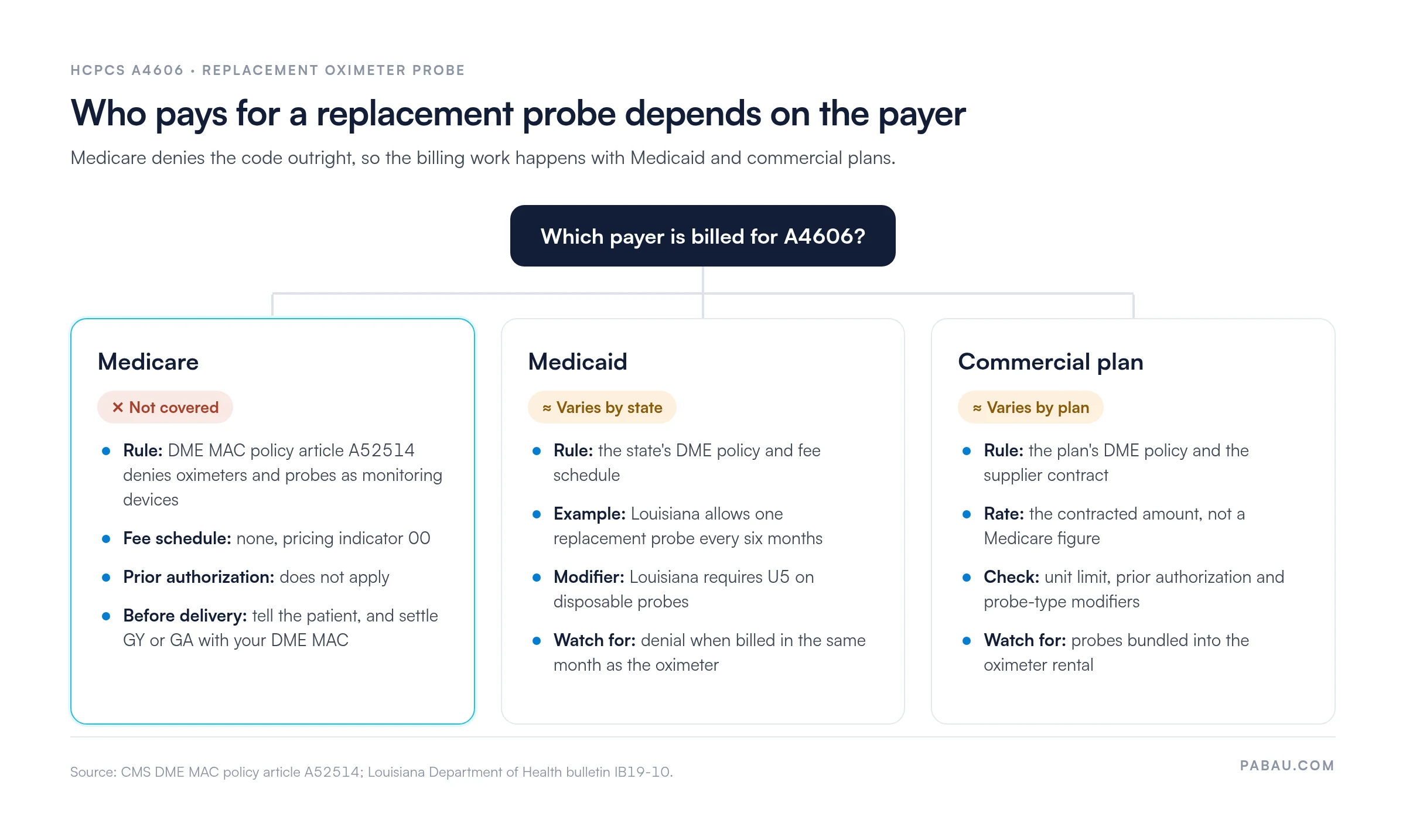
Medicare does not cover A4606. The DME MAC Oxygen and Oxygen Equipment policy article (A52514) states that oximeters (E0445) and replacement probes (A4606) will be denied as non-covered. The reason it gives is that they are monitoring devices that provide information to the treating practitioner.
CGS and Noridian publish the same article, so the rule applies in all four DME MAC jurisdictions. It holds whether or not the patient qualifies for home oxygen. A patient on rented oxygen equipment still has no Medicare benefit for the probe.
Prior authorization: Medicare prior authorization does not apply to A4606, because there is no covered benefit to authorize.
When a Medicare patient still needs a probe: Tell the patient before delivery that Medicare will not pay. If the patient also has Medicaid or a supplemental plan, the Medicare denial is usually the first step toward the secondary claim.
Medicaid programs and commercial plans decide coverage for A4606 on their own terms. Several state Medicaid programs pay for replacement probes when they also cover home pulse oximetry. Commercial plans follow their own DME policy and the supplier contract.
Louisiana Medicaid shows how specific those rules can get. Its 2019 informational bulletin on oxygen probes limits replacement probes to one every six months and requires modifier U5 on disposable probes. It also denies probes billed in the same month as the pulse oximeter.
Before you supply a probe, check these points in the payer’s policy:
Payers that cover A4606 want proof that the patient has a covered oximeter and needs a new probe for it. Keep these records on file before the claim goes out:
The last-supplied date matters most. Unit limits run over a set window, so that date decides whether the next claim falls inside the limit.
No modifier is needed to describe the probe itself. The modifiers that matter decide who carries the cost when Medicare denies the claim, plus any that a Medicaid program adds.
A52514 denies the probe as non-covered without applying a medical-necessity test, which points to GY. Confirm the choice with your DME MAC before you bill, because the modifier decides whether the patient or the supplier pays.
Medicare publishes no covered diagnosis list for A4606, because it does not pay the code. Medicaid and commercial payers tie the probe to the reason for home oximetry. The codes below are examples of diagnoses those requests often rest on. For a patient coded with J44.1, ask the payer whether home oxygen use must be documented as well.
The payer’s policy decides which diagnoses qualify, not this list. Keep a copy of the policy in effect on the date of service with the claim file.
A4606 has no Medicare fee schedule amount. Its Medicare pricing indicator is 00, which means Part B does not price it separately, and the DME MAC policy denies it anyway.
Medicaid programs publish their own DME fee schedules, and the rate for A4606 differs from state to state. Commercial plans pay the rate in the supplier contract. Pull the current figure for the date of service before you quote a patient.
Each payer type handles the code differently, and the diagram below sets out what to check before you bill.
In a physician office, Medicare pays for supplies used in an oximetry test through the practice expense of that test. The probe is not billed alongside CPT 94760, 94761 or 94762.
Record the date of every probe you supply on the patient record. Payers that cover A4606 cap units over a set window, so that date decides whether the next claim pays.
Most A4606 coding errors come from mixing up the probe, the device it plugs into and the oxygen supplies used by the same patient.
A4606 denials follow a short list of patterns. Each one has a fix you can build into intake and billing.
When a denial arrives, read the claim adjustment reason code first. It usually points to one of the patterns above, so the corrected claim can fix the cause on the first try.
Probe claims usually go wrong before anyone bills them. The order sits in one place, the delivery note in another, and the last replacement date lives in a spreadsheet. When a payer asks when the previous probe went out, the answer takes a search.
Pabau, the practice management system we build, keeps the order, clinical notes, authorization number and signed ABN on one patient record. Staff can set a recall for the next replacement window, so the limit gets checked before a probe ships.
For commercial payers, Pabau’s claims management for billers builds a pre-filled claim from the details already on the record and tracks it after submission. Your billing team works from the same record your clinicians wrote.

Pabau keeps orders, authorizations and replacement dates on one patient record. Your team can check each payer’s limits before the next probe ships.

Treat A4606 as what it is: a replacement sensor for a home pulse oximeter. Coding an oxygen mask under it, or billing Medicare as though the probe were covered, produces denials that no appeal will overturn.
The work that pays off happens before delivery. Confirm which payer covers the probe and how many units it allows. For Medicare patients, settle the ABN and modifier question first, so the cost lands with the right party.
Book a demo to see how Pabau keeps oximeter supply orders and replacement dates on one patient record.

Billing the oximeter the probe plugs into? HCPCS code E0445 covers coverage, modifiers and documentation for the pulse oximeter itself.
Supplying oxygen interfaces to the same patient? HCPCS code A4615 explains why a nasal cannula is paid inside the oxygen equipment rental.
Need a closer look at claim rejection patterns? Denial management in healthcare walks through the five-step process for finding, fixing and preventing denied claims.
Want to understand the broader billing workflow? Revenue cycle management explained covers each step from booking a patient to banking the payment.
HCPCS code A4606 covers a replacement oxygen probe for a pulse oximeter. The probe is the sensor that attaches to a finger, toe or earlobe and sends the saturation reading to the device. It is not an oxygen mask, which has its own codes, such as A4620.
No. The DME MAC Oxygen and Oxygen Equipment policy article A52514 denies oximeters (E0445) and replacement probes (A4606) as non-covered. It classes them as monitoring devices that provide information to the treating practitioner.
No modifier is needed to describe the probe. On a Medicare claim filed for a denial, suppliers use GY for a benefit exclusion, or GA or GZ for an expected medical-necessity denial. Some Medicaid programs add their own, such as U5 for disposable probes in Louisiana.
E0445 is the pulse oximeter that measures blood oxygen levels non-invasively. A4606 is a replacement probe for that device. The probe supplied with a new oximeter is part of E0445, and later replacements are billed under A4606.
Medicare denies A4606 because its policy article classes the probe as non-covered. Medicaid and commercial denials usually trace to an exceeded unit limit or missing prior authorization. A wrong probe type modifier, or billing the probe with the oximeter, causes the rest.



