CPT code 21011: Excision of soft tissue tumor of the face
CPT code 21011: Official descriptor and procedure overview CPT code 21011, as pu...

Last Updated: Oct 8, 2026
V2430 is the HCPCS Level II code for variable asphericity lens, bifocal, full field, glass or plastic, per lens.
It bills one bifocal spectacle lens with a variable aspheric surface, and each lens goes on its own claim line. Coders most often go wrong by billing it for a standard spherical bifocal or a trifocal lens. A second common error is adding it on top of a V2200-series code for the same lens.
Let Pabau's smart automation suggest the right codes, reduce claim denials, and keep your practice compliant—effortlessly.
Automate repetitive tasks and focus on what matters most—your patients.
Reduce coding errors and ensure compliance with the latest regulations.
Clean claims, fewer denials, and faster reimbursements.
Powerful insights and reporting to help your practice thrive.
HIPAA compliant SOC 2 certified GDPR-compliant Trusted by 4,000+ clinics worldwide

HCPCS Code V2430 bills one variable asphericity bifocal lens, full field, in glass or plastic, with each lens on its own claim line.
V2430 sits in the V2410–V2499 variable asphericity range, separate from the V2200 bifocal and V2300 trifocal series.
Medicare allows one lens code per lens, so V2430 replaces a V2200-series bifocal code instead of being added to it.
Medicare Part B excludes routine eyeglasses, so V2430 is generally payable only under the post-cataract benefit.
Pabau’s claims management software runs pre-submission validation checks and tracks claim status, so V-code errors surface before the payer sees them.
HCPCS Code V2430 describes a “variable asphericity lens, bifocal, full field, glass or plastic, per lens.” It is a HCPCS Level II code in the V-series, which covers vision services and supplies. The Centers for Medicare and Medicaid Services (CMS) maintains the code set. The code is billed per lens, not per pair.
V2430 belongs to the V2410–V2499 variable asphericity range. Three standard lens families sit just below it, and the table shows where V2430 fits among them.
Unlike the V2200 series, V2430’s descriptor sets no sphere power range. The code is defined by the lens design instead: a bifocal segment on a surface whose aspheric curve varies across the full field.
V2430 covers a bifocal spectacle lens with a variable aspheric surface, dispensed as part of a medically necessary eyeglass prescription. All of these must be true for the code to apply:
Common exclusions where a different code applies:
The aspheric-versus-spherical distinction is the most common selection error. Both lenses are bifocals, so counting segments does not settle the code. The lab order or invoice must state the variable asphericity design before V2430 goes on the claim.
Choosing between V2430 and its neighbors means checking two attributes: the number of focal zones and the lens surface design. A one-zone aspheric lens codes as V2410, while a standard spherical bifocal codes as V2200. The grid below places each lens family on those two axes, and the table after it spells out when each code applies.
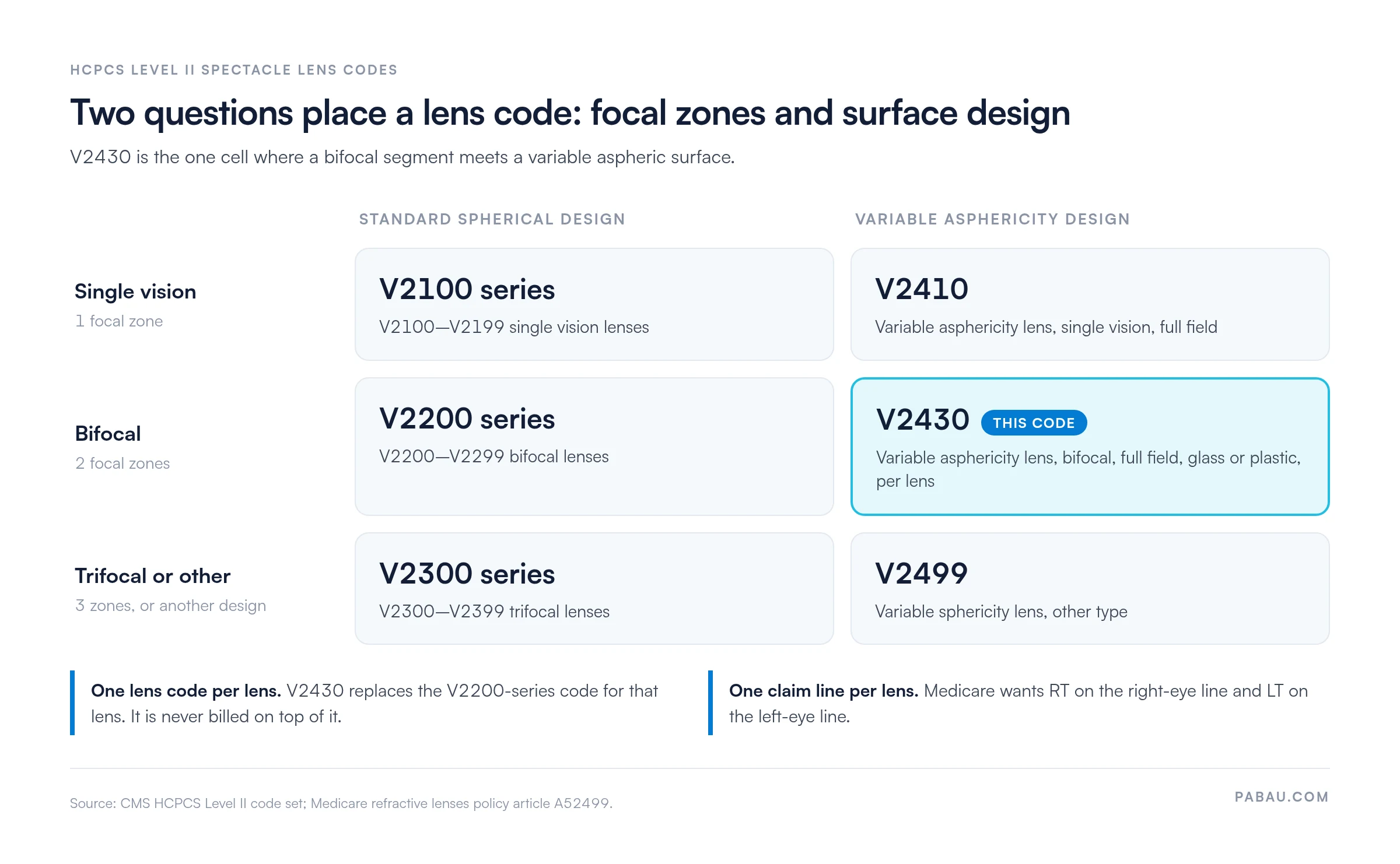
Before coding, read two details off the lab order: the segment count and the lens design. A bifocal with a variable aspheric surface is V2430, and a single vision aspheric lens is V2410. A standard spherical bifocal stays in the V2200 series. Medicare allows only one of these codes per lens, so never bill V2430 on top of a V2200-series code.
Complete documentation is the foundation of a clean claim for any vision supply code. For HCPCS Code V2430, the minimum documentation set must include all of the following before the claim is submitted.
Supporting medical billing compliance for vision supply codes also means keeping the lab invoice that confirms the variable asphericity bifocal design. Medicare contractors auditing a lens claim can request it as proof of what was dispensed. The diagnosis on the claim comes from the ICD-10-CM code set, and it has to match the reason the lens was prescribed.
V2430 is submitted on a CMS-1500 claim form or its electronic 837P equivalent. Each lens is billed as its own line item with one unit of service. When both lenses use the same code, the Medicare refractive lenses policy article (A52499) requires two claim lines, one with RT and one with LT.
The same policy article allows only one lens code per lens. V2430 therefore replaces the bifocal code for that lens and is never billed alongside a V2200–V2299 code.
Modifiers tell the payer which eye the lens was dispensed for and how coverage applies. Using the wrong modifier, or omitting a required one, is a leading cause of claim rejections.
For Medicare, every lens line carries RT or LT. Commercial and Medicaid managed care plans set their own modifier rules, so check each payer’s policy for stacking and sequence requirements.

Prior authorization (PA) requirements for V2430 vary by payer and plan year. No single PA rule applies across all payers, so practices must verify PA status before dispensing.
Medicare Part B does not cover routine eyeglasses or contact lenses for most beneficiaries. The exception is the post-cataract benefit under Section 1861(s)(8) of the Social Security Act. It covers one pair of eyeglasses or contact lenses after each cataract surgery with intraocular lens (IOL) insertion.
Medicaid vision coverage for V2430 is set by each state and varies considerably. The Alabama Medicaid Agency, for example, lists V2430 in its published eyeglasses fee schedule.
Checking insurance eligibility and benefits before dispensing is essential for Medicaid patients. Coverage and PA requirements can both change at each benefit renewal date.
V2430 claims fail for predictable reasons. Understanding each denial pattern lets the practice fix the workflow behind it instead of appealing claim after claim.
Most payers allow at least one level of administrative appeal for denied vision supply claims. The steps below apply to most commercial and Medicaid managed care appeals. Medicare appeals follow the five-level process governed by CMS.
Structured denial management workflows cut the time spent on each appeal. They also show which payers generate repeated V2430 denials, so the fix can happen upstream.
Reimbursement for V2430 is not a fixed national figure. Rates depend on the payer and the applicable fee schedule. The table below summarizes where each payer type sets its rate, so verify current figures before relying on them for financial planning.
To look up current Medicare allowables for V2430, download the CMS DMEPOS fee schedule and find V2430 for your state. For Medicaid rates, use your state Medicaid provider portal or its published fee schedule for eyeglasses.
Some commercial payers index their V2430 rate to a percentage of Medicare’s allowable. Review your payer contracts directly to confirm the applicable percentage.
Fee schedules update annually on January 1. Pull your top five V-code payers’ updated fee schedules each December and compare rates against your previous year’s remittances. If a payer’s allowable drops by more than 10%, open a contract renegotiation conversation before the new year begins.
V2430 errors usually start at dispense, when the lens design on the lab order never reaches the person coding the claim. The coder sees “bifocal,” picks a V2200-series code, and the aspheric design goes unbilled or gets billed twice.
Pabau, the practice management platform we build, runs pre-submission validation checks on every claim in its eye care claims software. An incomplete V2430 line is flagged before the claim goes out, while there is still time to add the missing detail.
Once a claim is submitted, claim-status tracking shows where each lens claim sits with the payer. Your billing team spots a stalled or rejected V2430 line early, so you correct it once instead of appealing it months later.

Pabau checks eye care claims before they are submitted and tracks the status of each one with the payer. Fewer V2430 lines come back denied, and the ones that do surface quickly.

V2430 is a narrow code: one bifocal lens with a variable aspheric surface, billed per lens in place of the standard bifocal code. Confirm the lens design at dispense, attach RT or LT to every line, and check the payer’s cataract and authorization rules before the patient leaves.
Practices that build those checks into the dispense workflow stop paying for the same denial twice. To see how Pabau handles V-code billing for eye care practices, book a demo with the team.

Need a structured approach to billing documentation? Medical billing fundamentals for healthcare practices covers the end-to-end claim lifecycle from patient intake through payment posting.
Getting repeated denials across multiple V-codes? Denial codes in medical billing explains how to read CARC and RARC codes and build systematic appeal responses.
Want to reduce claim errors before submission? What makes a clean claim outlines the pre-submission checks that prevent the most common optometry billing rejections.
Is the lens a trifocal after all? HCPCS code V2310 explains billing for a spherocylinder trifocal lens.
HCPCS Code V2430 covers one variable asphericity bifocal spectacle lens, full field, in glass or plastic, billed per lens. It applies when a licensed eye care provider prescribes a bifocal and the dispensed lens has a variable aspheric surface.
V2430 is a bifocal code. Trifocal spectacle lenses sit in the V2300–V2399 series, starting with V2300 for a spherical trifocal within plano to ±4.00D. Billing V2430 for a trifocal lens is a coding error.
Medicare Part B does not cover routine eyeglasses, including variable asphericity bifocal lenses, for most beneficiaries. The exception is the post-cataract benefit under Section 1861(s)(8). It covers one pair of eyeglasses after each cataract surgery with IOL insertion.
V2430 codes a bifocal lens with a variable aspheric surface across the full field. V2200 codes a standard spherical bifocal within plano to ±4.00D. Medicare allows only one of these codes per lens, so choose the one that matches the dispensed design.
Prior authorization requirements vary by payer. Original Medicare does not require PA for the post-cataract eyeglass benefit, but Medicare Advantage and Medicaid managed care plans may. Verify PA requirements with the specific plan before dispensing.
The most common V2430 denials are a non-covered benefit, the wrong lens code, and two lens codes on one lens. A missing RT or LT modifier, missing prior authorization, and frequency limit violations also cause denials. Each needs a different corrective action.
Reimbursement for V2430 varies by payer and state. Medicare pays it from the DMEPOS fee schedule, which is set by state and updated each year. Medicaid rates are state-set and published in each state’s fee schedule, and commercial rates are contract-negotiated.